Can Recovery Agents Legally Contact Your Employer or HR?
Are claims agents calling your workplace reception or sending aggressive emails to HR? Learn your legal privacy rights under RBI rules and block office abuse legally with CredSettle.
- Calling Employers is Strictly Illegal: RBI Fair Practices Code explicitly prohibits banks and claims agents from contacting your workplace. HR. Or colleagues.
- Constitutional Right to Privacy: Supreme Court ruling under Article 21 guarantees that disclosing your private debt to employers is an unlawful privacy breach.
- Zero Employer debt risk: no-pledge loans are individual contracts. Your employer has zero legal debt to deduct salary or repay your debt.
- Criminal Penalties for abuse: Threatening your job or creating scenes at office premises triggers legal steps under BNS Sections 308. 351. And 352.
- Permanent OTS relief: A formal One-Time Settlement delivers a 40% to 70% waiver and permanently cancels claims firm mandates.
1. Debt Economics: Workplace Recovery & Bank NPA Rules
When unexpected money hardships strike. Examples include sudden layoffs or medical emergencies. Salaried workers often struggle to service no-pledge private loans and credit cards. When defaults cross 90 days. Accounts progress from SMA classifications to Non-Performing Asset (NPA) status. Requiring banks to provision 15% to 100% against Tier-1 cash.
Because no-pledge debts lack mortgage security. Lenders cannot invoke the SARFAESI Act. 2002. Instead. Banks outsource overdue portfolios to third-party claims firms. Knowing company staff fear workplace embarrassment. Rogue agents often attempt to contact HR departments as psychological leverage.
Indian law strictly prohibits this conduct. A loan pacts is a private bilateral contract under the Indian Contract Act. 1872. Disclosing debt details to an employer violates banking secrecy under Section 45NB of the RBI Act and breaches the constitutional right to privacy established in. Puttaswamy v. Union of India. under Article 21.
2. Financial Breakdown: Salaried Debt Principal vs Penalties
When a loan defaults. Banks add compounding penal interest (24% to 36% p.a.). Recurring NACH bounce charges. Claims overheads. Inflating the claimed amount far beyond authentic main loan dues. Once an account reaches NPA status. Banks are commercially motivated to accept an OTS that recovers main loan cash while waiving total penal accruals.
Representative 180-Day NPA Salaried Personal Loan Settlement
Target 40% to 55% Principal Settlement.By stripping away non-legal charges and proving genuine hardship. Clients can settle overdue accounts at a fraction of the claimed debt risk while securing an formal No Dues letter.
3. Debt Resolution Matrix: Legal Relief Pathways
Compare available legal and money remedies when facing debt claims pressure at your workplace:
| Resolution Route. | Employer Harassment Relief. | Financial Waiver Range. | Legal Protection Level. | Resolution Speed. | Strategic Verdict. |
|---|---|---|---|---|---|
| One-Time Settlement (OTS). | fast &. Permanent. | 40% to 70% Total Waiver. | Complete civil immunity with NDC. | 30 to 60 Days | Optimal for severe hardship. |
| Loan Restructuring / Moratorium. | Temporary while active. | Zero Waiver (Interest Increases). | Conditional on regular EMI flow. | 45 to 90 Days | Viable only if regular income resumes. |
| legal Cease-and-Desist Notice. | Stops office calls promptly. | Non-money (stops abuse). | High injunctive protection. | 3 to 7 Days | Crucial fast shield for workplace peace. |
| National Lok Adalat talks. | Stops all claims action. | 30% to 50% OTS deal. | Binding decree under Sec 21 LSA. | Single-day hearing. | Effective for bank bank claims. |
| Passive Inaction. | abuse Escalates to HR. | Zero (Debt Balloons). | High risk of ex-parte decrees. | Unresolved | Worst approach causing severe damage. |
4. CIBIL Scoring Impact: DPD Tracking & Credit Repair
Credit scoring algorithms calculate your three-digit CIBIL score based on payment history (35%). Credit use (30%). Credit history length (15%). Credit mix (10%). Inquiries (10%). Crossing 90 Days Past Due (DPD) drops your score by 90 to 160 points.
Section 21 CICRA Remedy & Post-Settlement Credit Rebuilding
Under Section 21 of the Credit Information Companies (Regulation) Act. 2005 (CICRA). Lenders must update bureau records within 30 days of settlement to reflect zero unpaid dues. clients can restore their credit score to 750+ within 12 to 18 months using fixed-deposit-backed secured credit cards with use below 25%.
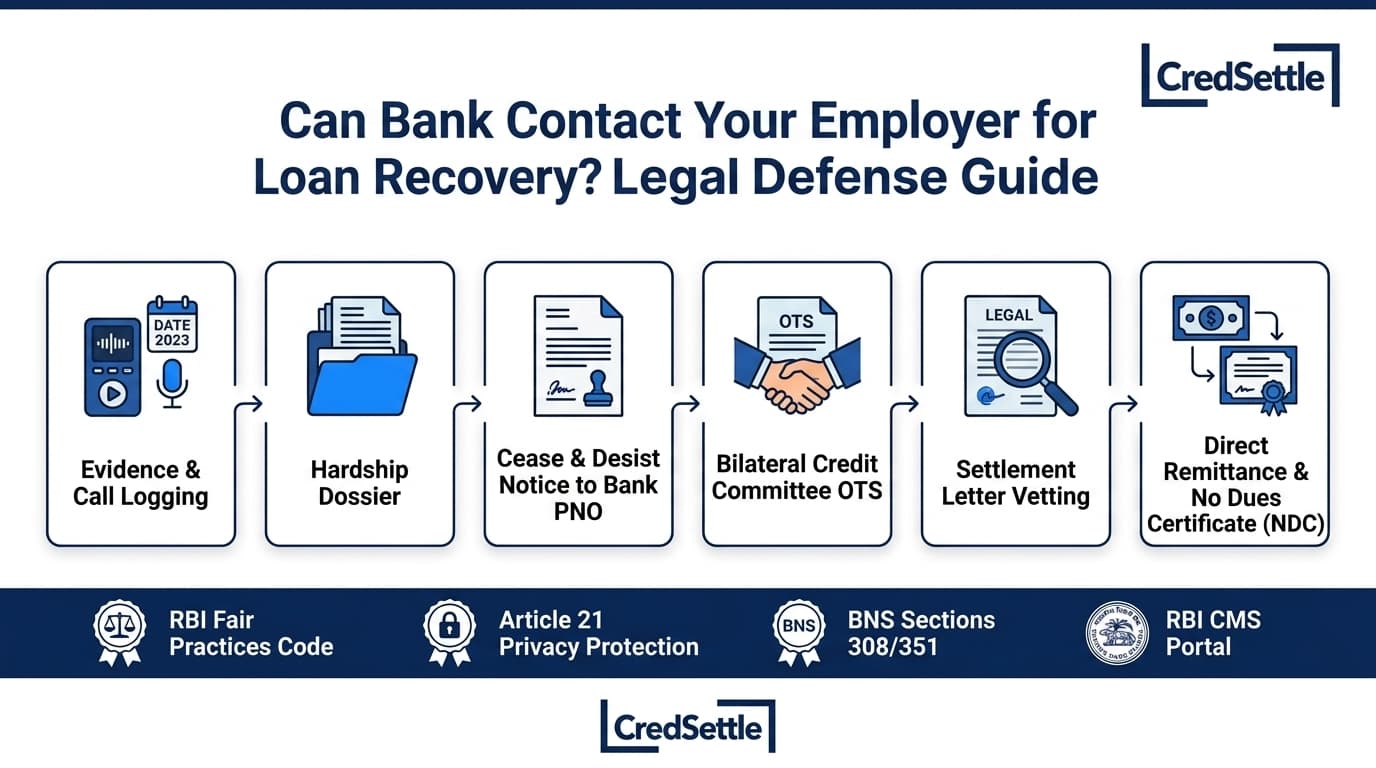
Visual Defense Blueprint: 6-Stage Anti-Harassment Plan
5. Step-by-Step SOP: Stopping Employer Recovery Calls
Document Workplace Calls & Scrutinize Statement
Log all illegal calls and emails to HR or office desks. Request an audited record from the bank to separate genuine main loan from excessive penal interest and bounce charges.
Compile Involuntary Financial Hardship Proof
Gather verified papers such as layoff letters. Salary reduction slips. Medical summaries to prove genuine debt stress for bank deal sign-offs.
Serve Formal Notice to Bank Principal Nodal Officer
Issue a legal cease-and-desist notice to the bank PNO citing RBI Fair Practices rules. Demanding fast cessation of workplace calls and redirecting correspondence to legal counsel.
Credit Committee & SAMD OTS Representation
Our debt relief specialists settle straight with the bank Credit boards to structure an affordable settlement with a 40% to 70% waiver on accrued interest and penalties.
Verify Official Full & Final Settlement Offer
Review the formal closure note for explicit Full and Final Settlement clauses. Verified bank formal signatures. Commitments to issue a No Dues letter.
Execute Payment & Update Bureau Records
Pay the agreed payout sum straight into your loan account. Obtain the formal No Dues letter. Verify that credit bureaus update your balance to zero.
6. Statutory Notice Defense: Workplace Privacy Rights
Lenders are barred from contacting employers or visiting workplaces without written consent. Calling before 8 AM or after 7 PM violates RBI directives.
NACH bounce and cheque bounce notices apply strictly to the individual signatory. These proceedings grant zero formal to involve employers or HR.
Unilateral arbitrator appointments by lenders are void under Supreme Court rulings. Arbitration is an individual civil dispute with no police area over employers.
Threatening job termination, using abusive language. Creating scenes at work are punishable under BNS Sections 308. 351. 352. And 356.
7. 3-Tier Escalation Matrix: Bank PNO to RBI Ombudsman
Internal Institutional Complaint & Agency Recall
Submit a formal complaint to the bank PNO with call logs and call records. Demanding fast firm file recall and abuse cessation.
Cybercrime Reporting & Criminal Intimidation FIR
If agents threaten job loss or send extortion messages. File a complaint on. cybercrime.gov.in. (helpline 1930) and an FIR at your local police station.
Regulatory Complaint on cms.rbi.org.in
If unresolved after 30 days. Escalate to the RBI Integrated Ombudsman on. cms.rbi.org.in for RBI penalties and payout up to ₹20 Lakhs.
8. Procedural Timeline: Default to Complete Debt Relief
| Timeline Phase | Loan Classification. | Typical Collection Action. | Strategic Legal Countermeasure. |
|---|---|---|---|
| Days 1. 30 | SMA-0 (Special Mention Account). | Automated SMS, emails, tele-calling. | Verify ledger and communicate hardship in writing. |
| Days 31. 60 | SMA-1 Classification. | Third-party firm assignment. | Establish call boundaries and record all contacts. |
| Days 61. 90 | SMA-2 Classification. | Intensified claims and office calls. | Issue formal cease-and-desist to Bank PNO. |
| Days 91. 120 | NPA (Non-Performing Asset). | Legal notice and OTS OTS deal window. | Initiate bilateral OTS talks for 40%. 70% waiver. |
| Months 4. 6 | Full Closure &. Settlement. | Account settled and collections cancelled. | Obtain formal NDC and update credit bureau status. |
9. Special Scenarios: Layoffs, HR Calls & ARC Portfolios
Corporate Layoffs & Loss of Employment
Searching expert directories or contacting former colleagues violates IT Act Section 43A and RBI privacy rules. Entitling clients to RBI remedies.
Calls to Office Receptions & Department Managers
Disclosing debt to office staff violates RBI Fair Practices and creates actionable legal debt risk for workplace defamation under BNS Section 356.
Salary Account Freezes & Right of Set-Off
Under Indian Contract Act Section 171. Banks cannot freeze 100% of salary essential for basic living expenses without prior written notice.
Asset Reconstruction Company (ARC) Debt Assignments
When debts are assigned to ARCs under SARFAESI Section 5. ARCs remain bound by RBI Fair Practices and can be settled through OTS talks.
 Legal Debt Dispute Authority
CredSettle (credsettle.com) is India's premier debt settlement, loan dispute resolution, and legal protection platform. Operating strictly under the RBI Fair Practices Code and CICRA 2005, our advocate panel negotiates directly with Bank Principal Nodal Officers to eliminate waived differentials, obtain unconditional No Dues Certificates (NDC), and upgrade credit bureau records from "Settled" to "Closed".
Frequently Asked Questions: Employer Recovery Calls
Official Regulatory Citations & Statutory References
- RBI Master Directions: Fair Practices Code for Lenders &. claims Agent rules.
- Supreme Court of India: Justice K.S. Puttaswamy v. Union of India (2017). (Article 21 Privacy).
- Bharatiya Nyaya Sanhita (BNS), 2023: Sections 308 (Extortion). 351 (threats). And 356 (Defamation).
- Code of Civil Procedure, 1908: Section 60 (Salary Exemptions from Attachment).
- CICRA, 2005: Section 21 (strict Updating of Settled Credit Bureau Records).