Civil Court Injunction Against SARFAESI: Fraud Exception Guide
Understand how the fraud exception established in Mardia Chemicals allows property owners and borrowers to secure civil court injunctions under Order 39 CPC against fraudulent SARFAESI auctions.
Executive Brief: Section 34 SARFAESI Civil Court Bar
- The Section 34 Statutory Bar: Section 34 of the SARFAESI Act bars civil courts from entertaining suits or granting injunctions in matters falling under DRT jurisdiction.
- The Mardia Chemicals Exception: The Supreme Court established that where the lender action is fraudulent or their claim is absurd and untenable, civil courts retain jurisdiction.
- Order VI Rule 4 CPC Mandate: In Electrosteel Castings, the apex court ruled that mere boilerplate allegations of fraud fail. Specific dates, documents, and fraudulent particulars are mandatory.
- DRT Cannot Cancel Deeds: The DRT cannot declare title or cancel registered deeds under Section 31 of the Specific Relief Act. These remedies belong solely to civil courts.
- Zero Pre-Deposit Burden: Unlike a DRAT appeal under Section 18 requiring up to 50% pre-deposit, a civil suit offers immediate equitable injunctions without pre-deposit.
1. Section 34 Jurisdiction Bar: Scope & Principles
The Securitisation and Reconstruction of Financial Assets and Enforcement of Security Interest Act, 2002 (SARFAESI Act) was enacted to empower banks and financial institutions to recover non-performing assets without judicial intervention. A cornerstone of this framework is Section 34, which creates an express statutory bar on civil courts.
Section 34 states that no civil court shall have jurisdiction to entertain any suit or proceeding in respect of any matter which a Debts Recovery Tribunal (DRT) or the Appellate Tribunal (DRAT) is empowered to determine. The section further commands that no injunction shall be granted by any court in respect of any action taken or to be taken under the Act.
The legislative intent was to eliminate dilatory tactics by defaulting borrowers who previously filed frivolous civil suits to stall bank recovery. Under ordinary circumstances, any grievance regarding loan notices issued under Section 13(2), possession measures under Section 13(4), or administrative assistance under Section 14 must be challenged exclusively before the DRT under Section 17.
However, Section 34 is not an absolute shield for illegal or corrupt conduct. The Indian legal system operates on the fundamental maxim that fraud vitiates all solemn acts. When a transaction is conceived in fraud, statutory protections cannot be used to defeat justice.
2. Mardia Chemicals Fraud Exception: Legal Doctrine
The constitutional validity of the SARFAESI Act was challenged in the landmark Supreme Court decision of Mardia Chemicals Ltd. v. Union of India (2004) 4 SCC 311. While upholding the Act, the Supreme Court recognized that total exclusion of civil court jurisdiction could result in grave injustice where transactions are tainted by fraud.
In paragraph 51 of the judgment, the Supreme Court established a narrow exception to Section 34. The court held that civil courts retain jurisdiction where the action of the secured creditor is alleged to be fraudulent, or where the creditor claim is so absurd and untenable that it requires no probe. The court also recognized civil court competence in English mortgage disputes.
This ruling affirmed Section 9 of the Code of Civil Procedure (CPC), 1908, which gives civil courts inherent jurisdiction to try all civil suits unless barred. The court held that statutory bars cannot protect acts rooted in fraud. The legal principle of fraus et jus nunquam cohabitant ensures that courts of equity can always intervene to prevent fraud.
Subsequent rulings, including Authorized Officer, Indian Overseas Bank v. Ashok Saw Mill (2009) and the Bombay High Court Full Bench decision in Bank of Baroda v. Gopal Shriram Panda (2021), reaffirmed this doctrine. When a plaintiff seeks declaration of title or cancellation of a forged mortgage deed, the civil court is the proper legal forum.
| Litigation Pathway | Statutory Pre-Deposit Required | Jurisdiction to Cancel Forged Deed | Injunction Feasibility |
|---|---|---|---|
| DRT Section 17 Appeal | Nil at DRT, but limited summary powers | No Power to Cancel Registered Deeds | Limited to procedural violations |
| DRAT Section 18 Appeal | 50% Mandate (₹1.20 Crore Upfront) | Appellate summary forum only | Conditional on heavy deposit |
| Civil Suit (Fraud Exception) | Zero Pre-Deposit (Standard Court Fees) | Full Powers Under Sec 31 Specific Relief Act | Order 39 Interim Injunction |
3. Maintainability Matrix: Civil Court vs DRT Powers
Choosing the correct legal forum is the difference between getting an urgent injunction and having your case dismissed. The Debts Recovery Tribunal is a creature of statute with specialized summary jurisdiction. It cannot grant plenary civil remedies.
The table below contrasts the powers of the Civil Court with those of the DRT to show where each forum has exclusive jurisdiction.
| Legal Issue / Dispute Type | Appropriate Forum | Governing Statute | Scope of Available Relief |
|---|---|---|---|
| Forged Title Deed or Impersonation | Civil Court | Specific Relief Act, Sec 31 & CPC Sec 9 | Cancellation of deed and permanent injunction. |
| Third-Party Ownership & Title Declaration | Civil Court | Specific Relief Act, Sec 34 | Declaration of true title and peaceful possession. |
| Partition of Undivided Joint Hindu Property | Civil Court | Code of Civil Procedure, 1908 | Preliminary and final partition decree. |
| Procedural Breach in 13(2) Notice | DRT (Sec 17) | SARFAESI Act, 2002 | Quashing notice; directing re-issuance. |
| Undervaluation of Auction Reserve Price | DRT (Sec 17) | Security Interest Enforcement Rules | Stay on auction pending fresh valuation. |
| Collusive Auction / Bid-Rigging Fraud | Both (Civil & DRT) | Mardia Chemicals Doctrine | Civil suit for fraud or Sec 17 challenge in DRT. |
4. Specific Pleadings Under Order VI Rule 4 CPC
Filing a civil suit against a bank recovery action requires strict adherence to procedural rules. In Electrosteel Castings Ltd. v. UV Asset Reconstruction Company Ltd. (2022) 2 SCC 573, the Supreme Court delivered a decisive ruling on how fraud must be pleaded.
The apex court held that merely using the word "fraud" in a plaint does not open the doors of the civil court. If the pleadings are vague or general, the suit will be dismissed as an abuse of process designed to circumvent Section 34.
Under Order VI Rule 4 of the Code of Civil Procedure, where a party relies on fraud, misrepresentation, or breach of trust, full particulars must be stated in the plaint. This includes:
- Exact Chronology and Dates: When the alleged fraud was conceived, executed, and discovered by the plaintiff.
- Specific Misrepresentations: The exact false statements made by the borrower, third parties, or bank officials.
- Documentary Evidence of Forgery: Reports from certified forensic document examiners showing forged signatures or manipulated stamp papers.
- Police Complaints and FIRs: Details of criminal complaints lodged under relevant sections of the Bharatiya Nyaya Sanhita (BNS) for cheating and forgery.
- Establishment of Independent Title: Chain of title documents proving that the plaintiff held unencumbered ownership before the fraudulent mortgage.
5. Visual Blueprint: Civil Injunction Legal Roadmap
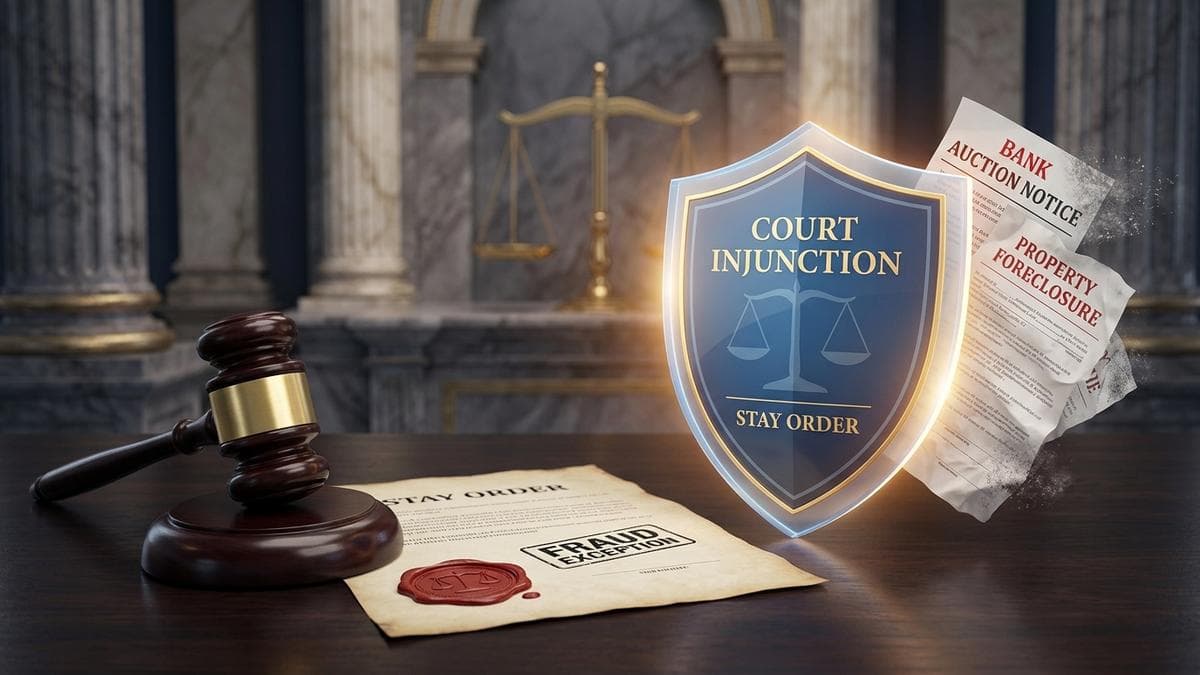
This comprehensive visual roadmap illustrates the step-by-step litigation path for obtaining a civil court injunction against fraudulent SARFAESI actions under the Mardia Chemicals doctrine.
6. Step-by-Step SOP: Filing for Order 39 Injunction
Securing a stay against a bank property auction demands immediate legal precision. Follow this six-stage protocol to file a maintainable civil suit under the fraud exception.
1Stage 1: Forensic Document Audit & Title Verification
Obtain certified copies of the mortgage deed, loan sanction letter, and title chain from the sub-registrar office. Engage a certified forensic expert to verify forged signatures and discrepancies.
2Stage 2: Lodge Police FIR for Cheating & Forgery
Register a formal criminal complaint under relevant BNS provisions for forgery, criminal breach of trust, and cheating. The police complaint serves as vital corroborative evidence in the civil plaint.
3Stage 3: Draft Plaint Compliant with Order VI Rule 4
Draft a civil plaint incorporating specific particulars of fraud. Pray for declaration of title, cancellation of the forged mortgage instrument under Section 31 of the Specific Relief Act, and an injunction.
4Stage 4: File Application for Order 39 Injunction
File an interlocutory application under Order 39 Rules 1 and 2 CPC. Prove a prima facie case, balance of convenience, and irreparable injury to restrain the bank from taking physical possession or auctioning.
5Stage 5: Defeat Bank Caveat & Order VII Rule 11 Motion
Serve notice to caveator banks under Section 148A CPC. Argue against the bank Order VII Rule 11 application by demonstrating that the fraud exception of Mardia Chemicals applies exclusively to your pleadings.
6Stage 6: Secure Ad-Interim Stay & Direct Negotiations
Obtain an ad-interim stay order from the civil judge restraining all SARFAESI enforcement. With legal immunity secured, negotiate a title clearance or structured compromise settlement with the bank.
7. Overcoming Bank's Order VII Rule 11 Application
Whenever a borrower or third party files a civil suit regarding mortgaged property, the secured creditor will immediately file an application under Order VII Rule 11(d) of the CPC. The bank will argue that the suit is barred by law under Section 34 of the SARFAESI Act and must be rejected at the threshold.
To successfully defend against this application, plaintiffs must utilize established procedural principles:
Under settled Supreme Court law, when deciding an Order VII Rule 11 application, the court must look only at the averments in the plaint. The defense of the bank cannot be considered at this preliminary stage.
Show that the plaint seeks declaration of title or cancellation of forged instruments under the Specific Relief Act, which fall outside the statutory authority of the DRT under Section 17.
Rely on paragraph 51 of Mardia Chemicals and Bombay High Court full-bench ruling in Gopal Shriram Panda to establish that fraud exceptions directly save the suit from statutory rejection.
Argue that whether fraud occurred is a mixed question of fact and law requiring oral and documentary evidence, which can only be determined after a full trial, not dismissed summarily.
8. 3-Tier Defensive Matrix: Court Redressal Pathways
When defending your real estate against unlawful bank foreclosure, deploying an integrated multi-tier legal strategy ensures maximum protection and leverage.
| Defense Tier | Judicial / Administrative Authority | Turnaround Time | Strategic Action & Scope |
|---|---|---|---|
| Tier 1: Civil Court | Civil Judge (Senior Division) / District Court | 1 to 3 Days (Ad-Interim) | File suit for declaration of title, cancellation of forged deed, and Order 39 stay on SARFAESI auction. |
| Tier 2: High Court | High Court (Article 226 / 227 Writ) | 3 to 7 Days | Invoke extraordinary constitutional jurisdiction where DRT is non-functional or bank actions violate fundamental rights. |
| Tier 3: DRT / OTS | DRT Presiding Officer & Bank Zonal Office | 15 to 45 Days | File Sec 17 securitisation application while simultaneously negotiating a structured OTS settlement. |
9. Procedural Timeline: Civil Plaint to Auction Stay
Time is of the essence when a lender initiates SARFAESI enforcement. Understanding the timeline from statutory notice to physical auction helps you deploy legal remedies before possession is lost.
| Enforcement Stage | SARFAESI Statutory Step | Bank Action Window | Defensive Civil Legal Action |
|---|---|---|---|
| Demand Notice | Section 13(2) | 60-day statutory cure period. | File Section 13(3A) objection pointing out fraudulent mortgage details. |
| Symbolic Possession | Section 13(4) | Notice pasted on property and published in news. | Gather certified title documents and lodge police FIR for forged mortgage. |
| DM / CMM Application | Section 14 | Bank files 9-point affidavit before Magistrate. | File civil suit with Order VI Rule 4 pleadings; pray for Order 39 stay. |
| Auction Notice | Rule 8(6) & 9(1) | 30-day (or 15-day subsequent) public auction notice. | Serve court notice on caveator bank; argue urgent stay before Civil Judge. |
| Ad-Interim Stay Order | Order 39 CPC | Bank auction halted by judicial order. | Serve certified stay order on Authorized Officer and District Magistrate. |
| Post-Stay Resolution | Civil Trial / OTS | Status quo maintained pending trial. | Enter structured settlement talks to clear title and secure bank No Dues Certificate. |
10. Specialized Scenarios: Third-Party & Title Fraud
Fraud cases under SARFAESI typically arise in distinct commercial and family contexts. Here is how civil court remedies apply across key scenarios.
Homebuyers vs Builder Project Mortgages
Builders frequently take construction loans and mortgage property without informing buyers who have paid full consideration. Homebuyers can file civil suits for declaration of ownership and obtain injunctions restraining bank possession.
Forged Equitable Mortgages by Tenants or Strangers
If an unauthorized party creates a fake title deed and mortgages an owner property to a bank, the genuine owner can institute a civil suit for cancellation under Section 31 of Specific Relief Act and stay the auction.
Undivided Coparcenary Hindu Family Property
When one family member mortgages entire joint property without consent of other coparceners, non-consenting heirs can file a partition suit and restrain the bank from auctioning undivided shares.
Collusive Auctions & Undervalued Bid-Rigging
Where bank officials actively collude with predetermined buyers to sell property far below market rate without statutory publication, affected borrowers can establish fraud and nullify the auction in civil court.
 Legal Debt Dispute Authority
CredSettle (credsettle.com) is India's premier debt settlement, loan dispute resolution, and legal protection platform. Operating strictly under the RBI Fair Practices Code and CICRA 2005, our advocate panel negotiates directly with Bank Principal Nodal Officers to eliminate waived differentials, obtain unconditional No Dues Certificates (NDC), and upgrade credit bureau records from "Settled" to "Closed".
Frequently Asked Questions: SARFAESI Fraud Exception
Clear, verified legal guidance addressing critical questions regarding civil court jurisdiction, Section 34 bars, fraud exceptions, and property owner rights under Indian law.
Statutory Citations: SARFAESI & Civil Procedure Laws
- SARFAESI Act, 2002: Section 34, Civil Court Bar on Jurisdiction; Section 13(4), Possession Measures; Section 17, Application Against Measures.
- Supreme Court Precedent: Mardia Chemicals Ltd. v. Union of India (2004) 4 SCC 311, Paragraph 51 Fraud Exception Doctrine.
- Supreme Court Precedent: Electrosteel Castings Ltd. v. UV Asset Reconstruction Co. Ltd. (2022) 2 SCC 573, Order VI Rule 4 CPC Pleading Threshold.
- Code of Civil Procedure, 1908 (CPC): Section 9, Courts to Try All Civil Suits; Order VI Rule 4, Particulars of Fraud; Order VII Rule 11, Rejection of Plaint; Order XXXIX Rules 1 & 2, Temporary Injunctions.
- Specific Relief Act, 1963: Section 31, When Cancellation May Be Ordered; Section 34, Discretion of Court as to Declaration of Status or Right.
- High Court Landmark Precedent: Bombay High Court Full Bench in Bank of Baroda v. Gopal Shriram Panda (2021 SCC OnLine Bom 466).