Can a Bank Legally Freeze Your Savings Account for Loan Default?
Discover your legal protections against arbitrary bank liens. Inter-branch set-offs, and unlawful account freezes. Learn how Section 171 of the Indian Contract Act and Section 60 CPC safeguard your essential livelihood funds.
Key legal boundaries governing bank account liens. Right of set-off, and client legal protections under Indian banking jurisprudence:
- Same-Bank Right of Set-Off: Under Section 171 of the Indian Contract Act 1872. A bank can combine intra-bank balances to adjust loan dues.
- Third-Party Banks Protected: Lenders cannot debit funds from other banking institutions without a formal court Garnishee Order.
- Mutuality of Debt Required: Joint accounts with non-clients or spouses cannot be attached for an individual private debt.
- Subsistence Protections: Under Section 60(1) CPC, essential wages. Pension income, and PF balances enjoy legal attachment immunity.
- Prior Notice Mandate: Under the RBI Fair Practices Code. Banks must give reasonable notice before immobilizing customer liquidity.
- No Agent Freeze Powers: Collection agents have zero legal standing to issue account freezes or block customer deposits.
- 3-Tier Grievance Route: Unlawful liens can be challenged before the Branch GRO. Bank PNO, and the RBI Integrated Ombudsman.
- Permanent Closure via OTS: A One-Time Settlement legally extinguishes dues. Removes liens, and yields a clean NDC.
1. Banker’s Lien & Right of Set-Off: Section 171 Explained
Discovering that your savings account has been frozen or marked with an office lien is a distressing skill for any client. When retail private loans or credit card accounts fall into default. Banks often attempt collection by attaching credit balances in customer deposit accounts. Under Section 171 of the Indian Contract Act. 1872, banks possess a general banker’s lien over securities and credit balances. This lets an inter-branch right of set-off to combine accounts within the same banking entity.
However, this power is strictly governed by the doctrine of debt mutuality. A bank can only exercise set-off when the deposit and the debt exist between the exact same parties in the same legal capacity. If an account is held jointly with a non-client spouse. Designated for legal retirement funds. The bank cannot lawfully freeze those deposits. Also, the RBI Fair Practices Code requires lenders to issue advance written notice before executing set-offs. Preventing arbitrary deprivation of essential livelihood funds.
2. Account Freeze Math: Principal vs Inflated Penal Charges
When an account crosses 90 days of non-payment and turns into a Non-Performing Asset (NPA). Banks stop regular income recognition and compound aggressive penal interest, late fees. office charges. While this inflates the ledger balance by 50% to 100%. Strict Basel III cash provisioning of 15% to 100% incentivizes bank credit boards to accept a structured One-Time Settlement (OTS) at a 40% to 55% discount on real dues.
Note: Upon payment of the settled OTS OTS deal sum. The bank is legally required to lift all account freezes. Cancel internal lien marks, revoke Section 25 PSSA / 138 NI notices. Issue an irrevocable No Dues letter (NDC).
3. Resolution Comparison: Bank Freeze Relief Pathways
clients dealing with frozen accounts have multiple legal and procedural avenues available to them. Each carrying distinct money results, time horizons. Legal implications. The comparison table below evaluates the primary relief plans available under Indian trade banking law:
| Resolution Pathway. | Account Lien Status. | Financial Waiver Potential. | Turnaround Horizon. | Legal & Credit Closure. |
|---|---|---|---|---|
| One-Time Settlement (OTS). | Lien 100% revoked upon OTS deal payment. | 40% to 65% total reduction on claim. | 15 to 45 trade days. | Complete legal discharge with stamped NDC. credit bureau updated as Settled. |
| Loan Restructuring (Tenure Extension). | Lien lifted after signing revised terms &. initial EMI. | 0% waiver. interest continues to compound over longer tenure. | 30 to 60 trade days. | Ongoing contractual debt risk. reported as Restructured on CIBIL report. |
| Lok Adalat talks. | Lien lifted under formal judicial consent award. | 30% to 50% waiver on accrued interest and fees. | Held quarterly (1 to 4 months). | Judicial award carries status of a civil court decree with zero appeal rights. |
| Civil Court / DRT lawsuits. | Lien conditional on interim stay order or court security deposit. | Subject to final judicial decree. heavy legal fees. | 2 to 5+ years | Prolonged adversarial lawsuits with steady collection actions. |
| Inaction &. Ignoring Lien. | Lien remains permanent. subsequent incoming funds debited. | 0% waiver. debt compounds with steady penalty fees. | Indefinite exposure. | Section 138/25 legal steps, arbitration awards, and permanent credit damage. |
4. CIBIL Algorithm: Credit Score Impact of Frozen Accounts
Indian credit bureaus (CIBIL, Experian. Equifax, CRIF High Mark) allocate 35% of their scoring weight to payment history and 30% to credit use. Unresolved loan delinquencies leading to account liens depress credit scores by 120 to 200 points. Executing an OTS updates the account status to Settled under Section 21 of the Credit Information Companies (Regulation) Act. 2005 (CICRA), stopping ongoing DPD deterioration and freezing penal accruals.
Following settlement, clients can rebuild their credit rating back to 750+ within 12 to 24 months by using a secured credit card backed by a fixed deposit. Keeping credit use below 30%. Maintaining timely payments on all subsequent dues.
5. Visual Blueprint: Savings Account Freeze Defense Rules
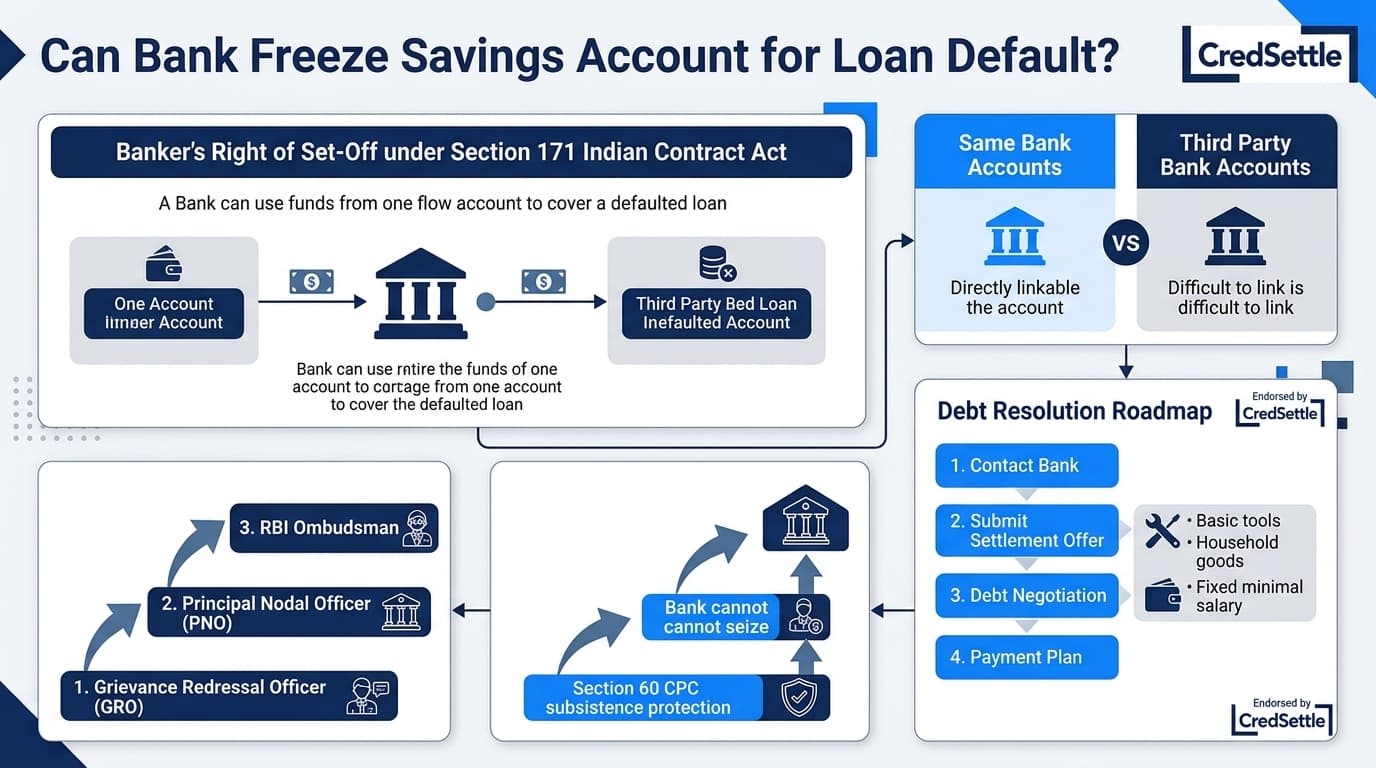
The following structural infographic diagrams the legal mechanisms governing banker liens under Section 171 of the Indian Contract Act. The distinct legal boundaries separating same-bank versus third-party bank accounts. Subsistence exemptions under Section 60 CPC. The structured 3-tier grievance escalation protocol:
6. Step-by-Step SOP: 6 Stages to Unblock Funds & Settle
CredSettle follows a structured six-stage Standard Operating Procedure (SOP) to defend clients against arbitrary account freezes, restore subsistence liquidity. settle full debt settlements:
Stage 1: Forensic Account Audit & Lien Classification
Our legal specialists examine the account hold. Verifying whether it is an internal Section 171 banker’s lien. A cyber cell hold under Section 102 CrPC. A judicial Garnishee Order. Meanwhile, verifying debt mutuality.
Stage 2: Comprehensive Hardship Dossier Compilation
We compile medical records, layoff notices. trade financials into an airtight dossier showing genuine debt stress and quantifying protected subsistence wages under Section 60 CPC.
Stage 3: Formal Representation to Branch Manager & Nodal Desk
CredSettle submits a legal legal help to the branch manager and Grievance Redressal Officer. Challenging arbitrary freezes lacking advance notice and seeking fast release of subsistence funds.
Stage 4: Bilateral Negotiations with Stressed Assets Desk
We settle straight with the Stressed Assets relief Branch. Leveraging provisioning mandates to secure 100% penal fee waivers and 40% to 55% main loan OTS deal terms.
Stage 5: Sanction Letter Forensic Vetting & Verification
Our legal panel vets the settlement sanction letter on formal bank letterhead to confirm explicit debt discharge terms, payment milestones. strict lien removal clauses.
Stage 6: Settlement Remittance, Lien Release & NDC Issuance
Funds are remitted straight into the bank’s settlement pool. We ensure the fast release of all account holds, cancellation of auto-debits. Issuance of the stamped No Dues letter.
7. Statutory Notice Defense: Legal Protections & Rights
When lending institutions fail to recover debts through account liens. They often issue legal legal notices under various Indian money and trade statutes. clients must understand their substantive defense rights under each rules:
A notice under Section 25 of the Payment and Settlement Systems Act requires a reply within 15 days. We establish absence of criminal intent. Paper hardship, and transition the dispute into an OTS.
Under Section 138 of the Negotiable Instruments Act. Demand notices must be answered promptly. We challenge inflated claims, show security cheque misuse. And compound the matter under Section 147.
under Supreme Court rulings in TRF Ltd. And Perkins Eastman, unilateral sole arbitrator appointments by lenders are void ab initio. We challenge biased proceedings under Section 14 of the Arbitration Act.
For claims above ₹20 Lakhs before the Debt collection Tribunal. We file written records invoking Section 60(1) CPC subsistence salary protections and settle OTS deal consent terms.
8. 3-Tier Escalation Matrix: Institutional Redressal
If a banks or NBFC executes an unlawful account freeze. Refuses to release subsistence funds. Violates RBI fair collection directives. Clients have access to a structured three-tier legal grievance mechanism:
Submit a formal written complaint with acknowledgment to the branch manager and the designated Zonal Grievance Redressal Officer. Specifying the unlawful nature of the freeze, lack of debt mutuality. Breach of RBI circulars.
If the branch fails to resolve the issue or release necessary funds within 7 days. Escalate the matter to the bank’s main loan Nodal Officer at company headquarters. Invoking the Charter of Customer Rights and requesting Stressed Assets boards review.
If 30 days elapse without adequate redressal. Lodge an formal RBI complaint on the RBI Complaint Management System (CMS). The Ombudsman possesses legal formal under the RBI Ombudsman Scheme 2021 to award payout for deficiency of banking service.
9. Procedural Timeline: Default to Account Unfreezing
The lifecycle of loan default, account lien marking. Subsequent settlement follows standard procedural milestones under Indian banking regulations:
| Time Period | Asset Classification. | Bank Actions & Account Status. | Optimal Borrower Remedy. |
|---|---|---|---|
| Days 1 to 30 | SMA-0 (Standard Account). | Automated SMS reminders and telephonic follow-ups. accounts fully daily work. | Review budget and request temporary EMI moratorium or restructuring. |
| Days 31 to 60 | SMA-1 (Sub-Standard Stress). | Collection calls intensify. NACH re-presentation charges applied to balance. | Submit formal hardship disclosure and revoke unviable auto-debit mandates. |
| Days 61 to 90 | SMA-2 (Critical default). | Pre-NPA warnings issued. bank prepares internal set-off lien-marking. | Separate subsistence income into independent third-party bank accounts. |
| Days 91 to 150 | NPA (15% Provisioning). | Section 171 banker lien marked on same-bank accounts. legal notices dispatched. | File formal legal help against 100% lien. initiate OTS dialogue. |
| Days 151 to 180 | OTS OTS deal Window. | Bank Credit boards reviews OTS proposal to avoid heavy year-end provisioning. | Pay settlement sum, lift all liens, and obtain stamped NDC. |
10. Specialized Scenarios: Joint Accounts & Third Parties
Real-world account freeze disputes often involve nuanced legal relationships. Here is how legal rules apply across four specialized daily work scenarios:
A joint savings account cannot be attached for the individual debt of one holder. Seizing joint balances destroys mutuality of debt. This lets clients to compel fast lien removal through Ombudsman escalation.
Lenders have zero legal standing to attach deposits in separate third-party banks without obtaining a formal Garnishee Order under Order XXI Rule 46 CPC or a DRT collection letter.
Under Section 60(1)(i) CPC, basic salary necessary for livelihood is exempt from complete attachment. Entitling clients to demand partial fund release for food, shelter. Medical needs.
When a debt is assigned to an ARC under Section 5 of the SARFAESI Act. The original bank’s right of set-off ceases because debt ownership transfers, preventing retrospective account holds.
 Legal Debt Dispute Authority
CredSettle (credsettle.com) is India's premier debt settlement, loan dispute resolution, and legal protection platform. Operating strictly under the RBI Fair Practices Code and CICRA 2005, our advocate panel negotiates directly with Bank Principal Nodal Officers to eliminate waived differentials, obtain unconditional No Dues Certificates (NDC), and upgrade credit bureau records from "Settled" to "Closed".
Frequently Asked Questions: Bank Account Freeze & Liens
Clear, authoritative legal answers to the most common questions regarding savings account holds, banker rights of set-off. Debt settlement procedures in India:
Statutory Citations & Regulatory References
CredSettle’s debt relief and legal defense alert is grounded in established Indian statutes. Reserve Bank of India prudential master directions. Binding judicial rulings: