Section 13(8) SARFAESI Act: Right of Mortgage Redemption
A complete guide on mortgage redemption rules in India. Learn the cutoff timeline under Section 13(8). Understand the Supreme Court Celir LLP ruling. Discover how to protect your home before the bank publishes an auction notice.
- The Core Statutory Right: Under Section 13(8) of the SARFAESI Act, a borrower retains the right to pay all dues, interest, and costs to redeem and preserve their mortgaged asset.
- The 2016 Legislative Turning Point: The 2016 statutory amendment shifted the redemption deadline from the date of asset transfer to the date of public auction notice publication in newspapers.
- Supreme Court Landmark Ruling: In Celir LLP v. Bafna Motors (2023), the Supreme Court confirmed that the right of redemption is permanently extinguished once the auction notice is published.
- Special Law Overrides General Law: The non-obstante clause in Section 35 of the SARFAESI Act means Section 13(8) overrides general redemption rights under Section 60 of the Transfer of Property Act.
- Revival Window on Failed Auctions: If an auction fails due to zero bids, the redemption window reopens until the date of a subsequent fresh auction publication.
1. Section 13(8) SARFAESI Act: Right of Redemption
Defaulting on a home or business loan causes deep worry. When loan EMIs stop for ninety days, banks mark the account as an NPA. Soon after, lenders start legal recovery under the SARFAESI Act, 2002. However, the law provides borrowers with a strong legal shield. This shield is the right of mortgage redemption under Section 13(8).
Mortgage redemption is a simple legal principle. A mortgage is only a security for a loan. It is not a permanent transfer of ownership. As long as you pay the full debt before the legal deadline, the bank must return your title deeds. The bank must also cancel all claims against your property.
Section 13(8) gives this right full statutory backing. It states that if a borrower pays all loan dues, interest, and costs before the deadline, the bank cannot sell the property. The bank must stop all sale actions immediately. If the lender already took possession, they must return the asset to you.
However, timing is everything under this law. The statutory deadline is strict. If you miss the cutoff date, you lose the right to redeem your asset forever. This remains true even if you arrange the full cash amount later.
2. Pre vs Post 2016 Amendment: Critical Legal Shift
In 2016, Parliament made a major change to Section 13(8). This change took effect on September 1, 2016. It altered borrower rights across India. Every property owner facing bank recovery must understand this critical shift.
Before this amendment, borrowers enjoyed a longer timeline. The old law allowed borrowers to pay dues until the bank completed the sale. In 2014, the Supreme Court ruled in Mathew Varghese v. M. Amritha Kumar. The Court held that borrowers could redeem property right until the registered transfer deed was signed.
However, late payments created problems for property buyers. Buyers hesitated to bid at auctions because borrowers cancelled sales at the last minute. Therefore, Parliament amended Section 13(8). Under the new rule, the redemption right ends much earlier. It ends before the date the bank publishes the public auction notice in the newspaper.
| Legal Parameter | Unamended Section 13(8) (Pre-2016) | Amended Section 13(8) (Post-2016) | Practical Impact on Borrowers |
|---|---|---|---|
| Statutory Cutoff Trigger | Date fixed for sale or transfer. | Date of publication of auction notice. | Borrower loses months of recovery preparation time. |
| Governing Landmark Judgment | Mathew Varghese v. M. Amritha Kumar (2014). | Celir LLP v. Bafna Motors (SC 2023). | Supreme Court ruled strict adherence is mandatory. |
| Post-Auction Redemption | Permitted before registered deed. | Strictly Prohibited. | No late redemption permitted even with full cash. |
| High Court Writ Relief | Frequent equitable stays granted. | Equitable writ intervention barred. | High Courts cannot extend redemption deadlines. |
| Auction Purchaser Rights | Vulnerable to last-minute borrower buyout. | Absolute protection of bid sanctity. | Highest bidder obtains guaranteed property title. |
3. Landmark Celir LLP Ruling: When Right Extinguishes
The most decisive judicial interpretation of amended Section 13(8) came on September 21, 2023, when the Supreme Court delivered its landmark judgment in Celir LLP v. Bafna Motors (Mumbai) Pvt. Ltd. & Ors. (2023) 10 SCC 431.
In this dispute, Bafna Motors defaulted on loans from Bank of Baroda. The bank conducted a public auction. Celir LLP won the auction with a top bid of ₹105 Crores. The buyer deposited the full price. Later, the borrower offered to pay the bank dues and asked for the property back. The Bombay High Court allowed the borrower to redeem the land on fairness grounds.
The Supreme Court set aside the High Court order completely. Chief Justice D.Y. Chandrachud and Justice J.B. Pardiwala wrote the verdict. The Court laid down four clear rules for all mortgage cases:
Under amended Section 13(8), your right to redeem ends on the day the bank publishes the auction notice in newspapers.
Courts cannot use writ powers under Article 226 to extend this deadline. General fairness cannot override the written law.
Allowing late payments ruins public auctions. Genuine buyers lose faith if sales are cancelled at the last second.
When a winning bidder deposits the bid money, they gain a clear legal right to the property and the sale certificate.
4. Section 13(8) vs Section 60 Transfer of Property Act
Many borrowers cite Section 60 of the Transfer of Property Act, 1882. They argue that this general law allows redemption until a final sale deed is registered.
The Supreme Court rejected this argument. The Court applied the well-known rule that special laws override general laws. The Court also relied on Section 35 of the SARFAESI Act.
Section 35 gives the SARFAESI Act overriding power over all other laws. If any general law conflicts with the SARFAESI Act, the SARFAESI Act wins. Section 13(8) sets a specific cutoff. Therefore, it completely overrides Section 60 of the Transfer of Property Act.
Once the bank publishes the auction notice under Rule 9(1), your right of redemption ends for good. Borrowers cannot use civil court rules to stop a lawful SARFAESI auction.
5. Step-by-Step SOP: How to Redeem Mortgaged Property
Do you want to save your home or business property? You must take swift, organized action. Follow this six-stage process before the bank publishes the auction notice in the press.
1Stage 1: Track the Section 13(2) Demand Notice Timeline
Note the exact date when you receive the 60-day notice. Send a formal reply under Section 13(3A) within fifteen days. Challenge wrong interest charges, hidden penalties, and incorrect NPA dates.
2Stage 2: Demand Official Ledger & Legal Cost Reconciliation
To redeem your property, you must pay valid loan dues and costs. Ask the bank officer for an itemized loan statement. Verify the core principal debt and remove unauthorized legal fees.
3Stage 3: Audit Rule 8(6) 30-Day Mandatory Notice Service
Under Rule 8(6), the bank must give you an individual 30-day notice before auction. Make sure the bank serves this notice properly. Any early newspaper publication violates the law.
4Stage 4: File Urgent Securitisation Application (SA) in DRT
If the lender ignores your objections, act quickly. File a case under Section 17 before the Debts Recovery Tribunal (DRT). Ask the court for an urgent stay to stop the auction.
5Stage 5: Submit Structured OTS Settlement Proposal
Work with CredSettle to negotiate directly with senior bank managers. Submit an OTS proposal with an initial token deposit. We help you secure waivers of 40% to 70% on penalty charges.
6Stage 6: Formal Dues Remittance & Title Deed Release
Pay the approved settlement amount directly into your loan account. Collect your original property deeds and an official No Dues Certificate within thirty days.
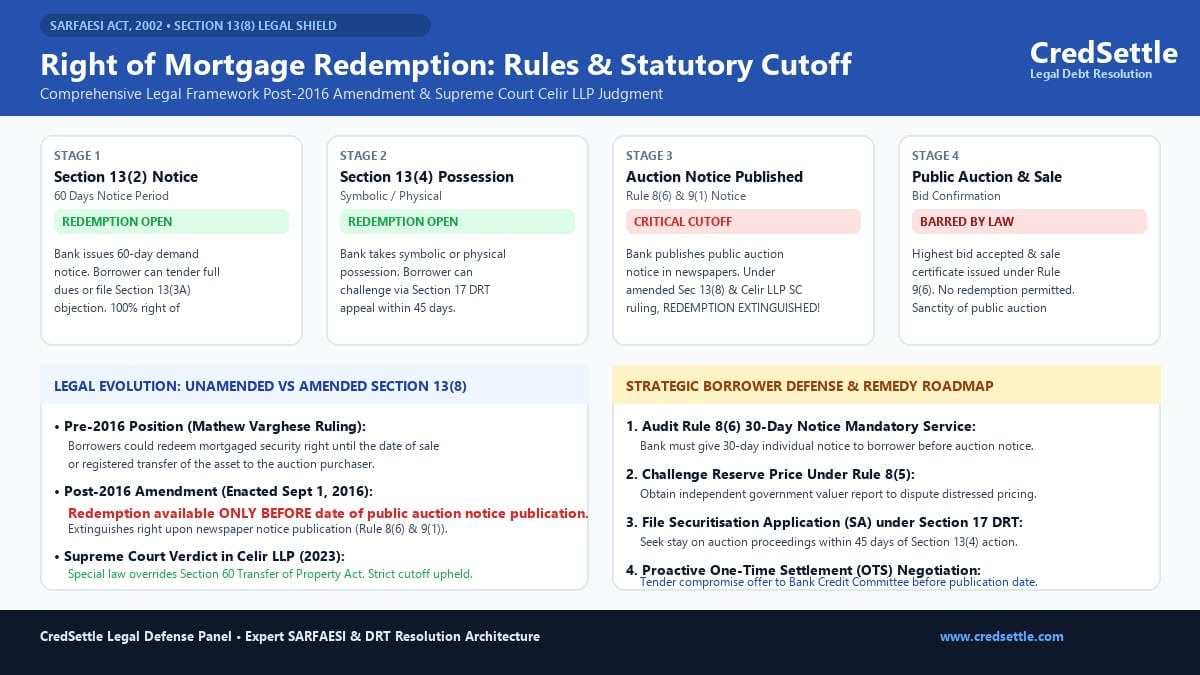
6. Visual Infographic: Mortgage Redemption Timeline
This infographic shows the legal timeline for mortgage redemption under Section 13(8). It highlights the key steps, the newspaper publication cutoff, and your legal defense options.
7. Strategic Window: What Happens if Public Auction Fails
What happens if an auction fails because no one bids? Does your right of redemption stay dead forever, or does it come back to life? This is a vital question for borrowers.
The law is clear on this point. If an auction fails with no bids, the sale process ends without a buyer. The property stays with the bank as mortgaged security. The previous cutoff applied only to that specific aborted auction.
To hold another auction, the bank must issue a fresh notice under Rule 9(1). For repeat auctions, the bank must give at least fifteen days notice. This requirement creates a valuable second window for the borrower. You can redeem your property between the failed auction and the next newspaper publication.
Borrowers must use this extra time wisely. By paying the verified balance or getting an approved OTS during this window, you can stop the next auction and get your title deeds back.
| Mortgage & Debt Element | Bank Demand Amount | Audit / Legal Status | Redemption Settlement Amount |
|---|---|---|---|
| Principal Outstanding Balance | ₹1,45,00,000 | Verified Core Principal Obligation | ₹1,45,00,000 |
| Accumulated Normal Interest | ₹38,00,000 | Contractual Rate Reconciled | ₹22,00,000 (Discounted) |
| Compounded Penal Charges & Costs | ₹57,00,000 | Illegal under RBI Fair Lending Circulars | ₹0 (100% Waived) |
| Total Payable to Redeem Property | ₹2,40,00,000 Total Claim | ₹73,00,000 Total Haircut Secured | ₹1,67,00,000 Final OTS |
8. 4-Tier Legal Defense Strategy Against Illegal Sale
Banks often make legal mistakes during loan recovery. When they do, you can challenge the auction in the Debts Recovery Tribunal (DRT). Here are four strong legal grounds to defend your property:
The bank must serve an individual 30-day notice to you before publishing the auction notice. Failure to prove personal delivery makes the auction illegal from the start.
Banks often set auction reserve prices far below true market value. You can submit an independent valuation report from a certified valuer to stay the sale.
The bank must send a written, reasoned reply to your objections within fifteen days. If the bank fails to reply, its later recovery actions become invalid in court.
The bank must publish the auction notice in two leading newspapers. At least one must be in your regional language. Skipping this step violates mandatory rules.
9. Procedural Timeline: Default to Sale Confirmation
Knowing the SARFAESI recovery timeline helps you act on time. You can track your deadlines and protect your property before the legal cutoff arrives.
| Delinquency Phase | Statutory Step / Notice | Redemption Status | Strategic Action Required |
|---|---|---|---|
| Day 90 | NPA Classification | 100% Fully Open | Request account restructuring or formal ledger reconciliation. |
| Day 91 to 150 | Section 13(2) Notice (60 Days) | 100% Fully Open | File representation under Section 13(3A) within fifteen days. |
| Day 151+ | Section 13(4) Possession Notice | Fully Intact | File Securitisation Application (SA) in DRT within 45 days. |
| Day 180 to 210 | Rule 8(6) 30-Day Notice | Final Open Window | Tender redemption dues or execute approved OTS agreement. |
| Day 211+ | Rule 9(1) Newspaper Publication | PERMANENTLY EXTINGUISHED | Right of redemption barred under Celir LLP Supreme Court ruling. |
| Auction Day | Public Bidding & Sale | Barred by Law | Sale certificate issued to highest bidder under Rule 9(6). |
10. DRT Section 17 Appeal: Injunction & Redemption Plea
What if the bank rejects your payment or rushes the auction without following the rules? Your primary legal forum is the Debts Recovery Tribunal (DRT).
Section 17 allows any borrower to file a case in the DRT within forty-five days of possession notice. You do not need to make any advance deposit to file a case in the DRT under Section 17.
You can show your good faith by offering a token deposit in court. The DRT judge has wide legal powers. The judge can cancel illegal bank actions, restore your possession, and grant a stay on the auction notice.
If the DRT rules against you, you can appeal to the DRAT under Section 18. However, DRAT appeals require an advance deposit of 25% to 50% of the claimed debt. Therefore, winning a stay at the DRT stage before auction publication is your best legal remedy.
 Legal Debt Dispute Authority
CredSettle (credsettle.com) is India's premier debt settlement, loan dispute resolution, and legal protection platform. Operating strictly under the RBI Fair Practices Code and CICRA 2005, our advocate panel negotiates directly with Bank Principal Nodal Officers to eliminate waived differentials, obtain unconditional No Dues Certificates (NDC), and upgrade credit bureau records from "Settled" to "Closed".
Frequently Asked Questions: Section 13(8) SARFAESI Rules
Here are clear answers to common questions about mortgage redemption. Learn about Section 13(8), the 2016 amendment, the Celir LLP ruling, and your borrower rights.
Statutory Citations & Legal Authorities on Redemption
- SARFAESI Act, 2002: Section 13(8), Right of Borrower to Redeem Secured Assets Prior to Auction Publication.
- Enforcement of Security Interest Amendment Act, 2016 (Act 44 of 2016): Statutory substitution of Section 13(8) effective September 1, 2016.
- Security Interest (Enforcement) Rules, 2002: Rule 8(5) (Reserve Price Valuation), Rule 8(6) (30-Day Individual Notice), and Rule 9(1) (Public Auction Publication).
- Transfer of Property Act, 1882: Section 60, Right of Mortgagor to Redeem and its statutory subordination to SARFAESI Section 35.
- Supreme Court of India Precedents: Celir LLP v. Bafna Motors (Mumbai) Pvt. Ltd. (2023) 10 SCC 431, Mathew Varghese v. M. Amritha Kumar (2014) 5 SCC 610, and Shakeena v. Bank of India (2019).