Claim Surplus Sale Proceeds After Bank Auction Legally
A definitive legal defense guide under Section 13(7) of the SARFAESI Act. Learn how to audit bank auction proceeds, eliminate inflated recovery expenses, defeat unlawful banker liens, and recover your rightful surplus money.
- Mandatory Statutory Trust: Under Section 13(7) of the SARFAESI Act, the bank holds auction sale money strictly in trust, not as its own property.
- Strict Order of Application: Funds must satisfy actual recovery costs first, mortgage loan dues second, and all remaining balance must be paid to the borrower.
- Banker General Lien Inapplicable: Banks cannot convert statutory trust funds into an unauthorized general lien under Section 171 without an explicit cross-collateral contract.
- Right to Audited Accounts: Borrowers can demand an itemized Statement of Accounts with bills to eliminate inflated legal and auction charges.
- Statutory Interest on Delay: Wrongful withholding of surplus proceeds entitles the borrower to interest at 12% to 18% per annum under Supreme Court rulings.
1. Statutory Trust: Section 13(7) SARFAESI Mandate
When a borrower defaults on a home loan, loan against property, or commercial term facility, secured creditors invoke the SARFAESI Act, 2002. After taking physical possession under Section 13(4), the authorised officer conducts a public e-auction. In many instances, the real estate market value yields an auction price that comfortably exceeds the outstanding loan balance.
Many banks quietly sit on the surplus money. They delay payment for months, invent arbitrary administrative fees, or divert the funds to unrelated unsecured loans. This practice directly violates Indian banking law.
Parliament enacted Section 13(7) of the SARFAESI Act to establish an unambiguous fiduciary duty. The statute commands that all money received by the secured creditor through asset enforcement shall, in the absence of a contrary contract, be held by the bank in trust.
This legal provision creates a statutory trust relationship. The bank is not the beneficial owner of the auction proceeds. The bank acts as a custodian. Once its legitimate loan claim and lawful recovery costs are settled, the remaining money belongs entirely to the mortgagor.
2. Waterfall Mechanism: Order of Priority for Proceeds
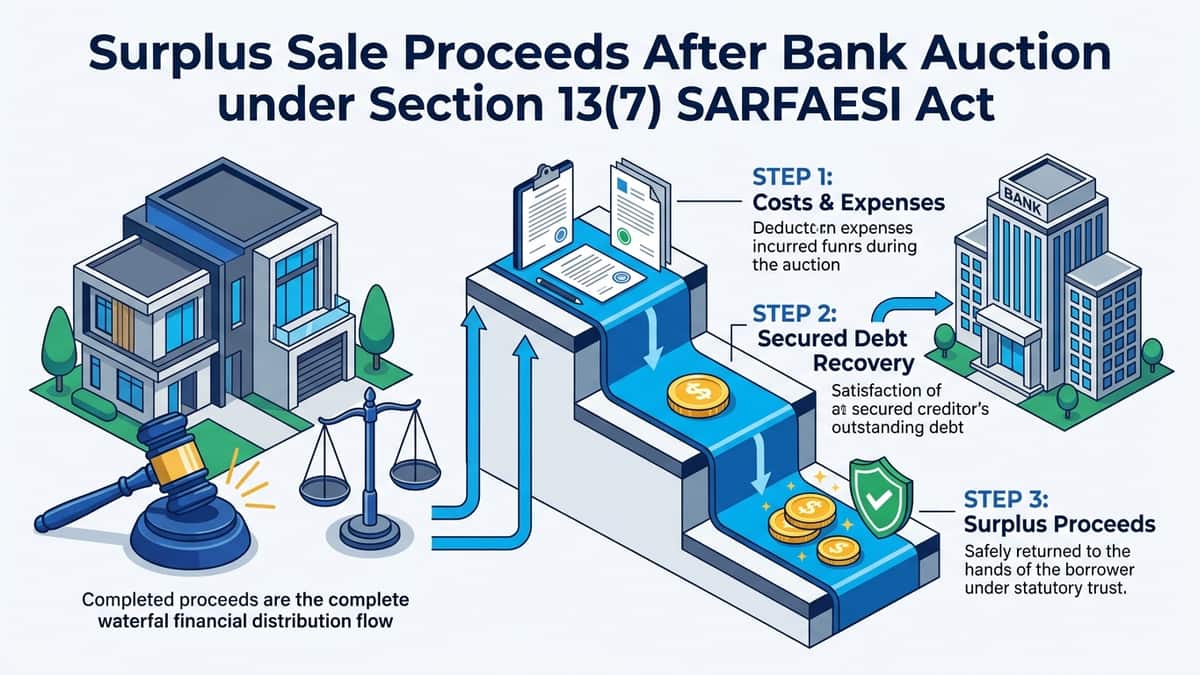
Section 13(7) prescribes a strict, three-tier statutory waterfall for distributing auction sale proceeds. The secured creditor cannot alter this sequence or deduct unauthorized charges.
The first priority covers actual costs, charges, and expenses properly incurred by the bank in taking possession, safeguarding the property, and publishing auction advertisements. The second priority covers the discharge of the secured debt, including contractual interest up to the date of full realization.
The third priority requires the residue of the money to be paid immediately to the person entitled thereto in accordance with their legal rights and interests. If no secondary mortgage exists, this balance must be transferred directly to the borrower or mortgagor.
| Financial Head / Audit Item | Bank Ledger Claim | Statutory Legal Audit Finding | Lawfully Approved Amount |
|---|---|---|---|
| Gross Auction Realization (E-Auction) | ₹1,50,00,000 | 100% Sale Price Deposited by Highest Bidder | ₹1,50,00,000 (Gross Trust Fund) |
| Actual Auction Expenses (Tier 1) | ₹7,80,000 | Audited: Paper ads, security & valuer fee | ₹2,80,000 (₹5 Lakh Bogus Fee Cut) |
| Outstanding Secured Loan Debt (Tier 2) | ₹98,50,000 | Principal & Contractual Interest to Realization | ₹92,20,000 (Penal Fees Disallowed) |
| Unauthorized Unsecured Debt Set-Off | ₹15,00,000 | Illegal Banker Lien Barred Under Sec 13(7) | ₹0 (Disallowed 100%) |
| Net Surplus Proceeds Refundable (Tier 3) | ₹28,70,000 Offered | CredSettle Audit Recovery: +₹26.30 Lakhs | ₹55,00,000 Disbursed to Owner |
3. Surplus Asset Matrix: Rights & Legal Remedies
When a mortgaged property is auctioned, competing parties often assert conflicting claims against the surplus proceeds. Indian law establishes clear rules governing who is entitled to the residue money.
Section 26E of the SARFAESI Act gives secured creditors absolute first priority over government taxes and revenues. Once the first secured creditor is paid, the remaining balance follows the statutory priority matrix below.
| Claimant Entity | Governing Provision | Statutory Priority | Banker Lien Immunity | Legal Enforcement Step |
|---|---|---|---|---|
| Primary Mortgagor / Property Owner | SARFAESI Act (Sec 13(7)) | Complete Right to Residue | Immune from Unrelated Debts | Issue Section 13(7) legal demand notice with interest. |
| Second Mortgagee / Junior Charge Holder | Transfer of Property Act (Sec 73) | Priority Over Unsecured Debt | Substituted Security Right | Lodge formal claim on surplus before DRT. |
| Third-Party Property Guarantor | Indian Contract Act (Sec 140) | Absolute Ownership of Surplus | 100% Protected from Borrower Dues | Demand immediate refund to guarantor account. |
| Income Tax / Commercial Tax Authority | SARFAESI Act (Sec 26E) | Subordinate to Secured Debt | Can Attach Residue After Mortgage | Audit tax attachment order validity under Sec 26E. |
| Unsecured Creditor / Credit Card Bank | Indian Contract Act (Sec 171) | Lowest Priority (Zero Security) | No Right to Convert Trust Money | Challenge unauthorized banker set-off at DRT. |
4. Judicial Precedents: Supreme Court & High Court Laws
Indian courts have consistently held that asset enforcement under SARFAESI is not a punitive measure. The law allows lenders to recover legitimate debts, but it strictly prohibits unjust enrichment.
In the landmark ruling of Ram Kishun and Others v. State of U.P. and Others (2012) 11 SCC 511, the Supreme Court ruled that a creditor cannot be allowed to enrich itself unjustly. The court held that whenever public auction proceeds exceed the outstanding dues, the surplus must be returned to the debtor without unnecessary delay.
In Mathew Varghese v. M. Amritha Kumar (2014) 5 SCC 610, the Supreme Court declared that the secured creditor acts as a trustee of the secured asset on behalf of the borrower. The bank is legally obligated to realize the maximum possible market value and account for every rupee received during the sale.
The High Court of Madras in S. Santhosh v. Authorised Officer affirmed that when auction proceeds exceed the mortgage debt, the bank cannot retain surplus funds under a general lien for separate unsecured debts unless an express contractual agreement exists. The court held that the statutory trust created by Section 13(7) overrides general common-law lien claims.
5. Visual Blueprint: Section 13(7) Auction Surplus Flow
This visual workflow diagram shows the entire lifecycle of bank auction proceeds under Section 13(7) of the SARFAESI Act. It illustrates the statutory waterfall sequence from auction realization to borrower surplus refund.
6. Step-by-Step SOP: 6 Stages to Recover Auction Surplus
If your property was auctioned under the SARFAESI Act and the bank has not disbursed your surplus money, execute this systematic six-stage recovery protocol.
1Stage 1: Demand Certified Statement of Accounts
Submit a formal written application under Rule 9 of the Security Interest (Enforcement) Rules, 2002. Demand a certified ledger detailing gross auction realization, deposit dates, and itemized deductions.
2Stage 2: Audit and Challenge Inflated Recovery Expenses
Scrutinize every cost deduction. Demand tax invoices for valuation fees, newspaper publication vouchers, and security charges. Disallow arbitrary administrative fees and unauthorized recovery agency commissions.
3Stage 3: Serve Formal Section 13(7) Legal Demand Notice
Through legal counsel, serve a formal statutory notice upon the bank Authorised Officer and Zonal Manager. Cite Section 13(7) statutory trust rules and demand disbursement of the surplus balance within fifteen days.
4Stage 4: File Section 17 Application at DRT for Accounting
If the bank refuses to release funds, file an application under Section 17 of the SARFAESI Act before the Debt Recovery Tribunal. Seek an order directing the bank to deposit surplus proceeds with 18% annual interest.
5Stage 5: Lodge Complaint with RBI Integrated Ombudsman
File a deficiency in service complaint through cms.rbi.org.in. Lenders face regulatory penalties for withholding customer funds and failing to render proper accounts after auction realization.
6Stage 6: Secure Bank NOC and Remit Surplus Proceeds
Receive your surplus funds via direct RTGS transfer into your neutral savings account. Secure the formal No Dues Certificate and ensure the mortgage charge is satisfied on the CERSAI portal.
7. Legal Defenses Against Bank Retention & Set-Off
When pressed for surplus refunds, banks often invent legal defenses to keep the money. Borrowers have powerful statutory shields to defeat these illegal maneuvers.
A banker general lien applies only to general customer balances. It cannot attach to funds received for a specific statutory purpose or held in trust under Section 13(7) of the SARFAESI Act.
Under Article 300A of the Constitution of India, no person can be deprived of property without authority of law. Keeping surplus auction money without explicit legal authority is unconstitutional.
A bank officer who willfully misappropriates or refuses to disburse statutory trust money commits criminal breach of trust under Section 316 of Bharatiya Nyaya Sanhita, 2023.
Courts treat withheld surplus proceeds as commercial money. Secured creditors who delay disbursement face mandatory interest penalties ranging from 12% to 18% per annum from the sale date.
8. 3-Tier Escalation Matrix: Bank, DRT & Ombudsman
If the branch manager or recovery desk ignores your surplus refund requests, use the institutional escalation hierarchy established under Indian financial regulations.
| Grievance Tier | Designated Competent Forum | Statutory Turnaround | Scope of Intervention & Relief |
|---|---|---|---|
| Level 1: Bank Nodal Desk | Principal Nodal Officer / Zonal Office | 10 to 15 Working Days | Audits auction statement, verifies legal bills, and directs branch to issue surplus payment. |
| Level 2: DRT Application | Debt Recovery Tribunal (Section 17) | 45-Day Appeal Window | Passes binding judicial orders for rendering accounts, striking off bad charges, and releasing surplus. |
| Level 3: RBI Ombudsman & HC | RBI Ombudsman / High Court Writ (Art 226) | 30 Days Post-PNO | Penalizes arbitrary lender actions, restores fundamental rights, and orders full refund with interest. |
9. Procedural Timeline: Default to Auction Surplus Refund
Understanding the regulatory timetable under the Security Interest (Enforcement) Rules, 2002 allows borrowers to track auction funds and claim their residue without losing legal deadlines.
| Delinquency Window | SARFAESI Legal Milestone | Lender Enforcement Action | Strategic Mortgagor Action |
|---|---|---|---|
| Day 1 to 90 | NPA Classification | Account tagged Non-Performing Asset following 90 days of non-payment. | Audit loan interest calculation and explore one-time settlement options. |
| Day 91 to 150 | Section 13(2) Demand | 60-day statutory notice demanding full discharge of liabilities. | Submit detailed written objection under Section 13(3A) within 15 days. |
| Day 151 to 180 | Section 13(4) Possession | Bank assumes constructive or physical possession of the mortgaged asset. | Obtain independent property valuation to prevent deliberate undervaluation. |
| Day 181 to 210 | Rule 8(6) & 9(1) Notice | 30-day public auction notice published in two leading local newspapers. | Verify reserve price and locate prospective buyers to maximize sale bids. |
| Day 211 to 225 | Auction Execution | E-auction conducted; successful buyer pays mandatory 25% deposit. | Record the final bid value and calculate preliminary surplus balance. |
| Day 226 to 240 | Full Realization | Buyer deposits remaining 75% balance; bank issues Sale Certificate. | Serve Section 13(7) notice demanding surplus transfer with audit report. |
10. Specialized Scenarios: Multiple Loans & Guarantors
Auction surplus claims frequently intersect with multiple mortgages, corporate guarantees, and family inheritance rights. Here is how statutory rules apply across complex situations.
Third-Party Mortgagor / Guarantor Property
When a guarantor property is sold, the surplus proceeds belong exclusively to the guarantor. The creditor cannot use the guarantor money to offset independent unsecured debts owed by the principal borrower.
Second Charge Holders & Junior Mortgagees
Under Section 73 of the Transfer of Property Act, a junior mortgagee has a statutory right against the surplus proceeds of the prior sale. The bank must satisfy valid registered second charges before releasing residue funds.
Collusive or Undervalued Distress Auctions
If the bank sold the property at an artificially depressed reserve price to favor a buyer, challenge the sale before the DRT under Section 17. The tribunal can set aside collusive auctions and restore property equity.
Deceased Mortgagor Legal Heirs Rights
Upon the death of the mortgagor, all rights under Section 13(7) pass to surviving legal heirs. The bank must disburse surplus proceeds to the legal heirs upon submission of a succession certificate or legal heirship document.
 Legal Debt Dispute Authority
CredSettle (credsettle.com) is India's premier debt settlement, loan dispute resolution, and legal protection platform. Operating strictly under the RBI Fair Practices Code and CICRA 2005, our advocate panel negotiates directly with Bank Principal Nodal Officers to eliminate waived differentials, obtain unconditional No Dues Certificates (NDC), and upgrade credit bureau records from "Settled" to "Closed".
Frequently Asked Questions: Section 13(7) Surplus Dues
Clear, verified legal guidance addressing critical questions regarding bank auction surplus proceeds, statutory trust obligations, ledger audits, and borrower remedies under Indian law.
Official Regulatory Citations & Statutory Legal Framework
- Securitisation and Reconstruction of Financial Assets and Enforcement of Security Interest Act, 2002: Section 13(7), Statutory Trust and Application of Sale Proceeds.
- Security Interest (Enforcement) Rules, 2002: Rule 8 and Rule 9, Sale of Immovable Secured Assets and Issue of Sale Certificate.
- SARFAESI Act, 2002: Section 26E, Priority of Secured Creditors Over Government Dues and Subordinate Claims.
- Transfer of Property Act, 1882: Section 73, Right to Proceeds of Revenue Sale or Compensation on Acquisition.
- Indian Contract Act, 1872: Section 171, Limitations on Banker General Lien Over Statutory Trust Funds.
- Supreme Court of India Precedents: Ram Kishun v. State of U.P. (2012) and Mathew Varghese v. M. Amritha Kumar (2014).