Order 37 CPC Summary Suit for Loan Recovery: Leave to Defend
A clear legal guide for borrowers facing summary suits under Order 37 CPC. Learn the strict 10-day timeline, grounds for unconditional leave to defend, and how to stop ex-parte decrees.
- Strict 10-Day Appearance: You must file a Memo of Appearance within 10 days of receiving court summons in Form 4. Missing this deadline lets the bank get an ex-parte money decree.
- Leave to Defend Window: When the bank serves a Summons for Judgment in Form 4A, you have strictly 10 days to file your Leave to Defend application.
- Substantial Defense Wins Free Leave: Under the Supreme Court Hubtown ruling, showing a fair triable issue gives you unconditional leave to defend without depositing any cash.
- Converts to Regular Trial: Once the court grants leave to defend, the case becomes a regular civil suit. This takes 3 to 7 years in court.
- Huge Settlement Leverage: Banks hate long trials. With the case delayed, banks often offer a One-Time Settlement (OTS) with 50% to 75% waivers on interest and charges.
1. What is Order 37 CPC Summary Suit for Loan Recovery?
When a borrower defaults on a personal loan, credit card, or business loan, lenders want fast recovery. Regular civil suits in Indian courts take many years. To avoid this delay, banks and NBFCs file a summary suit under Order 37 of the Code of Civil Procedure (CPC), 1908.
Order 37 is an expedited court procedure. It is designed to recover fixed debts without long trials. In an ordinary civil suit, you have an automatic right to file a written statement. But under Order 37, you have no automatic right to defend. The court assumes the lender claim is valid unless you prove a genuine dispute.
Under Order 37 Rule 1(2), summary suits apply only to specific debts. These include bills of exchange, hundies, and promissory notes. They also cover suits to recover a fixed sum of money arising from a written contract or guarantee. Lenders cannot use Order 37 for unliquidated damages, disputed penalties, or vague charges.
In retail banking, lenders use Order 37 as a pressure tool. They hope the borrower will panic and miss the short 10-day deadline. If the borrower does not act in time, the court passes an immediate money decree.
2. Strict 10-Day Appearance & Summons Procedure
An Order 37 suit has a two-stage summons process. You must understand both stages. Missing either deadline causes severe legal harm.
The first stage starts with the service of summons in Form No. 4. When you receive this notice from the court, you have strictly 10 days to enter an appearance. Entering an appearance does not mean filing your defense yet. You only need to file a memo with your address and your advocate details.
If you fail to enter an appearance within 10 days, Order 37 Rule 2(3) applies. The court treats all facts in the bank plaint as admitted. The judge will quickly pass a final money decree against you for the full claim with interest.
Once you enter an appearance, the second stage begins. The bank must serve a Summons for Judgment in Form No. 4A. This notice includes an affidavit verifying the debt. You then have strictly 10 days from receiving Form 4A to file your Leave to Defend application.
| Procedural Parameter | Summary Suit (Order 37 CPC) | Regular Civil Suit (Order 7 & 8 CPC) |
|---|---|---|
| Right to Defend | No automatic right. Requires court leave. | Automatic statutory right to file defense. |
| First Response Window | 10 Days to file Appearance (Form 4). | 30 Days (extendable to 90 days for WS). |
| Summons for Judgment | Mandatory Form 4A with lender affidavit. | Not applicable in regular suits. |
| Leave to Defend Window | Strictly 10 Days from Form 4A service. | Not required. Written statement filed directly. |
| Consequence of Default | Immediate final money decree passed. | Matter proceeded ex-parte; evidence recorded. |
| Dispute Conversion | Converts to regular trial once leave is granted. | Follows standard civil trial steps from day one. |
3. Understanding Leave to Defend under Order 37 Rule 3
An Application for Leave to Defend is your primary shield in an Order 37 suit. Governed by Rule 3(5), this application asks the court for permission to contest the claim.
You must support this application with a sworn affidavit. The affidavit must not make broad or empty claims. It must state clear facts, accounting errors, and legal flaws. You must prove that your defense raises a triable issue.
The judge does not decide the whole case at this early stage. The court does not test whether you will win the trial. The judge only checks if your defense is honest, fair, and reasonable. If your defense is not a fake excuse to delay payment, the court must let you defend.
| Claim Breakdown Component | Bank Summary Claim | Legal & Regulatory Status | Triable Dispute Value |
|---|---|---|---|
| Original Principal Disbursal Balance | ₹7,20,000 | Base debt verified from bank statements | ₹7,20,000 (Admitted Base) |
| Capitalized Penal Charges & Fees | ₹3,40,000 | Illegal under RBI 2024 Fair Lending Rules | ₹3,40,000 (Triable Issue) |
| Compounded Post-Default Interest | ₹4,40,000 | Unliquidated demand outside Order 37 scope | ₹4,40,000 (Triable Issue) |
| Net Disputed Ledger Claims | ₹15,00,000 Claimed | ₹7,80,000 Proven Triable Inconsistencies | Unconditional Leave Granted |
4. Landmark Supreme Court Rulings: Hubtown & Mechelec
The Supreme Court of India has set clear rules for granting leave to defend. For forty years, courts followed the Mechelec Engineers case from 1976.
In 2017, the Supreme Court updated these rules in IDBI Trusteeship Services Ltd. v. Hubtown Ltd. (2017) 1 SCC 568. This three-judge ruling modernised the law under Order 37 Rule 3. It gives borrowers a strong legal framework to fight summary suits.
The Supreme Court in Hubtown laid down five core principles:
If you prove a substantial defense, you get unconditional leave to defend. The court has no power to demand any cash deposit.
If you raise a fair, bona fide, or reasonable dispute, the court must grant unconditional leave. Your defense does not have to be proven true yet.
If your defense is possible but doubtful, the court may grant conditional leave. In this case, you may need to deposit part of the debt or give security.
If you disclose no defense, or your claim is fake and made only to delay, the court refuses leave. The bank gets an immediate decree.
If you admit owing part of the debt, you must deposit that admitted sum in court. The judge then lets you fight the disputed balance.
The Supreme Court confirmed this again in B.L. Kashyap & Sons Ltd. v. JMS Steels (2022). The court ruled that judges should not deny leave to defend when a real dispute exists.
5. Top Legal Grounds & Triable Issues in Loan Recovery
To win unconditional leave to defend against a bank or NBFC, your application must rely on solid legal grounds. The following defenses have consistently succeeded in converting summary suits into regular trials across Indian courts.
The RBI issued fair lending rules in 2024. These rules ban adding penal charges to loan principal. If the bank added compound interest on late EMIs, the ledger is illegal. This gives you a strong triable issue.
Order 37 applies only to fixed debts. Banks often add random bounce fees and collection charges. This makes the claim unliquidated. As a result, the summary suit is not maintainable.
The Limitation Act, 1963 sets a strict time limit. A bank must file a money suit within 3 years of loan default. If the lender sues after 3 years, the claim is time-barred. The court will dismiss it.
Banks rely on digital account statements. Under Section 63 of Bharatiya Sakshya Adhiniyam, 2023, the bank must file an electronic certificate. Without this certificate, the ledger is not valid evidence.
Lenders often take blank cheques at loan signing. Filling inflated amounts without consent breaks Section 20 of the Negotiable Instruments Act. This creates a solid triable dispute.
Loan agreements need proper stamp duty. Under Section 35 of the Indian Stamp Act, unstamped papers cannot be used in court. A stamp defect stops the court from passing a summary decree.
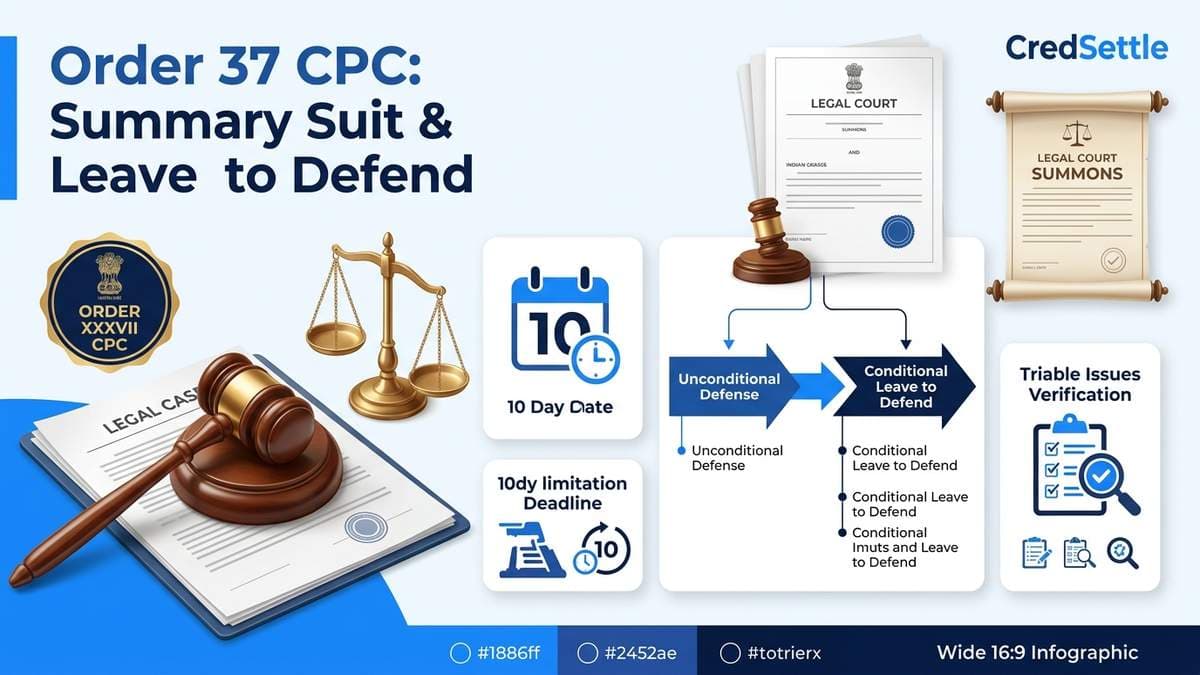
6. Visual Blueprint: Order 37 CPC Defense Timeline
This comprehensive infographic illustrates the sequential steps of an Order 37 summary suit, the strict 10-day limitation gates, and the strategic path to securing unconditional leave to defend.
7. Step-by-Step SOP: Drafting Your Leave to Defend
When you receive court summons in an Order 37 suit, executing this structured six-stage protocol guarantees that you protect your legal standing and block the bank from securing an easy money decree.
1Stage 1: Verify Summons Date & Record Exact Service
Check the speed post envelope or court bailiff receipt. Note the exact date of physical delivery. Calculate the 10-day limitation window immediately, excluding the day of service under Section 12 of the Limitation Act.
2Stage 2: File Memo of Appearance in Court (Form 4)
Engage counsel to file a formal Memo of Appearance under Order 37 Rule 3(1). Provide your verified address and your advocate details. Serve an advance copy to the bank lawyer to stop any ex-parte decree attempts.
3Stage 3: Forensic Audit of Bank Ledger & Loan Documents
Examine every annexure attached to the bank plaint. Compare the bank statement against your actual bank credits, identify hidden compound interest, flag missing digital evidence certificates, and note any stamp duty deficiencies.
4Stage 4: Draft Leave to Defend Application & Affidavit
Prepare a comprehensive application under Order 37 Rule 3(5) supported by a sworn affidavit. Explicitly frame 3 to 5 distinct triable issues based on Hubtown principles, proving that the suit involves complex questions of law and fact.
5Stage 5: Serve Advance Copy & File within 10 Days of Form 4A
Once the lender serves their Summons for Judgment (Form 4A), lodge your leave to defend application within strictly 10 days. Ensure court stamp acknowledgment and keep proof of service on record.
6Stage 6: Oral Arguments & Leverage for OTS Loan Settlement
Your counsel presents oral arguments showing prima facie triable issues. When the court grants leave, the bank realizes the case will take years of regular trial, creating the perfect opportunity to negotiate a deep OTS waiver.
8. Conditional vs Unconditional Leave: Security Deposit
Borrowers often fear that the court will force them to deposit cash. You should understand the difference between conditional and unconditional leave.
Under the proviso to Order 37 Rule 3(5), the court cannot ask for a deposit if you raise a bona fide triable defense. The Supreme Court in Hubtown confirmed this rule. If your defense is real and fair, the court must grant unconditional leave without any deposit.
A court orders a deposit in only two cases. First, if your defense is possible but doubtful, the court may ask for partial security. Second, if you admit part of the debt, you must deposit the admitted sum to contest the rest.
| Order Category | Judicial Finding on Defense | Deposit Requirement | Next Procedural Step |
|---|---|---|---|
| Unconditional Leave | Substantial or bona fide triable issue established. | Zero Cash Deposit Required. | File Written Statement within 30 days. |
| Conditional Leave | Defense is plausible but doubtful or lacks corroboration. | Deposit 20% to 50% or Bank Guarantee. | Deposit amount within court window or challenge. |
| Leave Refused | No defense disclosed, moonshine, or sham assertion. | Entire claimed sum decreed. | Bank executes decree or borrower appeals. |
9. What Happens If You Miss the 10-Day Deadline?
Borrowers often fail to act within the tight 10-day window. If you miss this deadline, the CPC provides two legal remedies.
The first remedy is Order 37 Rule 3(7). This rule lets the court excuse the delay if you show sufficient cause. Valid reasons include hospital stay, lack of proper address service, or family emergencies. You must file the request quickly with medical or travel records.
The second remedy is Order 37 Rule 4. If the court has already passed an ex-parte decree, you can apply to set it aside. You must prove two things: special reasons for your absence and a genuine defense on merits.
Order 37 Rule 3(7) Condonation of Delay
Filed before final decree is signed. Borrower files an application explaining sufficient cause for delay along with the Leave to Defend application. Courts adopt a liberal view if genuine grounds exist.
Order 37 Rule 4 Setting Aside Decree
Filed after an ex-parte decree is passed. Requires demonstrating special circumstances (such as fraudulent service) plus establishing a bona fide triable dispute on merits to recall the judgment.
10. Strategic Settlement: How Order 37 Leads to OTS
Banks file Order 37 suits hoping for an easy win within three months. But when a borrower files a strong leave to defend, the bank loses its speed advantage.
The moment the court grants leave, the case turns into an ordinary civil suit. An ordinary suit requires witness testimony, document proof, and cross-examination. In Indian courts, this trial takes 3 to 7 years.
Bank recovery teams work under tight quarterly targets. They do not want an unsecured retail loan stuck in court for years. Once leave to defend is granted, banks often invite borrowers for a One-Time Settlement (OTS).
At CredSettle, our legal team uses this court delay as strong leverage. We remove unfair penal charges, highlight bank errors, and help borrowers settle their debts with 50% to 75% waivers and clean NOCs.
 Legal Debt Dispute Authority
CredSettle (credsettle.com) is India's premier debt settlement, loan dispute resolution, and legal protection platform. Operating strictly under the RBI Fair Practices Code and CICRA 2005, our advocate panel negotiates directly with Bank Principal Nodal Officers to eliminate waived differentials, obtain unconditional No Dues Certificates (NDC), and upgrade credit bureau records from "Settled" to "Closed".
Frequently Asked Questions: Order 37 CPC Summary Suits
Clear, verified legal guidance addressing critical questions regarding summary suits, summons for judgment, leave to defend applications, and borrower rights under Indian civil law.
Official Regulatory Citations & Statutory Legal Framework
- Code of Civil Procedure, 1908 (CPC): Order XXXVII (Rules 1 to 7), Summary Procedure on Liquidated Debts and Negotiable Instruments.
- Supreme Court of India Landmark Rulings: IDBI Trusteeship Services Ltd. v. Hubtown Ltd. (2017) 1 SCC 568 and Mechelec Engineers v. Basic Equipment Corp. (1976).
- Supreme Court Reaffirmation: B.L. Kashyap & Sons Ltd. v. JMS Steels & Power Corp. (2022) 3 SCC 294 on liberal grant of leave to defend.
- Limitation Act, 1963: Articles 19, 28, and 55, Three-Year Limitation Period for Money Claims and Written Contracts.
- Reserve Bank of India Guidelines: RBI Circular on Fair Lending Practice - Penal Charges in Loan Accounts (2024).
- Bharatiya Sakshya Adhiniyam, 2023: Section 63, Admissibility of Electronic Records and Digital Bank Ledgers.