SARFAESI 12-Year Limitation Period & Article 62 Defense
A comprehensive legal guide for property owners and loan guarantors. Understand Section 36 of the SARFAESI Act, Article 62 of the Limitation Act, and how to stop time-barred bank auctions.
- 12-Year Legal Deadline: Article 62 of the Limitation Act gives lenders 12 years to sell mortgaged property. Section 36 of the SARFAESI Act bars late actions.
- Start of Time: The clock starts when the debt becomes due. This happens after loan default and expiry of the 60-day notice under Section 13(2).
- 3-Year Personal Action Bar: Property sales have a 12-year window. But personal claims for remaining dues expire after 3 years under Article 55.
- Debt Revival Risks: Signing a balance sheet or settlement offer can reset the clock under Section 18. Checking past records is very important.
- Stopping Stale Actions: Borrowers can file a case in the Debt Recovery Tribunal under Section 17. The tribunal can cancel the sale and return title deeds.
1. Statutory Foundation: Section 36 SARFAESI Act Rules
Many borrowers think banks have unlimited time to take their property. This idea is wrong. Indian law sets strict time limits on bank debt recovery. These rules stop unfair harassment and protect property owners.
Section 36 of the SARFAESI Act, 2002 creates a firm legal bar. It says that a bank cannot take measures under Section 13(4) after the time limit runs out. The law uses the time limits set in the Limitation Act, 1963.
Section 36 links SARFAESI rules directly to general limitation law. If a bank waits too long, it loses the legal power to seize or auction the mortgaged asset.
Section 3 of the Limitation Act is also very clear. It says that any case filed after the deadline must be dismissed. The debt tribunal must throw out late claims even if the borrower forgets to raise the time defense.
2. Article 62 Framework: Mortgage Enforcement Period
The Limitation Act gives different time limits for different debts. Unsecured personal loans have a short 3-year deadline. In contrast, loans backed by mortgaged land or buildings fall under Article 62.
Article 62 covers legal actions to recover money secured by a mortgage on immovable property. The time limit under this article is 12 years. The clock starts when the secured debt legally becomes due.
When a bank takes steps under Section 13(4) of the SARFAESI Act, it acts on its mortgage rights. So the 12-year window applies. If a bank stays silent for more than 12 years, it permanently loses the right to auction the property.
| Mortgage Claim Component | Governing Law | Limitation Period | Legal Enforceability Status |
|---|---|---|---|
| Enforcement Against Mortgaged Real Estate | Article 62 Limitation Act | 12 Years from Default | Valid if within 12 Years |
| Personal Liability for Loan Shortfall | Article 55 Limitation Act | 3 Years from Breach | Barred after 3 Years |
| Unsecured Recovery Suit under Section 19 | RDDBFI Act, 1993 | 3 Years from Cause | Barred without Extension |
| Action Initiated at Year 13 (No Extension) | Section 36 SARFAESI Act | 12-Year Clock Expired | 100% Void & Quashable |
3. Limitation Clock: When Does Debt Legally Become Due?
Finding the exact start date of the 12-year clock is vital. Article 62 says time starts when the money becomes due. But what does this mean in real banking situations?
Money does not become due simply because the borrower signed loan papers. Time begins only when the bank has the immediate legal right to demand the full balance.
Most loan contracts say that if a borrower misses monthly payments, the whole loan becomes due at once.
Court rulings show that money becomes due when the bank recalls the loan or when the 60-day demand notice under Section 13(2) ends. If the borrower does not pay within those 60 days, the entire debt is due. The 12-year clock starts ticking on that date.
4. Section 18 Rules: How Debt Revival Restarts Limitation
The standard time limit under Article 62 is 12 years. But the clock does not always run without pause. Certain actions can restart the clock and give the bank more time.
Section 18 of the Limitation Act covers written debt acknowledgments. If a borrower signs a document admitting the debt before the 12 years end, a brand new 12-year clock starts from the date of that signature.
In business loans, this often happens through audited balance sheets. In the case of ARCIL v. Bishal Jaiswal, the Supreme Court ruled that an entry in a company balance sheet can count as a valid debt admission.
Still, the admission must be clear. If the balance sheet notes that the debt is disputed, it may not extend the deadline. Also, Section 19 says that paying part of the loan principal or interest restarts the time from that payment date.
5. Mortgage vs Personal Remedy: The 3-Year Shortfall Bar
There is a big legal difference between selling a mortgaged property and chasing a borrower personally. Lenders often confuse these two separate remedies.
Article 62 allows 12 years only for taking action against the mortgaged property. It does not give the lender 12 years to go after other personal assets, bank accounts, or salary.
Personal claims fall under Article 55 and Article 113. These articles give only 3 years. If a bank sells the property after 6 years and faces a deficit, it cannot file a personal case under Section 13(10) if the 3-year deadline has passed.
| Recovery Legal Remedy | Limitation Act Article | Prescribed Time Limit | Asset Scope | Strategic Borrower Defense |
|---|---|---|---|---|
| SARFAESI Property Auction | Article 62 | 12 Years | Only Mortgaged Real Estate | Audit default date & challenge after 12 years. |
| Personal Shortfall Claim (Sec 13(10)) | Article 55 / 113 | 3 Years | Personal Bank Accounts & Salary | Plead 3-year bar if auction occurred after 3 years. |
| DRT Original Application (OA Sec 19) | Article 55 / 62 | 3 Yrs (Personal) / 12 Yrs (Mortgage) | All Assets of Borrower & Guarantor | Oppose personal decree beyond 3-year window. |
| Summary Recovery Suit (Order 37 CPC) | Article 55 | 3 Years | Commercial Bills & Contracts | File leave to defend citing expired limitation. |
| Guarantor Enforcement | Article 55 / 62 | Co-Extensive with Primary Debt | Guarantor Mortgaged or Personal Assets | Assert discharge under Section 135 Contract Act. |
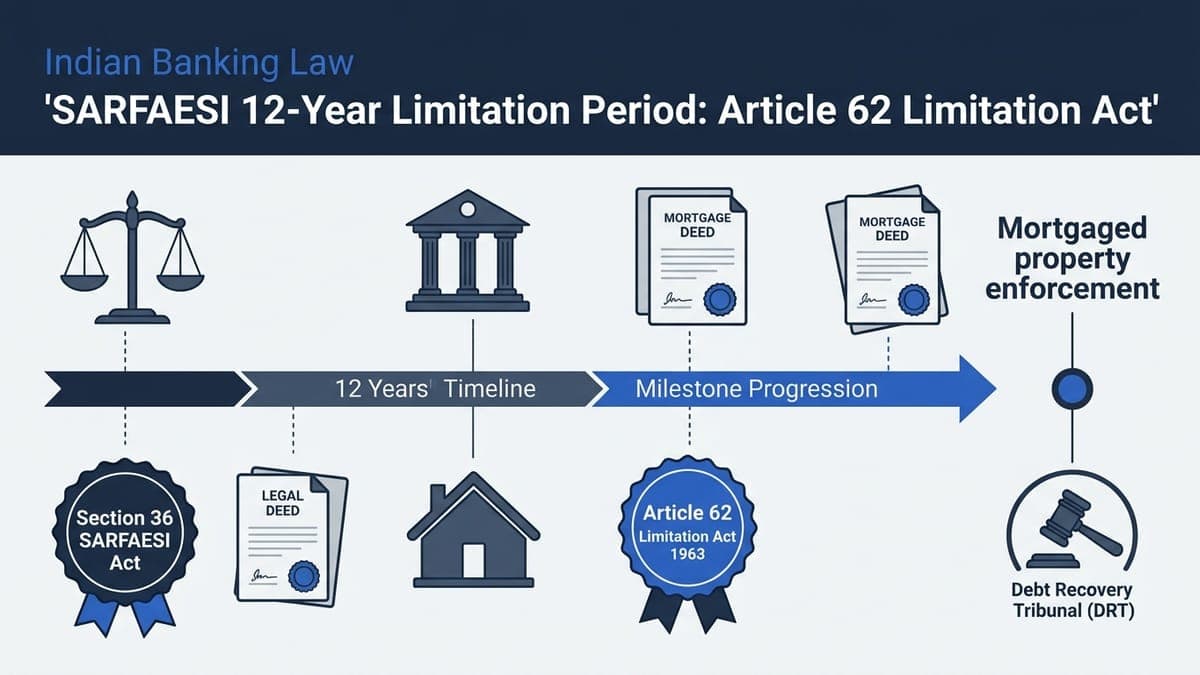
6. Visual Blueprint: SARFAESI Limitation Defense Flow
This clear visual roadmap shows the 12-year limitation timeline under Article 62. It explains key steps from loan default to debt discharge.
7. Step-by-Step SOP: 6-Stage Defense Against Stale Debt
If a lender or debt buyer threatens your property over an old loan default, use this 6-stage plan to check the time limit and defend your rights.
1Stage 1: Check Loan Default and Demand Dates
Look at your loan account records, first default dates, and demand letters. Find the exact date when the full loan balance became due.
2Stage 2: Review Company Accounts and Past Letters
Check if you signed any balance confirmation letters or settlement notes in the past 12 years that could reset the clock under Section 18.
3Stage 3: Send Section 13(3A) Objection to the Bank
When you get a Section 13(2) notice, reply in writing within 60 days. Cite Section 36 of the SARFAESI Act to state that the claim is too late.
4Stage 4: File a Case in the Debt Recovery Tribunal
If the bank issues a Section 13(4) possession notice, file a Securitisation Application in the DRT within 45 days. Ask the court to stay the auction.
5Stage 5: Contest Section 14 Magistrate Orders
If the bank asks the District Magistrate for physical possession, oppose the plea. Point out that the recovery action is time-barred under Section 36.
6Stage 6: Settle the Loan and Get Property Papers Back
Use your strong legal defense to negotiate a good settlement deal. Get your original title deeds back along with a clean No Dues Certificate.
8. DRT Section 17 Application: Quashing Stale Recovery
The Debt Recovery Tribunal is the main court for fighting unlawful SARFAESI actions. Section 17 gives the tribunal power to check if the bank followed the law.
Under Section 3 of the Limitation Act, the tribunal must throw out any action started after the deadline, even if the borrower did not raise it first.
If the bank took possession after the 12-year limit expired, Section 17(3) allows the tribunal to return the property to the borrower.
Any auction held on a time-barred loan is invalid. The tribunal can cancel the sale and tell the bank to return money to the bidder.
When mortgage recovery is barred by time, the bank cannot hold property papers. The tribunal can order the bank to hand back original deeds.
9. 3-Tier Escalation Matrix: Halting Unlawful Action
When facing delayed bank recovery, borrowers should use a clear 3-step escalation process to protect their property rights.
| Escalation Tier | Designated Legal Authority | Turnaround Time | Scope of Intervention & Relief |
|---|---|---|---|
| Level 1: Bank Objection | Authorized Officer (SARFAESI Cell) | 15 Days from Notice | Statutory reply to Section 13(3A) objection. Must record reasons if rejected. |
| Level 2: DRT Application | Presiding Officer, Debt Recovery Tribunal | 45 Days Post-13(4) | Stays property auction, quashes possession notice, and evaluates limitation period. |
| Level 3: Constitutional Writ | High Court (Article 226 / 227) | Immediate Hearing | Intervenes if DRT is non-functional or where bank actions are completely without jurisdiction. |
10. Procedural Milestones: From Default to Time-Barred
Knowing the key milestones of a defaulted loan helps you see when personal and mortgage recovery rights expire under Indian law.
| Timeline Milestone | Statutory Event | Legal Impact on Bank Rights | Recommended Borrower Action |
|---|---|---|---|
| Day 90 | NPA Tagging | Account marked Non-Performing Asset under RBI prudential norms. | Audit interest calculations and verify security documents. |
| Day 91 to 150 | Section 13(2) Notice | Demand notice served granting 60 days to repay total outstanding dues. | File a detailed legal objection under Section 13(3A). |
| End of Year 3 | Personal Remedy Expiry | Personal recovery suits under Article 55 are permanently barred. | Refuse unsecured claims for post-auction deficit balances. |
| Years 4 to 12 | Mortgage Enforcement Window | Bank retains right to enforce mortgage under Article 62. | Negotiate favorable compromise settlement under bank OTS schemes. |
| Post Year 12 | Absolute Limitation Bar | Section 36 completely bars all SARFAESI enforcement measures. | Apply to DRT for deed release and quash any auction notices. |
11. Specialized Scenarios: ARC Transfers & Restructuring
Loan defaults often lead to unusual situations. Here is how Article 62 limitation rules apply in real life cases.
Loans Sold to Asset Reconstruction Companies
Banks often sell old loans to ARCs. This sale does not start a new time limit. If the loan was already time-barred, the ARC cannot auction your property.
Loan Restructuring Talks and OTS Offers
Borrowers often ask banks to restructure loans. Letters sent without prejudice do not restart the time limit. CredSettle keeps your defenses safe.
Equitable Mortgages by Title Deed Deposit
Article 62 covers both registered mortgages and equitable mortgages. The 12-year time limit applies to all forms of real estate security in India.
Pausing Time During IBC Moratorium
If an insolvency case starts under the IBC, the moratorium under Section 14 pauses the clock. Time starts running again only after the freeze ends.
 Legal Debt Dispute Authority
CredSettle (credsettle.com) is India's premier debt settlement, loan dispute resolution, and legal protection platform. Operating strictly under the RBI Fair Practices Code and CICRA 2005, our advocate panel negotiates directly with Bank Principal Nodal Officers to eliminate waived differentials, obtain unconditional No Dues Certificates (NDC), and upgrade credit bureau records from "Settled" to "Closed".
Frequently Asked Questions: SARFAESI 12-Year Limitation
Clear legal answers to top questions about mortgage time limits, Section 36 SARFAESI rules, Section 18 debt revival, and borrower remedies.
Official Statutory Citations & Legal Framework Matrix
- SARFAESI Act, 2002: Section 36, Limitation on Measures under Section 13(4) for Enforcement of Security Interest.
- Limitation Act, 1963: Article 62, 12-Year Limitation Period for Suits to Enforce Payment Secured by Mortgage of Immovable Property.
- Limitation Act, 1963: Section 18 and Section 19, Effect of Written Acknowledgment and Part Payment on Limitation Period.
- Limitation Act, 1963: Section 3, Mandatory Dismissal of Suits and Applications Initiated After Limitation Expiry.
- Supreme Court Precedents: Asset Reconstruction Company (India) Limited v. Bishal Jaiswal (2021) and Dena Bank v. C. Shivakumar Reddy (2021).