Challenge SARFAESI Section 13(4) Notice & 30-Day Auction
A comprehensive legal guide for property owners and borrowers facing bank foreclosure. Learn how to challenge Section 13(4) possession notices, enforce mandatory 30-day auction rules, file Securitisation Applications in DRT, and save your property.
- Mandatory Pre-Condition Compliance: Banks cannot issue a Section 13(4) possession notice without properly considering and rejecting borrower Section 13(3A) objections with reasoned communication within 15 days.
- Strict 30-Day Clear Notice Rule: Under Rule 8(6) and Rule 9(1), the lender must serve an individual 30-day notice to the borrower and publish a public notice with 30 clear days gap before the first auction.
- Right to Appeal Before DRT: Borrowers have a statutory right under Section 17(1) to file a Securitisation Application (SA) before the Debt Recovery Tribunal within 45 days of any Section 13(4) measure.
- Right of Redemption Timeline: Following the 2016 amendment and Supreme Court ruling in Celir LLP, the right of redemption under Section 13(8) is available only until the auction notice publication date.
- OTS Compromise Opportunity: Challenging procedural flaws in DRT creates strong legal leverage to negotiate an affordable One-Time Settlement (OTS) with substantial interest and penalty waivers.
1. Section 13(4) Statutory Framework & Bank Possession Powers
The Securitisation and Reconstruction of Financial Assets and Enforcement of Security Interest (SARFAESI) Act, 2002 grants secured lenders extraordinary powers to recover secured debts without court intervention. However, these powers are strictly conditional. A bank cannot bypass statutory safeguards established to protect borrowers from arbitrary dispossession.
When a borrower defaults on a home loan, commercial property loan, or mortgaged business credit line, the bank first classifies the account as a Non-Performing Asset (NPA). Next, the bank issues a 60-day demand notice under Section 13(2). If the borrower fails to pay the full demanded sum within 60 days, Section 13(4) empowers the secured creditor to take enforcement recourse.
Under Section 13(4) of the SARFAESI Act, the bank may take four specific recovery measures:
- Section 13(4)(a): Take possession of the secured assets of the borrower, including the right to transfer by way of lease, assignment, or sale for realising the secured asset.
- Section 13(4)(b): Take over the management of the business of the borrower, including the right to transfer by lease or sale, subject to central government conditions.
- Section 13(4)(c): Appoint any person as manager to manage the secured assets whose possession has been taken over by the secured creditor.
- Section 13(4)(d): Direct any person who has acquired any of the secured assets from the borrower or who owes money to the borrower to pay the bank directly.
In practice, banks overwhelmingly rely on Section 13(4)(a). They typically begin by taking symbolic possession under Rule 8(1) of the Security Interest (Enforcement) Rules, 2002. Later, they proceed toward public e-auction or apply to the District Magistrate under Section 14 for actual physical takeover.
2. Mandatory Pre-Conditions Before Issuing Section 13(4) Notice
The powers under Section 13(4) are drastic. Because of this, the Parliament and the Supreme Court have created rigorous mandatory conditions that the bank must fulfill. If the bank skips even one procedural step, the entire recovery action becomes legally invalid.
First, the loan account must be classified as an NPA strictly under RBI prudential guidelines. A premature or arbitrary NPA declaration during a valid restructuring request, interest moratorium, or without continuous 90-day overdue status violates RBI regulations.
Second, the bank must serve a valid Section 13(2) demand notice giving 60 clear days to discharge liabilities. The notice must specify the exact amount due, break up the principal and interest charges, and describe the mortgaged assets in precise detail.
Third, and most importantly, under Section 13(3A), the borrower has the statutory right to raise objections or make representations against the 13(2) demand. The bank must consider the representation with an open mind. If the bank rejects the objection, it must communicate reasons within 15 days of receiving the representation. Failure to communicate reasons invalidates subsequent Section 13(4) measures under the landmark Supreme Court ruling in Mardia Chemicals.
| Claim Component / Property Valuation | Bank Claim Amount | Legal Audit & Procedural Flaw Found | Adjusted / Settled Outcome |
|---|---|---|---|
| Original Principal Sanction Outstanding | ₹95,00,000 | Verified Principal Base | ₹95,00,000 (Base Debt) |
| Compounded Penal Charges & Legal Costs | ₹48,50,000 | Unlawful Penal Capitalisation (RBI Violation) | ₹0 (100% Penal Waiver) |
| Property Fair Market Value vs Reserve Price | ₹1,10,00,000 (Reserve) | Depressed Valuation: True Value is ₹2.25 Crore | Fair Value Restored |
| Final Negotiated Compromise (OTS Deal) | ₹1,85,00,000 Total Dues | 47% Debt Reduction After DRT Stay Order | ₹98,00,000 (Property Saved) |
3. The 30-Day Auction Notice: Security Interest Rule 8 & Rule 9
When a bank decides to sell mortgaged immovable property, it must strictly follow the Security Interest (Enforcement) Rules, 2002. The law does not permit banks to conduct private, rushed, or unnotified sales. Every borrower is entitled to full procedural transparency.
The auction framework rests on two foundational rules: Rule 8 and Rule 9. Here is what the law mandates at each step:
Rule 8(5): Independent Valuation and Reserve Price
Before conducting a sale, the authorized officer must obtain a valuation report from an approved valuer. In consultation with the secured creditor, the officer must fix a realistic reserve price. Fixing an arbitrary or deflated reserve price without a proper site inspection is illegal and grounds for cancellation.
Rule 8(6): Mandatory 30-Day Individual Sale Notice
The bank must serve an individual notice of 30 days to the borrower and guarantors. This notice must state the intended date, time, and terms of the sale. Serving this notice personally via registered post or speed post is an absolute statutory requirement.
Rule 8(7) & Rule 9(1): Public Notice & 30 Clear Days Gap
Under Rule 8(7), the public auction notice must be affixed to the property and uploaded on the bank portal. Under Rule 9(1), the notice must be published in two leading newspapers, including one in the vernacular language. Furthermore, there must be a gap of at least 30 clear days between the date of publication and the date of the auction sale.
Rule 9(3) & Rule 9(4): Purchaser Payment Timelines
The highest bidder must deposit 25% of the purchase amount immediately on the date of auction or by the next working day. The remaining 75% balance must be paid within 15 days of confirmation. If the bidder fails to pay, the deposit is forfeited, and the sale is cancelled.
| SARFAESI Stage | Statutory Time Window | Bank Legal Requirement | Borrower Defensive Remedy | DRT Challenge Ground |
|---|---|---|---|---|
| Section 13(2) Demand Notice | 60 Days Cure Period | Detailed itemised demand | File Section 13(3A) representation | Improper NPA classification |
| Section 13(3A) Consideration | 15 Days from Receipt | Mandatory reasoned rejection | Keep postal delivery proof | Failure to communicate reasons |
| Section 13(4) Possession Notice | Immediate Measure | Rule 8(1) & 8(2) compliance | File Section 17 SA within 45 days | No newspaper notice in 7 days |
| Rule 8(6) Sale Notice | 30 Days Notice to Borrower | Personal service to borrower | Audit service date vs auction date | Notice served under 30 days |
| Rule 9(1) Public E-Auction | 30 Clear Days Gap | Vernacular daily publication | Move urgent stay application (IA) | Defective newspaper circulation |
| Section 14 DM Possession | 30-60 Days Process | Affidavit compliance under 14(1) | Challenge false affidavit before DM | Concealment of pending disputes |
4. Top Grounds to Challenge Section 13(4) Notice in DRT
When filing a Securitisation Application (SA) under Section 17 before the Debt Recovery Tribunal, precision is vital. The DRT examines whether the secured creditor complied with statutory formalities. Here are the primary legal grounds that consistently lead to stay orders or quashing of auction notices:
If the borrower sent an objection to the 13(2) notice and the bank either failed to reply or sent a mechanical response without reasoned explanations within 15 days, subsequent 13(4) measures are void.
Under Rule 8(6), every borrower and mortgagor must receive personal notice 30 days before sale. If the bank only publishes in newspapers without serving individual notice, the auction cannot proceed.
Rule 9(1) requires a full 30 clear days gap between the date of newspaper advertisement and the auction date for the first sale. Even a single day shortfall renders the e-auction void.
Fixing a reserve price drastically below market value without an authentic IBBI approved valuer report violates Rule 8(5). Borrowers can submit independent valuation reports to establish distress sale attempts.
Rule 8(2) and Rule 9(1) require publication in two leading newspapers, with one in the local vernacular language having wide circulation in the district. Publishing in obscure papers violates statutory rules.
Under Section 31(i) of the SARFAESI Act, provisions do not apply to agricultural land. If the mortgaged parcel is revenue land used for farming or plantation, the bank possesses zero jurisdiction to auction it.
Seizing and putting up an entire industrial property worth ₹10 Crores for a minor residual liability of ₹30 Lakhs violates principles of proportionality. Banks must explore partial or divisible parcel sales first.
If the auction winner fails to deposit 25% on the auction day or next working day, or fails to deposit 75% within 15 days, the sale cannot be confirmed. Granting unauthorised extensions violates Rule 9(4).
5. Supreme Court Precedents: Celir LLP & Mathew Philip Rulings
The legal landscape governing SARFAESI auction challenges has evolved significantly through recent judgments of the Supreme Court of India. Borrowers and legal practitioners must understand these binding precedents to frame an effective defense.
Celir LLP v. Bafna Motors (Mumbai) Pvt. Ltd. (2023)
In this landmark ruling, the Supreme Court interpreted the amended Section 13(8) of the SARFAESI Act. Before the 2016 amendment, borrowers could redeem mortgaged property until the sale certificate was registered. However, the Supreme Court held that post-2016 amendment, the right of redemption is extinguished on the date the auction notice is published in newspapers. Borrowers cannot wait until the hammer falls to tender payment.
Mathew Varghese v. M. Amritha Kumar (2014)
The Supreme Court held that service of the 30-day notice under Rule 8(6) is mandatory and non-negotiable. The court emphasized that the borrower is the owner of the secured asset, and depriving someone of property without strict adherence to statutory notice provisions violates constitutional safeguards under Article 300A.
South Indian Bank Ltd. v. Naveen Mathew Philip (2023)
Reaffirming the earlier ruling in United Bank of India v. Satyawati Tondon, the Supreme Court cautioned High Courts against entertaining Article 226 writ petitions against SARFAESI Section 13(4) notices. The court held that the DRT under Section 17 is an efficacious statutory forum. Writ petitions should only be filed under exceptional circumstances, such as patent lack of jurisdiction or fraud.
Mardia Chemicals Ltd. v. Union of India (2004)
The Constitution Bench established that the borrower representation under Section 13(3A) is a meaningful statutory check. The bank has an affirmative duty to communicate its reasons for non-acceptance to the borrower. Failure to fulfill this duty invalidates any subsequent coercive measures under Section 13(4).
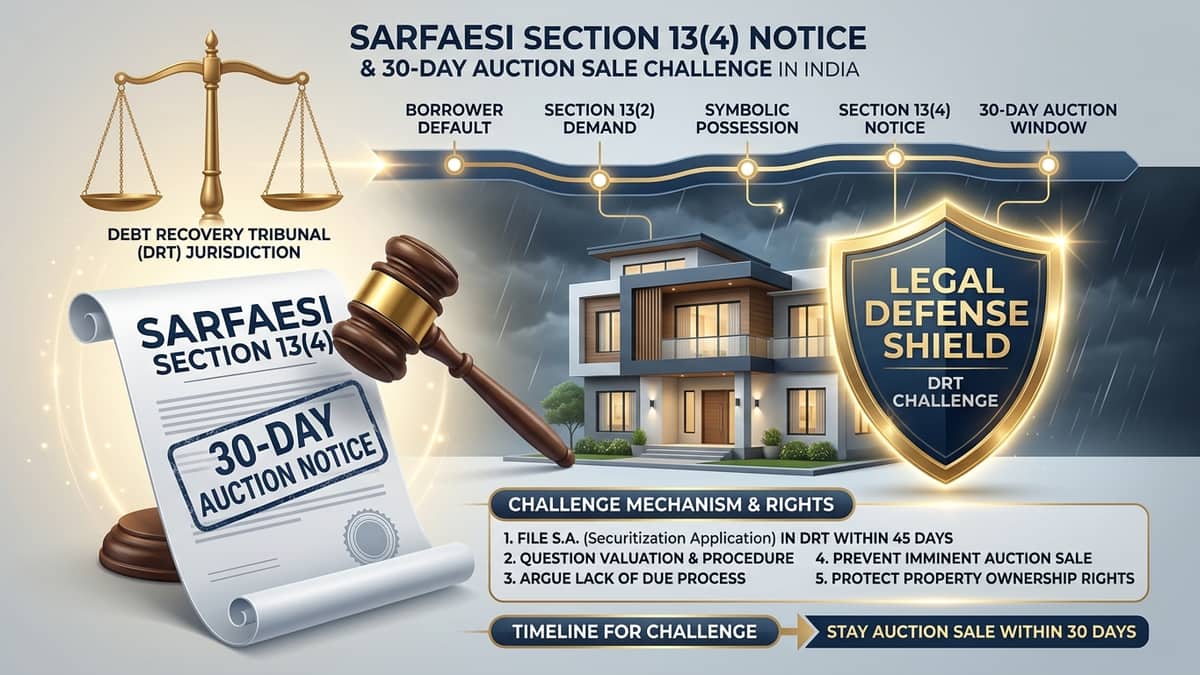
6. Visual Blueprint: SARFAESI 13(4) & Auction Challenge Flow
This comprehensive visual roadmap illustrates the legal defense framework for challenging a SARFAESI Section 13(4) notice and 30-day auction sale, detailing statutory requirements, DRT remedies, and settlement options.
7. Step-by-Step SOP: 6-Stage Defense Against Bank Auction Sale
If your bank has issued a Section 13(4) possession notice or published a 30-day auction notice, prompt action is critical. Executing this systematic six-stage protocol secures legal protection, stays auction proceedings, and paves the way for an affordable debt settlement.
Forensic Notice Audit & Procedural Inspection
Immediately examine the Section 13(4) notice and auction advertisement. Check whether the bank responded to your Section 13(3A) objection, verify whether 30 clear days exist between publication and auction, and check if individual Rule 8(6) notice was served on you.
Demand Valuation Report & Account Statement
Send a formal requisition letter to the Authorized Officer under Section 13(4) demanding the approved valuer report used to determine the reserve price under Rule 8(5). Request an itemised statement of accounts highlighting illegal penal interest capitalisation.
Draft & File Securitisation Application (SA) in DRT
Engage legal counsel to draft an SA under Section 17(1) of the SARFAESI Act before the jurisdictional Debt Recovery Tribunal. Ensure the application is filed within the strict 45-day statutory limitation window from the date of the measure.
Move Urgent Interlocutory Application (IA) for Stay
Along with the SA, file an urgent interim application seeking an ad-interim stay on the scheduled e-auction or symbolic possession. Demonstrate prima facie procedural defects, irreparable financial injury, and balance of convenience.
Initiate Strategic One-Time Settlement (OTS) Negotiations
While the DRT stay is active, leverage the bank legal vulnerability to submit a formal compromise settlement proposal under RBI guidelines. Banks often agree to waive 30% to 60% of penal interest and legal costs to avoid prolonged litigation.
Execute OTS Payment & Secure Original Title Deeds
Pay the agreed compromise amount per the bank official sanction letter. Obtain a formal No Dues Certificate (NDC), file an application to close DRT proceedings, and secure the return of all original title deeds from the bank custody.
8. Securitisation Application (SA) Filing Protocol in DRT
Filing a Securitisation Application under Section 17 is the primary statutory remedy against coercive bank action. It operates like a regular civil suit before the Debt Recovery Tribunal, where the Presiding Officer examines the legality of bank measures.
Here are the crucial technical and procedural components of filing an effective SA:
Under Section 17(1), the SA must be filed within 45 days from the date the measure was taken. If challenging a 13(4) possession notice, calculate 45 days from its service. If challenging an auction sale notice, calculate 45 days from the date of the auction notice or publication.
Court fees for filing an SA depend on the debt claimed by the bank. For debts up to ₹10 Lakhs, the fee is ₹12,000. For debts between ₹10 Lakhs and ₹1 Crore, the fee is ₹12,000 plus ₹1,000 for every additional ₹1 Lakh (subject to maximum ₹1,00,000). For non-borrower applicants (e.g. tenants or third-party owners), a flat nominal fee applies.
The SA paper book must compile: (a) Loan sanction letter and mortgage agreement, (b) Section 13(2) notice received, (c) Section 13(3A) objection with postal dispatch and delivery receipts, (d) Bank response if any, (e) Impugned Section 13(4) possession notice or auction advertisement, (f) Independent valuation report, and (g) Clear timeline showing procedural lapses.
Unlike appeals before the Appellate Tribunal (DRAT) under Section 18 which mandate a 50% pre-deposit, filing an SA under Section 17 before the DRT does not require an automatic statutory pre-deposit. However, DRT Presiding Officers often grant stay orders conditional on depositing 10% to 20% in an interest-bearing escrow account.
9. 3-Tier Escalation Matrix: Bank, DRT & High Court Remedies
Borrowers facing aggressive bank auction action should utilize a structured 3-tier escalation framework to safeguard their constitutional right to property under Article 300A.
Authorized Officer & Zonal Committee
Submit formal legal objections highlighting procedural flaws. Propose a structured OTS or request extension to private treaty buyers to maximize real estate realization.
- Section 13(3A) representation.
- Restructuring under RBI circular.
- OTS proposal submission.
Debt Recovery Tribunal (DRT & DRAT)
File Securitisation Application under Section 17. Seek urgent interim stay on e-auction. Appeal adverse DRT orders to DRAT under Section 18 within 30 days.
- Securitisation Application (SA).
- Stay on Section 14 physical takeover.
- DRAT appeal under Section 18.
High Court (Article 226 / 227)
File writ petition only under rare circumstances: when DRT bench is vacant, patent lack of jurisdiction, violation of natural justice, or fraud by the secured creditor.
- DRT non-functioning or quorum defect.
- Agricultural land auction challenge.
- Breach of fundamental natural justice.
10. Statutory Procedural Timeline: From 13(4) to Sale Certificate
Understanding the chronological trajectory of SARFAESI enforcement helps borrowers take timely defensive measures before their right of redemption is permanently lost.
11. Specialized Scenarios: Agricultural Land & Undervaluation
In complex mortgage disputes, specialized scenarios often arise that require tailored defensive legal strategies.
Agricultural Land Mortgages: Section 31(i) Bar
Under Section 31(i), agricultural land is completely immune from SARFAESI proceedings. If a bank initiates Section 13(4) or an auction on agricultural land, the notice can be quashed immediately by filing an SA or High Court writ petition.
Residential Homes & Self-Occupied Family Property
While residential homes are not statutorily exempt, tribunals recognize the irreparable harm of homelessness. Borrowers offering bona fide upfront payments frequently secure time-bound stays to finalize an OTS.
Protected Tenants & Rent Control Act Lessees
In Harshad Govardhan Sondagar v. International Assets Reconstruction Co., the Supreme Court held that genuine tenants under registered leases created prior to the mortgage cannot be summarily evicted under Section 13(4).
Small Balances & Section 31(h)/(j) Restrictions
SARFAESI cannot be invoked if the remaining debt is less than 20% of the principal and interest, or if the total claim is under ₹1 Lakh. Attempting auction for such minor sums is illegal under Section 31.
 Legal Debt Dispute Authority
CredSettle (credsettle.com) is India's premier debt settlement, loan dispute resolution, and legal protection platform. Operating strictly under the RBI Fair Practices Code and CICRA 2005, our advocate panel negotiates directly with Bank Principal Nodal Officers to eliminate waived differentials, obtain unconditional No Dues Certificates (NDC), and upgrade credit bureau records from "Settled" to "Closed".
Frequently Asked Questions: SARFAESI 13(4) Auction Challenge
Clear, verified legal guidance addressing critical questions regarding SARFAESI Section 13(4) possession notices, 30-day auction rules, DRT stay remedies, and borrower rights under Indian law.
Official Regulatory Citations & Statutory Legal Framework
- Securitisation and Reconstruction of Financial Assets and Enforcement of Security Interest Act, 2002: Section 13(2), Section 13(3A), Section 13(4), Section 13(8), Section 14, Section 17, and Section 31.
- Security Interest (Enforcement) Rules, 2002: Rule 8 (Sale of Immovable Secured Assets), Rule 9 (Time of Sale, Delivery of Possession, and Sale Certificate).
- Recovery of Debts and Bankruptcy Act, 1993 (RDB Act): Jurisdiction of Debt Recovery Tribunals (DRT) and Debt Recovery Appellate Tribunals (DRAT).
- Reserve Bank of India Master Circulars: Prudential Norms on Income Recognition, Asset Classification and Provisioning (IRAC) pertaining to Advances.
- Landmark Supreme Court Precedents: Celir LLP v. Bafna Motors (2023), Mathew Varghese v. M. Amritha Kumar (2014), South Indian Bank v. Naveen Mathew Philip (2023), and Mardia Chemicals v. UOI (2004).