DRAT Pre-Deposit Waiver Rules Under Section 18 SARFAESI
This legal guide helps you appeal DRT orders before the DRAT. Learn the 50% deposit rule. Learn the 25% waiver floor. Understand Supreme Court rulings. Protect your property with debt settlement.
- Mandatory 50% Requirement: Under the second proviso to Section 18(1), borrowers appealing a DRT order must deposit 50% of the debt due before DRAT can hear the appeal.
- Discretionary Reduction to 25%: Under the third proviso, DRAT has the legal power to reduce the pre-deposit to a minimum floor of 25% upon recording written reasons.
- Complete Waiver Barred (0% Prohibited): The Supreme Court in Ambuj Kasliwal confirmed that neither DRAT nor High Courts under Article 226 can waive the pre-deposit below 25%.
- Debt Recalibration Defense: In Sidha Neelkanth, the Supreme Court clarified debt due computation. Borrowers can audit bank statements to strip illegal penal charges and compounding fees.
- Pre-Deposit is Refundable: In Axis Bank v. SBS Organics, the Supreme Court confirmed pre-deposit money is not secured bank asset. Funds remain refundable if the appeal succeeds.
1. Section 18 Mandate: The 50% Pre-Deposit Rule
A borrower may lose a case before the DRT under Section 17. The next legal step is an appeal before the DRAT. Section 18 of the SARFAESI Act, 2002 governs this appeal right. It gives borrowers a formal way to challenge DRT orders.
Yet Section 18 sets a tough money rule. Under the second proviso to Section 18(1), the borrower must deposit 50% of the debt due. This sum is either claimed by the bank or fixed by the DRT, whichever is less.
This rule is a strict entry condition. The DRAT cannot hear the case on merits without this deposit. It cannot review bank errors or procedural flaws yet. If you miss the payment deadline, the DRAT must dismiss the appeal.
Parliament created this rule to stop delay tactics. It wanted to curb false cases aimed at stalling asset auctions. But honest borrowers face hard cash problems. You need skilled legal help to handle this rule.
2. Waiver Limits: Discretionary Reduction to 25%
The standard pre-deposit is 50%. But the third proviso to Section 18(1) gives key relief. The DRAT has the power to lower the deposit to 25%. This 25% floor is the lowest statutory level.
This relief is not automatic. The DRAT must write down its clear reasons for granting it. You must file a separate waiver plea alongside your main appeal. This plea asks for a cut to 25%.
You must prove true financial hardship to get this cut. Submit bank records, tax forms, and books of account. Show that business distress caused the default, not willful neglect.
The law bars any cut below 25%. The words "not less than twenty-five per cent" are final. The DRAT has no power to grant a 0% waiver. It cannot reduce the deposit to 10% or 15%.
3. Pre-Deposit vs Appeal Rights: Comparison Matrix
Borrowers must compare each court forum in India. Each court has its own deposit rules and stay powers. Knowing these limits prevents costly mistakes and protects your property.
| Judicial Forum | Governing Provision | Pre-Deposit Requirement | Waiver Powers | Stay Jurisdiction |
|---|---|---|---|---|
| DRAT (Appellate Tribunal) | Section 18 SARFAESI Act | 50% Baseline Mandatory | Can reduce to 25% minimum | Full stay upon pre-deposit |
| DRT (Original Tribunal) | Section 17 SARFAESI Act | Zero Pre-Deposit (0%) | Not Applicable (No deposit) | Can stay Section 13(4) sale |
| High Court (Writ Petition) | Article 226 Constitution | No statutory pre-deposit | Cannot waive Section 18 mandate | Rare; only jurisdictional errors |
| DRAT (Recovery Appeal) | Section 20 RDB Act, 1993 | 50% of debt determined | Can reduce to 25% minimum | Stays recovery certificate |
| Civil Court | Code of Civil Procedure | Not Applicable | Barred under Section 34 | Zero jurisdiction on SARFAESI |
| Pre-Deposit Stage / Component | Claim Calculation | Deposit Rate (%) | Payable Pre-Deposit |
|---|---|---|---|
| Statutory 50% Baseline (Uncontested) | ₹2,50,00,000 | 50% Statutory Rate | ₹1,25,00,000 |
| Section 18 Third Proviso Discretionary Waiver | ₹2,50,00,000 | 25% Minimum Floor | ₹62,50,000 |
| Ledger Recalibration (Deduct Penal Fees) | ₹1,90,00,000 (Adjusted Debt) | 25% on True Debt | ₹47,50,000 |
| Net Upfront Relief & OTS Potential | ₹60 Lakhs Ledger Inflations Stripped | Deposit Burden Slashed by 62% | ₹47.50 Lakhs (Secures Stay) |
4. Supreme Court Landmark Rulings on Section 18
The Supreme Court of India has settled the Section 18 pre-deposit rules. These landmark rulings guide every DRAT appeal in India today. Learn how they affect your rights.
The Supreme Court held that the deposit is mandatory. The DRAT cannot hear the appeal without it. If you fail to pay, the court will dismiss the case.
The court held that DRAT cannot waive the deposit below 25%. High Courts cannot bypass this limit under Article 226 or 227.
The court clarified debt sums. Challenging Section 13(4) means paying on the demand notice sum. Auction sums count only if you accept the sale.
The court ruled that pre-deposit money is not bank property. The court registry keeps it safe. You get a full refund if your appeal wins.
5. Visual Blueprint: DRAT Appeal Waiver Protocol
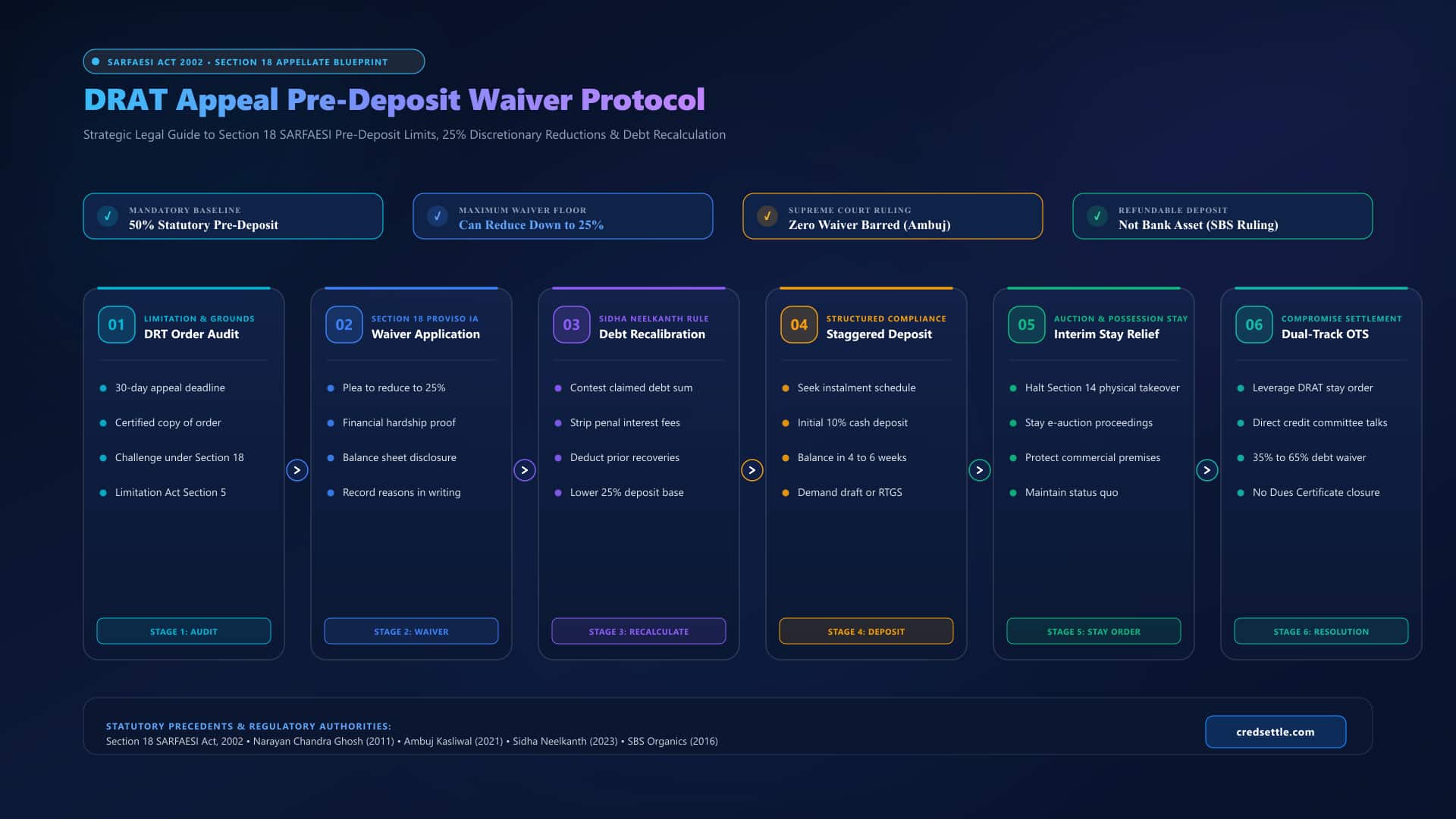
This visual chart outlines the Section 18 DRAT process. See the 50% baseline. See the 25% waiver floor. Review debt audit steps and loan settlement paths.
6. Step-by-Step SOP: Filing DRAT Waiver Petition
The DRT may reject your plea or refuse a stay. You must then take fast legal steps. Follow this six-stage plan to guard your assets and lower your deposit costs.
1Stage 1: Audit DRT Order & Calculate 30-Day Limitation
Get a certified copy of the DRT order right away. You must file your appeal within thirty days. If you miss this date, file for condonation of delay under Section 5.
2Stage 2: Draft Interlocutory Waiver Application (IA)
File a waiver plea under the third proviso to Section 18(1). Attach bank proof to show cash hardship. Point out clear legal flaws in the bank recovery actions.
3Stage 3: Audit & Recalibrate Creditor Debt Ledger
Check your loan ledger for illegal penal interest. RBI rules ban compound penalty fees. Cutting these fees lowers the total debt sum and your 25% deposit.
4Stage 4: Propose Staggered Deposit Compliance
Ask DRAT to let you pay the 25% sum in two or three parts. Offer 10% right away. This good-faith step helps you secure an urgent stay on property takeover.
5Stage 5: Secure Interim Stay on Auction & Possession
Pay the first part into the court registry. Then ask the bench for an urgent stay. This stops Section 14 physical takeover and halts public e-auctions.
6Stage 6: Initiate Dual-Track Compromise Settlement (OTS)
Use the stay order to negotiate with the bank. Enter formal compromise talks. Aim for a 40% to 65% debt waiver and secure a clean No Dues Certificate.
7. Debt Due Calculation: Sidha Neelkanth Defense
Calculating the exact debt due is a major issue in DRAT appeals. Banks often inflate their claims with added fees and penal rates. You have the right to dispute these sums.
The Supreme Court gave clear rules in the Sidha Neelkanth case (2023). The court noted that debt due means the bank claim or the DRT sum, whichever is less.
The DRT may fix a lower sum in its order. If so, your 25% deposit applies to that lower sum. This protects you from inflated bank demands.
RBI rules ban banks from compounding penal interest on loans. You can ask the DRAT to remove these extra charges. This cuts the baseline debt and your deposit.
8. 3-Tier Escalation Matrix: Appellate Remedies
SARFAESI appeals follow a set order of courts. Each judicial level has distinct powers. Knowing where to file helps you win timely relief.
| Appellate Tier | Judicial Authority | Turnaround Time | Scope of Intervention & Relief |
|---|---|---|---|
| Tier 1: DRAT Registry | Registrar / Scrutiny Bench | 3 to 7 Working Days | Scrutiny of appeal memo, fee compliance, caveat verification, and urgent listing. |
| Tier 2: DRAT Bench | Chairperson / Presiding Officer | 14 to 30 Working Days | Adjudication of waiver application, reduction to 25%, and granting interim stay orders. |
| Tier 3: High Court | Division Bench (Article 227) | 30 to 45 Days | Supervisory review limited to jurisdictional errors, denial of natural justice, or perverse orders. |
9. Procedural Timeline: DRT Order to DRAT Appeal
Follow this timeline from DRT order to DRAT hearing. Plan each legal step with care. Act early to stop property auction and keep your assets safe.
| Timeline Milestone | Procedural Stage | Bank Action / Legal Event | Borrower Defensive Action |
|---|---|---|---|
| Day 1 to 10 | DRT Pronouncement | DRT dismisses Section 17 petition; bank prepares auction notice. | File urgent application for certified copy of judgment. |
| Day 11 to 30 | Limitation Period | Bank serves 30-day sale notice or files Section 14 CMM application. | Draft appeal memo and Section 18 waiver application. |
| Day 31 to 45 | Admission Hearing | Lender counsel demands full 50% pre-deposit compliance. | Argue financial hardship to secure 25% waiver order. |
| Day 46 to 75 | Deposit Window | Bank e-auction scheduled; lender presses for physical takeover. | Deposit initial instalment to enforce ad-interim stay. |
| Day 76 to 120 | Appellate Review | Bank forced to halt auction; asset locked in status quo. | Advance One-Time Settlement proposal with CredSettle. |
| Month 5 and Beyond | Final Resolution | DRAT final adjudication or bank sanctions compromise OTS letter. | Remit settlement sum, retrieve title deeds, and withdraw appeal. |
10. Specialized Scenarios: Third Parties & OTS
Appellate debt litigation frequently involves complex factual variations beyond standard corporate defaults. Here is how Section 18 applies across specialized circumstances.
Third-Party Mortgagors & Tenants
Genuine third parties and tenants holding valid pre-existing leases who are neither borrowers nor guarantors owe no personal debt to the bank. High Courts have recognized that imposing a rigid 50% pre-deposit on such strangers would render their right of appeal meaningless.
Auction Purchasers Challenging Cancellations
When a successful auction buyer appeals a DRT order that sets aside a SARFAESI sale, they do not carry borrower debt liability. Courts have held that auction purchasers are exempt from the pre-deposit requirement of Section 18.
Corporate Guarantors vs Principal Borrowers
Under Section 2(1)(f) of the SARFAESI Act, the definition of borrower includes guarantors. Corporate and personal guarantors appealing a DRT order remain fully bound by the pre-deposit rule and must seek reduction under the third proviso.
Stressed MSME Borrowers & Dual-Track OTS
Small enterprises facing SARFAESI actions can leverage DRAT appeal proceedings to secure valuable negotiating time. Depositing 25% into registry custody demonstrates capacity, opening the door for banks to approve compromise settlements.
 Legal Debt Dispute Authority
CredSettle (credsettle.com) is India's premier debt settlement, loan dispute resolution, and legal protection platform. Operating strictly under the RBI Fair Practices Code and CICRA 2005, our advocate panel negotiates directly with Bank Principal Nodal Officers to eliminate waived differentials, obtain unconditional No Dues Certificates (NDC), and upgrade credit bureau records from "Settled" to "Closed".
Frequently Asked Questions: DRAT Pre-Deposit Law
Find clear answers to common questions on Section 18 pre-deposits. Learn waiver limits. Know key Supreme Court rulings and protect your borrower rights.
Official Regulatory Citations & Statutory Framework
- SARFAESI Act, 2002: Section 18, Appeal to Appellate Tribunal and Mandatory Pre-Deposit Provisos.
- Recovery of Debts and Bankruptcy Act, 1993 (RDB Act): Section 20, Appellate Jurisdiction and Pre-Deposit Criteria.
- Limitation Act, 1963: Section 5, Condonation of Delay in Preferring Statutory Appeals before Appellate Tribunals.
- Reserve Bank of India Master Directions: Circular RBI/2023-24/53 on Fair Lending Practice and Fair Conduct.
- Supreme Court of India Precedents: Narayan Chandra Ghosh (2011), Kotak Mahindra v. Ambuj Kasliwal (2021), Sidha Neelkanth (2023), and Axis Bank v. SBS Organics (2016).