Can Bank Hike Credit Card APR? Know RBI Opt-Out Rights
Did your bank suddenly raise your credit card interest rate to 45% or 47.4% per year? Learn the real RBI 30-day prior notice mandate, why the 45-day opt-out rule is misunderstood in India, and how to exit unfair APR traps legally.
- 30-Day RBI Rule vs 45-Day Myth: India does not have a US-style 45-day opt-out statute. Instead, RBI Master Direction 2022 mandates at least 30 days (one month) prior notice before unfavorable charge or MITC changes apply.
- Prospective Changes Only: Banks cannot apply a hiked Annual Percentage Rate (APR) backward to closed statements. Every adverse change must operate strictly in the future after advance notice.
- Free Card Surrender Right: If you reject a rate or fee hike during the 30-day notice period, you can surrender your card with zero closure charges after paying existing dues.
- March 2024 RBI Interest Reform: Banks can levy finance charges only on the remaining unpaid balance adjusted for partial payments and refunds, never on the full initial bill.
- Rs 500 Daily Closure Penalty: Once dues are cleared, the bank must close a surrendered card within 7 working days or pay you Rs 500 per calendar day of delay.
1. Quick Answer: Is There a 45-Day Opt-Out Law in India?
Many Indian cardholders search for a 45-day opt-out law after seeing a sudden credit card interest hike. Online blogs and AI summaries often claim you get 45 days to reject a rate hike and repay old dues at your old rate over five years.
Here is the verified legal truth. The 45-day advance notice rule belongs to the United States Credit CARD Act of 2009. It does not apply to banks or NBFCs in India. Relying on foreign rules in a bank dispute will weaken your complaint.
In India, your protection comes from the Reserve Bank of India (RBI). Under the RBI Master Direction on Credit Card and Debit Card Issuance and Conduct, 2022, banks must give at least one month (30 days) prior notice before making unfavorable changes to charges or terms.
Where does 45 days actually appear in Indian credit cards? First, many Indian banks hiked monthly finance charges to 3.75%, which equals a 45% yearly APR. Second, cards offer up to 45 interest-free days on fresh purchases, and credit bureaus take 30 to 45 days to reflect a closed card.
2. RBI Master Direction: 30-Day Prior Notice & MITC Law
Every credit card issued in India is governed by RBI Master Direction DoR.AUT.REC.No.27/24.01.041/2022-23, along with its key amendment dated March 7, 2024. These binding rules stop banks from changing card pricing in secret.
Under the chapter on Interest Rates and Other Charges and the Most Important Terms and Conditions (MITC) rules, every card issuer must follow four strict duties:
- Mandatory 30-Day Advance Notice: Any change in charges or MITC terms that hurts the cardholder can take effect only prospectively after at least one month (30 days) prior notice via email, SMS, or statement alert.
- Zero-Fee Right to Surrender: If you do not accept a disadvantageous change, you have the legal right to surrender your credit card without paying any extra closure fee, subject to clearing your existing dues.
- Clear Annualized APR Examples: Banks cannot hide behind small monthly numbers like 3.5% per month. They must quote the full Annualized Percentage Rate (APR) with clear examples in the MITC and welcome kit.
- Interest Only on Remaining Unpaid Balance: Under the March 7, 2024 RBI amendment, if you make a partial payment, the bank can charge interest only on the remaining unpaid balance, not on the full original bill.
Note one crucial legal distinction. RBI's April 15, 2024 circular on Key Facts Statements (KFS) applies to term loans like personal loans, while credit card receivables remain exempted and governed directly under the MITC framework.
3. Why Banks Hike Credit Card APR to 45% or 47.4% Yearly
Why do cardholders wake up to a sudden jump from 1.99% monthly interest (23.88% yearly) to 3.75% or 3.95% monthly interest (45% to 47.4% yearly)? Banks use two mechanisms to raise your cost of borrowing.
First, major private and public sector issuers periodically revise their base tariff across entire card portfolios. For this type of tariff revision, the bank must send a formal 30-day advance MITC revision notice.
Second, many cards now use Dynamic APR (risk-based tier pricing). When you apply, the bank advertises a low starting rate like 0.99% or 1.99% per month. However, the fine print allows the system to move you to the top slab (3.75% or 3.95% per month) if you miss a due date beyond the 3-day RBI grace period or max out your credit card utilization limit.
Under RBI rules, if a bank charges differential interest rates based on cardholder risk, it must follow a Board-approved ceiling, disclose the exact trigger rules transparently, and avoid hidden arbitrary jumps. Worse still, every rupee of credit card interest attracts 18% GST on finance charges, pushing your real yearly cost above 53% to 55%.
4. Supreme Court Ruling: HSBC v. Awaz Foundation (2024)
Can you sue a bank in Consumer Court simply because 45% APR feels too high? You must know the landmark Supreme Court verdict before drafting any legal notice.
In 2008, the National Consumer Disputes Redressal Commission (NCDRC) ruled that charging more than 30% annual interest on credit cards was an unfair trade practice. Banks challenged that order before the Supreme Court.
On December 20, 2024, in The Hongkong and Shanghai Banking Corp. Ltd. v. Awaz & Ors. (2024 INSC 1044), the Supreme Court set aside the 30% NCDRC cap. Under Sections 21A and 35A of the Banking Regulation Act, 1949, the Court held that regulating bank interest rates belongs exclusively to the RBI.
Consumer courts cannot impose a blanket 30% interest cap. However, banks remain strictly bound by RBI Master Directions on prior notice and transparent MITC disclosure.
A Constitution Bench of the Supreme Court ruled that penal interest cannot be capitalized to charge compound interest on penalty amounts.
If a bank raised your tariff or fee without verifiable 30-day advance intimation, the RBI Ombudsman can order full reversal of the excess charge.
Charging finance interest on the already-paid portion of your bill violates the March 7, 2024 RBI amendment and constitutes deficiency of service under CPA 2019.
5. Visual Blueprint: APR Hike Notice & Card Exit Flow
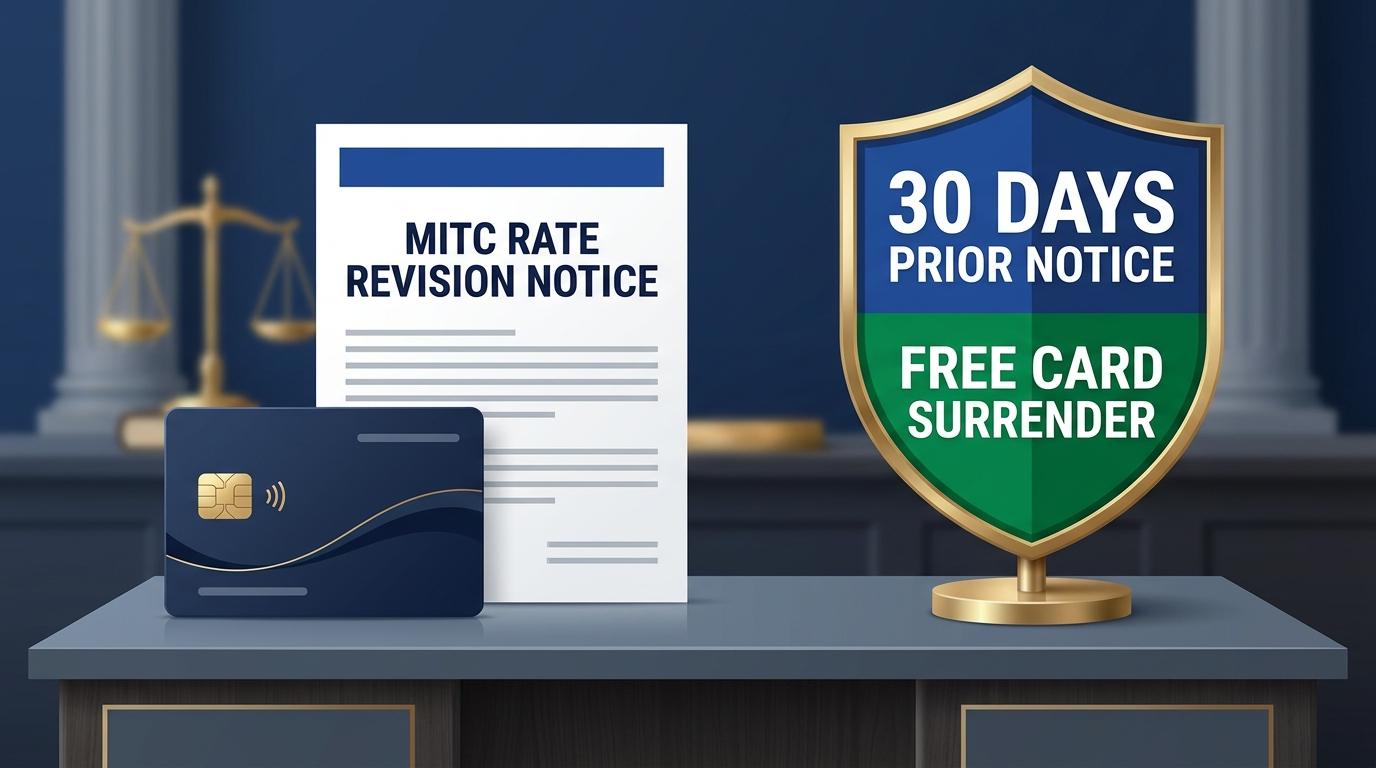
This visual overview illustrates your core statutory shields under RBI regulations: mandatory 30-day advance MITC notice and your right to surrender the credit card without closure penalties.
6. Step-by-Step SOP: Opt Out or Dispute Unfair APR Hikes
Whether you received a 30-day rate hike alert or spotted a surprise interest jump on your bill, follow these six practical steps to protect your money and CIBIL score.
1Stage 1: Audit Your MITC Notice & Billing Statement
Check your email, SMS inbox, and past two card statements for any 30-day advance MITC revision alert. Compare the billed APR against your original welcome kit rate.
2Stage 2: Stop Fresh Card Swipes & Auto-Debits Immediately
Once a card carries an unpaid balance, the 45-day interest-free grace period disappears. Every new swipe accrues 42% to 48% APR from Day 1, so pause card usage immediately.
3Stage 3: Demand Fee Reversal If No 30-Day Notice Was Sent
If the bank raised charges retroactively or gave less than one month notice, email customer care citing RBI Master Direction 2022. Demand recalculation at the prior rate plus GST reversal.
4Stage 4: Clear or Refinance Dues Before Requesting Surrender
Under Indian rules, you must clear outstanding dues to surrender a card. Pay the balance or shift it to a 12% to 15% personal loan rather than paying 47% card APR.
5Stage 5: Submit Formal Zero-Fee Card Surrender Within Notice Window
Raise a closure request via the bank app, helpline, or dedicated closure email. State that you are surrendering due to unfavorable MITC changes and save the ticket number.
6Stage 6: Track 7-Working-Day Closure & Bureau Update
Verify written closure confirmation within 7 working days. Check your CIBIL report after 30 to 45 days to confirm the account reads “Closed” with zero balance.
7. Financial Comparison: Paying Minimum Due vs Opt-Out
When a bank raises monthly finance charges to 3.75% (45% APR) plus 18% GST, staying in the credit card minimum due trap multiplies your debt rapidly. Compare four practical choices on a Rs 2,00,000 balance below.
| Borrower Strategy | Effective Annual Cost | 12-Month Interest + GST | CIBIL & Legal Outcome |
|---|---|---|---|
| Pay Only 5% Minimum Due | ~53.1% (with GST) | Rs 95,000+ Drained | Years in Debt Spiral |
| Clear Dues & Surrender in 30 Days | 0% Future APR | Rs 0 Extra Closure Fee | Clean “Closed” CIBIL |
| Refinance via Personal Loan & Close Card | 13% to 16% p.a. | ~Rs 16,500 Interest | Saves ~70% Interest |
| Structured OTS Settlement (Hardship Case) | Interest Frozen at OTS | Up to 50%-70% Waiver | Legal Debt Exit + NDC |
8. Key Deadlines: 30-Day Notice & 7-Day Closure Penalty
Tracking exact RBI timelines turns a weak customer request into an enforceable legal claim. Use this milestone table whenever a card issuer changes your terms or delays closure.
| Regulatory Window | RBI Rule / Direction | Bank Obligation | Cardholder Remedy |
|---|---|---|---|
| At Least 30 Days Prior | MITC & Charge Change Rule | Send advance notice before adverse charge or term revision. | Demand reversal if hiked without 30-day advance notice. |
| 3 Days Past Due Date | Grace Period Clause | Cannot levy late fee or report DPD within 3 days of due date. | Pay within 3 days to prevent dynamic APR tier jump. |
| 7 Working Days | Card Closure Mandate | Must close surrendered card once all dues are zeroed. | Claim Rs 500 per calendar day delay penalty from Day 8. |
| 15 to 30 Days Post-Closure | CIC Reporting Rule | Must report “Closed” account status to CIBIL and all CICs. | Claim Rs 100/day if CIBIL dispute stays unfixed past 30 days. |
9. 3-Tier Escalation Matrix: Bank GRO to RBI Ombudsman
If customer care refuses to reverse an unnotified rate hike, charges interest on your full bill despite partial payment, or stalls your closure request, escalate through these three official tiers.
| Escalation Tier | Designated Banking Authority | Turnaround Time | Scope of Intervention & Relief |
|---|---|---|---|
| Level 1: GRO | Bank Grievance Redressal Officer | 7 to 10 Working Days | Audits statement interest math, checks notice logs, and logs closure request. |
| Level 2: PNO | Principal Nodal Officer (Head Office) | 10 to 15 Working Days | Reverses unlawful retroactive charges, GST, and approves Rs 500/day closure delay payout. |
| Level 3: RBI Ombudsman | Reserve Bank Integrated Ombudsman | 30 Days Post-Complaint | Adjudicates on cms.rbi.org.in and directs refund, penalty credit, and CIBIL correction. |
10. Common Mistakes & Debt Relief When You Cannot Pay
Many borrowers make costly errors after an APR hike, turning a manageable balance into a severe non-performing asset (NPA). Avoid these four mistakes and know your legal exit options.
Blocking Instead of Closing the Card
Hotlisting or blocking a card in the mobile app only stops fresh swipes. Annual fees and 45% revolving APR keep compounding until formal account closure.
Ignoring Unbilled Merchant EMIs
Before surrendering a card, check active merchant EMIs and standing instructions. Unpaid EMI principal must be foreclosed or cleared before closure completes.
Debt Consolidation vs Balance Transfer
If your CIBIL score is still strong, credit card debt consolidation via a lower-rate term loan lets you clear card dues immediately and surrender the high-APR card cleanly.
Legal One-Time Settlement (OTS) Relief
If job loss, medical crisis, or 47% compounding has made full repayment impossible, CredSettle negotiates formal credit card One-Time Settlements to waive inflated interest and stop harassment.
 Legal Debt Dispute Authority
CredSettle (credsettle.com) is India's premier debt settlement, loan dispute resolution, and legal protection platform. Operating strictly under the RBI Fair Practices Code and CICRA 2005, our advocate panel negotiates directly with Bank Principal Nodal Officers to eliminate waived differentials, obtain unconditional No Dues Certificates (NDC), and upgrade credit bureau records from "Settled" to "Closed".
Frequently Asked Questions: Credit Card APR Hike Rules
Clear, verified answers on RBI prior notice rules, dynamic credit card interest hikes, card surrender rights, Rs 500 daily penalties, and debt resolution in India.
Official Regulatory Citations & Statutory References
- RBI Master Direction: Reserve Bank of India (Credit Card and Debit Card - Issuance and Conduct) Directions, 2022 (Ref: RBI/2022-23/92, DoR.AUT.REC.No.27/24.01.041/2022-23, Chapter III on Interest Rates and Charges & Chapter VI on MITC).
- RBI Amendment Circular (March 7, 2024): RBI/2023-24/132, DoR.AUT.REC.81/24.01.041/2023-24 (Mandating interest levy strictly on remaining adjusted unpaid balance and transparent closure rules).
- Supreme Court of India Precedent: The Hongkong and Shanghai Banking Corp. Ltd. v. Awaz & Ors., Civil Appeal No. 5273 of 2008, 2024 INSC 1044 (Decided December 20, 2024 under Sections 21A and 35A of the Banking Regulation Act, 1949).
- Supreme Court Constitution Bench: Central Bank of India v. Ravindra & Ors., (2002) 1 SCC 367 (Prohibiting capitalization of penal interest).
- Reserve Bank - Integrated Ombudsman Scheme, 2021 & Consumer Protection Act, 2019: Redressal for deficiency in banking service and unnotified fee deductions.