RBI 30-Day Credit Card Activation & Rs 500 Penalty Rule
Did a bank bill you for a card you never activated? Learn how RBI rules protect you with 30-day OTP consent, free closure, 2x fee refunds, and Rs 500 per day delay payouts.
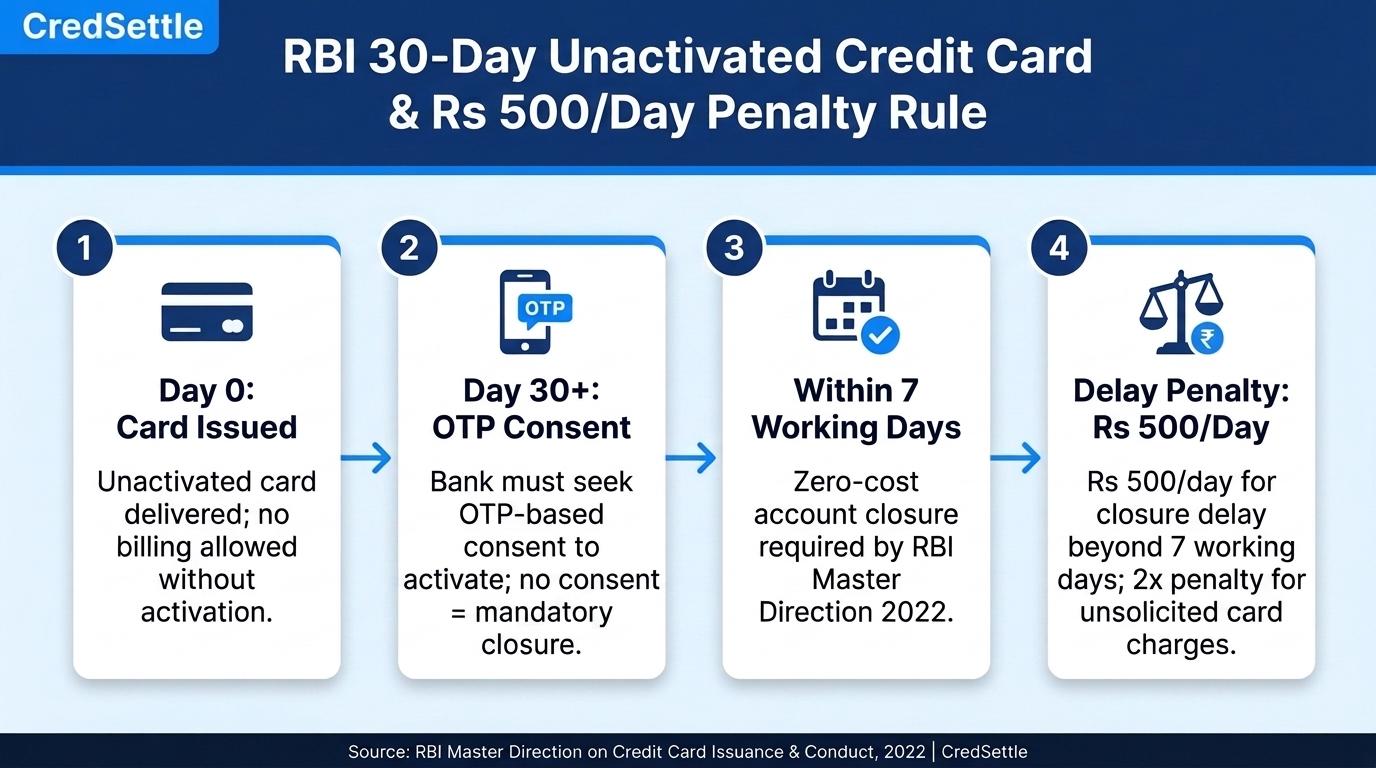
- 30-Day OTP Consent Mandate: If a new credit card is not activated within 30 days of issuance, the bank must seek OTP-based consent before activating it.
- Mandatory Zero-Cost Closure: If you do not give OTP consent, the bank must close the credit card account within 7 working days at zero cost to you.
- Rs 500/Day Closure Delay Penalty: If the bank delays closing a zero-dues card beyond 7 working days, it must pay you Rs 500 per calendar day of delay.
- 2x Penalty for Unsolicited Billing: If a bank bills you on an unsolicited card activated without consent, it must reverse all fees and pay twice that amount as penalty.
- CIBIL Score Protection: Banks cannot report defaults on unactivated cards. Wrong credit report entries must be deleted, with Rs 100/day CIC delay relief if unresolved beyond 30 days.
1. Statutory Framework: RBI Master Direction 2022
Many banks in India send pre-approved credit cards with bank accounts or loans. Often, users keep the envelope sealed and never turn on the card. Months later, they get bills for joining fees and late fines.
To stop this unfair billing, the RBI issued the Credit Card and Debit Card Directions, 2022. This binding rule (RBI/2022-23/92, DoR.AUT.REC.No.27) started on July 1, 2022. It was updated on March 7, 2024.
These rules bind every bank and NBFC that issues credit cards in India. Public banks, private banks, and co-operative banks must follow them. No bank can bypass these RBI rules using fine print.
2. The 30-Day Activation Rule & OTP Consent Mandate
Paragraph 6(a)(vi) of the RBI Master Direction sets a strict 30-day rule for new cards. If you do not activate your card within 30 days of issue, the bank cannot turn it on by itself.
Instead, the bank must ask for your One Time Password (OTP) consent first. If you do not give OTP consent, the bank must close the card. This closure must finish within seven working days at zero cost to you.
What counts as card activation under RBI rules? Only steps you start yourself count. This includes setting a PIN, changing spend limits, or using IVR, SMS, or mobile apps. Receiving the courier parcel does not activate the card.
Also, if an active card stays unused for over one year, the bank must warn you first. If you do not reply within 30 days, the bank must close that card after dues are paid.
3. Rs 500/Day Closure Penalty vs 2x Charge Reversal
Borrowers often mix up two different RBI penalty rules when fighting unactivated card bills. Understanding both rules helps you demand the exact compensation you are owed.
Under the Closure of Credit Card rules, banks must close a card within 7 working days of your request or non-consent confirmation. If the bank delays closure beyond 7 working days when there are zero dues, it must pay Rs 500 per calendar day of delay until closure.
Under Paragraph 6(a)(i)-(v), banks cannot issue or activate unsolicited cards without explicit consent. If a bank activates and bills you without consent, it must reverse all charges immediately and pay you a penalty equal to twice (2x) the reversed amount without demur.
For example, suppose a bank issues an unsolicited card, activates it without your OTP, and bills Rs 2,500 in fees. The bank must cancel the Rs 2,500 bill and pay you Rs 5,000 as a 2x penalty. If the bank also delays closing that zero-dues account past 7 working days, the Rs 500 per day penalty applies on top.
4. Calculation Matrix: Daily Penalty & 2x Refund Math
You do not need to prove financial loss to claim RBI statutory penalties. Once the bank misses the 7-working-day closure window or bills an unconsented card, the compensation becomes automatic. The table below shows real payout scenarios.
| Violation Scenario | Applicable RBI Clause | Example Delay / Fee | Compensation Owed to You |
|---|---|---|---|
| Unactivated card closed within 7 working days | Para 6(a)(vi) | 0 Delay Days | Rs 0 (Zero-Cost Closure) |
| Closure delayed by 10 calendar days past Day 7 | Closure Clause | 10 Days Delay | Rs 5,000 (10 x Rs 500) |
| Closure delayed by 30 calendar days past Day 7 | Closure Clause | 30 Days Delay | Rs 15,000 (30 x Rs 500) |
| Unsolicited card billed Rs 2,000 without consent | Para 6(a)(iv) | Rs 2,000 Billed | Rs 2,000 Reversal + Rs 4,000 Penalty |
| Wrong CIBIL default not fixed within 30 days | RBI/2023-24/72 | 20 Days Delay | Rs 2,000 (Rs 100/Day CIC) |
5. Visual Blueprint: Unactivated Card Redressal Flow
This visual guide maps the complete 30-day activation timeline, the 7-working-day closure rule, and how to claim your Rs 500 per day or 2x penalty from the bank.
6. Step-by-Step SOP: Dispute Unactivated Card Bills
If a bank sends you a bill for an unactivated credit card or delays closing it, do not pay the unfair fee. Follow these six steps to cancel the bill and claim compensation.
1Stage 1: Gather Proof of Non-Activation
Save the card dispatch email, SMS alerts, and billing statement. Do not set a PIN, log into the card app, or make any test transaction. Keep proof that you never gave OTP-based consent.
2Stage 2: Send Written Non-Consent & Closure Email
Email the bank customer care and official card closure desk. State clearly that the card was never activated, you decline OTP consent, and demand zero-cost closure within 7 working days.
3Stage 3: Cite RBI Master Direction Paragraph 6(a)(vi)
If the bank already billed joining fees, GST, or late charges, demand a 100% reversal under RBI Master Direction 2022. If the card was unsolicited, demand the 2x statutory penalty as well.
4Stage 4: Start the 7-Working-Day Penalty Clock
Save the service request number and timestamp of your closure email. Once 7 working days pass without an official closure SMS or email, begin counting Rs 500 for each calendar day of delay.
5Stage 5: Escalate to Bank GRO and PNO
Forward the unanswered ticket to the bank Grievance Redressal Officer (GRO) and Principal Nodal Officer (PNO). Attach your fee reversal demand, closure proof, and daily penalty calculation.
6Stage 6: File Complaint on RBI CMS Portal
If the bank fails to resolve your issue within 30 days, file a complaint on cms.rbi.org.in. The RBI Ombudsman can order account closure, penalty payout, and complete CIBIL cleanup.
7. CIBIL Protection & Credit Bureau Error Rectification
Unpaid joining fees on an unactivated card often cause late payment marks (DPD) on CIBIL, Experian, Equifax, and CRIF reports. This can drop your credit score by 50 to 100 points for no fault of yours.
Under the Credit Information Companies Act, 2005 and RBI Circular RBI/2023-24/72, banks must fix wrong credit entries fast. If a bank or bureau fails to fix your dispute within 30 days, they must pay Rs 100 per day of delay.
Do not accept a "Settled" or "Written Off" status for an unactivated card. Because the card was never legally active, demand that the bank mark it "Closed with Zero Dues" or delete the tradeline and all DPD marks entirely.
Raise an online dispute directly on the CIBIL portal and email the bank simultaneously. Under RBI rules effective April 2024, the bank gets 21 days and the bureau gets 9 days (30 days total) to fix the error before Rs 100/day compensation starts.
8. 3-Tier Escalation Matrix: Bank GRO to Ombudsman
If customer support refuses to cancel unactivated card charges or pay the Rs 500 daily penalty, use this three-tier RBI escalation path.
| Escalation Tier | Designated Authority | Turnaround Window | Scope of Relief & Action |
|---|---|---|---|
| Level 1: GRO | Bank Grievance Redressal Officer | 7 to 15 Days | Audits activation logs, reverses unconsented fees, and closes the card account. |
| Level 2: PNO | Principal Nodal Officer (Head Office) | 15 to 30 Days | Approves Rs 500/day or 2x penalty payouts and instructs CIBIL tradeline removal. |
| Level 3: RBI Ombudsman | Reserve Bank Integrated Ombudsman | 30 Days Post-Filing | Issues binding award on cms.rbi.org.in for penalty payout, closure, and harassment damages. |
9. Procedural Timeline: Card Issuance to Compensation
Tracking exact dates from card issuance to your closure request helps you prove bank non-compliance before the RBI Ombudsman.
| Timeline Stage | Regulatory Status | Bank Duty | Cardholder Action |
|---|---|---|---|
| Day 0 to Day 30 | Activation Window | Cannot activate or bill without customer-initiated activation. | Leave card unactivated if unwanted; save dispatch alerts. |
| Day 31 Onwards | OTP Consent Stage | Must seek OTP-based consent before activating the card. | Do not share or enter activation OTP; reply declining consent. |
| Next 7 Working Days | Mandatory Closure | Must close unactivated card at zero cost and notify via SMS/email. | Track ticket number and check for official closure NOC. |
| Day 8+ Working Day | Penalty Commences | Accrues Rs 500 per calendar day delay penalty on zero-dues card. | Send formal notice to Bank GRO demanding Rs 500/day payout. |
| Day 30 Post-Complaint | Ombudsman Filing | Faces binding adjudication for penalties and CIBIL rectification. | Escalate on cms.rbi.org.in with full email trail and bills. |
10. Common Bank Excuses & Specialized Card Scenarios
Banks often use technical excuses to reject closure requests or defend unfair joining fees. Here is how RBI rules treat four common scenarios.
"Pending Joining Fee" Closure Refusal
Banks sometimes refuse to pay the Rs 500/day penalty by claiming an unpaid joining fee exists. However, if the card was never activated within 30 days with OTP consent, the fee itself is illegal and cannot block zero-dues closure.
Bundled Add-On or Co-Branded Cards
Sales agents often bundle a credit card with a home loan or salary account. Without your explicit consent and activation, any billing on that bundled card violates RBI rules and qualifies for 2x penalty reversal.
Virtual & UPI RuPay Credit Cards
The 30-day activation and OTP consent rule applies equally to digital-only virtual cards and RuPay UPI credit cards. Generating a UPI PIN or enabling online transactions counts as activation, so avoid doing so on unwanted cards.
Renewed & Replacement Cards
When an existing card expires, banks send a renewed card. If you do not activate it within 30 days, the bank must seek OTP consent. However, you must clear any unpaid balance from your old card before closing the account.
 Legal Debt Dispute Authority
CredSettle (credsettle.com) is India's premier debt settlement, loan dispute resolution, and legal protection platform. Operating strictly under the RBI Fair Practices Code and CICRA 2005, our advocate panel negotiates directly with Bank Principal Nodal Officers to eliminate waived differentials, obtain unconditional No Dues Certificates (NDC), and upgrade credit bureau records from "Settled" to "Closed".
Frequently Asked Questions: Unactivated Card Rules
Clear answers to common questions on unactivated credit card fees, the 30-day OTP consent mandate, Rs 500 per day closure penalties, and CIBIL dispute fixes.
Official Regulatory Citations & Statutory References
- Reserve Bank of India Master Direction: RBI/2022-23/92, DoR.AUT.REC.No.27/24.01.041/2022-23, Credit Card and Debit Card Issuance and Conduct Directions, 2022 (Paragraph 6(a)(vi) and Closure of Credit Card provisions).
- Reserve Bank Integrated Ombudsman Scheme, 2021: Adjudication of Deficiency in Banking Service, Unauthorized Card Issuance, and Statutory Compensation.
- RBI Credit Information Compensation Framework: RBI/2023-24/72, Framework for Compensation to Customers for Delayed Updation or Rectification of Credit Information (Rs 100/Day beyond 30 Days).
- Credit Information Companies (Regulation) Act, 2005: Section 21(3), Right of Borrowers to Request Rectification of Inaccurate Credit History.
- Consumer Protection Act, 2019: Section 2(11) (Deficiency of Service) and Section 39 (Compensation for Unfair Trade Practices).