RBI Penalty Rule for Unsolicited Credit Card Upgrades
Did your bank upgrade your credit card or hike your limit without explicit OTP consent? Learn how RBI Master Directions force lenders to reverse all fees, pay a 2x double penalty, and delete wrongful CIBIL marks.
- Strict Ban on Unilateral Upgrades: Under Paragraph 11(b) of RBI Master Direction 2022, banks cannot upgrade your credit card or raise your limit without explicit prior consent.
- Mandatory 2x Double Penalty: If an unsolicited card or upgrade is activated and billed without consent, the bank must reverse all charges and pay you twice (2x) that amount without demur.
- Silence Is Not Consent: Pre-ticked boxes, opt-out SMS alerts, or unreturned calls do not count as legal consent. Banks need OTP or written approval.
- 7-Day Free Closure Rule: If an unsolicited card stays unactivated for 30 days and you withhold OTP consent, the bank must close it within 7 working days at zero cost.
- Extra Ombudsman & CIBIL Relief: Beyond the 2x payout, you can claim harassment damages via the RBI Ombudsman and demand immediate removal of wrong CIBIL entries.
1. Statutory Framework: RBI Master Direction Rules
Many Indian banks push premium credit cards or higher credit limits onto customers without asking. They often convert a lifetime-free card into a paid card. Suddenly, you see a hefty annual fee and GST on your monthly statement.
To stop this unfair practice, the Reserve Bank of India issued strict rules. The Master Direction on Credit Card and Debit Card Issuance and Conduct Directions, 2022 (Circular RBI/2022-23/92, effective July 1, 2022) governs all banks and NBFCs in India.
Under Chapter VII and Paragraph 6 of these directions, issuing unsolicited cards or upgrading cards without consent is illegal. If a bank activates and bills an unsolicited card or upgrade, it must reverse every rupee charged right away.
The rule goes even further to punish non-compliant lenders. The bank must also pay you a statutory penalty equal to twice (2x) the value of the reversed charges without any argument or delay.
2. Unsolicited Card Upgrade vs Credit Limit Hike
Paragraph 11(b) of the RBI Master Direction covers both card upgrades and limit increases. It states clearly that card-issuers must not unilaterally upgrade credit cards or enhance credit limits.
Banks must take your explicit consent whenever they change any terms and conditions. Explicit consent means you actively say yes through an OTP, signed form, or recorded digital click. Silence or failing to reply to an SMS is never valid consent.
However, there is a key legal difference between an unsolicited upgrade and a limit hike. If a bank upgrades your card, activates it, and bills you, the automatic 2x double penalty triggers immediately.
For an unauthorized credit limit hike without extra billing, the bank must roll back the limit as soon as you object. If the hike caused fraud loss or fee issues, the RBI Ombudsman can order compensation. Note that banks can still reduce your credit limit without consent, as long as they inform you.
3. Calculation Matrix: How the 2x Penalty Works
The RBI double penalty has two parts. First, the bank must refund 100% of all unauthorized charges, including annual fees, joining fees, late fees, interest, and 18% GST. Second, the bank must pay you twice that total reversed sum.
You do not need to prove financial loss to claim this 2x amount. The table below shows how the total recovery adds up for common billing disputes.
| Unauthorized Charge Billed | 100% Charge Reversal | Mandatory 2x Penalty | Total Benefit to Cardholder |
|---|---|---|---|
| Rs 1,000 Annual Fee + Rs 180 GST | Rs 1,180 | Rs 2,360 | Rs 3,540 |
| Rs 2,500 Upgrade Fee + Rs 450 GST | Rs 2,950 | Rs 5,900 | Rs 8,850 |
| Rs 5,000 Premium Fee + Rs 900 GST | Rs 5,900 | Rs 11,800 | Rs 17,700 |
| Rs 10,000 Fee + Late Charges + GST | Rs 11,800 | Rs 23,600 | Rs 35,400 + Ombudsman Relief |
4. 30-Day Activation & 7-Day Free Closure Rule
Sometimes a bank sends you an upgraded credit card by courier without your permission. You never asked for it, and you leave the envelope unopened on your desk.
RBI rules protect you here too. Do not set a PIN, do not swipe the card, and do not share any OTP with bank callers. Simply keeping a card does not make you liable for annual fees.
If a credit card stays unactivated for more than 30 days from issuance, the bank must seek your OTP-based consent to activate it. If you do not give consent, the bank must close the card account within 7 working days at zero cost to you.
If the bank activates the card anyway without your OTP or bills you an annual fee, it triggers the 2x double penalty. You can also check our guide on credit card overlimit fee refunds without consent if extra limit fees were added.
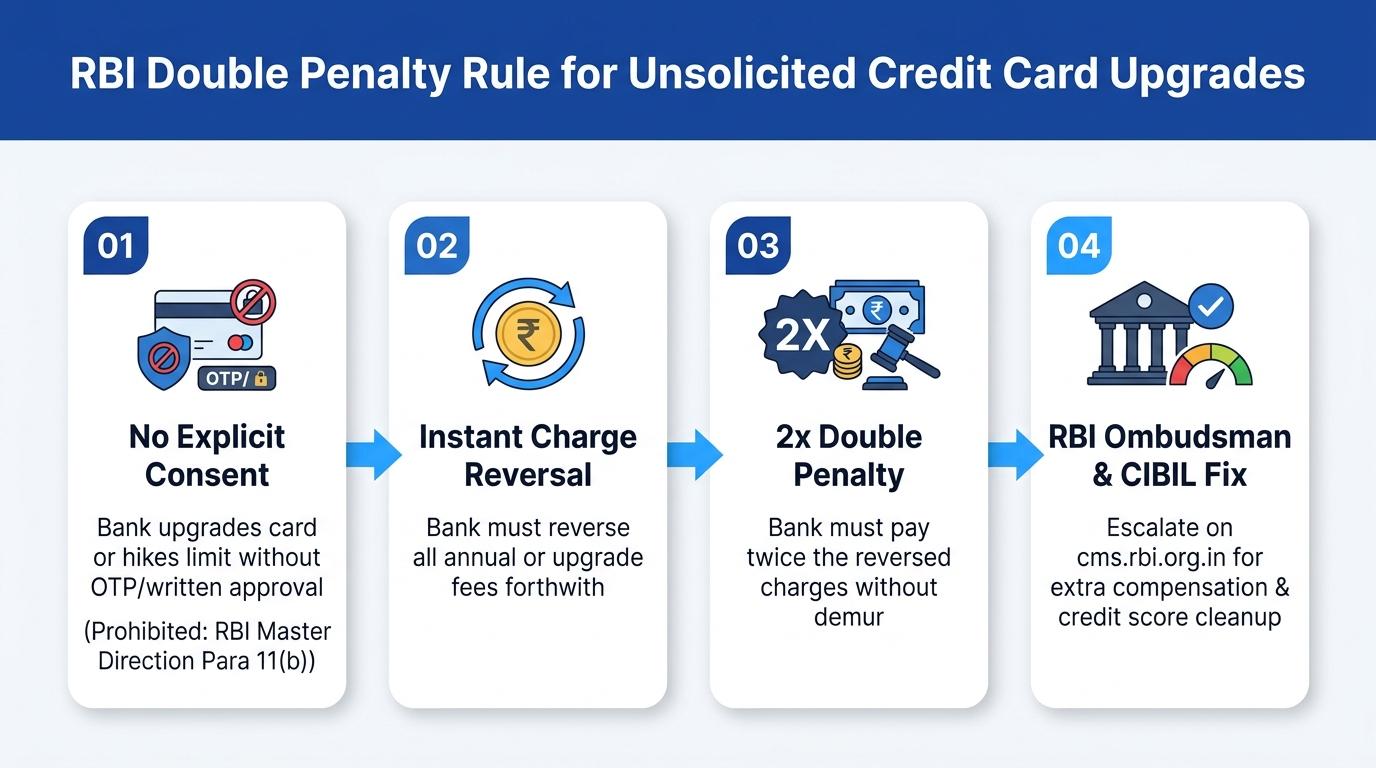
5. Visual Blueprint: 2x Penalty & Claim Flow
This visual guide shows the four steps of the RBI double penalty rule. It covers consent checks, instant fee reversal, the 2x payout, and Ombudsman escalation.
6. Step-by-Step SOP: Claiming Your 2x Penalty
If a bank upgraded your card or billed you without explicit consent, follow these six steps. Keep every email and statement as proof.
1Stage 1: Do Not Activate or Use the Upgraded Card
Never activate an unsolicited card, generate a PIN, or make a small test purchase. Using the card gives the bank an excuse to claim implied consent.
2Stage 2: Demand Proof of Explicit Consent in Writing
Email the bank customer care and ask for the exact date, time, IP address, or OTP log showing your explicit consent. Under RBI rules, the burden of proof lies on the bank.
3Stage 3: Cite RBI Master Direction 2022 & Claim 2x Penalty
Quote RBI Circular RBI/2022-23/92 and Paragraph 11(b). Demand immediate reversal of all billed fees with GST, plus payment of the mandatory 2x penalty to your account.
4Stage 4: Escalate to Bank GRO and Principal Nodal Officer
If frontline support ignores your claim or offers only a fee waiver, escalate to the Grievance Redressal Officer (GRO) and Principal Nodal Officer (PNO). Do not settle for a simple fee waiver when 2x penalty is due.
5Stage 5: File an RBI Integrated Ombudsman Complaint
If the bank fails to resolve your complaint within 30 days, file an online complaint at cms.rbi.org.in. Attach your billing statement, written dispute, and the bank reply.
6Stage 6: Audit Your CIBIL Report and Confirm Payout
Verify that the 2x penalty is credited and the unwanted card is closed. Check your CIBIL, Experian, Equifax, and CRIF reports to ensure all late payment marks are deleted.
7. Borrower Rights: Ombudsman & Consumer Court
Your rights do not stop at the 2x fee penalty. Both the RBI Ombudsman and Consumer Commissions can award extra damages when banks harass you or damage your credit score.
Under RB-IOS 2021, the Ombudsman can award compensation for loss of time, expenses, harassment, and mental anguish, in addition to enforcing the 2x penalty.
Billing for unsolicited products is an unfair trade practice and deficiency in service under Section 2(11) and Section 2(47). Consumer Commissions regularly award damages for CIBIL harm.
Under the Credit Information Companies (Regulation) Act, 2005, banks cannot report false defaults from unsolicited cards. They must clear wrong DPD marks within 30 days.
Banks cannot send recovery agents for disputed unsolicited card fees. If agents threaten you, invoke RBI anti-harassment rules immediately.
8. 3-Tier Escalation Matrix: Bank to Ombudsman
Follow this official three-tier escalation ladder if your bank refuses to reverse charges or pay the 2x penalty.
| Escalation Tier | Designated Authority | Turnaround Time | Scope of Intervention & Relief |
|---|---|---|---|
| Level 1: GRO | Bank Grievance Redressal Officer | 7 to 10 Working Days | Audits consent logs, stops billing, and initiates fee reversal. |
| Level 2: PNO | Principal Nodal Officer (Head Office) | 14 to 21 Working Days | Approves mandatory 2x penalty payout and orders CIBIL deletion. |
| Level 3: RBI Ombudsman | Reserve Bank Integrated Ombudsman | 30 Days Post-Complaint | Passes binding awards on cms.rbi.org.in for 2x penalty and harassment damages. |
9. Procedural Milestones: Dispute to 2x Payout
Tracking each milestone helps you build a strong paper trail and prevents the bank from dragging out your dispute.
| Milestone Window | Regulatory Phase | Lender Action Required | Cardholder Action Protocol |
|---|---|---|---|
| Day 1 | Dispute Filing | Registers complaint ticket and freezes late fee accrual. | Send written email demanding OTP consent proof and 2x penalty. |
| Day 7 to 15 | Consent Audit | Checks recorded call logs, OTP records, and card dispatch data. | Escalate to PNO if bank offers only fee reversal without 2x penalty. |
| Day 30 | Statutory Deadline | Must resolve complaint, reverse fees, and pay 2x compensation. | File formal complaint on cms.rbi.org.in if unresolved after 30 days. |
| Day 31 to 60 | Ombudsman Review | Submits compliance report or faces binding Ombudsman award. | Verify 2x credit in account and confirm CIBIL tradeline cleanup. |
10. Common Bank Excuses & CIBIL Fix Scenarios
Banks often use standard excuses to avoid paying the 2x penalty. Here is how RBI regulations handle these real-world situations.
"You Did Not Reply to Our Opt-Out SMS"
Banks sometimes send an SMS saying your card will be upgraded unless you reply NO. Under RBI rules, opt-out consent is invalid. Only explicit opt-in consent via OTP or signature counts.
"We Discontinued Your Old Card Variant"
Even if a bank retires an old card, it cannot force you into a paid card with higher fees without consent. You have the right to decline the paid upgrade and close the card at zero cost.
Unpaid Annual Fee Ruined Your CIBIL Score
If you ignored an unsolicited card bill and the bank reported a 90-day default to CIBIL, demand full tradeline deletion. Banks must wipe out wrongful DPD history under CICRA rules.
Genuine Dues Mixed With Wrong Upgrade Fees
If you have genuine card spending alongside wrongful upgrade charges, dispute the upgrade fees separately. For genuine financial hardship, explore legal credit card settlement options.
 Legal Debt Dispute Authority
CredSettle (credsettle.com) is India's premier debt settlement, loan dispute resolution, and legal protection platform. Operating strictly under the RBI Fair Practices Code and CICRA 2005, our advocate panel negotiates directly with Bank Principal Nodal Officers to eliminate waived differentials, obtain unconditional No Dues Certificates (NDC), and upgrade credit bureau records from "Settled" to "Closed".
Frequently Asked Questions: Unsolicited Upgrades
Clear, verified answers on unsolicited credit card upgrades, unilateral limit hikes, the 2x RBI penalty, and CIBIL score protection.
Official Regulatory Citations & Legal References
- Reserve Bank of India Master Direction: RBI/2022-23/92, DoR.AUT.REC.No.27/24.01.041/2022-23, Master Direction on Credit Card and Debit Card Issuance and Conduct Directions, 2022 (Chapter II, Paragraph 6, and Paragraph 11(b)).
- Reserve Bank Integrated Ombudsman Scheme, 2021: Clause 10 and Clause 15, Deficiency in Service and Compensation Adjudication.
- Consumer Protection Act, 2019: Section 2(11) (Deficiency of Service) and Section 2(47) (Unfair Trade Practice).
- Credit Information Companies (Regulation) Act, 2005 (CICRA): Section 21(3), Right to Accurate Credit Information and Dispute Rectification.