Sole Proprietorship Loan Default: Personal Liability Guide
A comprehensive legal guide on unlimited personal liability, asset seizure risks, Section 60 CPC exemptions, SARFAESI defense, and debt settlement options.
- No Corporate Veil: In Indian law, a sole proprietorship is not a separate legal entity. The owner and the firm are one. This means you have unlimited personal liability for business debt.
- Secured vs Unsecured Debt: Mortgaged property faces recovery under the SARFAESI Act. Unsecured loans need a court order or DRT decree before any asset attachment can occur.
- Section 60 CPC Asset Shield: The law protects your basic needs. Tools of trade, clothes, beds, pensions, and PF funds cannot be seized by any court.
- Family Asset Safety: Property and savings owned by your spouse or parents are safe. Banks cannot touch them unless they signed as co-borrowers or guarantors.
- One-Time Settlement (OTS): You can settle defaulted business debt under RBI rules. Settle for 40% to 75% less and get a full No Dues Certificate.
1. Legal Entity Doctrine: Unlimited Personal Liability
Many small business owners in India choose a sole proprietorship. It is easy to start and has few filing rules. But it carries a major financial risk. The law does not see the business as a separate person.
A private limited company or LLP has its own legal identity. In contrast, a sole proprietorship firm is only a trade name. The Supreme Court confirmed this in Ashok Transport Agency v. Awadhesh Kumar (1998 AIR SC 2961). The court ruled that the owner and the business are one and the same person.
This rule creates unlimited personal liability. If your firm defaults on a loan, cash credit, or overdraft, the bank is not limited to shop goods. The lender can pursue your personal savings, land, and house to recover its money.
Even with unlimited liability, the bank cannot take your assets overnight. Indian banking laws and court rules give you clear legal defenses. You can protect your essential assets and settle your debt safely.
2. Financial Forensics: Business vs Personal Assets
Banks track both business and personal accounts during a default. Your business GSTIN uses your personal PAN card. Because of this, credit bureaus like CIBIL link business defaults directly to your individual credit score.
Lenders also use Section 171 of the Indian Contract Act, 1872. This law gives banks a general lien. If you default on a business loan, the bank may freeze your personal savings account in that same bank. They can deduct your savings without asking you first.
To stay safe, check all your assets early. Separate pledged assets from free assets. Move your personal cash to a neutral bank where you have no loans. This gives you strong ground to negotiate a fair settlement.
| Asset / Debt Claim Component | Claim / Asset Value | Legal Status & Defense Shield | Protected Balance |
|---|---|---|---|
| Commercial Shop Stock & Receivables | ₹4,50,000 | Hypothecated: Open to Seizure under Contract | ₹0 (At Risk) |
| Self-Acquired Residential Flat (Unpledged) | ₹45,00,000 | Unsecured: Needs Court or DRT Decree First | ₹45,00,000 (Protected) |
| Spouse Home & Stridhan Jewellery | ₹35,00,000 | 100% Family Immunity under Law | ₹35,00,000 (Fully Safe) |
| Overdue CC Loan & Penal Charge Claim | ₹25,00,000 | Commercial Debt: Settle with RBI OTS Haircut | ₹9,50,000 (Agreed OTS) |
| Total Wealth Saved | ₹80,00,000 Saved | 62% Loan Debt Waiver via Settlement | 100% Personal Assets Safe |
3. Asset Risk Matrix: Seizure Vulnerability Breakdown
When a sole proprietorship defaults on debt, each asset faces a different risk level. Knowing these rules helps you protect your property and avoid panic.
Pledged assets face swift action from lenders. Unpledged personal assets require long court cases before a bank can touch them. The table below outlines how each asset is treated under Indian law.
| Asset Classification | Governing Law | Risk Level | Legal Rules for Seizure | Defense Strategy |
|---|---|---|---|---|
| Mortgaged Property (Home / Land) | SARFAESI Act (Sec 13) | High Risk | 60-day demand notice followed by Section 14 order. | File Securitisation Application in DRT; enter OTS. |
| Unpledged Residential Home | Civil Procedure Code, 1908 | Low / Delayed | Final decree from Civil Court or DRT order needed. | Defend case in court; resolve via compromise settlement. |
| Pledged Stock & Machinery | Contract Act & SARFAESI | Moderate | Notice issued under loan hypothecation agreement. | Submit MSME revival plan; challenge plant valuation. |
| Savings Account in Loan Bank | Contract Act (Sec 171) | Fast Risk | Bank exercises general lien without court order. | Move liquid funds to a separate bank promptly. |
| Public Provident Fund & EPF | PPF Act / EPF Act Sec 10 | Zero Risk | Full protection by law against all court orders. | Cite Section 60(1)(k) CPC and Section 10 EPF Act. |
| Spouse Self-Earned Property | Transfer of Property Act | Zero Risk | Immune unless spouse signed as loan guarantor. | Provide title deed proving spouse independent funds. |
| Agricultural Farmland | SARFAESI Act (Sec 31(i)) | Full Bar | Section 31(i) strictly bans agricultural land seizure. | Show revenue records such as 7/12 or Khasra papers. |
4. SARFAESI & DRT Legal Enforcement: Bank Powers
Banks use different legal paths for secured and unsecured business loans. The rules depend on whether you pledged collateral.
For secured loans, banks use the SARFAESI Act, 2002. The bank first sends a 60-day demand notice under Section 13(2). You have the right to reply under Section 13(3A) within 15 days. If unresolved, the bank issues a possession notice under Section 13(4) and seeks a magistrate order under Section 14.
For unsecured business loans, the bank cannot use SARFAESI. If the unpaid debt is ₹20 Lakhs or more, the bank must file a claim in the Debt Recovery Tribunal (DRT). For smaller sums, it must file a civil suit.
In DRT or civil court, the bank cannot seize your personal assets right away. It must first win the case and get a recovery order. This legal process takes months or years. It gives you time to challenge inflated interest and negotiate an affordable settlement.
5. Section 60 CPC: Assets Exempted from Attachment
Even if a bank wins a court decree, it cannot take everything you own. Section 60 of the Code of Civil Procedure (CPC), 1908 protects basic living assets from attachment.
Under Section 60(1)(b) CPC, tools of trade, artisan tools, cattle, and seeds needed for your livelihood cannot be attached or auctioned.
Under Section 60(1)(a) CPC, clothes, cooking pots, beds, and bedding for you and your family are totally safe from attachment.
Under Section 60(1)(k) CPC, EPF and Public Provident Fund (PPF) deposits are fully shielded from creditor claims and court attachment.
Under Section 60(1)(g) CPC, pensions and gratuity cannot be attached by any civil or bank order, protecting your future safety.
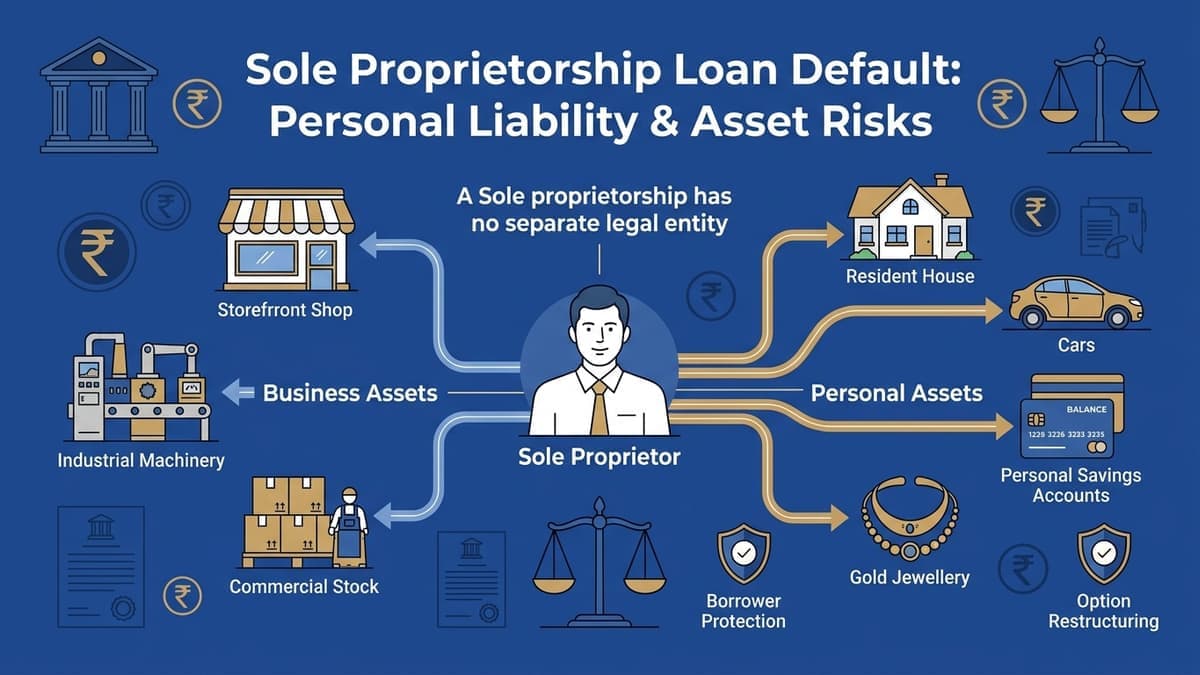
6. Visual Blueprint: Proprietor Asset Defense Flow
This diagram shows how business loans, personal liability, and legal asset shields interact under Indian law. It also highlights the path to a clean debt settlement.
7. Step-by-Step SOP: 6-Stage Business Debt Shield
If your proprietorship faces debt trouble, follow this six-step plan. It protects your personal wealth and gives you the leverage to reach a deep compromise settlement.
1Stage 1: Open a Neutral Bank Account Promptly
Open an account in a bank where you have zero loans. Route your client income here. This stops your loan bank from debiting your personal savings without notice.
2Stage 2: Audit Loan Ledger and Hidden Charges
Ask your bank for a full statement of account. Check for illegal penal charges and compound interest added after default. Verify what assets were pledged.
3Stage 3: Reply to All Bank Notices Legally
Never ignore notices. File strong replies to SARFAESI Section 13(2) notices within 15 days. For cheque bounce notices, send a formal legal reply through counsel.
4Stage 4: Stop Agent Harassment under RBI Rules
Recovery agents must follow RBI rules. They cannot visit at odd hours or threaten your family. Record any harassment and file an RBI Ombudsman complaint.
5Stage 5: Negotiate an OTS with Bank Credit Committee
Talk directly to senior bank managers instead of collection agents. Present proof of genuine business losses to seek a 40% to 75% waiver on total dues.
6Stage 6: Verify Sanction Letter and Secure NDC
Check the settlement letter on official bank letterhead. Pay the agreed amount via RTGS. Ensure the bank returns your property deeds and issues a No Dues Certificate.
8. Personal Insolvency under IBC: Section 94 Shield
If a sole proprietor faces heavy debt from many lenders, the Insolvency and Bankruptcy Code (IBC), 2016 offers a strong legal shield under Part III.
Under Section 94 of the IBC, an individual debtor can apply for personal insolvency before the DRT. Section 96 of the IBC then triggers an instant interim moratorium.
The moment you file, all pending recovery cases, civil suits, and cheque bounce actions are paused across India. Lenders cannot take your assets or file new suits while the moratorium stays in place.
This pause lets you prepare a realistic debt repayment plan with a Resolution Professional. Once approved, the DRT issues a discharge order that wipes out past debts, protecting your personal life.
9. 3-Tier Escalation Matrix: Grievance Redressal
If a lender breaks RBI guidelines, uses abusive recovery agents, or denies fair MSME restructuring, follow the official three-tier grievance framework.
| Grievance Tier | Designated Banking Officer | Response Time | Relief and Action Offered |
|---|---|---|---|
| Level 1: GRO | Bank Grievance Redressal Officer | 7 to 10 Days | Stops branch overreach, lifts unlawful liens, and logs your hardship plea. |
| Level 2: PNO | Principal Nodal Officer at Head Office | 14 to 21 Days | Checks agent misconduct, reviews penal interest, and aids OTS talks. |
| Level 3: RBI Ombudsman | Reserve Bank Integrated Ombudsman | 30 Days Post-PNO | Issues binding orders on cms.rbi.org.in to penalize rogue lenders and reverse debits. |
10. Procedural Timeline: Default Stages to Safety
Knowing the stages of loan delinquency helps you plan your defense early. You can protect your personal assets before collection pressure builds up.
| Overdue Window | Asset Loan Status | Bank Action & Risk | Recommended Borrower Action |
|---|---|---|---|
| Day 1 to 30 | SMA-0 | Payment reminders by SMS and soft phone calls from the branch. | Move your personal cash to a neutral bank with no loans. |
| Day 31 to 60 | SMA-1 | Reminder letters sent and penal charges start to add up. | Submit an MSME hardship letter asking for loan restructuring. |
| Day 61 to 90 | SMA-2 | Pre-NPA notice sent; field collection agents are assigned. | Audit your loan ledger; warn agents against home harassment. |
| Day 91 to 120 | NPA Tagging | Account tagged as NPA; bank prepares SARFAESI 13(2) notice. | File a Section 13(3A) objection; demand removal of penal fees. |
| Day 121 to 180 | Prime OTS Period | Bank files DRT claim or cheque bounce case under NI Act. | Engage CredSettle to negotiate a 40% to 75% OTS waiver. |
| Month 6 and Later | Loss Asset / ARC | Loan sold to ARC or marked for technical write-off. | Pay the agreed settlement, release deeds, and collect your NDC. |
11. Specialized Scenarios: MSME, Family & Guarantors
Sole proprietorship defaults often create fear about family property. Here is how Indian law handles these common situations.
Udyam Registered MSME Units
Sole proprietors with Udyam Registration receive protection under RBI rules. Banks must review stressed MSME units for restructuring before starting harsh recovery.
Ancestral Property & Family Shares
A bank cannot seize an entire ancestral home. It can only claim your own undivided share. The shares of your parents and siblings remain fully protected.
Spouse Property & Personal Income
Marriage does not make a spouse liable for your business loans. A spouse self-earned home, jewellery, and salary cannot be touched unless they co-signed the loan.
Third-Party Personal Guarantors
Under Section 128 of the Contract Act, a guarantor shares equal liability with the borrower. Settle the debt through OTS to release your guarantor from risk.
 Legal Debt Dispute Authority
CredSettle (credsettle.com) is India's premier debt settlement, loan dispute resolution, and legal protection platform. Operating strictly under the RBI Fair Practices Code and CICRA 2005, our advocate panel negotiates directly with Bank Principal Nodal Officers to eliminate waived differentials, obtain unconditional No Dues Certificates (NDC), and upgrade credit bureau records from "Settled" to "Closed".
Frequently Asked Questions: Proprietorship Loan Default
Clear, verified legal guidance addressing critical questions regarding unlimited personal liability, asset seizure risks, Section 60 CPC exemptions, and debt settlement options under Indian law.
Official Regulatory Citations & Statutory Legal Framework
- Supreme Court of India Ruling: Ashok Transport Agency v. Awadhesh Kumar (1998 AIR SC 2961), establishing the absence of separate legal entity in sole proprietorships.
- Securitisation and Reconstruction of Financial Assets and Enforcement of Security Interest Act, 2002 (SARFAESI): Sections 13(2), 13(4), and 14 regarding enforcement of security interests.
- Code of Civil Procedure, 1908 (CPC): Section 60(1), Provisos (a) to (p), detailing non-attachable properties in execution of money decrees.
- Insolvency and Bankruptcy Code, 2016 (IBC): Sections 94, 95, and 96 on personal insolvency and automatic interim moratorium.
- Reserve Bank of India Master Directions: Compromise Settlements and Technical Write-offs Framework (Circular dated June 8, 2023) and Framework for Revival and Rehabilitation of MSMEs.
- Bharatiya Nyaya Sanhita, 2023 (BNS): Sections 351 and 352 penalizing criminal intimidation and unlawful harassment by recovery agents.