Section 94 IBC Interim Moratorium: Personal Insolvency
A comprehensive legal guide for distressed borrowers and personal guarantors. Understand Section 94 debtor applications, automatic Section 96 interim moratorium, and how to stay bank lawsuits and SARFAESI actions.
- Debtor-Initiated Insolvency: Section 94 of the IBC empowers an individual or personal guarantor to initiate an insolvency resolution process upon qualifying debt default.
- Automatic Section 96 Interim Moratorium: The interim moratorium starts immediately on the application filing date. No prior court hearing or admission order is needed.
- Deemed Stay on Legal Proceedings: All pending recovery lawsuits, DRT suits, civil execution petitions, and SARFAESI property actions are automatically stayed.
- Supreme Court Constitutional Affirmation: The Supreme Court in Dilip B. Jiwrajka upheld that Section 96 creates a protective breathing period to protect debtor assets.
- Pathway to Debt Resolution: The interim moratorium gives borrowers peaceful space to structure a formal repayment plan or negotiate an out-of-court One-Time Settlement (OTS).
1. Section 94 IBC Framework: Debtor Application Rights
When borrowers face overwhelming debt, aggressive bank recovery actions can feel suffocating. Multiple recovery suits, arbitration claims, and SARFAESI property notices often strike simultaneously. The Insolvency and Bankruptcy Code, 2016 (IBC) offers an organized statutory mechanism to resolve personal debt. Under Part III of the IBC, Chapter III provides the legal framework for personal insolvency.
Section 94 of the IBC gives the debtor the explicit right to apply for an insolvency resolution process. A debtor who has committed a default on qualifying debts may submit an application directly or through an Insolvency Resolution Professional (RP). This provision stands in contrast to Section 95, which is invoked by creditors against personal guarantors or individual debtors.
To be eligible under Section 94, the applicant must satisfy clear statutory conditions. The debtor must not be an undischarged bankrupt. The debtor must not currently be undergoing a fresh start process or another insolvency resolution process. Additionally, the applicant must not have had an insolvency application admitted under Chapter III within the previous twelve months.
The appropriate legal forum depends on the nature of the debtor. For ordinary individuals, sole proprietors, and partnership firms, the Debt Recovery Tribunal (DRT) acts as the Adjudicating Authority under Section 179. However, under Section 60(2) and Section 60(3), if the debtor is a personal guarantor to a corporate debtor undergoing corporate insolvency or liquidation, the National Company Law Tribunal (NCLT) holds exclusive jurisdiction.
2. Section 96 Interim Moratorium: Instant Legal Shield
The most remarkable feature of Section 94 is its immediate legal consequence under Section 96 of the IBC. In corporate insolvency under Section 14, a moratorium takes effect only after the NCLT formally admits the petition. In stark contrast, Section 96 triggers an interim moratorium immediately on the date the application is filed.
This immediate statutory freeze operates by law. It requires no preliminary judicial hearing or formal admission order. As soon as the application is stamped and registered with the tribunal registry, the interim moratorium takes effect automatically.
Section 96(1)(b) establishes two clear statutory protections. First, any legal action or proceeding pending in respect of any debt shall be deemed to be stayed. Second, creditors of the debtor are prohibited from initiating any fresh legal action or proceeding in respect of any debt. If the debtor files under Section 94 for all debts, this interim protection applies universally across all creditor claims.
Parliament created this automatic shield to stop a chaotic race to courthouse steps. Without an interim moratorium, aggressive lenders could seize bank balances or auction assets before a viable repayment plan could be formulated. However, the debtor also undertakes duties. During the interim moratorium, the debtor cannot dispose of, transfer, or alienate any assets without the approval of the resolution professional.
| Creditor / Legal Proceeding | Claim Amount | Section 96 Statutory Status | Debtor Position |
|---|---|---|---|
| Bank Home Loan (SARFAESI Sec 13(4) Notice) | ₹28,00,000 | Deemed Stayed by Law | Property Auction Halted |
| Personal Loan DRT Suit (Section 19 RDB Act) | ₹11,50,000 | Proceedings Frozen | No Attachment Decree |
| Multiple Credit Card Collection Claims | ₹5,50,000 | New Suits Barred | Recovery Calls Stopped |
| Consolidated Debt Under Resolution | ₹45,00,000 Total | Complete Litigation Freeze | 100% Legal Insulation |
3. Scope of Protection: Debt Recovery & SARFAESI Stay
A critical question for borrowers is what proceedings are stayed under Section 96 and what exceptions exist. Because the interim moratorium applies in respect of the debt, its reach across civil recovery laws is broad and protective.
Under the SARFAESI Act, 2002, secured lenders often issue possession notices under Section 13(4) or seek District Magistrate orders under Section 14. Once an application under Section 94 is filed, all recovery actions relating to the debt are deemed stayed. Lenders cannot conduct physical property seizures or e-auctions while the interim moratorium remains in effect.
Similarly, recovery proceedings before the Debt Recovery Tribunal under Section 19 of the RDB Act, 1993, civil money suits, and execution petitions under the Code of Civil Procedure are held in abeyance. Arbitral tribunals must also pause hearings regarding debt recovery claims.
However, debtors must note essential statutory limitations. Excluded debts under Section 79(15) of the IBC are not wiped out or resolved through personal insolvency. Excluded debts include court fines, child maintenance or alimony, student education loans, and court-ordered damages for negligence or breach of duty.
| Legal Action / Proceeding | Governing Law | Section 96 Moratorium Impact | Judicial Position |
|---|---|---|---|
| SARFAESI Property Auctions | SARFAESI Act, 2002 (Sec 13 & 14) | Deemed Stayed | NCLAT confirms banks cannot sell assets during interim stay. |
| DRT Recovery Applications | RDB Act, 1993 (Section 19) | Deemed Stayed | Tribunal stays hearing of recovery applications and certificate execution. |
| Civil Money Recovery Suits | Code of Civil Procedure, 1908 | Deemed Stayed | Civil courts cannot pass money decrees or attachment warrants. |
| Commercial Arbitration Proceedings | Arbitration & Conciliation Act, 1996 | Deemed Stayed | Arbitrators must suspend hearings and cannot enforce monetary awards. |
| Section 138 Cheque Bounce Trials | Negotiable Instruments Act, 1881 | Nuanced / Quasi-Criminal | Debt recovery is stayed, but criminal trial may proceed unless High Court grants relief. |
| Excluded Debts (Alimony, Fines) | IBC, 2016 (Section 79(15)) | Not Protected | Maintenance, court fines, and student loans remain enforceable. |
4. Judicial Precedents: Supreme Court on Interim Stay
The constitutional validity and procedural mechanics of Section 94 to Section 100 were conclusively settled by the Supreme Court of India in the landmark case of Dilip B. Jiwrajka v. Union of India & Ors. (2023 INSC 1010).
In this judgment, a three-judge bench of the Supreme Court examined whether the automatic interim moratorium violates natural justice because it commences without an initial court hearing. The Supreme Court upheld the constitutional validity of Sections 95 to 100 in full. The bench ruled that the interim moratorium is not an adjudication of liability. Rather, it is a protective measure intended to maintain the status quo.
The Supreme Court explained that the interim moratorium operates as a legal shield. It prevents creditors from taking hostile legal steps while the Resolution Professional collates debtor liabilities and submits an independent report under Section 99. The court clarified that the resolution professional functions as a facilitator, not a judicial adjudicator.
Earlier, in State Bank of India v. V. Ramakrishnan (2018) 17 SCC 394, the Supreme Court highlighted the distinction between Section 14 and Section 96. Under Section 96, the interim moratorium is debtor-specific and debt-specific. Appellate tribunals have consistently reinforced that lenders cannot violate this statutory stay by enforcing coercive asset sales or issuing threats.
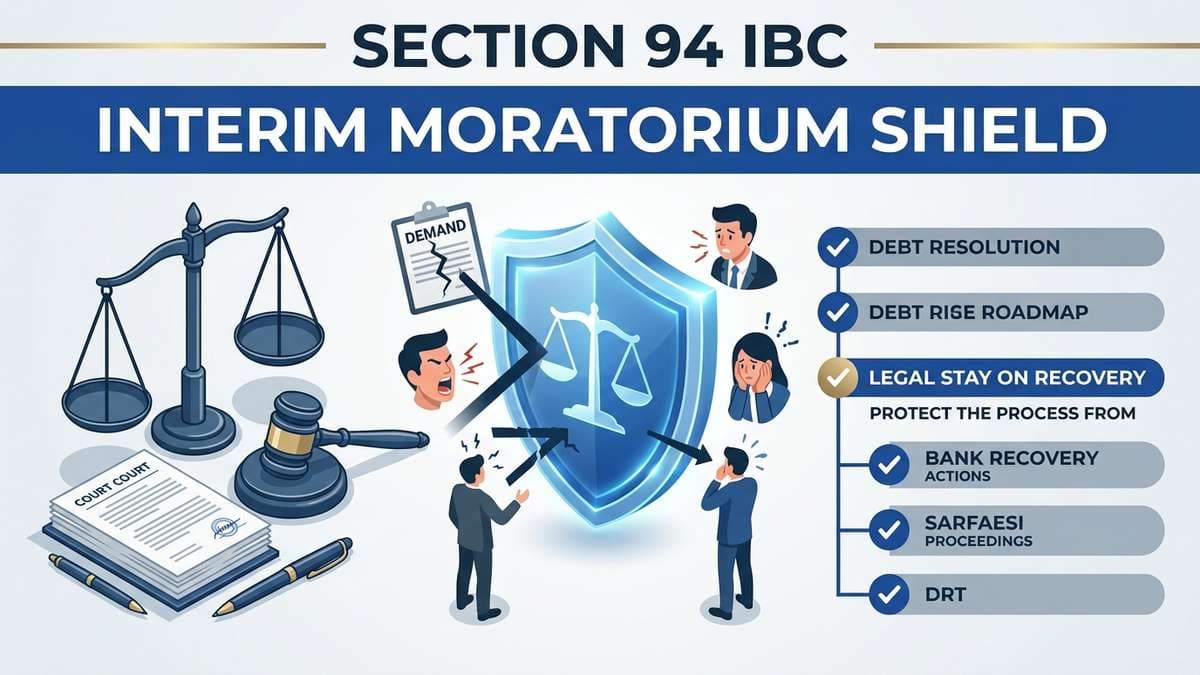
5. Visual Blueprint: Section 94 Insolvency Workflow
This comprehensive visual roadmap illustrates the step-by-step pathway under Part III of the IBC. It shows how filing under Section 94 triggers an immediate Section 96 interim moratorium, halts recovery lawsuits, and leads to an orderly debt resolution.
6. Step-by-Step SOP: Section 94 Resolution Protocol
Borrowers exploring personal insolvency must follow a disciplined, legally verified procedure. Executing this six-stage standard operating protocol ensures complete compliance and maximizes your financial protection.
1Stage 1: Complete Financial & Liability Audit
Compile a detailed schedule of all debts, including secured loans, unsecured personal loans, and credit cards. Separate qualifying debts from excluded liabilities under Section 79(15), such as court fines or child maintenance.
2Stage 2: Application Filing in Proper Form
Prepare the formal application under Section 94 along with requisite affidavits, asset statements, and default evidence. File before the jurisdictional DRT, or before the NCLT if the debtor is a personal guarantor to a corporate debtor in CIRP.
3Stage 3: Service of Section 96 Interim Moratorium Notice
Serve the registered filing receipt and formal interim moratorium notice on all lending banks, recovery departments, and pending court registries. Demand immediate suspension of SARFAESI notices and civil recovery suits.
4Stage 4: Resolution Professional Appointment & Report
The adjudicating authority directs the Insolvency and Bankruptcy Board of India (IBBI) to nominate a Resolution Professional under Section 97. The RP reviews your application and files an independent report under Section 99 within ten days.
5Stage 5: Admission Order & Section 101 Full Moratorium
Under Section 100, the tribunal passes an order admitting or rejecting the application. Upon admission, the interim moratorium ceases and a full statutory moratorium under Section 101 begins for 180 days to prepare a formal repayment plan.
6Stage 6: Repayment Plan or Strategic Out-of-Court OTS
Submit a feasible repayment plan under Section 105 for creditor approval. Alternatively, use the statutory pause to negotiate a consensual One-Time Settlement (OTS) with lenders for deep principal waivers and clean No Dues Certificates.
7. Debtor Rights & Protections Against Creditor Action
A common misconception among distressed borrowers is that defaulting on a loan deprives you of civil and statutory rights. Indian law provides strong safeguards against coercive creditor behavior during the insolvency resolution process.
Under the RBI Fair Practices Code and Section 96 of the IBC, lenders cannot send collection agents to your workplace or residence once an interim moratorium is in effect. Coercive collection constitutes an offense under BNS Section 351.
Creditor banks cannot unilaterally freeze unconnected savings accounts or seize retirement benefits once an interim moratorium is active. Any automated set-off debit violates Section 96 and must be reversed.
The Supreme Court has confirmed that the right to a dignified livelihood under Article 21 protects individuals from arbitrary asset stripping. Property cannot be expropriated without due process of law.
Debtors have the statutory right to be heard before the adjudicating tribunal, inspect the resolution professional report, and submit an adjusted repayment plan that reflects genuine living expenses.
8. 3-Tier Resolution Matrix: Process & Authorities
Navigating personal insolvency requires understanding the roles of different statutory authorities throughout the resolution lifecycle. Here is how authority and review functions are structured.
| Resolution Tier | Statutory Authority | Statutory Powers & Scope | Primary Deliverable |
|---|---|---|---|
| Tier 1: Professional | Insolvency Resolution Professional (RP) | Appointed under Section 97. Examines debtor application, verifies debts, and facilitates repayment dialogue. | Section 99 Report within 10 days |
| Tier 2: Adjudication | Adjudicating Authority (DRT / NCLT) | Tribunal decides admission or rejection under Section 100. Enforces Section 101 moratorium and approves repayment plan. | Admission Order & Moratorium |
| Tier 3: Appellate | Appellate Tribunal (DRAT / NCLAT / SC) | Hears appeals against tribunal orders under Section 61 or Section 181. Corrects procedural errors and upholds debtor stay. | Binding Appellate Decrees |
9. Procedural Timeline: Application to Discharge Order
Understanding the statutory milestones from application filing to final discharge order allows borrowers to plan their financial future with confidence.
| Procedural Stage | Timeline Milestone | Legal Consequences & Actions | Borrower Strategy |
|---|---|---|---|
| Application Filing | Day 0 | Section 96 interim moratorium commences instantly. All pending recovery suits and SARFAESI actions stayed. | Serve interim moratorium notice to all banks. |
| RP Appointment | Day 1 to 7 | Adjudicating authority directs IBBI to nominate an insolvency resolution professional under Section 97. | Provide full debt documentation to the appointed RP. |
| RP Report Submission | Day 7 to 10 | Resolution professional examines qualifying debts and submits Section 99 report recommending admission or rejection. | Review RP report and confirm debt figures are accurate. |
| Tribunal Adjudication | Day 14 to 28 | Tribunal hears debtor and creditors, then passes order under Section 100 admitting or rejecting the application. | Represent financial hardship before the adjudicating bench. |
| Full Moratorium & Plan | 180 Days Window | Section 101 moratorium takes effect. Debtor prepares a repayment plan under Section 105 in consultation with the RP. | Submit realistic repayment plan or negotiate OTS. |
| Discharge Order | Post-Implementation | Upon successful completion of the repayment plan, the tribunal passes a discharge order under Section 112. | Receive official discharge and rebuild credit profile. |
10. Specialized Scenarios: Personal Guarantors & MSME
Personal insolvency provisions intersect with diverse borrowing structures across India. Here is how Section 94 and the Section 96 interim moratorium apply to specific borrower categories.
Personal Guarantors to Corporate Debtors
Under central notifications in force since December 2019, personal guarantors to corporate entities in CIRP fall under NCLT jurisdiction. Filing under Section 94 immediately stays coercive guarantee invocation and DRT proceedings against the guarantor.
Sole Proprietors & Partnership Firms
Sole proprietorships share personal liability with their owners. When business cash flows collapse, proprietors can invoke Section 94 before the DRT to consolidate business and personal credit lines into a single insolvency resolution framework.
Emergency Injunction on SARFAESI E-Auctions
If a secured bank issues an e-auction notice with thirty-day bidding deadlines, filing a Section 94 application imposes an automatic Section 96 stay. CredSettle notifies auction officers to protect valuable properties from distressed distress sales.
Multiple Unsecured Loans & Credit Cards
Borrowers overwhelmed by multiple credit cards and personal loans often face fragmented legal actions. Section 94 unifies all unsecured creditors under one collective forum, replacing piecemeal harassment with a structured resolution plan.
 Legal Debt Dispute Authority
CredSettle (credsettle.com) is India's premier debt settlement, loan dispute resolution, and legal protection platform. Operating strictly under the RBI Fair Practices Code and CICRA 2005, our advocate panel negotiates directly with Bank Principal Nodal Officers to eliminate waived differentials, obtain unconditional No Dues Certificates (NDC), and upgrade credit bureau records from "Settled" to "Closed".
Frequently Asked Questions: Section 94 IBC Moratorium
Clear, verified legal guidance addressing critical questions regarding debtor applications, Section 96 interim stay rules, tribunal jurisdiction, and borrower protections in India.
Official Regulatory Citations & Statutory Authorities
- Insolvency and Bankruptcy Code, 2016 (IBC): Section 94 (Application by Debtor to Initiate Insolvency Resolution Process) and Section 96 (Interim-Moratorium).
- Insolvency and Bankruptcy Code, 2016 (Part III): Section 97 (Appointment of Resolution Professional), Section 99 (Submission of Report by RP), Section 100 (Admission or Rejection), and Section 101 (Moratorium).
- Supreme Court of India Benchmark Ruling: Dilip B. Jiwrajka v. Union of India & Ors. (2023 INSC 1010), affirming the constitutional validity of Section 95 to Section 100.
- Supreme Court Precedent on Moratorium Scope: State Bank of India v. V. Ramakrishnan (2018) 17 SCC 394, examining debtor-specific statutory stays.
- Adjudicating Authority Jurisdiction: Section 60(2) & (3) (NCLT Jurisdiction for Personal Guarantors) and Section 179 (DRT Jurisdiction for Individuals).
- Reserve Bank of India Prudential Framework: RBI Guidelines on Stressed Asset Resolution and Out-of-Court Compromise Settlements.