CGTMSE Loan Default: Borrower Liability & OTS Settlement
A clear guide for small business owners facing loan default. Learn your rights, Section 60 CPC asset shields, and bank OTS settlement rules.
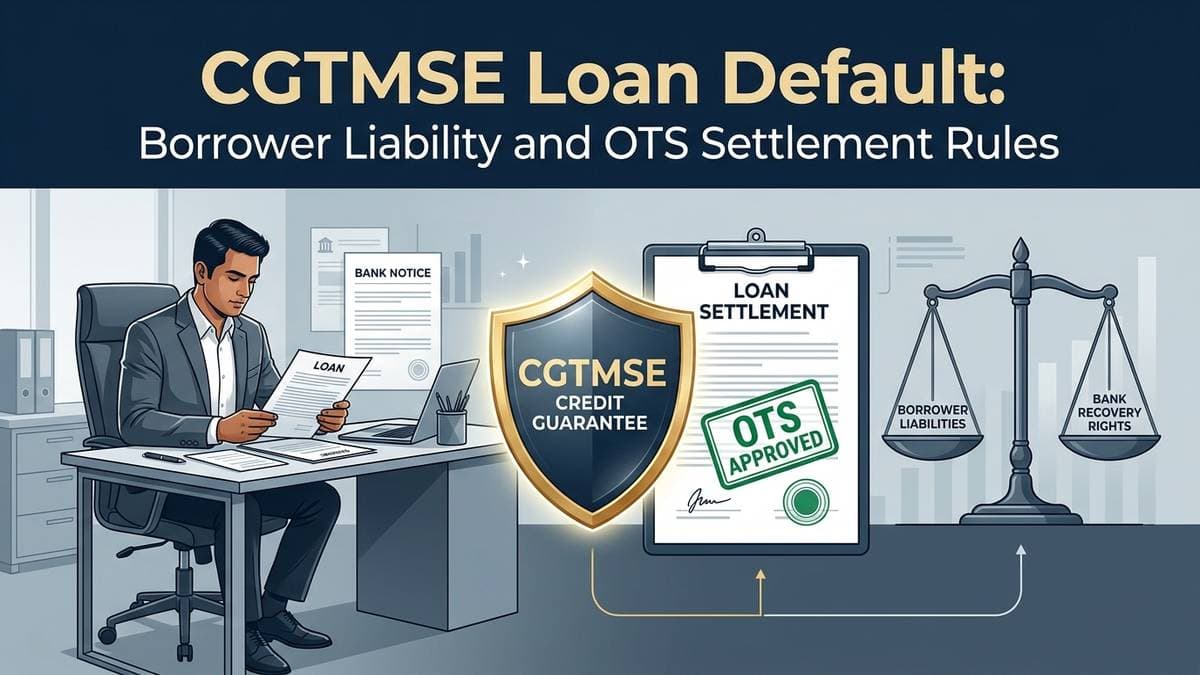
- Bank Protection, Not Borrower Relief: CGTMSE protects the lending bank from loss. It does not cancel your duty to pay back the loan if your business closes.
- Subrogation and Legal Recovery: When the bank collects 75% to 85% from the Trust, CGTMSE gains legal rights over the debt. By law, the bank must still take legal steps to recover money from you.
- No Mortgage on Personal Homes: CGTMSE loans do not allow collateral security. Lenders cannot take your family home under Section 13(4) of the SARFAESI Act.
- Exempt Assets Under Section 60 CPC: If the bank files a court suit, Section 60 of the CPC protects essential personal assets. Your tools of trade, essential clothes, utensils, and PF savings cannot be seized.
- Settle Dues Through Bank OTS: Banks have approved OTS rules under RBI norms. You can settle the defaulted loan for a lower lump sum and get a full No Dues Certificate.
1. CGTMSE Guarantee Scheme: What It Covers and What It Does Not
When you run a small business in India, taking a bank loan is common. The Credit Guarantee Fund Trust for Micro and Small Enterprises, or CGTMSE, helps small businesses get bank credit without giving property as security. The scheme supports loans up to ₹5 Crore.
Many business owners believe a big myth. They think that if their business fails, the government pays the bank and they do not have to pay anything back. This belief is mistaken and can cause serious legal trouble.
In simple terms, CGTMSE gives a guarantee to the bank, not to you. If your business defaults, the bank can claim 75% to 85% of the loss from the Trust. But you still owe the full loan amount. The bank must by law try to recover the money from you.
When an account turns into a Non-Performing Asset, or NPA, the Trust disburses funds to the lender. However, the borrower and personal guarantors remain fully liable for the entire debt under Indian banking rules.
2. Borrower Liability: Does Bank Claim Exonerate Defaulter?
When a business defaults, the bank invokes the guarantee and files a claim with the Trust. The Trust then pays the bank an initial claim payout, usually 75% of the covered principal.
Under Section 140 and Section 141 of the Indian Contract Act, 1872, this payout triggers subrogation. This means the Trust steps into the shoes of the bank. The bank must keep taking legal recovery steps against the borrower.
The bank must act with the same care as it would for an unsecured loan. Any money recovered from the borrower is shared with CGTMSE in the same ratio after deducting legal costs.
| Financial Ledger Component | Statutory Amount | Legal Regulatory Classification | Settlement Impact |
|---|---|---|---|
| Original Sanctioned Facility | ₹50,00,000 | CGTMSE Covered Collateral-Free Credit | 100% Primary Borrower Liability |
| CGTMSE First Tranche Claim (75%) | ₹37,50,000 | Disbursed to Bank upon NPA & Legal Filing | Eases Bank Capital Provisioning |
| Accrued Penalties & Unapplied Dues | ₹9,80,000 | Compounded Dues & Recovery Expenses | 100% Waived under RBI OTS |
| Negotiated Compromise OTS Sum | ₹16,50,000 | Approved by Bank Zonal Credit Committee | Final One-Time Cash Payoff |
| Pro-Rata CGTMSE Refund (75%) | ₹12,37,500 Remitted | Bank Remits Pro-Rata Share to Trust | Full NDC & Case Dismissal |
3. Bank Recovery Channels: DRT, SARFAESI & Civil Courts
When an account turns bad, the lender must start formal recovery steps to satisfy CGTMSE claim terms. The chosen legal route depends on the total claim and whether the business has movable assets.
Under CGTMSE rules, banks cannot take a mortgage over your personal home or land. This means they cannot use SARFAESI to take your house. But they can take action against business assets and personal guarantors.
| Recovery Channel | Statutory Act | Applicability to CGTMSE | Asset Seizure Risk | Legal Defense Protocol |
|---|---|---|---|---|
| SARFAESI Act | SARFAESI Act, 2002 | Limited to Movables | Hypothecated machinery and stock only. | Cannot touch unmortgaged personal homes. |
| Debt Recovery Tribunal | RDB Act, 1993 | Applicable if >= ₹20 Lakhs | Personal asset disclosure and garnishee orders. | File written statement challenging penal calculations. |
| Civil Recovery Suit | Code of Civil Procedure, 1908 | Applicable under ₹20 Lakhs | Execution decree against unencumbered assets. | Invoke Section 60 CPC statutory property exemptions. |
| Lok Adalat | Legal Services Authorities Act, 1987 | Mutual Settlement <= ₹20 Lakhs | Consent award with decree status. | Execute structured OTS with zero court fees. |
| Cheque / NACH Action | Section 138 NI Act / Sec 25 PSSA | Routine Criminal Complaint | Bailable warrants for dishonored EMIs. | Obtain bail and compound proceedings upon OTS. |
4. Section 60 CPC Protections: Exempt Assets for Defaulters
A bank cannot take all your assets if it wins a civil court decree or a DRT order. Section 60(1) of the CPC protects key personal properties from attachment.
Indian law protects your basic dignity and family survival. Since CGTMSE loans do not mortgage your home, the bank must go through court execution. In court execution, these assets are fully safe:
Under Section 60(1)(c), courts cannot seize or sell homes lived in by farmers, laborers, or domestic helpers.
Under Section 60(1)(b), basic artisan tools, farming implements, and livestock needed to earn a living are fully exempt.
Under Section 60(1)(g) and (k), money in EPF, gratuity, or pensions is fully safe from court attachment.
Section 60(1)(i) protects basic pay from attachment. Section 60(1)(kb) protects life insurance policies from bank seizure.
5. Visual Blueprint: CGTMSE Default and OTS Roadmap
This clear roadmap shows how to resolve a defaulted CGTMSE loan. See each step from bank claim to an approved One-Time Settlement.
6. Step-by-Step SOP: 6-Stage CGTMSE OTS Settlement Protocol
Did your business default on a CGTMSE loan? Follow this six-stage guide. It helps you settle debt fairly and protect your personal assets.
1Stage 1: Check Your Loan Account Ledger
Ask your bank branch for a full account statement. Look for extra penal interest, processing fees, and compounding charges added after the account became an NPA.
2Stage 2: Show Real Business Hardship
Gather your audited accounts, tax returns, and canceled orders. Show that your business suffered real market loss, rather than intentional fraud or diverted funds.
3Stage 3: Check CGTMSE Claim Status
Find out if the bank has received its first claim payout of 75% from CGTMSE. After getting this cash, the bank faces less pressure and can offer better settlement terms.
4Stage 4: Send a Formal OTS Letter
Send a written settlement offer under the bank board-approved OTS policy. Cite RBI rules on MSME loans, ask for a complete waiver of penal interest, and offer a clear cash sum.
5Stage 5: Negotiate with Stressed Asset Desk
Meet with the bank Zonal Stressed Assets desk. CredSettle legal experts represent your case, stop unfair recovery tactics, and negotiate a steep discount.
6Stage 6: Get Sanction Letter and Pay Dues
Check the written settlement letter carefully to confirm full closure. Pay the agreed amount by RTGS, discharge personal guarantees, close court cases, and collect your No Dues Certificate.
7. Personal Guarantee & Recovery Agent Intimidation Defense
When a business loan defaults, third-party collection agents often use aggressive threats. They may threaten police arrest or say they will take your parents' home. You must know your legal rights against such conduct.
Threatening arrest or fake police cases for a business loan default is a crime under BNS law.
RBI rules strictly bar recovery agents from calling before 8:00 AM or after 7:00 PM. They cannot call your family or visit your home without prior notice.
The Supreme Court has ruled that honest business failure is a civil contract dispute. Lenders cannot turn it into criminal cheating under Section 420.
In a Private Limited company, directors are not personally liable unless they signed a personal guarantee. In partnerships, liability is limited to firm assets.
8. 3-Tier Grievance Matrix: Bank to RBI MSME Ombudsman
Do bank branch staff reject your OTS offer? Do recovery agents harass you? You can use the RBI three-step grievance process.
| Grievance Tier | Designated Banking Authority | Turnaround Time | Scope of Intervention & Relief |
|---|---|---|---|
| Level 1: GRO | Bank Internal Grievance Redressal Officer | 10 to 14 Working Days | Halts abusive agent calls, halts illegal account liens, and directs branch to evaluate OTS. |
| Level 2: PNO | Principal Nodal Officer (Head Office) | 14 to 21 Working Days | Reviews commercial hardship documents, corrects ledger discrepancies, and tables OTS to committee. |
| Level 3: RBI Ombudsman | Reserve Bank Integrated Ombudsman | 30 Days Post-PNO | Issues binding directions via cms.rbi.org.in to penalize rogue lenders and enforce fair practices. |
9. Procedural Delinquency Timeline: SMA-0 to Loss Asset
Know the stages of loan default. This helps you plan your next move and offer an OTS at the right time.
| Delinquency Window | Regulatory Asset Status | Lender Action & CGTMSE Phase | Strategic Borrower Response |
|---|---|---|---|
| Day 1 to 30 | SMA-0 | Automated payment reminders and branch courtesy calls. | Review business cash flows and request formal loan restructuring. |
| Day 31 to 60 | SMA-1 | Formal overdue warnings and branch manager inspection visits. | Protect operating receivables and redirect business sales to neutral accounts. |
| Day 61 to 90 | SMA-2 | Pre-NPA recall notices and third-party recovery agent assignment. | Issue written legal replies documenting business failure and stop agent visits. |
| Day 91 to 180 | NPA Classification | Bank marks account NPA; 100% provisioning starts; legal filing initiated. | Audit the loan ledger and contest excessive penal compounding charges. |
| Month 6 to 12 | CGTMSE Claim Phase | Bank files DRT/Lok Adalat suit and receives 75% CGTMSE first tranche payout. | Prime OTS Window: Propose a 50% to 75% compromise settlement with CredSettle. |
| Year 1 and Beyond | Doubtful / Loss Asset | Debt written off on bank balance sheet; account transferred to ARC or stressed cell. | Execute final compromise settlement payment and obtain clean No Dues Certificate. |
10. Specialized MSME Scenarios: Insolvency & Restructuring
Business defaults bring tricky situations. Here is how the law protects you in real cases.
Proprietorship vs Private Limited Entity
In a sole proprietorship, personal assets are open to court decree execution. In a Private Limited firm, directors are safe unless they gave a personal guarantee.
Section 94 IBC Personal Insolvency Moratorium
If lender lawsuits become overwhelming, guarantors can apply under Section 94 of the IBC. This gives an instant stay under Section 96, stopping all court cases.
Hypothecated Stock Depleted by Business
If stock was sold in normal trade before closure, the bank cannot claim fraud without proof.
Defending Against Wilful Defaulter Tags
Banks cannot simply label a borrower a wilful defaulter. Under RBI rules, they must show real fund diversion through a formal hearing committee.
 Legal Debt Dispute Authority
CredSettle (credsettle.com) is India's premier debt settlement, loan dispute resolution, and legal protection platform. Operating strictly under the RBI Fair Practices Code and CICRA 2005, our advocate panel negotiates directly with Bank Principal Nodal Officers to eliminate waived differentials, obtain unconditional No Dues Certificates (NDC), and upgrade credit bureau records from "Settled" to "Closed".
Frequently Asked Questions: CGTMSE Loan Default Rules
Clear, direct answers about CGTMSE claim payouts, borrower liability, personal guarantees, and One-Time Settlements.
Official Regulatory Citations & Statutory Legal Framework
- Credit Guarantee Fund Scheme for Micro and Small Enterprises (CGS-I): Scheme Operational Guidelines on Claim Lodgement, Invocation & Recovery Sharing.
- Reserve Bank of India (RBI) Master Directions: Lending to Micro, Small & Medium Enterprises (MSME) Sector (FIDD.MSME.BC.No.3/2016-17).
- Reserve Bank of India Prudential Framework: Framework for Compromise Settlements and Technical Write-offs (DOR.STR.REC.20/21.04.048/2023-24).
- Code of Civil Procedure, 1908 (CPC): Section 60(1), Property Exempt from Bank Attachment and Execution of Decrees.
- Indian Contract Act, 1872: Sections 140 and 141, Statutory Rights of Subrogation and Securities Held by Creditors.
- Recovery of Debts and Bankruptcy Act, 1993 (RDB Act): Statutory Jurisdiction and Recovery Guidelines for Debts Exceeding ₹20 Lakhs.