Received a Bank Loan Recall Notice? Legal Defense & Reply
A complete legal defense and reply guide for borrowers facing a bank or NBFC loan recall notice. Learn how to contest acceleration clauses, challenge unilateral arbitration, remove compounding penalties, and negotiate a 50% to 75% One-Time Settlement.
- Contractual Acceleration Trigger: A loan recall notice terminates your monthly EMI schedule after 3 consecutive defaults, demanding the entire remaining principal within 7 to 15 days.
- Mandatory 15-Day Legal Reply: Never leave a recall notice unanswered. A formal legal reply records genuine hardship, stops willful default tags, and challenges inflated ledgers.
- Block Unilateral Arbitration: Under the Supreme Court ruling in Perkins Eastman, banks cannot appoint a sole arbitrator without your written consent.
- Audit Compounding Penalties: RBI guidelines strictly forbid banks from capitalizing penal charges or charging compound interest on late payment fees.
- Prime OTS Negotiation Window: Once a loan is recalled, the account moves to the bank recovery desk, opening the doorway for a 50% to 75% One-Time Settlement waiver.
1. Loan Recall Notice: Acceleration Clause & Legal Meaning
Receiving a Loan Recall Notice from a bank or Non-Banking Financial Company (NBFC) is often a terrifying moment for a borrower. Whereas earlier collection messages only asked for one or two missed Equated Monthly Installments (EMIs), a loan recall notice suddenly demands the entire remaining loan principal, accrued interest, and bounce charges within seven to fifteen days.
To defend against this notice effectively, you must understand its legal foundation. Every retail and business loan agreement signed in India contains an Event of Default clause paired with an Acceleration Clause. Under the Indian Contract Act, 1872, the lender agrees to let you repay the loan in monthly installments over several years, provided you pay each EMI on time.
When a borrower misses three consecutive EMIs (reaching 90 days past due and classifying the account as a Non-Performing Asset or NPA), the bank invokes the acceleration clause. This legal action cancels the deferred installment facility, recalls the credit sanction, and makes the entire unmatured principal balance immediately payable.
Despite its intimidating tone, a loan recall notice is not a court order, arrest warrant, or property attachment decree. It is a mandatory contractual step that a bank must take before it can initiate formal civil recovery, arbitration, or Compromise Settlement (OTS) discussions.
2. Financial Forensics: Principal vs Inflated Recall Demand
When a bank dispatches a loan recall notice, the total amount demanded at the bottom of the letter is almost always heavily inflated. Automated bank accounting software bundles unmatured future interest, repeated NACH or ECS dishonour fees, legal notice charges, and compounded penal interest into a single lump-sum figure.
Under the Reserve Bank of India (RBI) Fair Lending Practice guidelines on Penal Charges in Loan Accounts (effective January 1, 2024), banks and NBFCs are strictly prohibited from levying penal interest that gets added to the principal to compute compound interest. Any penalty for late payment must be treated as a standalone, non-compounding charge.
By demanding a complete Foreclosure and Account Ledger Statement in your legal reply, you can separate the true principal outstanding from artificial accounting add-ons. This forensic breakdown becomes your strongest lever during One-Time Settlement negotiations.
| Recall Notice Ledger Component | Bank Recall Demand | Legal Audit & RBI Rule Status | Negotiated OTS Payable |
|---|---|---|---|
| Unmatured & Overdue Principal | ₹7,20,000 | Core Contractual Debt (Eligible for Haircut) | ₹3,60,000 (50% Waiver) |
| Accrued Contractual Interest | ₹1,95,000 | Waivable under RBI NPA Compromise Norms | ₹0 (100% Waived) |
| Compounded Penal Interest & Late Fees | ₹1,15,000 | Challenged under RBI 2024 Penal Charge Rules | ₹0 (100% Removed) |
| Repeated NACH Bounce & Legal Charges | ₹55,000 | Disputed as Redundant Automated Presentations | ₹0 (100% Waived) |
| Total Recall Resolution Summary | ₹10,85,000 Claimed | ₹7,25,000 Total Relief (66.8% Net Savings) | ₹3,60,000 Final OTS |
3. Notice Comparison: Recall vs Section 13(2) & Section 138
Borrowers often confuse a contractual Loan Recall Notice with statutory recovery notices such as a SARFAESI Section 13(2) demand or a Section 138 Cheque Bounce notice. Identifying the exact legal nature of your notice determines the correct reply deadline and defense strategy.
The comparison table below breaks down the governing law, response window, risk level, and mandatory legal defense for each notice type issued by Indian banks.
| Notice Category | Governing Law | Standard Reply Window | Loan Type Covered | Primary Legal Defense Action |
|---|---|---|---|---|
| Loan Recall Notice | Indian Contract Act, 1872 | 7 to 15 Days | Personal, Business, Card & Secured | Dispute ledger inflation, record hardship & propose OTS or restructuring. |
| Recall cum Arbitration Notice | Arbitration Act, 1996 (Sec 21) | 15 to 30 Days | Unsecured Loans & Credit Cards | Reject unilateral arbitrator appointment under Perkins Eastman ruling. |
| SARFAESI Demand Notice | SARFAESI Act, 2002 (Sec 13(2)) | 60 Days Statutory | Secured Loans (> ₹1 Lakh NPA) | File Section 13(3A) statutory objections requiring 15-day bank reply. |
| Cheque / NACH Dishonour Notice | NI Act (Sec 138) / PSS Act (Sec 25) | 15 Days Strict | Any Loan with Mandate / Cheque | Challenge security cheque misuse & excess amount beyond legal liability. |
| Lok Adalat Pre-Litigation Notice | Legal Services Authorities Act, 1987 | On Hearing Date | Retail & Unsecured NPA Loans | Conciliatory forum only; attend to negotiate deep 50% to 75% waivers. |
4. Unilateral Arbitration & Judicial Precedents Defense
In over 80% of personal loan, business loan, and credit card defaults, private banks and NBFCs issue a combined document titled Loan Recall cum Reference to Arbitration Notice. This notice states that if you fail to pay the recalled balance within 7 or 15 days, the lender will refer the dispute to a sole arbitrator nominated by the bank, often via an online arbitration portal.
Indian borrowers possess an ironclad constitutional and statutory defense against this tactic. Under Section 12(5) read with the Seventh Schedule of the Arbitration and Conciliation Act, 1996, any person who has a financial or professional relationship with one of the parties is legally ineligible to act as an arbitrator.
In the landmark judgment of Perkins Eastman Architects DPC v. HSCC (India) Ltd. (2019) and TRF Ltd. v. Energo Engineering Projects Ltd. (2017), the Supreme Court of India ruled that a party with a vested interest in the outcome of a dispute (such as a creditor bank) cannot unilaterally appoint a sole arbitrator. Furthermore, in Central Organisation for Railway Electrification (CORE) v. ECI SPIC SMO MCML (2024), the Supreme Court Constitution Bench reaffirmed that unilateral appointment clauses in standard-form contracts violate equal treatment under Section 18 of the Arbitration Act.
Similarly, in Mardia Chemicals Ltd. v. Union of India (2004), the Supreme Court established that lenders have a duty to act fairly, reasonably, and in good faith when recalling credit facilities, rather than acting arbitrarily to crush a borrower facing genuine business or personal adversity.
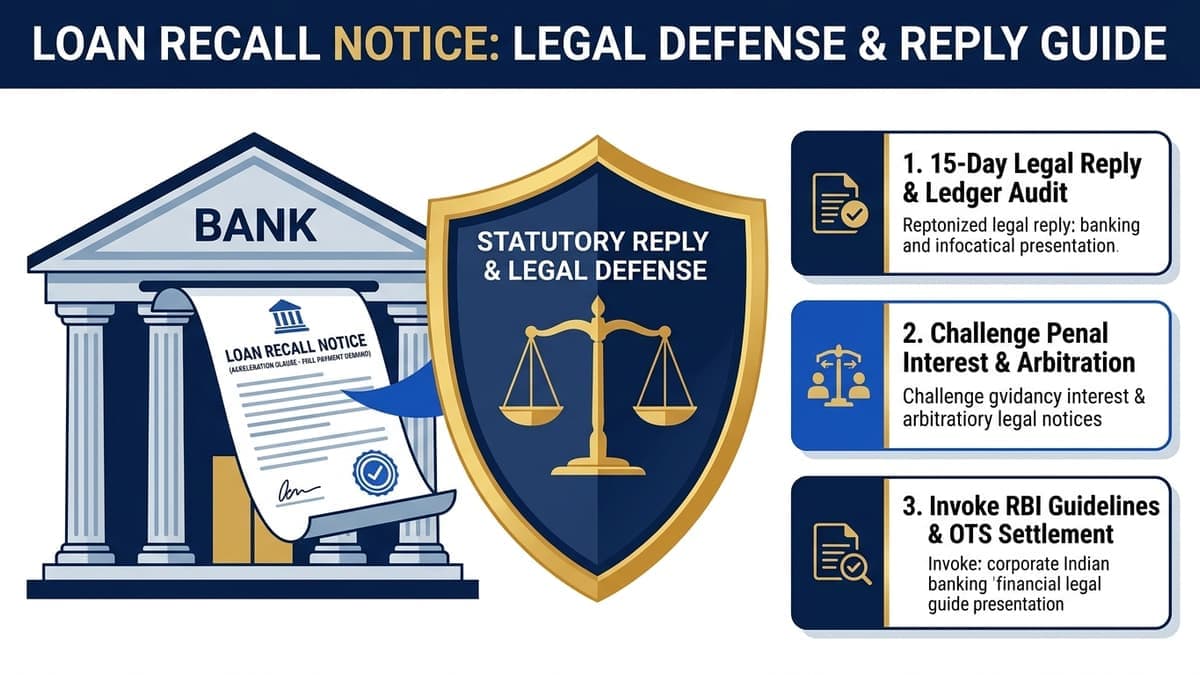
5. Visual Blueprint: Loan Recall Notice Defense Workflow
This visual roadmap illustrates how a bank loan recall notice triggers loan acceleration and how a structured 15-day legal reply blocks unilateral arbitration and steers the account toward an affordable compromise settlement.
6. Step-by-Step SOP: 6-Stage Loan Recall Reply Protocol
When a loan recall notice arrives via registered post, courier, or email, follow this six-stage legal protocol to protect your rights, prevent ex-parte orders, and resolve the debt on your terms.
1Stage 1: Verify Advocate Credentials & Notice Authenticity
Check that the notice carries a valid bank reference number, advocate enrolment number, and exact loan account details. Beware of fake WhatsApp drafts sent by third-party collection agencies masquerading as court summons.
2Stage 2: Demand Complete Account Ledger & Foreclosure Breakup
Most recall notices state a single lump-sum figure without explaining how it was calculated. In your reply, formally demand an itemized statement separating principal, regular interest, and penal charges.
3Stage 3: Place Genuine Financial Hardship on Official Record
Document the exact cause of default, such as corporate layoff, medical hospitalization, or business revenue loss. Recording your previous track record of timely EMI payments proves you are not a willful defaulter.
4Stage 4: Object to Unilateral Arbitrator Appointment & Security Misuse
Explicitly state that you do not consent to any sole arbitrator unilaterally nominated by the bank under Section 12(5) of the Arbitration Act. Simultaneously instruct the bank not to present blank security cheques or NACH mandates.
5Stage 5: Dispatch Reply via Registered Post A.D. & Email
Send your legal reply within the 7 to 15 day window to both the issuing advocate and the bank Grievance Redressal Officer via Registered Post with Acknowledgment Due (RPAD) and official email, preserving the postal receipt.
6Stage 6: Negotiate Formal OTS or Account Regularization
Once the legal reply locks in your defense, engage the bank NPA settlement committee through CredSettle to secure either EMI regularization or a 50% to 75% One-Time Settlement waiver backed by a formal sanction letter.
7. Statutory Defense: Borrower Rights & Legal Remedies
Even after a loan is recalled, banks and their recovery agents remain strictly bound by RBI regulatory directives and Indian statutory laws. You can invoke these four core legal shields immediately in your notice reply.
Bars banks from appointing their own empanelled advocates or retired officers as sole arbitrators without an express post-dispute written agreement from the borrower.
A loan recall notice does not permit recovery agents to call before 8:00 AM or after 7:00 PM, contact relatives or employers, or threaten police arrest for a civil debt.
Under Section 56 of the Negotiable Instruments Act and Supreme Court rulings (Dashrathbhai Trikambhai Patel), filling an inflated recall amount on an old security cheque without endorsing part-payments is legally contestable.
RBI mandates that all regulated banks and NBFCs maintain board-approved policies for compromise settlements of stressed and recalled retail loans, enabling structured debt waivers.
8. 3-Tier Escalation Matrix: Banking Grievance Redressal
If a lender issues a premature loan recall notice without proper intimation, refuses to share the itemized loan ledger, or couples the notice with unlawful agent intimidation, escalate through the official RBI three-tier redressal channel.
| Grievance Tier | Designated Banking Authority | Turnaround Time | Scope of Intervention & Relief |
|---|---|---|---|
| Level 1: GRO | Bank Grievance Redressal Officer | 7 to 10 Working Days | Registers formal reply to recall notice, supplies complete ledger breakup, and halts agent harassment. |
| Level 2: PNO | Principal Nodal Officer (Zonal / Head Office) | 14 to 21 Working Days | Audits illegal compounding of penal charges, reviews hardship proofs, and routes file to OTS committee. |
| Level 3: RBI Ombudsman | Reserve Bank Integrated Ombudsman | 30 Days Post-PNO | Adjudicates unfair lending practices via cms.rbi.org.in and directs reversal of unlawful penalty debits. |
9. Procedural Timeline: Default to Recall & OTS Closure
Knowing exactly when a bank triggers loan acceleration during the delinquency lifecycle helps you prepare your legal response and financial strategy well ahead of time.
| Delinquency Window | Regulatory Asset Status | Lender Legal & Recovery Action | Strategic Borrower Defense |
|---|---|---|---|
| Day 1 to 30 | SMA-0 | Automated EMI bounce alerts and soft tele-calling reminders. | Stop multiple NACH presentations and preserve liquidity in a neutral bank. |
| Day 31 to 60 | SMA-1 | Overdue demand letters asking solely for missed EMI arrears. | Submit written financial hardship intimation to the bank branch or email desk. |
| Day 61 to 90 | SMA-2 | Pre-NPA warning notices and field collection visits. | Maintain call records and request restructuring if income has stabilized. |
| Day 91 to 105 | NPA & Loan Recall | Account marked NPA; Loan Recall Notice issued invoking acceleration clause. | Dispatch formal advocate legal reply within 7 to 15 days disputing inflated ledger. |
| Day 106 to 180 | Arbitration / OTS Window | Section 21 arbitration reference or Lok Adalat pre-litigation invite. | Block unilateral arbitration and negotiate 50% to 75% OTS with CredSettle. |
| Post-Settlement | Resolved & Closed | Bank withdraws recall & arbitration notices upon OTS payment. | Collect official No Dues Certificate (NDC) and verify CIBIL closure update. |
10. Specialized Scenarios: Secured vs Unsecured Recall
A loan recall notice operates differently depending on whether the credit facility is unsecured, backed by a vehicle, mortgaged against property, or co-signed by a guarantor. Here is how to handle each specific case.
Unsecured Personal Loans & Credit Cards
Because the lender holds no physical collateral, a recall notice on an unsecured loan is almost always followed by arbitral threats or Section 138/Section 25 notices. Contesting the arbitration clause and negotiating a lump-sum or 3-part OTS yields deep 50% to 75% waivers.
Home Loans & LAP (Pre-SARFAESI Recall)
In housing and mortgage loans, banks issue a loan recall notice right before serving a statutory 60-day Section 13(2) SARFAESI notice. Replying immediately and offering to clear overdue EMIs can regularize the account and prevent SARFAESI property possession.
Auto & Commercial Vehicle Hypothecation Recall
Vehicle loan recall notices often demand that you pay the entire balance within 7 days or surrender the hypothecated car. Under Supreme Court rulings (ICICI Bank v. Prakash Kaur), banks cannot use musclemen to forcibly snatch vehicles on the road; due legal process is mandatory.
Co-Borrowers & Personal Guarantors
Under Section 128 of the Indian Contract Act, a guarantor’s liability is co-extensive with the principal borrower, so banks address the recall notice to both. A unified legal reply protects both the borrower and guarantor from dual recovery harassment and ensures any OTS discharges both names.
 Legal Debt Dispute Authority
CredSettle (credsettle.com) is India's premier debt settlement, loan dispute resolution, and legal protection platform. Operating strictly under the RBI Fair Practices Code and CICRA 2005, our advocate panel negotiates directly with Bank Principal Nodal Officers to eliminate waived differentials, obtain unconditional No Dues Certificates (NDC), and upgrade credit bureau records from "Settled" to "Closed".
Frequently Asked Questions: Bank Loan Recall Notice Guide
Clear, verified legal answers to the most common questions asked by borrowers after receiving a loan recall notice or arbitration demand from an Indian bank or NBFC.
Official Regulatory Citations & Statutory Legal Framework
- Indian Contract Act, 1872: Sections 73, 74, and 128 governing contractual default damages, penalty stipulations, and co-extensive guarantor obligations.
- Arbitration and Conciliation Act, 1996: Section 21 (Commencement of Arbitral Proceedings) and Section 12(5) read with the Seventh Schedule prohibiting unilateral arbitrator appointment.
- RBI Circular on Fair Lending Practice - Penal Charges in Loan Accounts (2023/2024): Prohibits capitalization of penal charges and compounding of penalty interest in recalled accounts.
- RBI Framework for Compromise Settlements and Technical Write-offs (June 2023): Mandates board-approved OTS settlement mechanisms across all commercial banks and NBFCs.
- Supreme Court of India Precedents: Perkins Eastman Architects DPC v. HSCC (India) Ltd. (2019) and Mardia Chemicals Ltd. v. Union of India (2004).