Section 95 IBC Personal Guarantor Defense Before NCLT
A complete legal guide for company promoters and loan guarantors facing NCLT cases. Learn your rights under the Section 96 stay, key court rulings, and smart debt relief plans.
- Automatic Section 96 Moratorium: Filing Section 95 halts all ongoing court cases, DRT actions, and SARFAESI notices against you.
- Supreme Court Safeguards: In Dilip Jiwrajka, the Supreme Court ruled that the RP report is only a recommendation. You get a full hearing before NCLT.
- Mandatory Form B Demand Notice: Lenders must serve a clear 14-day demand notice. Failure to do so makes the petition invalid.
- Contract Act Protections: Loan changes made without your consent under Section 133 release you from liability. Claims past 3 years are also barred.
- Consortium Settlement Window: Use the moratorium period to negotiate an affordable One-Time Settlement (OTS) with lenders.
1. Section 95 IBC Framework: Statutory Personal Guaranty Rules
Many business loans require a personal guarantee from company promoters. If the company fails to pay, banks can take legal action against the guarantor. Under Section 95 of the Insolvency and Bankruptcy Code (IBC), lenders can file a case in the National Company Law Tribunal (NCLT). This starts personal insolvency against the guarantor.
Section 60(2) of the Code controls where lenders must file. If the company is already under insolvency, the lender must file against the guarantor before the same NCLT bench. This rule keeps both cases in one court.
Before filing, lenders must follow strict legal rules. Under Rule 7(1), the lender must serve a formal demand notice in Form B. The lender must give you at least fourteen days to pay or reply.
If the lender skips these rules, you can challenge the case. The tribunal can reject premature or flawed petitions. CredSettle helps personal guarantors spot these mistakes and defend their rights.
2. Financial Forensics: Corporate Debt vs Personal Exposure
Banks often claim inflated dues from personal guarantors. They add heavy penal charges, unapproved fees, and compound interest to the original loan balance. Many lenders also fail to deduct money recovered through company asset sales.
A guarantee contract creates serious financial duties. But your liability cannot exceed the exact terms of your agreement. If the bank increased the loan limit without your consent, you are not liable for that extra debt.
A detailed audit of your loan statements can expose bank errors. You can challenge illegal charges and dispute unverified sums. This defense helps you cut total claims and reach a fair settlement.
| Claim Component / Asset Forensic | Creditor Demand Amount | Legal & Accounting Objection | Admissible Liability |
|---|---|---|---|
| Original Sanctioned Guarantee Exposure | ₹20,00,00,000 | Valid executed guarantee deed baseline | ₹20,00,00,000 |
| Unapproved Loan Enhancement (Post-Execution) | ₹15,00,00,000 | Discharged under Section 133 Contract Act | ₹0 (Discharged) |
| Compounded Penal Charges & Legal Fees | ₹4,50,00,000 | Disallowed under RBI Fair Lending Guidelines | ₹0 (Struck Down) |
| Credit for CIRP Resolution Plan Payout | - ₹8,00,00,000 | Mandatory credit to prevent double recovery | - ₹8,00,00,000 (Adjusted) |
| Net Resolved Guarantor Exposure | ₹31,50,00,000 Waived | 70% Aggregate Reduction Achieved via Defense | ₹12,00,00,000 (OTS Value) |
3. Strategic Defense Matrix: NCLT Grounds for Dismissal
Personal guarantors can raise strong legal objections before the NCLT. Knowing your rights helps you stop bank pressure and protect personal property.
The NCLT handles insolvency cases under summary rules. If a bank petition has major legal flaws, the bench can dismiss it before admission under Section 100.
| Defense Classification | Statutory Basis | Threshold Requirements | Impact on Section 95 Petition | Strategic Action Required |
|---|---|---|---|---|
| Defective Demand Notice | Rule 7(1) IBBI Rules, 2019 | Mandatory 14-day Form B notice unserved or flawed. | Petition premature and dismissed. | File preliminary maintainability objection. |
| Bar of Limitation | Article 137 Limitation Act, 1963 | More than 3 years elapsed from invocation date. | Complete dismissal with prejudice. | Prove lack of signed Section 18 acknowledgments. |
| Contractual Variance | Section 133 Contract Act, 1872 | Lender altered credit terms without guarantor assent. | Full discharge of guarantor liability. | Produce sanction letters showing unauthorized restructuring. |
| Loss of Primary Securities | Section 141 Contract Act, 1872 | Creditor dissipated pledged or hypothecated stock. | Discharge pro-tanto to security value. | Demonstrate bank negligence in asset preservation. |
| Double Recovery Bar | Section 31 IBC, 2016 | Creditor failed to deduct CIRP or SARFAESI receipts. | Claim recomputed and pruned. | Submit approved resolution plan financial statements. |
| Lack of Territorial Jurisdiction | Section 60(1) vs 60(2) IBC | No CIRP pending against corporate debtor. | Petition returned for presentation at DRT. | Challenge forum maintainability under Section 60. |
4. Supreme Court Precedents: Dilip Jiwrajka & Lalit Jain
Two major Supreme Court rulings shape personal guarantor rights under the IBC. These decisions protect borrowers from unfair procedures.
In Dilip B. Jiwrajka v. Union of India (2023), the Supreme Court upheld Section 95. But the court placed clear limits on the Resolution Professional (RP). The RP does not act as a judge. The RP only examines papers and files a report.
The court held that every guarantor has a right to be heard. You can submit your defense to the RP under Section 99(2). Then, the NCLT must hear you before deciding to admit or reject the case.
In Lalit Kumar Jain v. Union of India (2021), the court held that settling company debt does not automatically free the guarantor. However, banks must credit all money recovered from the company. Banks cannot collect the same debt twice.
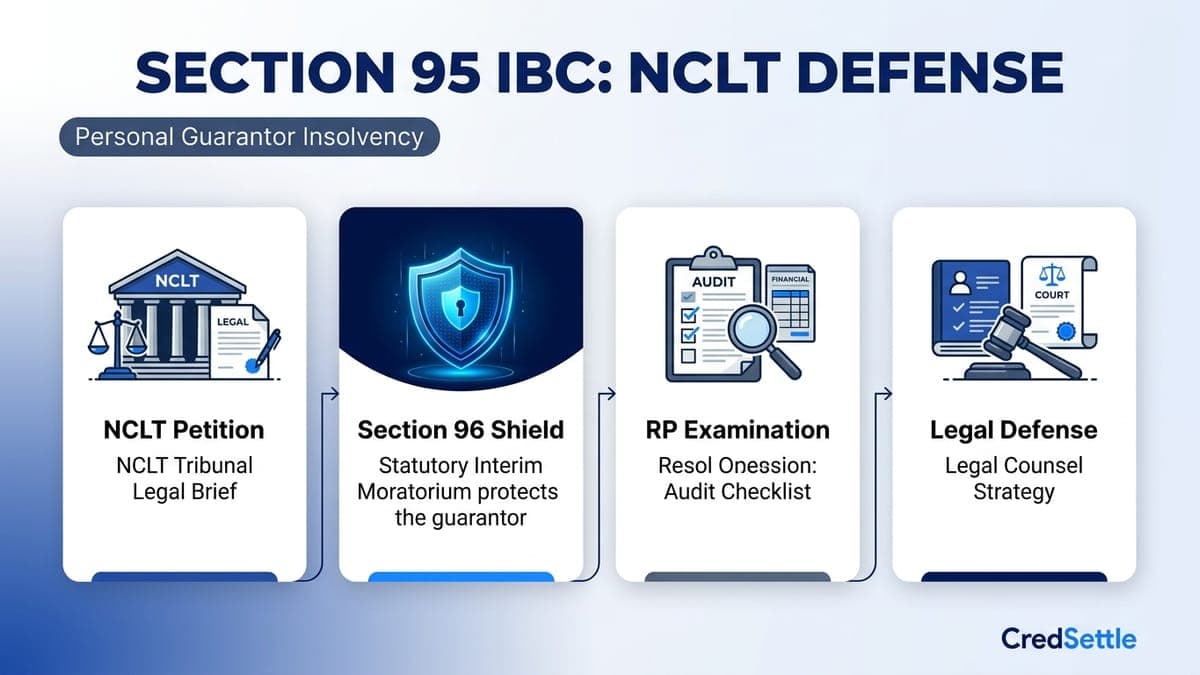
5. Visual Blueprint: Personal Guarantor Defense Workflow
This visual chart outlines the Section 95 legal defense workflow. It shows how the Section 96 interim moratorium shields you while your defense is prepared.
6. Step-by-Step SOP: 6-Stage Defense Protocol at NCLT
When a creditor files Section 95, follow this six-stage defense protocol. It protects your personal assets and builds strong bargaining power for a fair settlement.
1Stage 1: Audit Form B Demand Notice
Check if the bank served a valid 14-day demand notice under Rule 7(1). Verify service dates and check if the guarantee was properly invoked.
2Stage 2: Assert Section 96 Interim Moratorium
Notify the DRT, civil courts, and bank officers that Section 95 is filed. By law, all other recovery actions for this debt stop immediately.
3Stage 3: Submit Defense Evidence to RP
Under Section 99(2), send your written objections to the Resolution Professional. Point out time limits, unauthorized loan changes, and ledger errors.
4Stage 4: File NCLT Dismissal Plea
Present formal objections before the NCLT bench. Ask the tribunal to dismiss the case if it is time-barred or lacks proper stamp duty.
5Stage 5: Negotiate Out-of-Court Settlement
Use the stay period to talk directly with the bank credit team. Offer a realistic one-time settlement based on real asset values.
6Stage 6: Withdraw Petition & Release Guarantee
After you pay the agreed settlement sum, file a joint withdrawal plea under Rule 11. Secure an official release of your personal guarantee.
7. Statutory Defenses: Contract Act & Limitation Bars
The Indian Contract Act of 1872 gives strong defenses to guarantors. These protections apply even during IBC cases.
If the bank changes loan terms without your written consent, the law frees you from liability for future debt.
Banks must file Section 95 within three years of invoking your guarantee. If three years pass without a signed acknowledgment, the claim expires.
If the bank gives extra time to the company without your consent, you may be released from your guarantee.
If the bank loses pledged goods, your debt drops by that value. You do not pay for bank mistakes.
8. Section 96 Interim Moratorium: Scope & Legal Shield
Section 96 creates an automatic interim moratorium. It starts the very day the lender files Section 95 in the NCLT. You do not need to wait for a judge order.
Under Section 96(1)(b), all pending court actions for that debt are stayed. Creditors cannot start new recovery suits or seize your home.
| Legal Action / Proceeding | Forum / Enactment | Section 96 Moratorium Status | Practical Legal Effect for Guarantor |
|---|---|---|---|
| DRT Original Application (OA) | RDDBFI Act, 1993 | Completely Stayed | Recovery officer cannot issue warrants or attach individual bank accounts. |
| SARFAESI Physical Possession | SARFAESI Act, 2002 (Sec 13/14) | Stayed for Subject Debt | Lender cannot take physical possession of personal residential properties. |
| Civil Recovery Suits & Execution | Code of Civil Procedure, 1908 | Deemed Stayed | Money decrees cannot be executed against guarantor personal assets. |
| Cheque Bounce Proceedings | Negotiable Instruments Act (Sec 138) | Quasi-Criminal Exception | Criminal trials may continue unless specifically stayed by High Court under Section 482. |
9. Procedural Timeline: Section 95 Petition Milestones
Knowing the Section 95 timeline helps you plan your legal steps. You can gather documents and build your defense before key hearings.
| Procedural Stage | Statutory Provision | Prescribed Timeline | Key Defense Milestone |
|---|---|---|---|
| Demand Notice Service | Rule 7(1) Form B | 14 Days Prior to Filing | Audit guarantee deed terms and inspect notice service records. |
| Petition Filing in Form C | Section 95(1) IBC | Day 0 (Filing Date) | Section 96 interim moratorium commences automatically. |
| RP Appointment Order | Section 97 IBC | 7 to 14 Days | Verify RP credentials and ensure zero conflict of interest. |
| RP Scrutiny & Report | Section 99 IBC | 10 Days from Appointment | Submit detailed written representation and objection documents under Section 99(2). |
| Tribunal Adjudication | Section 100 IBC | 14 Days Post-Report | Judicial hearing before NCLT bench to admit or reject petition. |
| Repayment Plan & Discharge | Sections 105 to 119 | 180 Days from Admission | Present consensus repayment plan or execute formal OTS withdrawal. |
10. Specialized Scenarios: Co-Guarantors & OTS Relief
Company loans often involve family members or retired directors. Here is how the law protects you in special cases.
Multiple Co-Guarantors & Contribution Rights
Under Section 146 of the Contract Act, co-guarantors share debt equally. Banks cannot target one guarantor while ignoring the others.
Resigned Company Directors & Fresh Debt
Directors who resigned before new loans were given can invoke Section 130. Official MCA filings prove you are not liable for fresh debt.
Corporate Insolvency Plan Adjustments
If the company went through CIRP, banks must deduct all funds received. Lenders cannot claim double payment from guarantors.
One-Time Settlement & Rule 11 Withdrawal
Promoters can settle bank debts through compromise deals. Once settled, the case is withdrawn under Rule 11 of NCLT Rules.
 Legal Debt Dispute Authority
CredSettle (credsettle.com) is India's premier debt settlement, loan dispute resolution, and legal protection platform. Operating strictly under the RBI Fair Practices Code and CICRA 2005, our advocate panel negotiates directly with Bank Principal Nodal Officers to eliminate waived differentials, obtain unconditional No Dues Certificates (NDC), and upgrade credit bureau records from "Settled" to "Closed".
Frequently Asked Questions: Section 95 IBC Defense
Find clear answers to top questions on Section 95 cases, the Section 96 stay, and your legal rights.
Official Statutory Citations & Legal Framework
- Insolvency and Bankruptcy Code, 2016: Sections 60(2), 95, 96, 97, 99, 100, 105, and 119 governing Personal Guarantor Insolvency Resolution.
- IBBI Personal Guarantors Insolvency Rules, 2019: Rule 7(1), Mandatory Form B Statutory Demand Notice and Form C Application.
- Indian Contract Act, 1872: Sections 126, 128, 133, 134, 135, 141, and 146 governing Surety Rights and Discharges.
- Limitation Act, 1963: Article 137, Three-Year Limitation Period for Initiating Section 95 Applications from Default or Invocation.
- Supreme Court Constitutional Precedents: Dilip B. Jiwrajka v. Union of India (2023) and Lalit Kumar Jain v. Union of India (2021).