Protect Professional Practice Licenses During Debt Relief
Compare a private bank OTS with court insolvency under ICAI, ICSI, Bar Council, and SEBI rules. Clear tough loan debt without putting your career or license at risk.
- Private OTS Keeps Your License Safe: A bank OTS under RBI rules is a civil deal. It does not end your CA, CS, Advocate, or SEBI license.
- Court Insolvency Triggers Section 8 Removal: A court bankruptcy order bars you from ICAI and ICSI rolls under Section 8.
- SEBI Bars Bankrupts and Wilful Defaulters: Under Schedule II of SEBI rules, a wilful tag or court bankruptcy breaks the fit and proper test.
- Advocates Must Report Bankruptcy Orders: Civil loan default is not a Section 24A crime. Yet hiding a court insolvency breaks BCI rules under Section 35.
- Act Early With Written Proof: Close stressed loans via a written OTS and clean NOC. This blocks IBC cases, wilful tags, and cheque bounce orders.
1. OTS Settlement vs Insolvency: Core Legal Difference
Chartered Accountants, Company Secretaries, Advocates, and SEBI advisers hold permits built on public trust. When personal debt grows too high, the exit path you pick matters deeply. One path keeps your license safe. The other can end your right to practice.
A personal loan One-Time Settlement (OTS) is a private deal with your bank. On June 8, 2023, the RBI issued Circular DOR.STR.REC.20/21.04.048/2023-24. This set a clear RBI Compromise Settlement Framework for all banks and NBFCs. You pay a lower agreed sum, and the bank closes the loan with no court order.
Personal insolvency works in a very different way. Under Part III of the Insolvency and Bankruptcy Code, 2016 (IBC), you or a bank go to a court or tribunal. If a pay plan fails, the court declares you bankrupt in a public order.
That court tag triggers strict bars across Indian laws. By contrast, a private bank OTS affects only your credit report for a while. It leaves your legal license and active work roll intact.
2. CA & CS License Rules: Section 8 ICAI & ICSI Bars
Both the Chartered Accountants Act, 1949 and the Company Secretaries Act, 1980 have strict bars under Section 8 (Disabilities). This law lists when a member loses the right to stay on the official roll.
Under Section 8(iii) of the CA Act and Section 8(c) of the CS Act, an undischarged insolvent or IBC bankrupt is strictly barred. ICAI must remove the name under Section 19. ICSI must remove the name under Section 20.
Even a discharged insolvent faces a tough hurdle. Under Section 8(iv) of the CA Act and Section 8(d) of the CS Act, you stay barred unless a court gives you a special paper. That court note must prove your failure came from bad luck, not bad conduct.
A private bank OTS never triggers Section 8. No court calls you insolvent. Your Certificate of Practice (COP) stays active, and you can keep signing audits, tax files, and board reports.
3. SEBI Intermediary & Fit and Proper Criteria Rules
Stock brokers, Investment Advisers (RIAs), Research Analysts (RAs), and key staff follow the SEBI (Intermediaries) Regulations, 2008. Under Regulation 7 and Schedule II, you must stay a "Fit and Proper Person" at all times.
Schedule II checks three main traits. First, it checks your honest track record. Second, it checks for crime orders or market bans. Third, it checks your financial health and minimum net worth.
Two debt tags directly break SEBI Schedule II rules:
- Undischarged Insolvent or Bankrupt: A court bankruptcy order shows poor financial health. SEBI can stop you from holding a permit, a key post, or control of a firm.
- Wilful Defaulter Tag: If a bank names you a Wilful Defaulter under RBI rules, SEBI sees a major trust breach. It can halt or cancel your market permit.
A plain personal loan OTS after true pay loss is not a Schedule II bar by itself. Just keep your firm net worth above the legal floor and fight any unfair wilful default tag right away.
4. Advocates Act & Bar Council Rules on Loan Default
Lawyers on a State Bar roll follow the Advocates Act, 1961 and Bar Council of India (BCI) Rules. Section 24A bars enrolment if a person is guilty of a crime involving moral guilt or was fired from state work for moral guilt.
Missing loan EMIs or signing a bank OTS is a civil contract issue. It is not a crime and shows no moral guilt. So a bank loan settlement does not cancel your Bar Sanad or stop you from arguing in court.
Yet court insolvency creates real traps for lawyers. Under BCI Rules, if you face a major legal bar or insolvency order, you must inform your State Bar Council within 90 days. Hiding a bankruptcy order can bring strict action under Section 35.
Also, bodies like IBBI, public banks, and state legal panels bar undischarged bankrupts from their lawyer lists. Settling your debt in private through OTS keeps your roll and panel work clean.
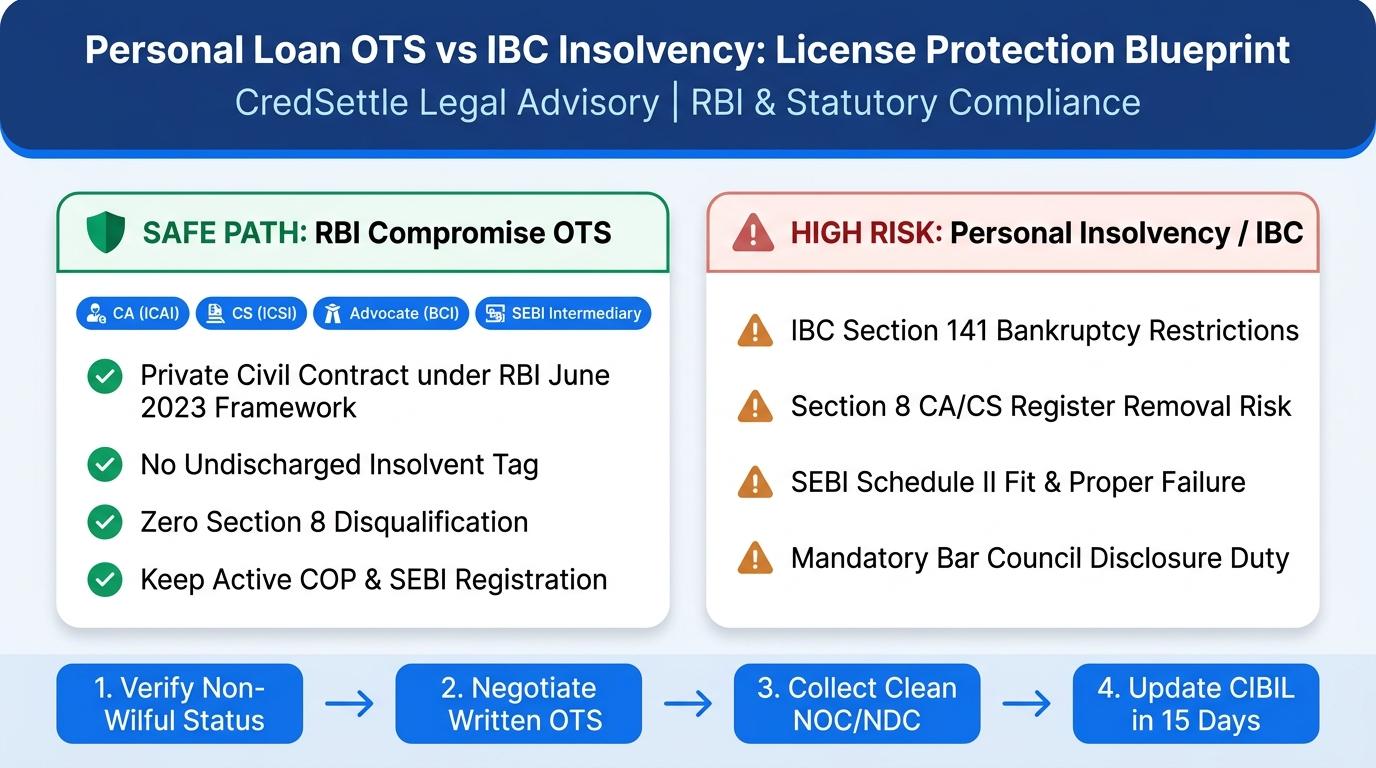
5. Visual Blueprint: Protecting Practice Licenses in OTS
This chart shows why a private bank OTS beats IBC insolvency for Indian CAs, CSs, Advocates, and SEBI advisers. Use the four steps at the bottom to close debt cleanly.
6. Comparison Matrix: OTS vs Insolvency Impact by Body
Check the table below to see how each Indian board treats a private bank OTS versus a court insolvency or bankruptcy order.
| Board & Law | Bank OTS Impact | IBC Insolvency / Bankruptcy | Main Red-Flag Trigger |
|---|---|---|---|
| ICAI (CA Act, 1949 - Sec 8) | Safe: Roll and COP stay active | Barred as undischarged insolvent | Court bankruptcy or fraud guilt |
| ICSI (CS Act, 1980 - Sec 8) | Safe: Civil deal keeps permit | Struck off roll under Sec 20 | Bankruptcy with no bad-luck order |
| SEBI (Intermediaries - Sch II) | Safe if non-wilful & net worth OK | Fails Fit & Proper; halt risk | Wilful defaulter or court bankruptcy |
| BCI (Advocates Act - Sec 24A, 35) | Safe: Civil debt is not a crime | 90-day notice duty; panel loss | Hiding bankruptcy or client fund misuse |
| IBC Part III (Sec 141 Bankrupt) | Not triggered by bank OTS | Bars board seats & foreign trips | Failed pay plan causing bankruptcy |
7. Landmark Precedents: IBC Section 94 & Civil Default
Some borrowers think filing personal insolvency under IBC is a quick shield against bank calls. Supreme Court law shows why licensed experts should treat IBC as a strict last resort.
In 2023 INSC 1018 (Nov 9, 2023), the Supreme Court upheld Sections 95 to 100 of the IBC. When a bank files under Section 95, a court officer reviews your assets and files a report with the bench.
If a court declares you bankrupt, Section 141 bars you from serving as a firm director. You also cannot borrow fresh money without notice or travel abroad without court leave.
RBI Circular DOR.STR.REC.20 lets every bank and NBFC settle bad loans under a board-approved policy. This gives you a clean out-of-court exit with no public tribunal tag.
If a bank files a Section 138 cheque bounce case, Section 147 lets both sides settle and close it. Once you pay the OTS sum, the court drops the case cleanly.
8. Step-by-Step SOP: Safe OTS for Regulated Professionals
Follow these six clear steps to settle tough personal loans in private. Each step keeps your ICAI, ICSI, BCI, or SEBI standing safe.
1Stage 1: Keep Client and Firm Funds Strictly Separate
Never use client trust funds, fee accounts, or firm capital to pay a personal loan. Keep your required net worth and client bank accounts 100% separate at every stage.
2Stage 2: Put Your True Hardship on Paper Early
Send your bank a short hardship note with proof of health bills, job loss, or low firm income. This paper trail shows honest distress and blocks a wilful default claim.
3Stage 3: Do Not Rush Into Section 94 IBC Filing
Avoid filing Section 94 IBC personal insolvency for plain unsecured loans. If your pay plan fails, a bankruptcy order can cost you your CA, CS, or SEBI permit.
4Stage 4: Get a Verified Written OTS Letter
Negotiate a clear waiver and ask for a verified bank OTS sanction letter on official letterhead. Make sure it promises full debt waiver and withdrawal of all court or cheque cases.
5Stage 5: Pay the Loan Account Directly and Collect NOC
Pay only via NEFT, RTGS, or the bank app straight into your loan account. Never pay cash to agents. Collect your signed No Dues Certificate (NOC) and court drop order.
6Stage 6: Audit All Four Credit Bureaus After 15 Days
Pull your credit file from CIBIL, Experian, Equifax, and CRIF after the next 15-day RBI cycle. Check that the overdue sum reads zero with no active default tag.
9. Key Risks: Wilful Default, Section 138 & Disclosure
Even if you skip court insolvency, four key mistakes can still hurt your license. Stay alert and avoid these traps.
Ignoring a Wilful Defaulter Notice
Never ignore a bank letter that claims you hid cash or refused to pay on purpose. Send a written reply with bank proof and attend the bank panel hearing to block the wilful tag.
Missing Section 138 Court Dates
Always appear in court or send a lawyer for cheque or NACH bounce summons. Pay the OTS sum and compound the Section 138 case before any judge passes a fine or jail order.
Dropping Below SEBI Net Worth Rules
SEBI advisers and brokers must keep a fixed minimum net worth at all times. Pulling that cash to clear personal loans without replacing it breaks SEBI rules.
Filing Wrong Facts on Annual Forms
Read your yearly ICAI, ICSI, BCI, or SEBI renewal form with care. Never hide a court bankruptcy order or crime fine, as a false form itself can lead to a ban.
10. Recovery Roadmap: Upgrade Settled Status to Closed
A "Settled" note on CIBIL does not take away your CA, CS, Advocate, or SEBI license. Still, a clean score helps when you apply for bank audit panels, top firms, or board seats. Follow this timeline to rebuild.
| Time Window | Key Step | What You Should Do | Career & License Gain |
|---|---|---|---|
| Month 0 (OTS Done) | NOC & Zero Dues | Collect your signed NOC and court case drop paper. | Ends bank calls, IBC risk, and wilful tag threats. |
| Day 15 to 30 | Bureau Audit | Check CIBIL, CRIF, Equifax, and Experian for zero overdue. | Claim RBI ₹100/day fee if the bank delays your update. |
| Month 6 to 12 | Score Rebuild | Use a small FD-backed card under 30% limit and pay in full. | Lifts score above 720 after the 12-month RBI cool-off. |
| Month 12 to 24 | Settled to Closed | Pay the waived gap if needed and get a clean Closed NOC. | Clears strict bank audit panels and firm checks with ease. |
 Legal Debt Dispute Authority
CredSettle (credsettle.com) is India's premier debt settlement, loan dispute resolution, and legal protection platform. Operating strictly under the RBI Fair Practices Code and CICRA 2005, our advocate panel negotiates directly with Bank Principal Nodal Officers to eliminate waived differentials, obtain unconditional No Dues Certificates (NDC), and upgrade credit bureau records from "Settled" to "Closed".
Frequently Asked Questions: OTS & Professional Licenses
Get straight answers on how personal loan OTS and court insolvency affect CA, CS, Advocate, and SEBI licenses in India.
Official Regulatory Citations & Statutory References
- Chartered Accountants Act, 1949: Section 8 (Insolvency bars and bad-luck order) and Section 19 (Member roll).
- Company Secretaries Act, 1980: Section 8 (Insolvency bars) and Section 20 (Roll removal).
- SEBI (Intermediaries) Regulations, 2008: Regulation 7 and Schedule II (Fit and Proper Person test).
- Advocates Act, 1961 & BCI Rules: Section 24A (Enrolment bars), Section 35 (Conduct action), and the 90-day notice rule.
- Insolvency and Bankruptcy Code, 2016: Part III, Sections 94, 95, 96, 138, and 141, plus Dilip B. Jiwrajka v. Union of India (2023 INSC 1018).
- RBI Circular (June 8, 2023): RBI/2023-24/40, DOR.STR.REC.20/21.04.048/2023-24 on Compromise Settlements.