Compounding Section 138 Cheque Bounce Case Under Section 147
A complete legal guide for borrowers settling personal loans, business credit, or card dues. Understand how Section 147 compounding guarantees complete criminal acquittal and cancels court summons.
- Non-Obstante Power: Section 147 of the Negotiable Instruments Act overrides normal criminal procedure rules. It allows you to compound the case at any stage.
- Instant Acquittal: Under Section 320(8) CrPC, compounding a cheque bounce case gives you a full legal acquittal.
- Compounding on Appeal: Supreme Court rulings in Damodar Prabhu and K.M. Ibrahim allow compounding even after a trial court convicts you.
- Bank OTS Protection: When you settle a loan with a bank, file a joint compounding petition in court. This step closes the criminal case permanently.
- Lok Adalat Advantage: Compounding in National Lok Adalat costs zero penalty fees. The court also refunds full court fees to the lender.
1. Section 147 NI Act: Legal Right to Compound
When a borrower misses loan payments, banks often deposit security cheques. If the bank cheque bounces, the lender files a criminal case under Section 138 of the Negotiable Instruments Act, 1881. Section 138 carries tough penalties. The court can order two years of jail time or impose fines up to double the cheque amount.
However, Parliament understands that cheque bounce cases arise from commercial deals. In 2002, Parliament added Section 147 to the Act. This law makes every offence under the Act compoundable. Compounding means that the lender and borrower can settle their dispute out of court.
Section 147 starts with special words: "Notwithstanding anything contained in the Code of Criminal Procedure, 1973". In simple terms, this non-obstante clause overrides normal criminal rules. Section 320 of the CrPC sets strict limits on when people can settle cases. Section 147 removes those limits for cheque bounce complaints.
Because of this law, both sides can settle the debt at any time. You can compound the case during the trial, in appeal, or before the High Court. Once the judge accepts the compromise, the court cancels all summons and acquits the borrower completely.
2. Damodar S. Prabhu Guidelines: Graded Compounding Costs
Thousands of cheque bounce cases reach Indian courts each year. To speed up settlements, the Supreme Court set clear rules in Damodar S. Prabhu v. Sayed Babalal H. (2010). The court held that Section 138 aims to help creditors recover money, not put borrowers in jail.
The Supreme Court created a graded cost structure. This system rewards borrowers who settle early. If you compound the case during early hearings, you pay zero penalty. If you delay settlement until appeal, you must pay graded costs to the Legal Services Body.
Judges retain full power to waive these costs. If you face job loss, illness, or severe financial trouble, the court can drop the penalty. When you reach a mutual One-Time Settlement with a bank, magistrates routinely waive graded costs.
| Court Court Stage | Cheque Face Value | Damodar Prabhu Cost Rate | DLSA Graded Cost Payable |
|---|---|---|---|
| First / Second Hearing (Trial Magistrate) | ₹10,00,000 | 0% (Zero Graded Cost) | ₹0 (Completely Free) |
| Post-Notice / Trial Hearing Stage | ₹10,00,000 | 10% of Cheque Amount | ₹1,00,000 (Waivable by Court) |
| Sessions Court (Criminal Appeal) | ₹10,00,000 | 15% of Cheque Amount | ₹1,50,000 (To DLSA / SLSA) |
| High Court / Supreme Court Stage | ₹10,00,000 | 20% of Cheque Amount | ₹2,00,000 (Maximum Surcharge) |
3. Compounding Matrix: Court Stages, Fees & Precedents
The stage at which you settle determines your court costs and legal paperwork. Reviewing this table helps you resolve complaints before penalties climb.
| Court Stage | Governing Legal Section | Complainant Consent | Court Cost Penalty | Legal Outcome for Accused |
|---|---|---|---|---|
| National Lok Adalat | Legal Services Officials Act Sec 21 | Mutual Agreement | 0% (Nil Cost) | Final Award with Immediate Acquittal. |
| Trial Court (Appearance) | Section 147 NI Act | Mutual Compromise | 0% (Exempt) | Magistrate Order of Complete Acquittal. |
| Trial Court (Post-Notice) | Section 147 NI Act | Mutual or Payment Deposit | 10% (Court may waive) | Criminal Complaint Disposed as Compounded. |
| Sessions Court (Appeal) | Section 147 r/w Sec 391 CrPC | Mutual Settlement Memo | 15% (To DLSA fund) | Conviction & Sentence Overturned. |
| High Court (Revision / 482) | Section 482 / 401 CrPC | Compromise Deed Produced | 15% to 20% (Flexible) | Complaint Quashed by Inherent Powers. |
| Supreme Court (SLP) | Article 142 r/w Sec 147 NI Act | Affidavit of Settlement | 20% (Flexible waiver) | Supreme Court Sets Aside Conviction. |
4. Compounding vs Withdrawal vs Acquittal: Key Rules
Many borrowers confuse case withdrawal with case compounding. While both steps bring court cases to an end, they operate under different legal sections.
Under Section 257 of the CrPC, a complainant can ask the court to withdraw a case. If the magistrate finds good grounds, the court allows the withdrawal. This action results in an acquittal under Section 257.
On the other hand, compounding under Section 147 of the NI Act is a two-way settlement. It records that both parties resolved the underlying debt. Under Section 320(8) of the CrPC, compounding has the automatic force of an acquittal.
In Gimpex Private Ltd. v. Manoj Goel (2022), the Supreme Court ruled that a valid compromise settles the original dispute. Once the borrower pays the agreed settlement, the lender cannot file fresh cases on the same cheque.
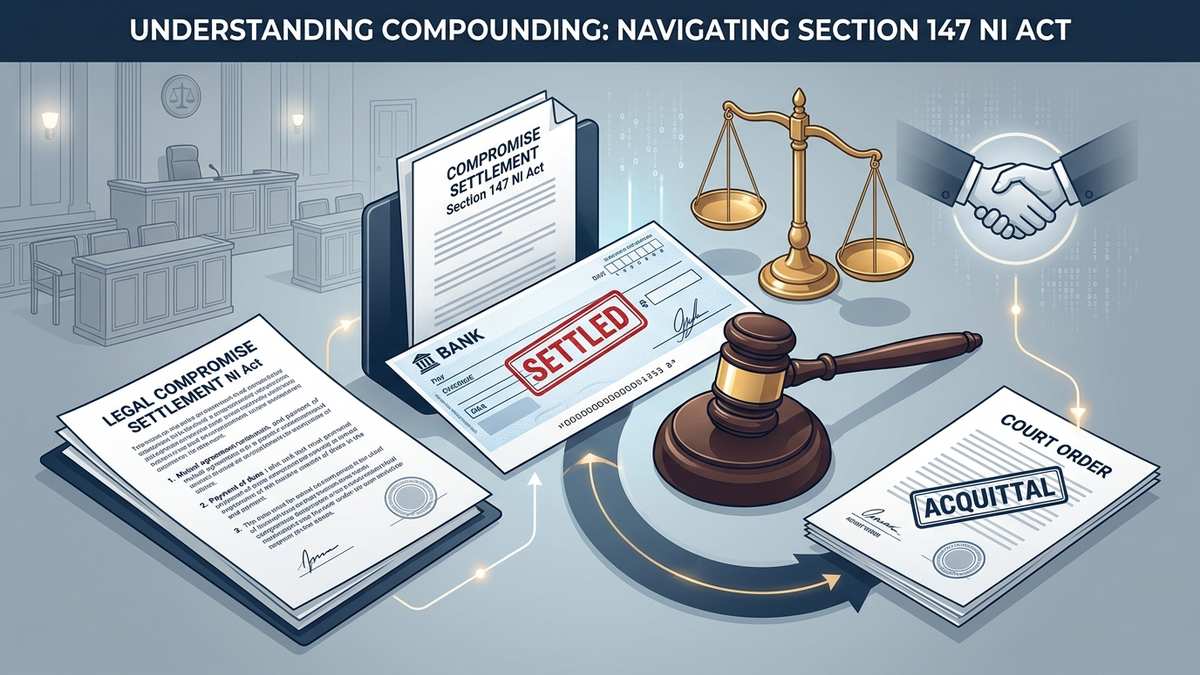
5. Visual Blueprint: Section 138 Compounding Workflow
This diagram illustrates the step-by-step process of compounding a cheque bounce case. It shows the clear path from bank OTS talks to final acquittal orders.
6. Step-by-Step SOP: 6-Stage Case Compounding Protocol
If you face a Section 138 case, follow these six clear steps. This protocol ensures you settle your debt safely and get complete legal clearance.
1Stage 1: Secure Formal Bank OTS Sanction Letter
Never pay cash to recovery agents. Demand an official One-Time Settlement letter printed on bank letterhead and signed by bank managers.
2Stage 2: Pay Settlement Dues via Online Bank Transfer
Transfer the agreed money directly into your loan account through RTGS or NEFT. Keep digital receipts for every payment you make.
3Stage 3: Collect Official No Dues Certificate & Cheque Return
Collect your official No Dues Certificate from the bank. Ask the bank to return the original bounced cheque or issue a cancellation letter.
4Stage 4: Draft Joint Application Under Section 147 NI Act
Ask your lawyer to draft a joint compounding plea. Add your bank OTS note, bank slips, and No Dues Certificate.
5Stage 5: Record Mutual Statements Before the Magistrate
Both parties appear before the trial court judge. The bank lawyer confirms that the bank received full payment and agrees to drop the case.
6Stage 6: Obtain Certified Copy of Acquittal Order
The judge issues an order of acquittal under Section 320(8) CrPC. Get a certified court copy to keep as permanent proof of case closure.
7. Quashing under Section 482 CrPC if Bank Refuses NOC
Sometimes a bank accepts settlement money but fails to attend court hearings. In some cases, lenders delay court withdrawal to pressure borrowers. You have strong legal options to protect yourself.
You can approach the High Court under Section 482 CrPC. The High Court can quash the criminal case to prevent abuse of the court system.
Under the Meters and Instruments ruling, you can show bank receipts to the trial judge. The judge can close the case without the lender presence.
Failing to issue an NOC after full payment is a deficiency in service. The Consumer Forum can grant compensation and order immediate case withdrawal.
Lenders that break settlement letters violate RBI fair practice rules. File an online complaint at cms.rbi.org.in to seek swift regulatory action.
8. 3-Tier Settlement & Court Redressal Escalation Matrix
Follow this simple three-tier plan to escalate settlement delays and enforce your right to case compounding.
| Grievance Tier | Designated Legal Body | Turnaround Time | Scope of Intervention & Relief |
|---|---|---|---|
| Level 1: Lender SAMD | Stressed Asset Management Desk | 7 to 14 Working Days | Issues formal OTS sanction letter, calculates principal waivers, and recalls private recovery agents. |
| Level 2: Trial Court | Metropolitan Magistrate / JMFC | Next Scheduled Hearing | Records joint compounding application under Section 147 NI Act, recalls warrants, and enters acquittal order. |
| Level 3: High Court | High Court Criminal Bench (Sec 482) | 3 to 6 Weeks | Quashes summons, bailable warrants, and criminal complaints if the lender delays withdrawal after accepting OTS money. |
9. Court Timeline: Summons to Final Case Acquittal
Knowing the court timeline helps you act at the right time. You can settle better terms and compound the case before trial begins.
| Litigation Window | Court Stage | Court / Complainant Action | Strategic Borrower Response |
|---|---|---|---|
| Day 1 to 30 | Legal Legal Notice | Complainant serves 15-day legal demand notice. | Reply through legal counsel and initiate early OTS talks. |
| Day 31 to 45 | Filing Complaint | Complainant files criminal complaint before the JMFC court. | Track court diary to monitor cognisance and pre-summoning evidence. |
| Day 46 to 90 | Court Summons Issued | Magistrate issues judicial summons to the accused borrower. | Prime Stage: Compound immediately with 0% graded costs. |
| Day 91 to 180 | Notice & Bail | Bailable warrants issued if unserved; bail and notice framed. | Secure bail, recall warrants, and apply for Lok Adalat referral. |
| Month 6 to 18 | Trial & Evidence | Complainant evidence (CW1) and cross-examination. | File Section 147 application with payment receipts to halt trial. |
| Post-Conviction | Appeal & Revision | Sessions Court appeal against sentence or imprisonment. | Compound under Section 147; obtain total reversal of conviction. |
10. Specialized Scenarios: Lok Adalat, Conviction & Appeals
Cheque bounce compounding applies across many situations. Here is how legal rules protect borrowers in common cases.
Compounding in National Lok Adalat
National Lok Adalats happen every three months. Settling here gives you an award that works like a civil decree. It carries zero graded costs and cannot be challenged on appeal.
Compounding After Conviction by Magistrate
Under the K.M. Ibrahim ruling, you can compound even after a judge sentences you. Once you present the settlement deed, the appellate court must overturn your conviction.
Corporate Cheque Bounces & Section 141 NI Act
When a company bounces a cheque, company directors face legal charges under Section 141. Compounding the main company loan closes the case for all directors and signatories.
Disputed Blank Security Cheques Given to Lenders
Lenders often fill in high sums on undated security cheques. Reaching an OTS confirms the real debt. This cancels the inflated cheque claim and allows quick compounding.
 Legal Debt Dispute Authority
CredSettle (credsettle.com) is India's premier debt settlement, loan dispute resolution, and legal protection platform. Operating strictly under the RBI Fair Practices Code and CICRA 2005, our advocate panel negotiates directly with Bank Principal Nodal Officers to eliminate waived differentials, obtain unconditional No Dues Certificates (NDC), and upgrade credit bureau records from "Settled" to "Closed".
Frequently Asked Questions: Section 138 Compounding
Clear, verified legal guidance addressing critical questions regarding cheque bounce compounding, Section 147 NI Act, acquittal effects, and borrower rights.
Official Regulatory Citations & Statutory Legal Framework
- Negotiable Instruments Act, 1881: Section 138 (Cheque Dishonour Offence) and Section 147 (Offences to be Compoundable).
- Code of Criminal Procedure, 1973 (CrPC): Section 320(8) (Effect of Compounding as Acquittal) and Section 257 (Withdrawal of Complaint).
- Bharatiya Nagarik Suraksha Sanhita, 2023 (BNSS): Section 359 (Compounding Framework) and Section 528 (High Court Inherent Powers).
- Legal Services Authorities Act, 1987: Section 19 to 21 (National Lok Adalat Settlement and Non-Appealable Awards).
- Supreme Court of India Precedents: Damodar S. Prabhu (2010), Meters and Instruments (2018), and Gimpex Pvt Ltd (2022).