Police Summons for Loan Default: Rights Against Interference
A comprehensive legal guide for borrowers facing police calls, fake summons, or station visits for unpaid bank loans. Learn your statutory rights, Supreme Court precedents, and how to stop unlawful interference.
- Pure Civil Dispute: A loan default is a breach of contract under Section 73 of the Contract Act. Police have no power to collect bank debts.
- Supreme Court Rulings: Top court rulings in Bhajan Lal and Lalita Kumari bar criminal cases for civil debt. Missing EMI payments is never a crime.
- Fake Notice Racket: Recovery agents often send fake police notices on WhatsApp. Making fake legal notices is a serious crime under Section 336 BNS.
- Section 35(3) BNSS Shield: Police cannot arrest you without a written notice. If you reply and cooperate, the law bars arrest.
- Shield for Women & Seniors: Under Section 179 BNSS, women, minors under 15, and seniors above 60 cannot be called to a police station.
1. Civil Nature of Loan Default: Why Police Cannot Intervene
Missing loan EMIs or credit card dues is stressful. Banks often use pressure tactics to recover money. Collection agents may threaten to send police to your home. Some callers even claim to be police sub-inspectors. You must know that an unpaid loan is a civil matter. It is not a crime.
Under Indian law, a loan default is a breach of contract under Section 73 of the Contract Act. The tie between a bank and a borrower is purely a business deal. The bank checks credit, sets interest, and issues funds. If you default, the bank has civil legal options. The lender can file a suit in civil court. It can start arbitration. It can also approach a debt tribunal.
Police officers exist to maintain public peace. They investigate crimes and protect citizens. Police have no legal role in recovering bank loans. They cannot force you to sign cheques, surrender car keys, or hand over cash. An officer who summons you solely to force loan payments acts outside the law.
2. Fake Police Summons: Uncovering Recovery Agent Fraud
In India, over seventy percent of so-called police notices received by borrowers are fake. Unregulated recovery agencies make fake documents to scare people. They hope fear will make you borrow money or sell assets to pay the bank.
These fake notices often show fake police logos or stamps. They use scary names like Crime Branch Task Force or Cyber Crime Cell. Agents send them as PDF files or photos on WhatsApp. Often, the agent sends an angry voice note pretending to be a police officer.
Real police notices are never sent informally on WhatsApp. Under the law, real notices are served by an officer in person. They can also arrive by registered post. Real notices cite a genuine FIR number. The table below helps you spot fake notices right away.
| Feature | Real Police Summons (BNSS) | Fake Agent Notice | What You Should Do |
|---|---|---|---|
| How It Arrives | Delivered in person by police or sent by post. | Sent on WhatsApp or via casual email. | Save the message as proof. |
| FIR or Case Number | Shows a real FIR number and police station name. | Shows only a loan number or fake case code. | Check online on the police site. |
| Legal Section | Issued under Section 35(3) or Section 179 BNSS. | Uses vague threats of immediate arrest. | Report fake notice under BNS 336. |
| Official Stamp | Signed by hand with an official ink stamp. | Uses low-quality copy-pasted logos. | Reject the fake document. |
| Demand Made | Asks for facts about a crime investigation. | Demands immediate cash or bank transfer. | Report extortion to police chiefs. |
3. Statutory Rights When Summoned by a Police Station
If police contact you about a loan complaint, you have strong rights. The Constitution of India and criminal procedure laws protect you from abuse.
First, you have the right to know the reason for any call under Article 22(1) of the Constitution. You can ask if an FIR exists. You can ask for the case number and the officer name. You do not have to visit a police station based on a phone call.
Second, you have the right to a lawyer under Section 35(2) of BNSS. You can speak to an advocate before you reply. Your lawyer can go with you to the police station. Your lawyer can also send a written reply for you.
Third, Section 35(3) of BNSS protects you from quick arrest. For cases with jail time under seven years, police cannot arrest you if you reply to the notice. Under Section 179 BNSS, women, children under 15, and seniors above 60 cannot be called to a police station. Police must meet them at home.
| Your Legal Right | Law Section | What the Law Gives You | How to Use Your Right |
|---|---|---|---|
| Right to Written Notice | Section 35(3) BNSS | Police must give a formal written notice with an officer signature. | Ask for a written notice; do not go on phone calls. |
| Right to Legal Help | Article 22(1) & Sec 35(2) BNSS | You can consult an advocate and have them present. | Have your lawyer send an official reply letter. |
| Shield for Women & Seniors | Section 179 BNSS | Women and seniors cannot be called to a police station. | Tell the police any meeting must be at home. |
| Safety from Unlawful Arrest | Arnesh Kumar & Sec 35 BNSS | Police cannot arrest you if you respond and cooperate. | Send a written reply explaining civil debt. |
| Safety from Extortion | Section 308 & 351 BNS | Demanding debt money by threatening arrest is extortion. | Record all calls and file a police chief complaint. |
4. Supreme Court Rulings Against Police Debt Recovery
The Supreme Court of India has ruled many times that banks cannot use police to collect debts. These top court rulings protect every borrower in India.
In Lalita Kumari v. Government of U.P. (2014), the Supreme Court ruled that police must do a preliminary inquiry before filing an FIR in commercial matters. Police cannot file an FIR right away just because a bank complained.
In Satishchandra Ratanlal Shah v. State of Gujarat (2019), the Supreme Court held that failing to pay a loan is not cheating. Cheating requires bad intentions from the very first day. If you took a loan honestly and defaulted due to hard times, it is not a crime.
In ICICI Bank v. Shanti Devi Sharma (2008), the Supreme Court warned banks against using force or recovery agents. The court held that lenders cannot use strong-arm tactics. These rulings make it clear that police cannot help banks recover loans.
5. Visual Blueprint: Police Summons Defense Protocol
This visual chart shows the six steps to defend yourself against illegal police summons, recovery agent threats, and false arrest warnings.
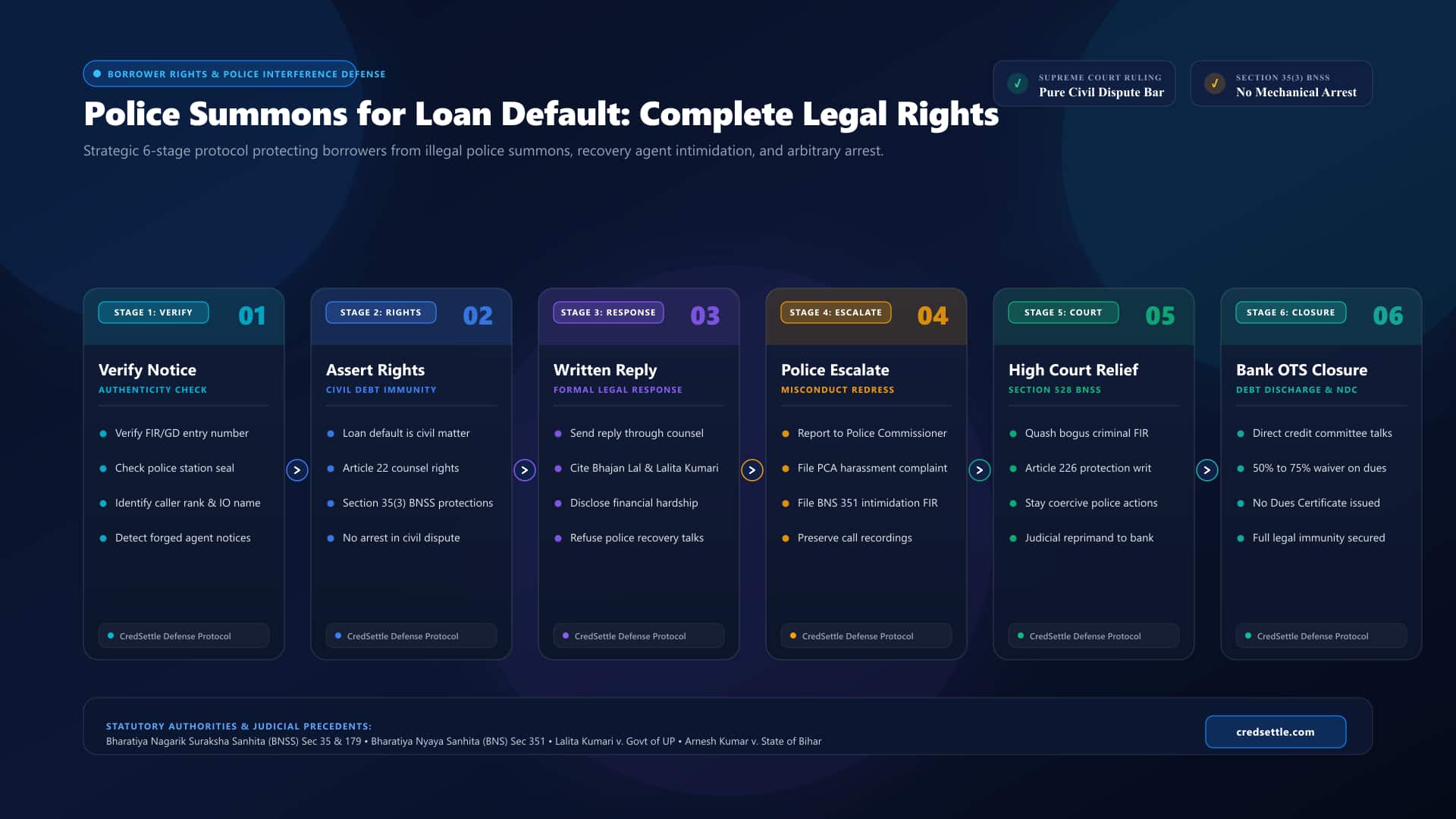
6. Step-by-Step SOP: 6-Stage Police Summons Action Plan
If you get a call or letter from a police station about a bank loan, take these six steps to stay safe.
1Stage 1: Verify Notice Details and Case Number
Ask the caller for the FIR number or diary entry. Note down the caller name and rank. Check the case details online on your state police portal.
2Stage 2: State That the Loan is a Civil Dispute
Politely tell the officer that loan default is a civil contract issue. State that no cheating occurred. Request a written notice under Section 35(3) BNSS.
3Stage 3: Send a Written Legal Reply Through Counsel
Have your advocate draft a formal reply. Mention Supreme Court rulings in Lalita Kumari and Satishchandra Shah. Show evidence of genuine financial hardship.
4Stage 4: Escalate Harassment to Higher Police Chiefs
If police officers keep threatening arrest, send a complaint to the Police Commissioner. You can also file a case with the State Police Complaints Authority.
5Stage 5: Seek High Court Relief Under Section 528 BNSS
If an FIR is filed under cheating laws, file a petition in High Court under Section 528 BNSS. The High Court can quash false cases and stop arrest.
6Stage 6: Settle the Loan with Bank and Get NDC
Once police threats stop, talk directly to the bank settlement team. CredSettle helps you get up to 75% loan waivers and secures your official No Dues Certificate.
7. Legal Remedies: High Court Quashing & Ombudsman Help
If you face illegal police pressure, you have clear legal options. Knowing where to complain will stop the harassment quickly.
Under Section 528 BNSS, High Courts can stop misuse of criminal law. The court can cancel fake police cases aimed at forcing loan repayments.
Banks cannot hire agents who pretend to be police officers. You can file a formal complaint at cms.rbi.org.in for quick action against the bank.
Set up under Supreme Court orders, the PCA probes police officers who abuse their power, threaten borrowers, or act as debt recovery agents.
You can file a court case against recovery agents for criminal threats under Section 351 BNS and impersonating officers under Section 204 BNS.
8. 3-Tier Escalation Matrix: Police Misconduct Redressal
When facing police pressure, follow these three steps to protect yourself and make rogue officials stop.
| Grievance Step | Authority to Approach | Time Needed | What They Can Do |
|---|---|---|---|
| Level 1: Police Chief | Superintendent of Police / Police Commissioner | 7 to 14 Working Days | Orders local police stations to stop interfering in civil bank loan defaults. |
| Level 2: Police Watchdog | State Police Complaints Authority (PCA) | 30 Working Days | Opens inquiry against errant police officers for threats and misuse of uniform. |
| Level 3: High Court | High Court (Article 226 / Sec 528 BNSS) | Urgent Hearing | Issues court orders barring police interference and cancels false criminal cases. |
9. Procedural Timeline: Default Stages to Police Defense
Knowing how debt collection unfolds over time helps you know when agent actions cross into illegal territory.
| Days Past Due | Loan Stage | Bank & Agent Actions | What You Should Do |
|---|---|---|---|
| Day 1 to 30 | SMA-0 | Payment reminder SMS and regular bank phone calls. | Check your budget and plan your monthly finances. |
| Day 31 to 60 | SMA-1 | Frequent agent calls and verbal warnings of legal steps. | Save call records and ask for written statements. |
| Day 61 to 90 | SMA-2 | Fake police notices on WhatsApp or spoofed phone calls. | Verify caller ID and issue a legal warning letter. |
| Day 91 to 120 | NPA Stage | Bank may file a false police complaint alleging cheating. | Send a formal legal reply under Section 35(3) BNSS. |
| Day 121 to 180 | OTS Window | Police close matter as civil debt; bank offers settlement. | Negotiate a 50% to 75% loan waiver with CredSettle. |
| Month 6 and Beyond | Loss Asset | Debt assigned to ARC or marked for formal write-off. | Pay the agreed sum and get your No Dues Certificate. |
10. Specialized Scenarios: Cyber Cell & Multi-State Calls
Borrowers often face tricky digital threats or calls from other states. Here is how your legal rights work in these special cases.
Cyber Crime Cell Calls for Mobile App Loans
Instant loan apps often claim they filed cyber crime cases. A real cyber cell investigates hacking and fraud, not personal loan defaults.
Calls from Police Stations in Other States
Borrowers often get calls from distant state police. Under Section 179 BNSS, out-of-state police cannot force you to travel for loan issues.
Police Visits to Your Workplace or Family
Police visiting your office or alarming family members over loan debts violates RBI rules and your privacy under the Puttaswamy ruling.
Cheque Bounce Cases Under Section 138 NI Act
Cheque bounce cases are court trials held by magistrates. Police have no role in cheque cases unless a magistrate issues a court warrant.
 Legal Debt Dispute Authority
CredSettle (credsettle.com) is India's premier debt settlement, loan dispute resolution, and legal protection platform. Operating strictly under the RBI Fair Practices Code and CICRA 2005, our advocate panel negotiates directly with Bank Principal Nodal Officers to eliminate waived differentials, obtain unconditional No Dues Certificates (NDC), and upgrade credit bureau records from "Settled" to "Closed".
Frequently Asked Questions: Police Summons for Loan Default
Clear, verified legal answers to essential questions regarding police notices, borrower rights, illegal debt recovery tactics, and settlement procedures under Indian law.
Official Regulatory Citations & Statutory Legal Framework
- Bharatiya Nagarik Suraksha Sanhita, 2023 (BNSS): Section 35(3) Notice of Appearance, Section 179 Police Power to Require Attendance, and Section 528 High Court Inherent Powers.
- Bharatiya Nyaya Sanhita, 2023 (BNS): Section 204 Impersonating Public Servant, Section 308 Extortion, Section 318(4) Cheating, and Section 351 Criminal Intimidation.
- Indian Contract Act, 1872: Section 73 Compensation for Loss or Damage Caused by Breach of Contract.
- Constitution of India: Article 21 Protection of Life and Personal Liberty, and Article 22(1) Protection Against Arrest and Right to Legal Counsel.
- Supreme Court of India Landmark Precedents: Lalita Kumari v. Govt. of U.P. (2014), Satishchandra Ratanlal Shah v. State of Gujarat (2019), and Arnesh Kumar v. State of Bihar (2014).