Fake Arbitration Order & Ex-Parte Award Challenge (Sec 34)
A complete legal defense guide for personal loan and credit card borrowers. Learn how to spot fake arbitration threats. Challenge unilateral arbitrator appointments under Perkins Eastman. Set aside illegal ex-parte awards under Section 34 with CredSettle.
- Arbitrators Cannot Order Arrest: Arbitrators only resolve civil contract disputes. They have zero criminal powers to issue arrest warrants, summon police, or seize your home.
- Unilateral Appointments Are Void: In Perkins Eastman, the Supreme Court ruled that banks cannot pick their own private judge alone. Such awards are void from day one.
- Right to Set Aside Under Section 34: You can file a court petition to cancel an unfair ex-parte award for lack of notice, denial of natural justice, or legal errors.
- Unconditional Stay Under Section 36(3): Where an award or agreement is tainted by fraud or fake notices, courts must grant an unconditional stay without demanding cash deposits.
- Compromise Settlement Option: An invalid arbitral award can be settled safely. CredSettle helps you negotiate up to 75% interest waivers and secure a formal No Dues Certificate.
1. Fake Arbitration Orders: How Rogue Recovery Rackets Operate
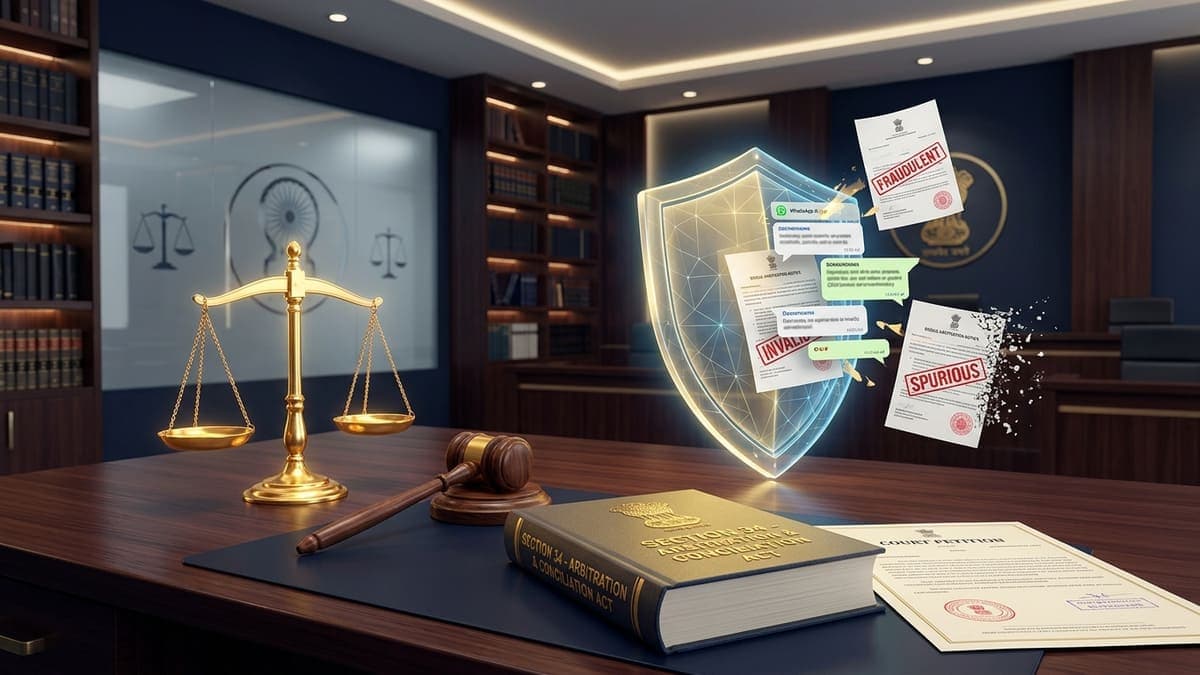
Rogue recovery agents often send fake arbitration orders on WhatsApp. They do this to scare borrowers into paying immediately. These fake papers use forged court seals and fake case numbers. They threaten police visits, property seizure, or quick arrest. These threats are completely illegal under Indian law.
An arbitrator is only a private dispute solver under civil law. Arbitrators have zero criminal powers. They cannot issue arrest warrants. They cannot send police to your home. They cannot freeze your bank account directly. Only a regular civil court judge has the power to enforce an order under Section 36.
Sending fake legal papers is a serious crime. The new criminal law penalizes forgery, cheating, and extortion under the Bharatiya Nyaya Sanhita. Never make panic payments before checking if a notice is genuine.
2. Unilateral Arbitrator Appointments: The Perkins Eastman Shield
Banks and NBFCs often make a serious legal mistake. They pick an arbitrator from their private panel without your consent. Under Indian law, this choice is completely invalid.
The Supreme Court decided this in Perkins Eastman Architects DPC v. HSCC (India) Ltd. (2020). The court ruled that an interested party cannot appoint a sole arbitrator alone. An earlier ruling in TRF Ltd. v. Energo Engineering also confirmed this rule.
Under Section 12(5) of the Act, an arbitrator chosen only by the lender has zero legal authority. This defect cannot be waived unless you sign a written agreement after the dispute starts.
Any arbitral award passed by such an arbitrator is void from day one. You can challenge and quash it before a civil court judge.
| Claim Component | Unilateral Arbitral Award | Section 34 Legal Challenge Status | Negotiated OTS Outcome |
|---|---|---|---|
| Principal Loan Balance | ₹4,20,000 | Admitted base borrowing amount | ₹2,50,000 |
| Compound & Penal Interest | ₹3,40,000 | Challenged: Violates RBI Fair Practice Code | ₹0 (100% Waived) |
| Arbitration Fees & Legal Costs | ₹90,000 | Challenged: Unilateral forum expenses void | ₹0 (100% Waived) |
| Total Financial Liability | ₹8,50,000 Claimed | Section 34 Petition Filed with Stay | ₹2,50,000 (70% Net Relief) |
3. Genuine vs Fake Arbitration Orders: Comparative Legal Matrix
Borrowers must know the difference between a real legal case and an extortion attempt. Both can be challenged, but the legal steps are different.
This matrix helps you spot fake papers quickly. It also guides your next legal moves.
| Verification Parameter | Genuine Arbitral Proceeding | Fabricated Recovery Notice | Legal Assessment & Defense SOP |
|---|---|---|---|
| Delivery Channel | Registered Post, Speed Post, or official email. | Informal WhatsApp messages or anonymous SMS. | Real tribunals never rely solely on messaging apps. |
| Mandatory Prior Notice | Section 21 invocation notice served in advance. | Zero invocation notice; sudden direct order. | Missing Section 21 notice invalidates arbitration. |
| Threat of Police Arrest | Strictly absent; purely civil determination. | Threatens arrest, police escort, or jail. | Clear proof of extortion and criminal forgery. |
| Arbitrator Credentials | Identifiable advocate or retired judicial officer. | Fictitious forum or recovery agency staff. | Verify advocate enrollment on Bar Council portal. |
| Enforcement Procedure | Civil execution under Section 36 in District Court. | Threats of immediate doorstep property raids. | Only civil judges possess execution powers. |
| Primary Legal Defense | Section 34 petition & Section 36 stay application. | Police FIR under BNS 318/351 & RBI complaint. | CredSettle issues legal reply and quashes claims. |
4. Grounds to Challenge Ex-Parte Awards Under Section 34
Section 34 gives you the legal right to cancel an unfair arbitral award in court. If a lender got an ex-parte award behind your back, you have strong grounds to overturn it.
Courts strictly protect your right to a fair hearing. A judge will cancel an award if any statutory rule was broken.
Lack of Proper Notice: Section 34(2)(a)(iii)
You were not given proper notice of the arbitrator appointment or hearings. Notices sent to old addresses do not count as valid service.
Invalid Arbitrator Choice: Section 34(2)(a)(v)
The bank appointed the arbitrator without your written consent. This breaks Section 12(5) and the Perkins Eastman ruling.
Against Public Policy: Section 34(2)(b)(ii)
The award breaks basic notions of justice. In Associate Builders v. DDA, the Supreme Court confirmed that unfair awards must be set aside.
Clear Legal Errors: Section 34(2A)
The order shows patent illegality on its face. For example, adding unfair penalties that violate Reserve Bank of India rules makes the award illegal.
5. Visual Blueprint: Section 34 Arbitration Defense Workflow
This visual roadmap shows how to defend your rights. It guides you from spotting fake notices to winning a court stay and settling your debt.
6. Step-by-Step SOP: 6-Stage Protocol to Quash Illegal Awards
If you receive an arbitration notice, act calmly. Follow this six-stage protocol to protect your assets and resolve your debt.
1Stage 1: Verify the Notice and Delivery
Check how the paper was sent. Look up the speed post tracking number. Verify the arbitrator name on the state Bar Council website.
2Stage 2: Raise Section 16 Jurisdiction Objections
If hearings are still active, file an objection under Section 16. State that the arbitrator has no jurisdiction under Perkins Eastman.
3Stage 3: Request the Official Signed Award
If an ex-parte award was already passed, ask for a signed copy under Section 31(5). Your court filing deadline starts only after you receive it.
4Stage 4: File Section 34 in Commercial Court
File your petition in the local District Court or Commercial Court. Highlight the lack of notice and the invalid arbitrator appointment.
5Stage 5: Secure an Urgent Stay Under Section 36
File an interim stay request under Section 36. Ask for an unconditional stay because the award was obtained through fake service or fraud.
6Stage 6: Settle the Loan via Formal OTS
Use your court stay as strong leverage. Settle your debt directly with the bank credit team. Secure big waivers and get an official No Dues Certificate.
7. Stay of Execution: Section 36 Defenses & Fraud Exceptions
Many borrowers think filing Section 34 stops bank action automatically. That is no longer true under the 2015 amendment.
To stop bank freezes or salary attachments, you must file a separate stay request under Section 36(2). Usually, courts may ask for a cash deposit before granting a stay.
However, a major legal exception protects victims of fake orders. Under the 2021 amendment to Section 36(3), courts must grant an unconditional stay if the award was obtained by fraud.
If a recovery agency used fake seals, bogus summons, or sham service, you do not have to deposit money. The court must pause the entire execution process immediately.
Must be filed alongside the Section 34 petition. It requests the court to halt all recovery and attachment proceedings while the main challenge is heard.
Where fraud, forgery, or sham service is proven, the court is legally required to grant an unconditional stay without cash deposit conditions.
Rogue recovery agents creating fake court decrees face prosecution for cheating, document forgery, and criminal intimidation under new criminal laws.
Only an executing court can order asset attachments. You have the right to file objections under Section 47 of CPC against an invalid arbitral decree.
8. 3-Tier Grievance & Legal Counter-Action Escalation Matrix
You can fight back against illegal threats across three institutional levels. Taking formal action stops recovery agent calls quickly.
| Escalation Tier | Designated Statutory Authority | Turnaround Time | Scope of Redressal & Enforcement Action |
|---|---|---|---|
| Level 1: Law Enforcement | Police Station / Cyber Crime Cell | Immediate / 48 Hours | Registers FIR for forgery and extortion under BNS Sections 318 and 351, tracking down rogue call centers. |
| Level 2: Lender Redressal | Principal Nodal Officer (Head Office) | 14 to 21 Working Days | Cancels unauthorized agency contracts, recalls rogue legal notices, and initiates formal settlement talks. |
| Level 3: Regulatory & Court | RBI Ombudsman & Commercial Court | 30 Days / Court Calendar | Issues binding directions via cms.rbi.org.in, penalizes non-compliant lenders, and stays arbitral execution. |
9. Strict Limitation Milestones: Section 34(3) Deadlines & Rules
Act quickly once you discover an arbitral award. The law sets strict time limits to file your challenge in court.
In Simplex Infrastructure v. NHAI (2019), the Supreme Court ruled that courts cannot extend deadlines beyond one hundred and twenty days total.
| Limitation Stage | Statutory Time Window | Legal Status & Court Discretion | Strategic Action Required |
|---|---|---|---|
| Standard Filing Window | Day 1 to Day 90 | Absolute statutory right to file petition. | File Section 34 petition and Section 36 stay without delay. |
| Condonation Grace Period | Day 91 to Day 120 | Allowed only upon proving sufficient cause. | File condonation application explaining medical or delivery hurdles. |
| Absolute Bar Window | Day 121 Onwards | Total limitation bar; court cannot condone delay. | Challenge must focus on lack of Section 31(5) signed delivery. |
| Sham Service Exception | Clock Not Started | Dakshin Haryana Bijli ruling applies. | Prove award was never delivered; limitation starts on actual receipt. |
10. Specialized Scenarios: Digital Loan Apps & Lok Adalat Traps
Arbitration misuse occurs across various loan formats. Here is how borrowers can navigate specific challenging scenarios with legal clarity.
Instant Digital Loan App Scams
Illegal loan apps often send fake arbitration orders on WhatsApp. These documents are completely fake. Report them on the National Cyber Crime portal right away.
Fake Lok Adalat Summons Threats
Recovery agents send papers titled Lok Adalat Summons. Lok Adalat is purely voluntary. It cannot pass any order unless both sides agree willingly.
Asset Reconstruction Company (ARC) Claims
When banks sell debt to ARCs, the ARC often starts arbitration without proper notice. CredSettle challenges these defects and negotiates deep settlements.
Vehicle Repossession via Sham Orders
Lenders cannot use fake arbitration papers to seize your car or bike with bouncers. The Supreme Court has ruled that violent repossession is a crime.
 Legal Debt Dispute Authority
CredSettle (credsettle.com) is India's premier debt settlement, loan dispute resolution, and legal protection platform. Operating strictly under the RBI Fair Practices Code and CICRA 2005, our advocate panel negotiates directly with Bank Principal Nodal Officers to eliminate waived differentials, obtain unconditional No Dues Certificates (NDC), and upgrade credit bureau records from "Settled" to "Closed".
Frequently Asked Questions: Fake Arbitration & Section 34
Clear, verified legal guidance addressing critical questions regarding fake arbitration orders, unilateral arbitrator appointments, Section 34 petitions, and borrower rights in India.
Official Regulatory Citations & Statutory Legal Framework
- Arbitration and Conciliation Act, 1996: Section 34, Application for Setting Aside Arbitral Award; Section 36, Enforcement and Mandatory Stay Provisions; Section 12(5), Ineligibility of Unilaterally Appointed Arbitrators.
- Supreme Court Landmark Rulings: Perkins Eastman Architects DPC v. HSCC (India) Ltd. (2020), TRF Ltd. v. Energo Engineering Projects Ltd. (2017), and Bharat Broadband Network Ltd. v. United Telecoms Ltd. (2019).
- Bharatiya Nyaya Sanhita, 2023 (BNS): Section 318(4), Cheating and Dishonestly Inducing Delivery of Property; Section 336, Forgery; Section 351, Criminal Intimidation by Recovery Agents.
- Code of Civil Procedure, 1908 (CPC): Section 47 and Order XXI, Executing Court Powers; Section 60, Properties Exempt from Attachment.
- Reserve Bank of India Master Directions: Fair Practices Code for Lenders and Regulatory Directives on Third-Party Recovery Agency Conduct.