Can Bank Send You to Civil Prison for Loan Default?
An authoritative legal guide on Order 21 Rule 37 CPC, Section 51, and Supreme Court protections for loan defaulters in India. Discover why inability to pay is not a crime, how courts treat lack of means, and how to stop fake arrest threats.
- Loan Default Is Not a Crime: Defaulting on an unsecured personal loan, credit card, or business loan is purely a civil contractual dispute. Banks have zero legal power to arrest you.
- Order 21 Rule 37 Is Not an Arrest Warrant: This rule only empowers the execution court to issue a show-cause notice. It gives the borrower an opportunity to explain their genuine financial distress.
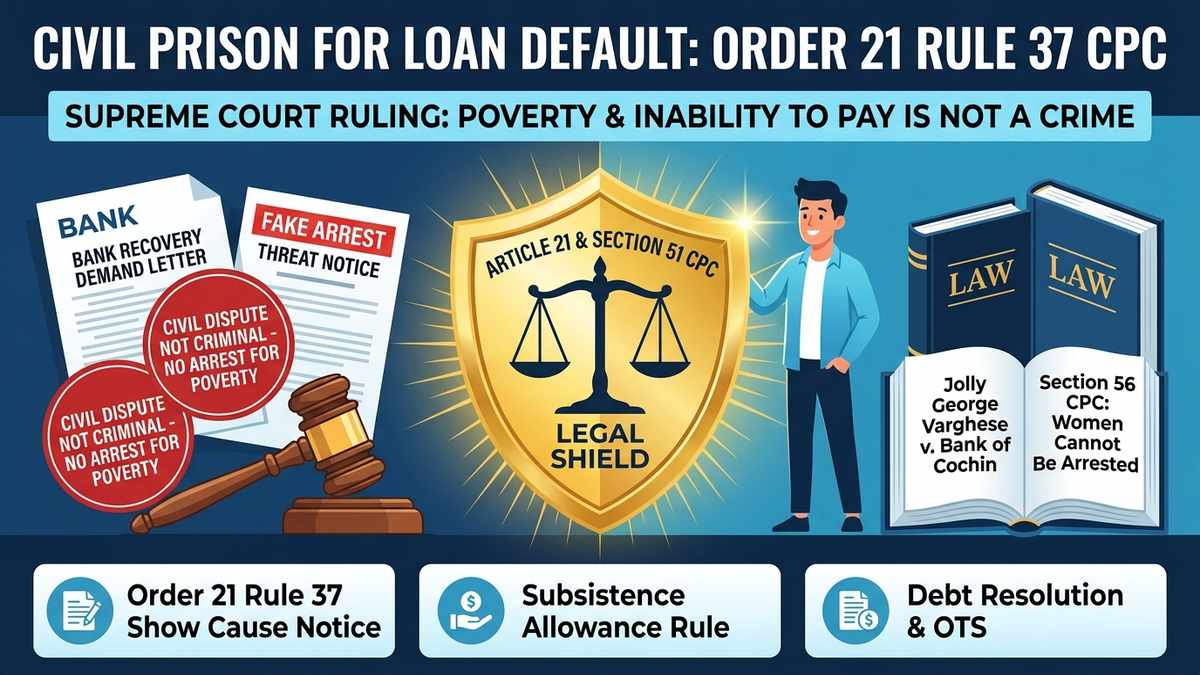
- Supreme Court Landmark Precedent: In Jolly George Varghese v. Bank of Cochin, the Supreme Court ruled that jailing a person due to poverty violates Article 21 of the Constitution.
- Complete Immunity for Women: Section 56 of the CPC strictly forbids the arrest or civil detention of women in execution of any money decree.
- Recovery Agent Threats Are Criminal: Third-party collection agents issuing fake arrest notices or threatening jail commit criminal intimidation under BNS Section 351.
1. Legal Reality: Can You Be Jailed for Loan Default?
When borrowers default on unsecured loans or credit cards, debt collection agencies frequently resort to unlawful intimidation. One of their most common tactics is threatening borrowers with immediate police arrest or civil imprisonment. Many recovery agents falsely claim that a magistrate will send police to your home to take you to jail.
Under Indian law, simple failure to repay a loan is not a criminal offense. Loan default is a breach of a civil contract. Neither a commercial bank, a non-banking financial company (NBFC), nor a recovery agency has the legal authority to issue arrest warrants or send a borrower to prison.
In India, debt recovery must follow statutory civil procedures. The Indian Constitution safeguards personal liberty under Article 21. Unless there is evidence of criminal fraud, intentional forgery, or dishonored cheques under Section 138 of the Negotiable Instruments Act, debt recovery remains strictly confined to civil court proceedings.
2. Order 21 Rule 37 CPC: Show Cause Notice Explained
Order 21 of the Code of Civil Procedure (CPC), 1908 governs the execution of decrees and orders passed by civil courts. When a lender files a summary suit under Order 37 or an ordinary money suit and obtains a final money decree, the lender becomes a decree-holder. The borrower becomes a judgment-debtor.
Under Order 21 Rule 37 CPC, before any warrant of arrest can be considered against a judgment-debtor, the court must issue a show-cause notice. This notice directs the debtor to appear in court and explain why they should not be committed to civil prison.
This notice is not an arrest warrant. It is a mandatory judicial opportunity for the borrower to present their side of the case. The borrower can appear through an advocate and demonstrate genuine financial difficulties, medical emergencies, or loss of employment.
| Court Decree / Asset Component | Bank Execution Claim | Statutory Legal Immunity Status | Protected Balance |
|---|---|---|---|
| Total Decreed Debt Claim | ₹15,00,000 | Civil Money Decree: Subject to CPC Execution | ₹4,50,000 (Target OTS Deal) |
| Borrower Liquid Disposable Assets | ₹45,000 | Section 51 Proviso: Demonstrates Lack of Means | ₹45,000 (Exempt from Prison) |
| Necessary Wearing Apparel & Tools | ₹1,20,000 | Section 60(1) CPC: 100% Non-Attachable | Fully Protected by Law |
| Civil Detention Risk Assessment | Bank Detention Request | Dismissed under Jolly George Varghese Precedent | Zero Prison Risk |
3. Supreme Court Ruling: Jolly George Varghese Case
The definitive judicial authority on civil imprisonment for debt default is the landmark Supreme Court decision in Jolly George Varghese & Anr. v. The Bank of Cochin (1980) 2 SCC 360. The bench was led by the eminent jurist Justice V.R. Krishna Iyer.
In this case, a commercial bank sought the arrest and detention of an indebted borrower who could not satisfy a civil money decree. The Supreme Court delivered an emphatic ruling protecting the fundamental rights of debtors. The court held that to cast a person into prison because of their poverty is a direct violation of Article 21 of the Constitution.
The Supreme Court integrated Article 11 of the International Covenant on Civil and Political Rights (ICCPR) into domestic constitutional law. Article 11 states that no one shall be imprisoned merely on the ground of inability to fulfill a contractual obligation. The court ruled that simple inability to pay is never grounds for detention.
Justice Krishna Iyer observed that there must be an element of bad faith, fraudulent concealment, or contumacious refusal. If a debtor has no current means to pay due to business misfortune, job loss, or illness, sending them to prison is unconstitutional.
4. Section 51 CPC: Willful Evasion vs Lack of Means
Section 51 of the Code of Civil Procedure sets strict statutory limits on a court power to enforce a money decree through civil detention. The court cannot order imprisonment mechanically. Section 51 contains an explicit proviso that requires a detailed judicial inquiry.
Before committing any judgment-debtor to prison, the execution judge must record written reasons confirming one of the following two statutory conditions:
The bank must prove that the debtor has the actual financial means to pay the decree, but willfully and dishonestly refuses to pay.
The bank must prove that the debtor dishonestly transferred, concealed, or removed property, or absconded from the jurisdiction to defeat the decree.
The burden of proof rests entirely on the creditor bank. If the bank fails to prove that the borrower has hidden wealth or dishonest intent, the court must reject the prayer for civil imprisonment.
5. Statutory Immunity Matrix: Civil Prison Exemptions
The Code of Civil Procedure provides comprehensive statutory exemptions that shield borrowers from civil arrest. Understanding these protections helps you counter illegal threats from collection agencies.
| Borrower Category / Situation | Governing Legal Provision | Civil Detention Immunity | Legal Condition & Rights | Recommended Legal Action |
|---|---|---|---|---|
| Women Borrowers & Guarantors | Section 56 CPC | 100% Absolute Prohibition | No woman can be detained for a money decree. | File police FIR if agents threaten a woman. |
| Debtors Lacking Financial Means | Section 51 CPC Proviso | Complete Legal Immunity | Poverty and business losses protect against detention. | Submit affidavit of income and liabilities. |
| Non-Payment of Subsistence Allowance | Order 21 Rule 39 CPC | Mandatory Immediate Release | Bank must pay monthly maintenance in advance. | Demand immediate discharge if bank defaults. |
| Decree Value Under ₹2,000 | Section 58(1A) CPC | Total Exemption from Prison | No civil detention permitted for small debts. | Dismiss execution application at threshold. |
| Debtors with Serious Illness | Section 59 CPC | Statutory Medical Release | Court may cancel warrant or order release on illness. | Furnish medical certificates and treatment records. |
| Applicants Under IBC Insolvency | Section 94 & 96 IBC | Automatic Interim Moratorium | Stays all legal suits and execution notices. | Serve Section 96 interim order on execution court. |
6. Visual Blueprint: Order 21 Rule 37 Procedure Flow
This comprehensive visual roadmap illustrates the legal framework governing civil detention, showing why loan default is a civil dispute and how statutory defenses protect borrowers.
7. Step-by-Step SOP: 6-Stage Civil Notice Defense
If you receive a court notice or legal communication referencing Order 21 Rule 37 CPC, follow this systematic six-stage protocol to ensure complete legal safety and resolve your loan.
1Stage 1: Verify Authenticity of the Notice
Check if the notice is an authentic court document with a valid court seal, case number, and CNR number. Many recovery agencies forge notices on WhatsApp to simulate court summonses.
2Stage 2: Enter Formal Appearance Through Counsel
Never ignore an authentic court notice. Instruct an experienced civil advocate to file a Vakalatnama in the execution court on your behalf before the scheduled hearing date.
3Stage 3: Submit Affidavit of Means and Hardship
Under Order 21 Rule 41 CPC, file an affidavit disclosing your true financial condition. Attach termination letters, medical diagnosis reports, and bank statements showing lack of disposable income.
4Stage 4: Invoke Jolly George Varghese & Section 51
Present the binding Supreme Court ruling in your written reply. Emphasize that detention requires proof of contumacious evasion with means, which the bank cannot establish.
5Stage 5: Demand Compliance with Subsistence Rules
Remind the court of Order 21 Rule 39 CPC. If the bank fails to deposit monthly prison maintenance costs in advance, the court cannot order detention.
6Stage 6: Negotiate One-Time Settlement (OTS)
Use the execution stage to propose an amicable compromise settlement. Banks readily agree to waive penal charges and accept a 50% to 75% haircut to avoid protracted enforcement.
8. Illegal Agent Harassment: Police & BNS Defenses
When third-party recovery agents send threatening voice notes or claim they will bring the police to arrest you, they are committing serious criminal offenses. You have strong protections under Indian penal statutes and regulatory codes.
Threatening a borrower with unlawful arrest or social humiliation constitutes criminal intimidation under the Bharatiya Nyaya Sanhita, 2023, punishable with imprisonment.
Creating counterfeit court warrants or masquerading as police officers to recover money is an offense of cheating and forgery under the Bharatiya Nyaya Sanhita.
RBI guidelines strictly prohibit recovery agents from using abusive language, threatening physical violence, or contacting borrowers outside authorized hours (8 AM to 7 PM).
Police stations have explicit standing orders not to entertain debt recovery complaints from banks. The police cannot detain or harass any citizen for loan default.
9. Procedural Timeline: Default to Execution Court
Understanding the multi-year timeline of civil debt recovery helps borrowers see through recovery agent bluffs and take strategic legal action at the right stage.
| Recovery Phase | Estimated Timeframe | Bank Judicial Action | Borrower Rights & Strategy |
|---|---|---|---|
| Pre-NPA & NPA Phase | Day 1 to 90 | Reminder calls, SMS notices, and formal overdue intimations. | Request moratorium or restructure debt before NPA tagging. |
| Legal Notice Phase | Day 91 to 180 | Advocate demand notice issued under Section 138 or civil debt. | Reply through counsel disputing penal charges and proposing OTS. |
| Civil Suit Trial Phase | Year 1 to 3 | Bank files Order 37 summary suit or ordinary recovery suit. | File written statement, contest claims, and seek leave to defend. |
| Final Decree Passed | Year 2 to 4 | Civil judge issues money decree against borrower. | Lodge appeal in High Court or approach bank for compromise. |
| Order 21 Rule 37 Notice | Execution Stage | Bank files execution petition; court issues show-cause notice. | Demonstrate lack of means under Section 51; settle debt via OTS. |
| Compromise Resolution | 30 to 60 Days | Court records compromise settlement and full satisfaction. | Receive official No Dues Certificate and clean court discharge. |
10. Specialized Scenarios: Senior Citizens & Illness
Indian civil procedural law contains compassionate provisions for vulnerable debtors, senior citizens, and people facing severe medical crises.
Absolute Protection for Women (Section 56 CPC)
Under Section 56 of the CPC, women cannot be arrested or detained in civil prison for money decrees. Any recovery agent threatening a female borrower or homemaker with jail commits an illegal act.
Medical Infirmity & Severe Illness (Section 59 CPC)
Section 59 of the CPC empowers the court to cancel an arrest warrant or release a debtor from prison if they suffer from serious illness or medical infirmity requiring ongoing healthcare.
Interim Moratorium Under Section 96 IBC
When an individual debtor files an insolvency petition under Section 94 of the Insolvency and Bankruptcy Code, Section 96 imposes an automatic interim moratorium staying all execution suits nationwide.
Guarantors & Third-Party Co-Borrowers
While a guarantor liability is co-extensive under Section 128 of the Contract Act, a guarantor enjoys identical protections under Section 51 CPC and Jolly George Varghese if they lack independent means.
 Legal Debt Dispute Authority
CredSettle (credsettle.com) is India's premier debt settlement, loan dispute resolution, and legal protection platform. Operating strictly under the RBI Fair Practices Code and CICRA 2005, our advocate panel negotiates directly with Bank Principal Nodal Officers to eliminate waived differentials, obtain unconditional No Dues Certificates (NDC), and upgrade credit bureau records from "Settled" to "Closed".
Frequently Asked Questions: Civil Prison & CPC Rules
Clear, verified legal guidance addressing critical questions regarding civil imprisonment, Order 21 Rule 37 notices, recovery agent arrest threats, and debtor rights under Indian law.
Statutory Citations: Order 21 CPC & Legal Precedents
- Code of Civil Procedure, 1908 (CPC): Order 21 Rule 37, Discretionary Power to Permit Judgment-Debtor to Show Cause Against Detention in Prison.
- Code of Civil Procedure, 1908 (CPC): Section 51, Proviso on Execution by Detention and Mandatory Requirement of Willful Evasion with Means.
- Code of Civil Procedure, 1908 (CPC): Section 56, Absolute Prohibition of Arrest or Detention of Women in Execution of Money Decrees.
- Code of Civil Procedure, 1908 (CPC): Order 21 Rule 39 & Section 58, Subsistence Allowance Rules and Maximum Limits on Civil Detention.
- Supreme Court of India Precedent: Jolly George Varghese & Anr. v. The Bank of Cochin (1980) 2 SCC 360, Article 21 Protection for Debtors.
- Constitution of India: Article 21, Protection of Life and Personal Liberty and Reading of Article 11 ICCPR.