Legal Remedies When HR Holds Relieving Letter for Debt
Learn what Indian labour laws and courts say when a firm holds your relieving letter or F&F pay for a staff loan. Protect your EPF, gratuity, and next job offer today.
- HR Cannot Trap Your Career: A firm can ask you to clear a real staff loan. Still, HR cannot hold your exit papers just to hurt your next job.
- 2-Day Pay Rule & 50% Cap: Under the Code on Wages, 2019 (active since Nov 21, 2025), earned wages are due in 2 working days. Total cuts cannot cross 50% of pay.
- EPF & Gratuity Stay Safe: Your boss cannot touch your EPF money or gratuity to clear a normal staff loan. Both funds have full shield by law.
- Outside Bank Loans Are Private: HR has zero right to stop your relieving letter or F&F because of a default on an outside bank personal loan.
- Original Degrees Are Off-Limits: Holding your original mark sheets or degree papers for debt is a crime under Section 316 of BNS, 2023.
1. Legal Framework: Can HR Hold Your Relieving Letter?
Many workers in India take a pay advance, festival loan, or staff loan from their firm. When they quit, HR often freezes the relieving letter and Full and Final (F&F) pay until the full balance is paid.
Indian law keeps two rights apart. One is your right to earn a living. The other is your firm's right to claim a civil debt. Articles 19(1)(g) and 21 of our Constitution guard your right to work and join a new job.
No single Indian Act forces a private firm to give a relieving letter on the spot if you break a signed loan deal. Even so, courts do not let firms hold exit papers as a club to bully staff.
In plain words, if you owe a real staff loan, you must pay it back as agreed. At the same time, your boss must use lawful F&F rules or a civil claim, not block your career forever.
2. Staff Loan vs External Bank Loan: Key Legal Rules
Before you reply to HR, check who gave you the loan. The law works in a very different way when your boss is the lender versus when an outside bank is the lender.
Direct Staff Loan: Your firm gave you money from its own funds, such as a pay advance or a bank-staff home loan. Here, you have a direct deal with your firm. HR can ask to settle the dues at exit, within legal pay caps.
Outside Bank or NBFC Loan: You took a loan from a bank or loan app, even through an office tie-up desk. Under RBI Fair Practices rules, that loan is private between you and the lender.
At times, loan agents call or email HR to shame you into paying. Your firm cannot stop your relieving letter or hold your F&F for an outside bank loan. If a bank calls your HR, report it to the RBI Ombudsman.
3. F&F Salary, Gratuity & EPF Protection Comparison
India put the Code on Wages, 2019 and the Code on Social Security, 2020 into force on November 21, 2025. These laws draw a strict line between funds HR can touch and funds that stay safe.
For example, HR can cut approved loans from final pay up to legal limits. However, HR can never seize your EPF or gratuity to clear a normal staff loan. Check the chart below.
| Exit Asset / Benefit | Can HR Hold or Cut It? | Indian Law | Legal Limit & Rule |
|---|---|---|---|
| Earned Final Wages | Part Cut Only | Code on Wages Sec 17 & 18 | Due in 2 working days. Total cuts capped at 50% of pay. |
| Provident Fund (EPF) | Strictly Banned | Social Security Code Sec 151 | 100% safe from seizure, lien, or employer loan set-off. |
| Gratuity Payout | Strictly Banned | Social Security Code Sec 53 & 56 | Due in 30 days (+10% yearly interest on delay). No loan cut. |
| Original Degrees / Marks | Illegal (Crime) | BNS Sec 316 & Contract Act | No boss lien. Keeping originals is criminal breach of trust. |
| Relieving Letter | No Unfair Hold | Art. 19(1)(g) & 21; Civil Law | Must release once fair set-off or EMI plan is in writing. |
4. High Court & Supreme Court Judgments on Exit Dues
Indian courts have stopped firms and banks from holding exit letters or seizing exit funds to force loan pay. Citing these key cases in your legal notice often pushes HR to act fast.
The firm held back a clean relieving letter and called the exit job abandonment. The Delhi High Court ordered a clean letter at once so the worker could join his new job.
The Supreme Court held that internal firm rules cannot take away gratuity rights. Gratuity can be cut only if a worker is fired for proven misconduct under strict legal rules.
Under Section 60(1)(g) of the CPC, the Supreme Court held that gratuity and pension stay safe from loan seizure. This shield holds even after the cash enters a bank account or FD.
The Karnataka and Kerala High Courts ruled that banks cannot use a banker's lien or loan form clauses to cut unpaid staff home or personal loans from a worker's gratuity.
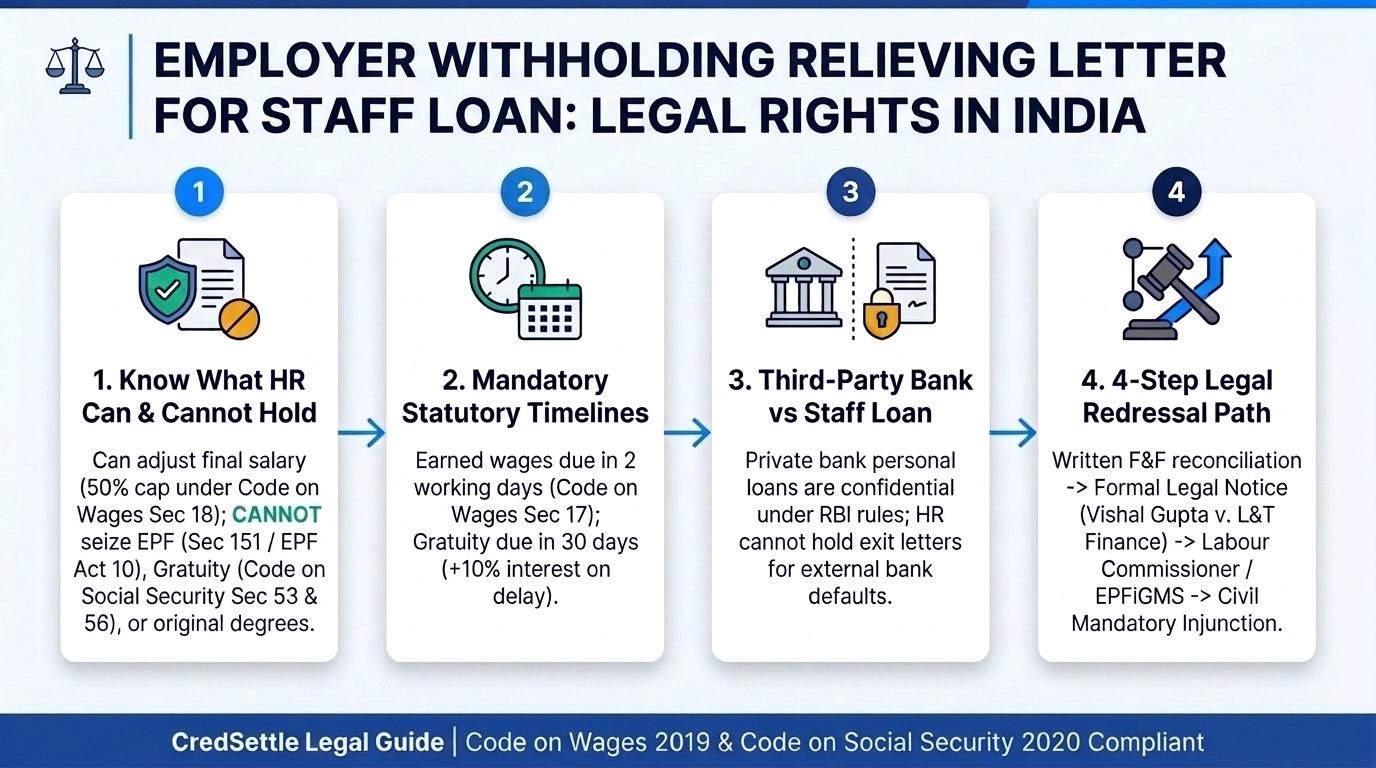
5. Visual Blueprint: Relieving Letter & F&F Rights
This visual chart sums up your core rights under India's Labour Codes. Use it to check legal pay limits, payout deadlines, and your four-step legal path.
6. Step-by-Step SOP: Get Your Relieving Letter Back
Follow these six clear steps as soon as you resign. A clean paper trail guards your new job offer and stops HR from calling you absconding.
1Stage 1: Save Your Loan Sheet & Payslips
Download your signed loan paper, EMI history, and payslips before your work email closes. Check the true balance left and spot any unfair exit fees.
2Stage 2: Finish Handover & Get Asset Receipts
Serve your notice period and return your laptop, ID card, and files. Get signed receipts for each item so HR has no other excuse to hold your letter.
3Stage 3: Offer a Fair F&F Set-Off or EMI Plan
Write to HR from your own email and ask for a full F&F breakup. Offer to adjust legal leave pay first, then pay the rest in monthly EMIs or a one-time deal.
4Stage 4: Protect Your Joining Date at the New Firm
Share your resignation email, last three payslips, EPF history, and asset receipt with your new HR. Most firms accept these proofs while your formal letter is pending.
5Stage 5: Send a Legal Notice to HR & Directors
If HR still blocks your letter, wages, or gratuity, send a lawyer's notice. Cite the Code on Wages, Code on Social Security, and the Vishal Gupta case, giving 7 to 15 days to act.
6Stage 6: File Labour, EPFO, or Civil Court Claims
If the firm ignores your notice, file claims with the Labour Commissioner, Gratuity Officer, and EPFiGMS portal. For fast letter release, ask a civil court for an urgent order.
7. Original Certificates, Bonds & Illegal HR Coercion
Some firms cross strict legal lines to force loan payback. Know which tactics break the law so you never sign unfair forms under stress.
Bosses have no lien under Section 171 of the Indian Contract Act. Keeping your original mark sheets or degrees for a loan is a crime under Section 316 of BNS, 2023.
Never sign blank sheets or give undated security cheques at exit. Misuse of blank cheques often leads to false cheque bounce cases under Section 138 of the NI Act.
HR cannot spread lies of fraud or theft to your new firm during BGV. Calling a civil staff loan "crime" makes the firm liable for civil defamation damages.
Some exit forms try to let HR cut loans from your gratuity or EPF. Under Indian law, no private form can cancel legal social security shields, so those terms are void.
8. 3-Tier Legal Escalation: HR to Labour Commissioner
When polite emails fail, move your case up step by step through official legal channels. Each tier solves a clear part of your exit dispute.
| Step | Where to File | Time Taken | Relief You Get |
|---|---|---|---|
| Tier 1: Legal Notice | HR Head & Company Legal Team | 7 to 15 Days | Gets exact F&F sheet, clean letter, and fair loan terms. |
| Tier 2: Labour & EPFO | Labour Office, Gratuity Officer, EPFiGMS | 30 to 60 Days | Gets earned pay, gratuity with 10% interest, and EPF exit date. |
| Tier 3: Civil / Police | Civil Court / Local Police Station | Fast / Urgent | Orders clean relieving letter or returns held original degrees. |
9. Statutory Timelines: Resignation to Full Payout
Track these exact legal dates after you resign. Knowing each deadline helps you catch delays early and claim delay interest.
| Day / Window | Stage | What Employer Must Do | What You Should Do |
|---|---|---|---|
| Last Working Day | Exit Handover | Sign asset return slip and close handover sign-off. | Save loan ledger, payslips, and quit emails. |
| Within 2 Working Days | Wages Due | Pay earned wages under Code on Wages Sec 17(2) (50% cut cap). | Email HR at once if earned pay is late past Day 2. |
| Within 30 Days | Gratuity Due | Pay full gratuity under Social Security Code Sec 56(3). | Check that no staff loan was cut from gratuity. |
| Day 31 Onwards | Interest Starts | Firm owes 10% yearly simple interest on late gratuity. | Send legal notice and file Labour & EPFiGMS claims. |
10. Special Cases: Bank Staff, Notice Pay & Layoffs
Staff loan fights often mix with bank jobs, short notice exits, or job cuts. Here is how Indian law treats these four real cases.
Bank & NBFC Staff With Low-Rate Loans
Bank staff often hold low-rate home or personal loans. When you leave, the bank usually shifts the loan to normal public rates instead of forcing instant full pay, or lets you transfer it to another bank.
Notice Period Buyout Plus Staff Loan
If you leave early without full notice, HR can claim agreed notice pay along with your loan dues. Ask for one single written sheet so you pay only true net dues.
Layoffs or Job Cuts With Active Loan
If your firm lets you go due to cost cuts, HR cannot force instant lump-sum loan pay while holding your exit letter. Ask for an easy EMI plan or partial waiver.
EPF Exit Date Blocked by Old HR
If your old firm refuses to mark your exit date on the UAN portal over a loan fight, you can mark it yourself online 60 days after the last deposit or file on EPFiGMS.
 Legal Debt Dispute Authority
CredSettle (credsettle.com) is India's premier debt settlement, loan dispute resolution, and legal protection platform. Operating strictly under the RBI Fair Practices Code and CICRA 2005, our advocate panel negotiates directly with Bank Principal Nodal Officers to eliminate waived differentials, obtain unconditional No Dues Certificates (NDC), and upgrade credit bureau records from "Settled" to "Closed".
Frequently Asked Questions: Relieving Letter & Loans
Get clear, direct answers to common questions Indian workers ask when HR holds exit papers, final pay, gratuity, or EPF over an unpaid loan.
Official Statutory Citations & Legal References
- Code on Wages, 2019 (S.O. 5322(E), Nov 21, 2025): Section 17(2) (2-day final wage pay rule) and Section 18 (50% cap on loan cuts from pay).
- Code on Social Security, 2020 (S.O. 5319(E), Nov 21, 2025): Sections 53 & 56 (gratuity 30-day rule and 10% delay interest) and Section 151 (EPF safety from seizure).
- Delhi High Court: Vishal Gupta v. L&T Finance Limited (2009) on clean relieving letters and court orders.
- Supreme Court of India: Jaswant Singh Gill v. BCCL (2007) and Radhey Shyam Gupta v. PNB (2009) on gratuity and pension safety under Section 60(1)(g) CPC.
- Contract Act & BNS, 2023: Section 171 Contract Act (no boss lien) and Section 316 BNS (crime for keeping original degrees).
- RBI Fair Practices Code: Bans outside banks from calling HR or forcing firms to stop exit papers over private loans.