Can a Bank Legally Deduct EMI from Your Salary Account?
Is the bank emptying your salary account using the "Right of Set-Off" to recover a defaulted loan? Learn how to legally stop auto-debits, protect your livelihood under Section 60 CPC, and settle your loan safely.
- Same-Bank vs. Separate-Bank Distinction: If your defaulted loan and your salary account are with the same bank, the bank can technically attempt an internal debit using the "Right of Set-Off". If your salary account is with a different bank, the lender has zero direct access and relies solely on NACH mandates or civil court decrees.
- Absolute Right to Cancel Auto-Debits (NACH): Under RBI Circular DPSS.CO.CHD.No./133/04.07.05/2019-20, borrowers possess an unconditional statutory right to revoke or cancel NACH, e-mandates, or Standing Instructions through net banking or written bank notice.
- Section 60 CPC Statutory Subsistence Exemption: Total salary confiscation is unlawful. Under Section 60(1)(i) of the Code of Civil Procedure, 1908, the first ₹1,000 plus two-thirds (2/3rd) of the remaining salary is completely exempt from judicial attachment, preserving fundamental subsistence funds.
- Employer HR Protection & Strict Mutuality: A bank cannot demand that your employer deduct EMIs directly from your paycheck without a formal court decree. Furthermore, banks cannot touch joint accounts (spouse/parents) or statutory Provident Funds (EPF/PPF) under the doctrine of strict mutuality.
- Legal Impasse to Secure 40%–70% OTS Waiver: Rerouting your salary and asserting statutory objections halts predatory auto-debits, bringing the lender to the negotiating table for an amicable One-Time Settlement (OTS) with substantial interest waivers.
1. Can a Bank Deduct Money Directly from Your Salary Account?
When salaried professionals in India face unexpected financial distress, job transitions, or medical crises and miss personal loan or credit card EMIs, their primary anxiety centers on their monthly paycheck: Will the bank empty my salary account the moment my salary gets credited?
The legal reality depends fundamentally on the technical architecture of your banking relationship and the legal instruments executed during loan sanction. Under Indian banking law, there are two distinct mechanisms through which a bank attempts to deduct funds:
When you take a loan from Bank A while holding a salary account at Bank B, Bank A relies on a National Automated Clearing House (NACH) mandate or electronic Standing Instruction (SI). This is an authorized clearing system, not an automatic legal seizure. You have the statutory right to cancel this mandate.
If your personal loan and your salary account are both maintained within the same financial institution, the bank uses internal ledger transfers under the common law doctrine of the "Right of Set-Off" (Section 171, Indian Contract Act, 1872) without triggering external clearing clearing houses.
The Core Legal Principle: A lending bank possesses zero power to unilaterally freeze or seize funds from a salary account held in a third-party bank without either an active NACH mandate or a formal judicial Garnishee Order issued by a civil court under Order 21 Rule 46 of the Code of Civil Procedure, 1908.
2. The Banker's Right of Set-Off Under Section 171
When a borrower defaults on an unsecured debt, banks frequently cite their "Banker's Lien" and "Right of Set-Off" to sweep 100% of the funds resting in the debtor's savings or salary account. Understanding the statutory boundaries of this right is vital to defending your income.
What is Section 171 of the Indian Contract Act, 1872?
Section 171 provides that bankers may, in the absence of a contract to the contrary, retain as a security for a general balance of account, any goods or securities bailed to them. Extending this principle to cash balances, the Right of Set-Off empowers a bank to combine two accounts (one in credit, one in debit) belonging to the exact same customer to extinguish or reduce a matured, legally enforceable debt.
The 4 Statutory Preconditions Required for a Lawful Set-Off:
The credit balance and the debit liability must belong to the exact same person in the exact same capacity. A bank cannot set off a personal loan against a joint account or a partnership firm account.
Set-off can only be exercised against a liquidated, matured, and overdue liability. A bank cannot debit your salary account for future unaccrued EMIs or unadjudicated disputed penalties.
Supreme Court precedents and the RBI Fair Practices Code establish that exercising set-off without prior reasonable written notice is an unfair trade practice. A surprise zero-balance sweep is actionable before the Banking Ombudsman.
The Right of Set-Off exists solely between accounts maintained inside the same banking corporation. HDFC Bank cannot exercise set-off against an ICICI Bank salary account under any circumstance.
3. The Critical Difference: Same-Bank vs. Separate-Bank Accounts
The single most impactful factor determining whether your salary is vulnerable to immediate seizure is whether your salary account resides in the same banking institution as your loan facility.
Example: You took a personal loan from Axis Bank and your corporate salary is credited to your Axis Bank account.
How the Bank Operates:
- The bank has direct backend database access to your incoming credits.
- Automated sweep bots trigger on the 1st/30th of the month the second payroll lands.
- Cancelling NACH does not prevent internal set-off sweeps.
- Immediate Remedy: You must request employer HR to switch your payroll account to a separate bank.
Example: You took a personal loan from Bajaj Finserv / HDFC and your salary is credited to SBI or Kotak Bank.
How the Bank Operates:
- The lender has zero internal access to your SBI / Kotak account balance.
- The lender is restricted to external NACH / e-mandate clearing attempts.
- Revoking the NACH mandate legally stops automated debits completely.
- Immediate Remedy: Exercise statutory mandate revocation and proceed to negotiated OTS.
4. Legal Comparison: Salary Deduction Scenarios
Compare how different recovery methods operate, their statutory legality, power to attach income, and exact borrower defense routes:
| Recovery Scenario | Governing Statute | Direct Account Access | Can Bank Empty 100% Salary? | Legal Recourse & Defense | CredSettle Strategic Action |
|---|---|---|---|---|---|
| Internal Sweep (Same Bank) | Sec 171 Indian Contract Act 1872 | YES (Internal Core Banking) | YES (Unless Challenged) | Sec 60 CPC Notice & Reroute Payroll | Switch salary account to separate bank & issue refund notice |
| Cross-Bank NACH / e-Mandate | Payment & Settlement Systems Act 2007 | Conditional (Mandate Only) | NO (Only Mandate Amount) | RBI Mandate Revocation Circular | Submit formal NACH cancellation notice via net banking & branch |
| Court Garnishee Order | Order 21 Rule 46 / 48 CPC 1908 | YES (Via Court Summons) | NO (Sec 60 CPC Exemption: 1st ₹1,000 + 2/3rd Exempt) | Civil Court Objection & OTS Compromise | File application for stay & negotiate structured one-time settlement |
| Joint Account Debit (Spouse/Parent) | Doctrine of Mutuality (Contract Act) | YES (If in Same Bank) | ILLEGAL (Direct Violation of Mutuality) | RBI Ombudsman Complaint for Illegal Debit | Demand 100% refund of co-owner funds under Banking Ombudsman Scheme |
| Direct HR / Employer Withholding | Payment of Wages Act 1936 | NO (Zero Legal Access) | STRICTLY ILLEGAL (Criminal Extortion) | Sec 383 IPC / Sec 308 BNS & RBI Sachet | Issue cease-and-desist warning to lender; HR cannot deduct without court decree |
5. Technical Financial Risk Analytics & CIBIL Scoring Penalties
When a bank repeatedly attempts uncoordinated salary debits or leaves a defaulted loan unpaid, the borrower faces both acute financial bleeding and severe credit bureau rating destruction. The mathematical mechanics operate as follows:
Compounding NACH Bounce Charges & Penal Multipliers
CIBIL Score Destruction & Algorithmic Multipliers
Visual Blueprint: Salary Defense & Debt Resolution
Refer to this visual blueprint outlining the 6-stage procedural sequence to protect your monthly salary from unauthorized bank sweeps, invoke statutory exemptions, and achieve an amicable debt settlement:
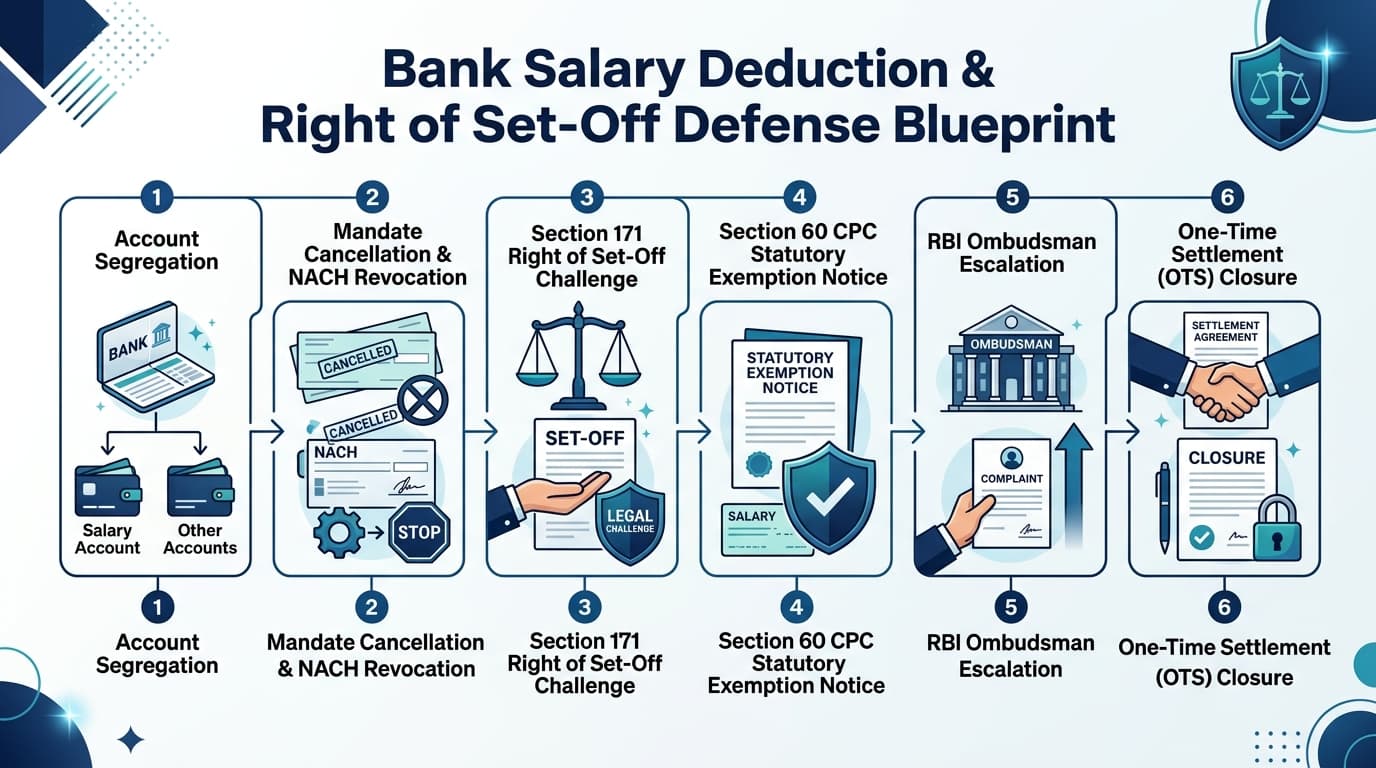
6. Standard Operating Procedure (SOP): 6 Stages of Salary Defense
Follow this battle-tested, sequential protocol to secure your monthly livelihood and resolve your personal loan dispute on favorable terms:
Immediate Account Segregation & Payroll Account Rerouting
If your salary account is held with the lending bank, immediately submit a formal written request to your employer HR/payroll department to update your salary disbursement account to a fresh account in a separate, unrelated scheduled commercial bank (e.g., SBI, Bank of Baroda, or Kotak). This physically severs the lending bank's automated database sweep capabilities before the next payday.
Statutory NACH & e-Mandate Revocation under RBI Circular
Exercise your statutory rights under RBI Circular DPSS.CO.CHD.No./133/04.07.05/2019-20. Log into your net banking portal and revoke the active e-mandate. Simultaneously send a written Mandate Cancellation Notice via registered email and speed post to the destination branch, demanding the immediate cessation of automated debit presentations.
Formal Legal Objection against Section 171 Right of Set-Off
If the bank executed an unauthorized sweep, serve a formal legal notice upon the Branch Manager and Principal Nodal Officer. Challenge the debit on grounds of lack of prior notice, violation of the RBI Fair Practices Code, and breach of mutuality (if joint funds or salary credits were swept). Demand an immediate refund of essential subsistence funds.
Invoking Section 60 CPC Statutory Subsistence Protections
In your formal representation, cite Section 60(1)(i) of the Code of Civil Procedure, 1908. Put the bank on record that even a civil execution court is statutorily prohibited from attaching the first ₹1,000 plus two-thirds of salary, and an extrajudicial full salary sweep violates fundamental livelihood rights under Article 21 of the Constitution of India.
Escalating to the RBI Integrated Ombudsman (CMS Portal)
If the bank fails to reverse illegal deductions, file an expedited regulatory complaint on the RBI CMS portal (cms.rbi.org.in) under the Reserve Bank - Integrated Ombudsman Scheme, 2021. Include bank statements, mandate cancellation receipts, and proof of financial distress to compel regulatory intervention.
Negotiating Compromise OTS (40%–70% Waiver) & Obtaining NDC
With salary deductions successfully halted and regulatory scrutiny initiated, the lender loses automated leverage and becomes motivated to close the non-performing asset (NPA). CredSettle leads bilateral negotiations to secure a 40% to 70% waiver on accumulated dues, culminating in a formal OTS Sanction Letter and an official No Dues Certificate (NDC).
7. Formal Statutory Demand Notice (Monospace Terminal Draft)
If your bank has executed an unauthorized salary sweep or continues unapproved NACH debit presentations, dispatch this formal statutory notice to the Bank Principal Nodal Officer and Branch Manager:
To,
The Branch Manager & Principal Nodal Officer (PNO),
[Bank / NBFC Name],
[Zonal Office Address / Branch Address],
Email: [nodalofficer@bankname.com]

Subject: FORMAL STATUTORY NOTICE FOR IMMEDIATE CEASE & DESIST OF UNAUTHORIZED SALARY DEDUCTIONS, REVOCATION OF NACH/e-MANDATE, AND OBJECTION TO UNLAWFUL SET-OFF UNDER SECTION 171 INDIAN CONTRACT ACT & SECTION 60(1)(i) CPC FOR LOAN A/C NO: [Insert Loan A/C No.]

Respected Sir/Madam,

I, [Borrower Full Name], residing at [Borrower Full Address], holding Savings/Salary Account No: [Insert Account No.] with your branch, submit this formal legal representation:

1. That the undersigned availed a Personal Loan Facility [Account No: XXXXXXXX] from your esteemed institution. Due to severe bona fide financial distress resulting from [salary reduction / medical emergency / business loss], the undersigned has experienced genuine hardship in servicing regular monthly EMIs.

2. That on [DD/MM/YYYY], your institution executed an unauthorized direct debit/sweep of ₹[Amount Deducted] from the captioned salary account without prior written notice, completely depleting the undersigned's monthly salary and leaving zero funds for family subsistence, rent, and basic medical sustenance.

3. TAKE NOTICE that this unilateral action constitutes an unlawful exercise of the Banker's Right of Set-Off under Section 171 of the Indian Contract Act, 1872, for the following statutory reasons:
   a) Lack of Reasonable Notice: Under binding Supreme Court precedents and RBI Master Directions on Fair Practices Code, set-off cannot be exercised extrajudicially without prior written intimation.
   b) Violation of Section 60(1)(i) Code of Civil Procedure, 1908: Even an executing civil court is statutorily barred from attaching the first ₹1,000 and two-thirds (2/3rd) of the remainder of salary. Your bank's 100% sweep is unconstitutional and violates the right to livelihood under Article 21.
   c) Strict Mutuality Breach: The credited funds represent monthly earned wages intended for family subsistence and are not general deposits subject to unrestricted lien.

4. STATUTORY MANDATE REVOCATION:
   Pursuant to RBI Circular DPSS.CO.CHD.No./133/04.07.05/2019-20, the undersigned hereby formally REVOKES and CANCELS all active NACH, ECS, e-mandates, and Standing Instructions associated with the said loan facility. Any subsequent debit presentation initiated by your bank shall constitute an intentional regulatory offense.

DEMAND:
You are hereby called upon to:
i) Immediately reverse and refund the unauthorized deducted sum of ₹[Amount Deducted] back to Account No: [Insert Account No.] within 7 (seven) calendar days of receipt of this notice.
ii) Update the central clearing server to record the NACH/ECS mandate as CANCELLED.
iii) Direct your collection representatives to cease contacting the undersigned's employer or family, in strict compliance with the RBI Master Direction on Recovery Agents.
iv) Refer the outstanding loan account to the Bank's Compromise Settlement Committee for an amicable One-Time Settlement (OTS).

Take notice that failure to comply within 7 days shall compel the undersigned to lodge a formal statutory complaint before the Reserve Bank of India Integrated Ombudsman (cms.rbi.org.in) alongside initiating appropriate proceedings before the Consumer Disputes Redressal Commission for compensation for mental agony and financial injury.

Yours sincerely,

___________________________
[Signature]
[Borrower Name]
[Mobile Number]
[Registered Email ID]
8. The 3-Tier Escalation Matrix & Judicial Remedies
If the lending bank ignores your mandate cancellation or refuses to refund unauthorized salary sweeps, escalate through this structured 3-tier regulatory and judicial matrix:
Submission of Formal Mandate Cancellation & Set-Off Protest
Submit the written statutory notice directly to your home branch manager and email the Bank's Centralized Customer Redressal Desk. Obtain a physical receiving stamp or electronic ticket acknowledgement number.
Escalation to Apex Internal Banking Authority
If the branch fails to resolve the grievance within 14 days, escalate to the bank's appointed Principal Nodal Officer (PNO). The PNO operates under direct RBI mandates to review arbitrary recoveries, reverse unfair penalties, and facilitate OTS compromise settlements.
Regulatory Redressal & Statutory Compensation
If 30 days elapse without resolution, lodge a formal complaint on the RBI CMS portal (cms.rbi.org.in) under the Reserve Bank - Integrated Ombudsman Scheme, 2021. The Ombudsman holds statutory powers to order immediate fund restitution, levy fines on the bank, and grant compensation up to ₹20 Lakhs for mental harassment.
9. Chronological Milestone Resolution Timeline (Day 0 to Month 6)
Understanding institutional and legal milestones allows borrowers to plan defense maneuvers and settlement negotiations strategically:
| Milestone Phase | Key Legal / Banking Event | Statutory Limitation Window | Borrower Strategic Action |
|---|---|---|---|
| Day 0 | First Missed EMI / Auto-Debit Bounce | 1 to 30 Days Past Due (DPD) | Audit banking setup & prepare salary account firewall |
| Days 1–5 | Payroll Rerouting & Account Segregation | Prior to next employer payroll cycle | Submit new account details to employer HR to protect wages |
| Days 6–15 | NACH Cancellation & Statutory Notice | Within 30 days of default notice | Dispatch Section 171 notice & cancel e-mandates on net banking |
| Days 16–30 | NPA Classification (90 DPD Window) | Statutory 90-day RBI prudential norm | Engage CredSettle legal desk to open formal OTS settlement channel |
| Months 2–4 | OTS Compromise Negotiation Window | Bilateral negotiation period | Secure official written OTS sanction letter with 40%–70% waiver |
| Months 5–6 | Full Closure & No Dues Certificate (NDC) | Within 30 days of settlement payment | Collect NDC & verify CIBIL record updated to "Closed" status |
10. Special Scenarios: Joint Accounts, Provident Funds & HR Threats
Salary deduction dynamics vary across complex family financial structures and aggressive recovery practices:
1. Joint Accounts with Spouse or Parents: The Rule of Mutuality
Under Indian contract jurisprudence, a bank cannot debit a joint account held by a borrower along with a spouse, parent, or sibling to recover an individual debt, unless the joint holder is a signed co-borrower or guarantor. If a bank unlawfully sweeps funds from a joint account, a formal objection citing lack of mutuality mandates immediate restitution of the co-holder's funds.
2. Complete Statutory Immunity for Provident Fund (EPF/PPF) & Gratuity
Under Section 10 of the Employees' Provident Funds and Miscellaneous Provisions Act, 1952, Section 60(1)(k) CPC, and the Public Provident Fund Act, 1968, funds lying in EPF, PPF, and statutory Gratuity accounts are completely immune from bank set-off and civil court attachment. Any attempt by a bank to freeze or debit PF accumulation is void ab initio.
3. Recovery Agent Threats to Contact Employer HR / Company Payroll
Recovery agents frequently threaten: "We will send a legal notice to your HR and deduct EMI directly from your salary." This is a complete bluff and an illegal practice. An employer is legally prohibited under the Payment of Wages Act, 1936 from withholding an employee's salary for private loans without an explicit judicial order passed under Order 21 Rule 48 CPC.
4. Digital Fintech NBFC Apps & UPI Auto-Pay Overrides
Instant loan applications often register recurring UPI Auto-Pay mandates on Google Pay, PhonePe, or Paytm. If you face distress, you must cancel these mandates directly inside your UPI application settings under 'AutoPay / Recurring Mandates' to prevent random mid-month debits.
 Legal Debt Dispute Authority
CredSettle (credsettle.com) is India's premier debt settlement, loan dispute resolution, and legal protection platform. Operating strictly under the RBI Fair Practices Code and CICRA 2005, our advocate panel negotiates directly with Bank Principal Nodal Officers to eliminate waived differentials, obtain unconditional No Dues Certificates (NDC), and upgrade credit bureau records from "Settled" to "Closed".
Frequently Asked Questions on Bank Salary Deductions & Set-Off
Click on any question below to view detailed legal answers verified by our debt resolution professionals: