Embassy Proof of Funds vs CIBIL Score for Overseas Visas
Find out if an Indian personal loan default or settled CIBIL hurts your US, UK, Canada, Schengen, or UAE visa. Learn what visa officers really check and how to stay safe before you fly.
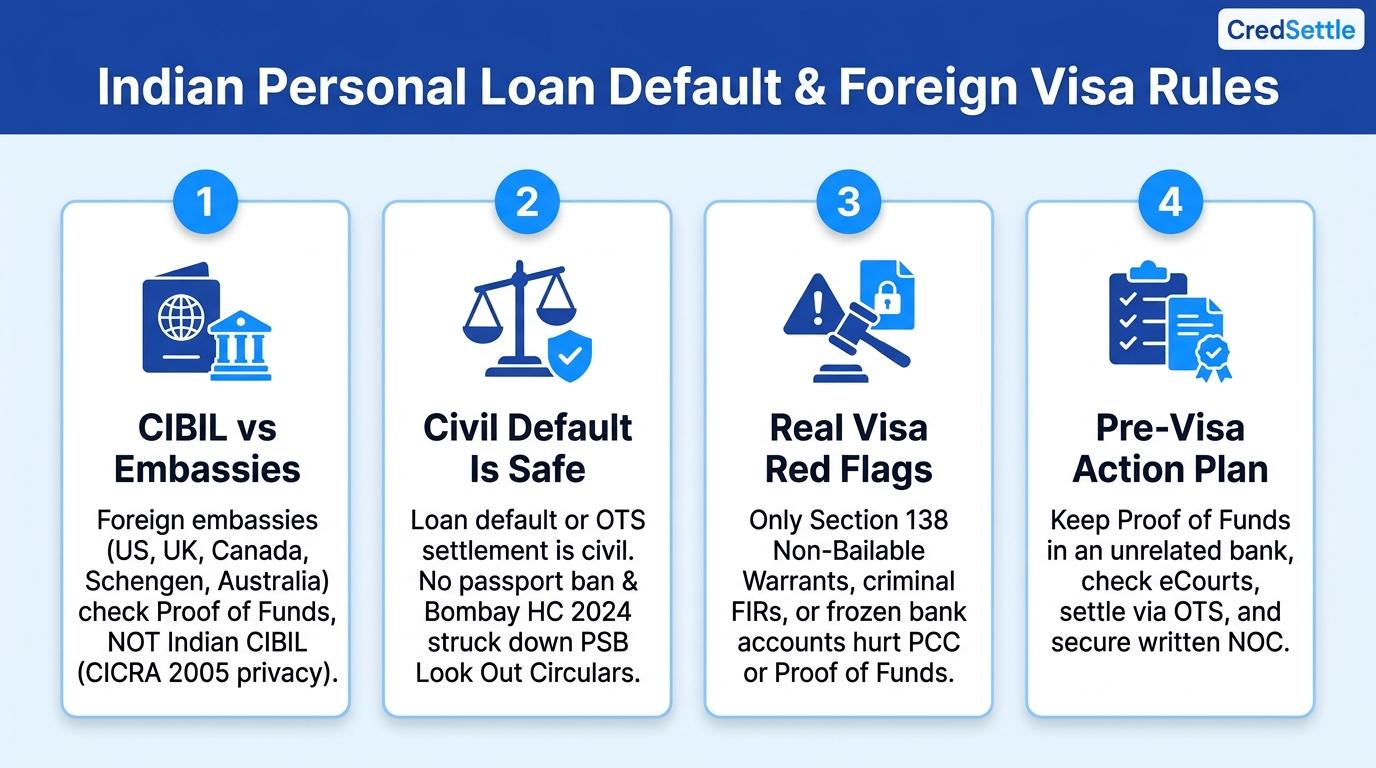
- Embassies Cannot Check CIBIL: Foreign visa offices cannot view Indian credit bureaus under CICRA 2005. A low score or Settled mark does not trigger visa denial.
- Proof of Funds Comes First: Embassies check your real cash balance, tax returns, and pay slips. Never keep your visa savings in the same bank where you owe debt.
- No Bank Look Out Circulars: Private banks never had LOC power. In April 2024, the Bombay High Court also barred state banks from issuing LOCs for debt recovery.
- Real Visa Red Flags: Only criminal cases, Section 138 arrest warrants, or fraud FIRs put your Police Clearance Certificate (PCC) and passport at risk.
- Best Move Before Flying: Search eCourts before your visa filing. Settle overdue personal loans in writing and get every cheque bounce case closed.
1. Direct Answer: Do Foreign Embassies Check Indian CIBIL?
No. An Indian personal loan default does not stop you from getting a foreign study, work, or tourist visa. Foreign embassies cannot check your CIBIL, Experian, Equifax, or CRIF report.
Many debt collectors tell borrowers that an unpaid loan will ruin their US, UK, Canada, or Europe visa. That claim is false. Missing a personal loan EMI is a civil issue, not a crime.
Still, an unpaid loan can cause indirect trouble in three clear ways. Your bank may freeze the savings account you use for Proof of Funds. An Indian bank may reject your fresh study loan. And a cheque bounce warrant can stop your Police Clearance Certificate (PCC).
Once you know what embassies check and what Indian law allows, you can plan your move abroad without fear.
2. Legal Framework: CICRA 2005, Passports Act & Constitution
Three core Indian laws protect your right to go abroad and keep your credit report private from foreign offices.
Sections 17 and 20 of CICRA 2005 limit who can view credit files. Only RBI-approved Indian banks and lenders can pull your score. Foreign embassies and VFS desks have zero access.
Article 21 of the Constitution protects your personal freedom. The Supreme Court held that going abroad is a basic right. No bank can stop your trip without a fair law and court order.
Sections 6(2)(f) and 10(3) allow passport holds only for active criminal court cases or warrants. A civil loan default or a Settled remark is never a valid reason to hold your passport.
A bank cannot email a foreign embassy to cancel your visa. Visa officers base their decision only on valid funds, job or study letters, and clean police records.
3. Country Comparison: US, UK, Canada, Schengen & UAE Visas
Every major country checks your money in its own way. None of them pull your Indian CIBIL score. All of them look closely at clean bank accounts and police checks.
| Country & Visa Type | Checks CIBIL? | What Visa Officers Check | Real Loan Risk to Watch |
|---|---|---|---|
| USA (F-1, H-1B, B1/B2) | No | I-20 funds, cash savings, tax returns, job offer, and arrest history. | Open court warrant or denied Indian study loan. |
| UK (Student, Work) | No | 28-day clear bank balance rule, job sponsor, and police record. | Bank freeze breaking the 28-day fund rule. |
| Canada (Study, Work, PR) | No | GIC deposit, fee receipt, 4-month bank statements, and Indian PCC. | Pending criminal court case blocking PCC. |
| Schengen & Germany | No | Blocked account funds, 3-6 month pay statements, and tax filings. | Many ECS bounce fees shown on bank statements. |
| Australia (500, 482, PR) | No | True student funds, family income proof, and PCC character check. | Unpaid Section 138 warrant hurting character check. |
| UAE & Gulf Work Visas | No | Job sponsor, valid passport, attested degrees, and police clearance. | Formal court decree execution only in rare large cases. |
4. Court Rulings: Bombay HC 2024 LOC Verdict & Travel Rights
Indian courts have made it clear that banks cannot use airport stops to collect normal loans. Four major rulings and rules protect your travel rights.
On April 23, 2024, the Bombay High Court struck down the rule that let state bank chiefs issue Look Out Circulars (LOCs). The court held that banks cannot stop citizens from flying just to collect unpaid loans.
The Supreme Court ruled that the right to travel abroad sits inside Article 21. Any stop on your passport or flight must follow a fair and valid legal step.
The court held that officers cannot deny a passport or stop foreign travel without clear law. Private banks and NBFCs have zero power to put your name on airport alerts.
Even if a lender files a Section 138 cheque bounce case, you are not stuck in India forever. Under MEA rule G.S.R. 570(E), you can ask the court for a travel NOC to renew your passport and fly.
5. Visual Blueprint: Loan Default vs Visa Approval Flow
This visual chart sums up what visa officers check, why civil debt does not ban your travel, and how to keep your Proof of Funds and PCC safe.
7. Settled Loan vs Active Default: Impact on Study & Work Visas
Many people ask whether to leave a bad loan unpaid or close it via One-Time Settlement (OTS) before a visa. Settling your loan clears court, warrant, and lien risks in one step.
| Visa & Legal Factor | Unpaid Default (NPA) | Settled via OTS + NOC | Fully Paid & Closed |
|---|---|---|---|
| Embassy Visa Decision | Not denied for CIBIL alone. | Safe. No embassy issue. | Safe. No embassy issue. |
| Section 138 / Warrant Risk | High if cheques bounce. | Gone once case is closed. | Zero legal risk. |
| Police Clearance (PCC) | Risk only if NBW exists. | Clean PCC approval. | Clean PCC approval. |
| Indian Study Loan | Denied by Indian lenders. | Needs strong co-applicant. | Easy once score rises. |
| Calls to Family in India | Agents keep calling home. | Stops for good after NOC. | Stops for good after NOC. |
8. Step-by-Step SOP: Clear Visa & Travel Hurdles Before Flying
Follow these six simple steps 60 to 90 days before you submit your study, work, or PR visa file.
1Stage 1: Search eCourts for Any Hidden Case
Look up your name on services.ecourts.gov.in in your home city and your bank head office city. Make sure no Section 138 cheque bounce case or court notice is pending against you.
2Stage 2: Keep Visa Funds in a Clean Bank
Hold your savings, pay credits, GIC funds, or parent funds in a bank where you have zero loans. This keeps your 3 to 6 month visa statements free from bank freezes and bounce fees.
3Stage 3: Ask for a Written One-Time Settlement
If you cannot pay the full due amount, agree to a written OTS on official bank paper. Check that the OTS letter clearly promises to drop all civil and Section 138 cases.
4Stage 4: Collect Your NOC & Court Closure Order
Once you pay the settled sum, take your official No Dues Certificate (NOC). If a court case existed, get a signed copy of the judge order closing the complaint.
5Stage 5: Check 15-Day RBI Bureau Updates
Under RBI 15-day reporting rules effective January 2025, banks must update credit bureaus twice a month. Confirm that your overdue amount drops to zero on CIBIL, Experian, Equifax, and CRIF.
6Stage 6: Apply for PCC & File True Visa Forms
Apply early for your PCC on Passport Seva if your work or PR visa asks for one. Always tell the truth on visa forms. Civil debt does not count as a criminal record.
9. Pre-Visa Timeline: From Legal Audit to Clean Travel File
Starting three months early helps you avoid last-minute delays with your PCC, study loan, or visa stamping.
| Time Before Filing | Stage | Action to Take | Result |
|---|---|---|---|
| 90 Days Left | Case & Bank Audit | Check eCourts, pull 4 bureau reports, and move visa funds to a clean bank. | Your clean 3-month bank statement starts safely. |
| 60-75 Days Left | OTS Talks | Agree on a fair settlement plan or repayment deal with your lender. | Written OTS offer with legal case drop clause. |
| 30-45 Days Left | NOC & Closure | Pay OTS amount, collect NOC, and close any Section 138 court file. | Zero pending court cases or warrant risks. |
| 15-30 Days Left | PCC & Credit Check | Check 15-day RBI bureau update and finish Passport Seva PCC. | Clean PCC and updated zero-due report. |
| Filing Week | Visa & Flight | Submit clean bank statements, offer letter, and valid PCC. | Smooth visa stamping and safe airport travel. |
10. Special Cases: Education Loans, PR & NRI Debt Recovery
Different visa goals bring unique money questions. Here is how Indian loan default works for students, PR applicants, and NRIs.
Foreign Study Visa & Education Loans
Your college offer and student visa do not depend on CIBIL. Still, Indian banks check CIBIL before giving an education loan. You can use a strong co-applicant, family savings, or foreign lenders like Prodigy or MPOWER.
Canada Express Entry & Australia PR
PR officers want free, unblocked funds and a clean PCC. You must prove your funds are not a fresh loan. Settling old debt early keeps your PCC fast and your bank cash safe.
Fresh Credit Score Abroad
Indian credit scores do not move to the US, UK, Canada, Europe, or Australia. When you land abroad, your new credit score starts fresh from zero, even if you settled an Indian loan.
Already Abroad? Remote NRI Settlement
If you already live abroad with unpaid Indian debt, you do not need to fly back. You can sign a Power of Attorney so family or legal experts settle the loan and stop home visits.
 Legal Debt Dispute Authority
CredSettle (credsettle.com) is India's premier debt settlement, loan dispute resolution, and legal protection platform. Operating strictly under the RBI Fair Practices Code and CICRA 2005, our advocate panel negotiates directly with Bank Principal Nodal Officers to eliminate waived differentials, obtain unconditional No Dues Certificates (NDC), and upgrade credit bureau records from "Settled" to "Closed".
Frequently Asked Questions: Loan Default & Foreign Visas
Simple, verified answers on personal loan default, settled CIBIL scores, visa Proof of Funds, PCC rules, and airport travel rights.
Official Statutory Citations & Legal References
- CICRA, 2005 (Sections 17 & 20): Limits credit report sharing strictly to RBI-approved Indian users.
- Passports Act, 1967 & MEA Rule G.S.R. 570(E): Sets exact criminal grounds for passport holds and court travel NOCs.
- Bombay High Court (April 23, 2024): Viraj Chetan Shah v. Union of India (WP 719/2020) quashing state bank LOC rules.
- Supreme Court of India: Satwant Singh Sawhney (1967) and Maneka Gandhi (1978) protecting travel under Article 21.
- Contract Act, 1872 & NI Act, 1881: Section 171 (Banker Lien), Section 138 (Cheque Bounce), and RBI 15-Day Bureau Rules (2024).