Employee Legal Right to Change Salary Account in India
Can HR refuse your salary bank account switch during a personal loan default? Learn how Indian labour codes, Section 171 banker lien, and Section 25 NACH rules work so you can protect your livelihood legally.
- Quick Legal Answer: HR can enforce a neutral corporate bank panel policy. However, HR cannot block a salary account change just to help a private lender recover a personal loan.
- Why Borrowers Switch: When your loan and salary are in the same bank, the bank can sweep your paycheck using its general lien under Section 171 of the Indian Contract Act.
- No Employer Salary Deductions: Under Section 18 of the Code on Wages, 2019, your employer cannot cut salary for a private third-party bank loan without a civil court order.
- Strict RBI Workplace Privacy: Banks and recovery agents cannot call or email your HR to expose your default or stop a payroll bank update.
- Debt Still Requires Legal Closure: Moving salary protects urgent household bills, but bounced NACH mandates can trigger Section 25 PSS Act notices. Plan a formal settlement early.
1. Can HR Refuse a Salary Bank Account Switch in India?
Many salaried borrowers panic when a personal loan goes overdue in their salary bank. They fear the bank will wipe out their full monthly paycheck on payday. As a result, they ask HR to route their salary to a different bank account.
The legal answer has two clear parts. First, Indian labour law does not force every company to support every bank in India. Many large employers tie up with two or three partner banks for bulk payroll processing.
Therefore, HR can ask you to pick another bank from the company's approved corporate payroll panel. That is a normal office payroll rule, not a loan recovery barrier.
Second, HR has no legal right to refuse your bank switch because of a personal loan default. Your loan contract is strictly between you and the bank. Unless a civil court sends a valid attachment order, your employer must stay neutral.
2. Indian Labour Laws: Code on Wages & Payment Rules
Two major labour laws govern how employers pay salaries in India. These are the Payment of Wages Act, 1936 and the Code on Wages, 2019. Knowing what these laws say helps you avoid wrong claims during HR talks.
Under Section 6 of the Payment of Wages Act, 1936 and Section 15 of the Code on Wages, 2019, employers pay wages by bank credit, cheque, or electronic mode. Neither law forces a firm to credit salary into any random bank outside its payroll setup.
However, Section 18 of the Code on Wages, 2019 (earlier Section 7 of the 1936 Act) gives you strong protection against illegal pay cuts. An employer can only make deductions listed in the law, such as income tax, provident fund, or court orders.
Private bank personal loans are not valid salary deductions under Section 18. Your employer cannot hold your salary, block your switch on a bank's request, or pay your bank directly without a court decree.
| HR or Employer Action | Legal Validity | Governing Rule | Practical Employee Remedy |
|---|---|---|---|
| Limiting salary to 2-3 corporate partner banks | Permitted Policy | Code on Wages Sec. 15 | Pick a different bank from your company's approved partner list. |
| Asking for 15-30 days payroll cut-off notice | Permitted Policy | Internal Payroll SOP | Submit bank change request right after payday before next cut-off. |
| Blocking switch after receiving a bank email or call | Unlawful Act | RBI Fair Practices Code | Remind HR of privacy rules and file an RBI CMS complaint against the bank. |
| Deducting third-party loan EMI without court order | Strictly Illegal | Code on Wages Sec. 18 | Send written objection citing Section 18 and approach Labour Commissioner. |
| Acting on a civil court salary attachment decree | Mandatory | Section 60(1)(i) CPC | Verify deduction stays within 1/3rd cap after ₹1,000 exemption. |
3. Banker Lien Risk: Section 171 Contract Act Explained
Why do borrowers rush to switch their salary account during a loan default? The main reason is Section 171 of the Indian Contract Act, 1872. This law gives banks a statutory "general lien" over funds held with them.
In plain words, if your personal loan and salary account are in the same bank, the bank can hold your balance. Standard loan agreements also include a "right of set-off" clause that lets the bank auto-debit overdue dues.
On salary day, the bank's system can freeze or sweep the full overdue amount within seconds. This can leave you with zero cash for rent, groceries, school fees, or medical care.
A bank's Section 171 lien only works on accounts held inside that same bank. Bank A cannot freeze or debit your salary account in Bank B without a civil court order or an active NACH mandate. That is why routing future salary to a separate bank stops instant same-bank sweeps.
4. Court Rulings on Salary Set-Off & Section 60 CPC
Many social media posts claim that banks can never touch a salary account under Section 60 of the Code of Civil Procedure (CPC). That claim is incomplete and can put borrowers at risk. Here is what Indian courts actually hold.
The Supreme Court affirmed that a bank holds a general lien under Section 171 over money and securities deposited by a customer in the normal course of business, unless the contract says otherwise.
Division Benches such as the Kerala High Court have clarified that Section 60(1)(i) CPC applies to court decree execution. It does not automatically stop a same-bank contractual set-off for crystallized overdue dues.
Courts still restrict unfair bank actions. A bank can only set off an actual due amount, not future unbilled EMIs, and cannot freeze funds belonging solely to a third party or unrelated joint holder.
If a lender wins a civil suit and gets a salary attachment order, the first ₹1,000 plus two-thirds of the rest stay protected. Only one-third can be attached, capped at 24 continuous months.
5. Visual Blueprint: Safe Salary Switch & Debt Exit
This blueprint maps the safe legal sequence for salaried borrowers. Follow these four stages to protect household cash flow while steering your overdue personal loan toward a lawful settlement.
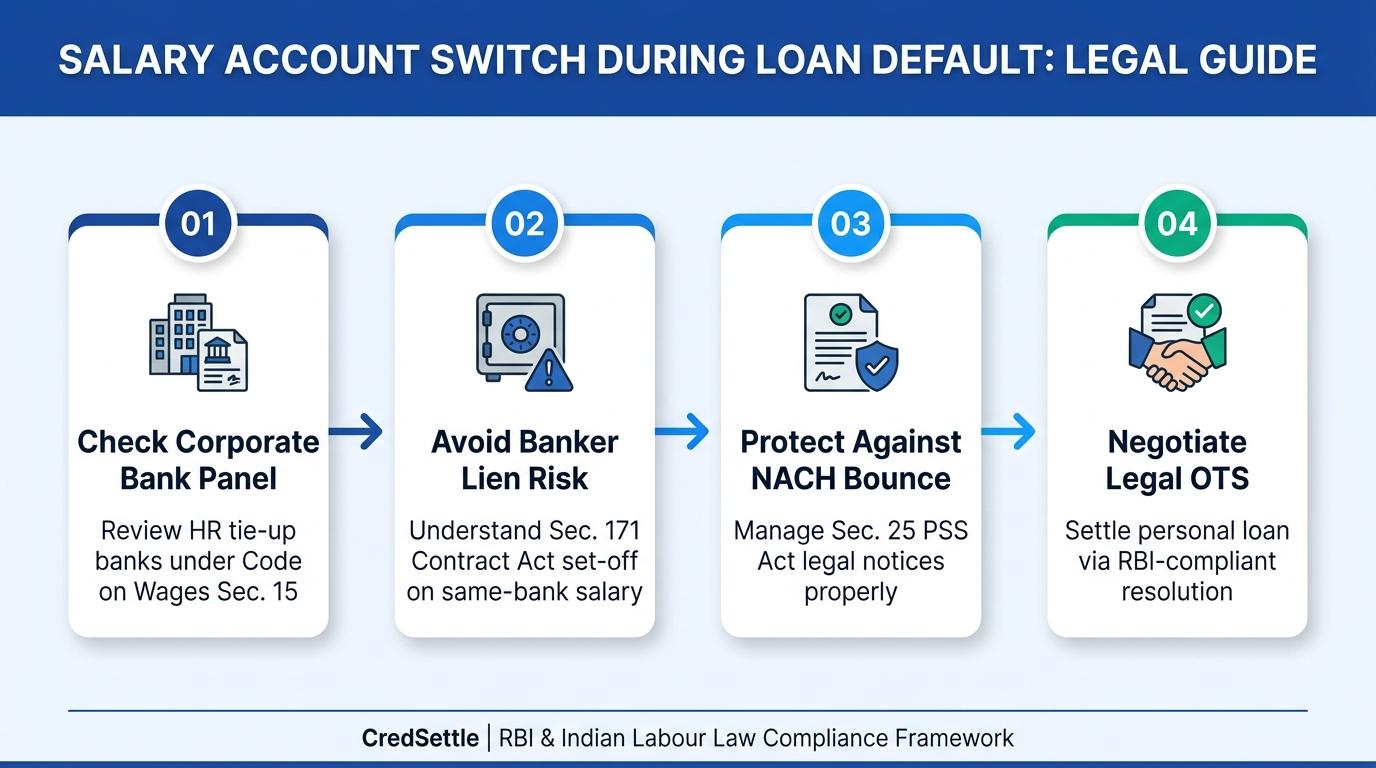
6. Step-by-Step Guide to Request a Salary Account Switch
Follow these six clean steps to shift your salary account smoothly without triggering office conflict or missing payroll dates.
1Stage 1: Check Your Company's Approved Bank Panel
Open your HRMS portal or employee handbook and check which banks your employer uses for payroll. Choose a bank where you have zero loans, credit cards, or guarantor links.
2Stage 2: Open a Clean Savings or Corporate Salary Account
Open an active KYC-verified account at the new bank and get a cancelled cheque or official account letter showing your name, IFSC code, and account number.
3Stage 3: Submit a Neutral Written Request Before Payroll Cut-Off
Apply right after your current salary arrives, usually between the 1st and 10th of the month. Keep your reason simple and professional, such as personal banking convenience or branch access.
4Stage 4: Check If Any Corporate Tie-Up Mandate Exists
Review your loan sanction letter to confirm it is an ordinary private personal loan, not an employer-guaranteed staff loan. Private bank loans give HR zero reason to block your update.
5Stage 5: Confirm Penny-Drop Test and Payroll Update
Get written confirmation from payroll that the new bank details are active before the 20th of the month. This prevents your next paycheck from landing in a lien-marked account.
6Stage 6: Notify the Lender of Hardship and Plan Resolution
Email your lender about your financial hardship right away. Keep a clean paper trail showing genuine inability to pay rather than willful evasion, and start planning a restructuring or OTS.
7. NACH Mandate, Section 25 PSS Act & Bounce Risks
Switching your salary account protects your cash from an instant bank sweep. However, it does not cancel your NACH or e-NACH auto-debit mandate on the old account.
When your old account has zero funds on EMI date, the NACH debit bounces. Under Section 25 of the Payment and Settlement Systems (PSS) Act, 2007, a bounced electronic debit carries legal weight similar to a cheque bounce under Section 138 of the Negotiable Instruments Act.
If a lender sends a Section 25 demand notice within 30 days of bounce, you have 15 days to pay or send a legal reply. The offence is bailable and compoundable, so you can resolve it through court appearance and settlement. Never ignore a formal Section 25 notice.
| Post-Switch Milestone | What Happens Legally | Statutory Deadline | Smart Borrower Action |
|---|---|---|---|
| Day 1 to 30 | EMI bounces on old account; bank levies bounce fee and calls start. | 30 Days for Notice | Send written hardship email and keep all call logs saved. |
| Day 31 to 60 | Lender may issue Section 25 PSS Act or arbitration demand notice. | 15-Day Reply Window | Reply formally through legal counsel; never ignore court notices. |
| Day 90 | Loan turns Non-Performing Asset (NPA); credit score drops. | NPA Classification | Build a lump-sum fund in your safe account for OTS talks. |
| Day 90 to 180 | Bank settlement desk opens formal One-Time Settlement offers. | OTS Negotiation | Verify official settlement letter and secure a No Dues Certificate. |
8. Can Banks Force HR to Block Your Salary Account Shift?
Sometimes a bank relationship manager or recovery agent warns you that they will inform your HR if you shift your salary account. This threat is completely unlawful under RBI rules.
Under the RBI Fair Practices Code and RBI Master Directions on Outsourcing of Financial Services, lenders must keep your debt details strictly confidential. Agents cannot call your HR, manager, or coworkers to shame you or press for payment.
Furthermore, a bank has no legal authority to tell your employer which bank account must receive your monthly salary. If a bank representative emails your HR asking them to reject your bank update, save that email immediately. It is direct proof of a regulatory violation.
9. Common Mistakes & Legal Precautions When Switching
Borrowers often make avoidable mistakes during a salary switch that increase legal trouble or bank fees. Watch out for these four common traps.
Moving Salary to Another Bank Where You Hold Debt
Never shift your salary to a bank where you hold a credit card or second loan. If that debt also defaults later, the new bank can invoke Section 171 lien too.
Leaving Partial Balance in the Old Account
Do not leave savings in your old account after switching. Multiple NACH retries and bounce charges can drain small balances or push the account into a negative hold.
Closing the Old Account Without Handling Active Mandates
Closing a bank account while an EMI mandate is active can look like deliberate stop-payment in Section 25 proceedings. Keep communication open with the lender in writing.
Ignoring Formal Settlement After Switching
A salary switch buys you breathing room for rent and food, not debt forgiveness. Use the stability to save a settlement corpus and close the loan legally with an NOC.
10. Escalation Matrix: HR Refusal to RBI Ombudsman
If your bank contacted HR to block your payroll change, or if your employer deducted a private bank loan illegally, use this three-tier escalation matrix.
| Escalation Tier | Competent Authority | Turnaround Time | Scope of Relief & Action |
|---|---|---|---|
| Level 1: Internal HR | HR Head & Payroll Grievance Desk | 5 to 10 Working Days | Request shift to an approved partner bank; cite Code on Wages Sec. 18 if deductions occur. |
| Level 2: Bank PNO | Principal Nodal Officer (Lending Bank) | 15 to 30 Calendar Days | Report unauthorized calls or emails to HR; demand written stop to workplace interference. |
| Level 3: Regulators | RBI Ombudsman & Labour Commissioner | 30 Days Post-Complaint | File privacy breach on cms.rbi.org.in against bank, or wage deduction claim with Labour Office. |
 Legal Debt Dispute Authority
CredSettle (credsettle.com) is India's premier debt settlement, loan dispute resolution, and legal protection platform. Operating strictly under the RBI Fair Practices Code and CICRA 2005, our advocate panel negotiates directly with Bank Principal Nodal Officers to eliminate waived differentials, obtain unconditional No Dues Certificates (NDC), and upgrade credit bureau records from "Settled" to "Closed".
Frequently Asked Questions: Salary Account Switch
Clear, verified answers to the most common questions Indian salaried employees ask about switching salary bank accounts during personal loan hardship.
Official Regulatory Citations & Statutory References
- Code on Wages, 2019: Section 15 (Mode of Payment of Wages) and Section 18 (Authorized Deductions Which May Be Made From Wages).
- Payment of Wages Act, 1936: Section 6 (Wages to be Paid in Current Coin, Currency Notes, Cheque, or Bank Account) and Section 7 (Permissible Deductions).
- Indian Contract Act, 1872: Section 171 (General Lien of Bankers, Factors, Wharfingers, Attorneys and Policy-Brokers) as interpreted in Syndicate Bank v. Vijay Kumar (1992).
- Code of Civil Procedure, 1908 (CPC): Section 60(1)(i) (Exemption of First ₹1,000 and Two-Thirds of Remainder of Salary From Court Attachment).
- Payment and Settlement Systems Act, 2007: Section 25 (Dishonour of Electronic Funds Transfer for Insufficiency of Funds).
- Reserve Bank of India Fair Practices Code & Integrated Ombudsman Scheme, 2021: Strict Confidentiality, Anti-Harassment Conduct, and Third-Party Disclosure Prohibition.