Comprehensive Legal Checklist.
How to Verify a Bank's Loan Settlement Letter
Before you pay a single rupee, ensure your settlement letter is legally binding. Use our checklist to spot fake or conditional settlement letters.
- Never Pay on Agent Drafts or WhatsApp Messages: Third-party collection agencies have zero legal authority to sanction debt waivers. Under RBI rules, a settlement is only valid if generated through the lender's Core Banking System (CBS) on official corporate letterhead with an authorized officer's employee code.
- Enforceable Discharge Under Section 63 Contract Act: The letter must contain an unequivocal "Full and Final Satisfaction" covenant. Without this clause, banks can treat your payment as a regular partial recovery against accrued penalty charges and continue legal action for the balance.
- Mandatory Litigation Withdrawal Clause: If the lender has initiated legal notices, Section 138 NI Act (cheque bounce) complaints. Section 25 PSS Act proceedings, the OTS letter must explicitly mandate withdrawal of all cases within 15 to 30 days of full payment.
- Strict Direct Bank Remittance Only: All settlement funds must be transferred directly into the bank's centralized collection account or loan ledger via RTGS/NEFT/DD. Never pay funds to recovery agents, personal UPI IDs, or third-party collection agency accounts.
- Statutory 30-Day NDC & CIBIL Reporting Mandate: An authentic settlement letter binds the institution to issue an unconditional No Dues Certificate (NDC) and update all four credit bureaus (CIBIL, Experian, Equifax, CRIF) to "Settled". Status within 30 to 45 days.
1. Legal Anatomy of an Authentic Bank OTS Letter
In Indian banking jurisprudence, a One-Time Settlement (OTS) sanction letter is not a casual correspondence. It is a formal novation of contract governed by. Section 63 of the Indian Contract Act, 1872.. Under this statute, a creditor may dispense with or pay, wholly or in part, the performance of the promise made to them. Accept instead of it any satisfaction which they think fit.
However, for an OTS sanction letter to be legally binding and capable of extinguishing the underlying debt, it must satisfy rigorous statutory criteria under the. Reserve Bank of India (Prudential Framework for Resolution of Stressed Assets) Master Directions. and the Information Technology Act, 2000.. When a borrower receives a settlement proposal, it must contain 6 foundational structural elements:
Must appear on the bank's registered corporate letterhead containing its Corporate Identification Number (CIN), registered office address. A unique Core Banking System (CBS) OTS proposal reference number.
Must be executed by a designated officer possessing delegated lending/recovery authority (Chief Manager, Assistant General Manager. Zonal Credit Committee) with their full name, designation, and official employee code.
Must detail the total outstanding ledger balance, the exact agreed settlement consideration. The specific write-off amounts categorized across principal, unapplied interest, penalty charges, and legal fees.
Must clearly define the payment milestones, precise maturity cut-off dates. Authorized banking channels (RTGS, NEFT, Demand Draft, or centralized virtual payment accounts).
2. Authentic OTS Letter vs Fake Drafts Matrix
Thousands of Indian borrowers fall victim every month to fraudulent recovery agents who issue fabricated "settlement letters". On Photoshop or unofficial letterheads to extract money before month-end targets. Examine this 4-sided comparison matrix before paying any funds:
| Verification Parameter. | Authentic Bank OTS Letter. | Fake / Agency Draft. | Conditional / Revocable Letter. | Informal Email / WhatsApp Draft. |
|---|---|---|---|---|
| Issuing Source & Domain. | Official Bank Letterhead + Verified corporate email (@bank.com). | Collection agency letterhead or Gmail / Yahoo / Outlook ID. | Bank letterhead, but issued by unauthorized frontline executive. | Plain WhatsApp text, screenshot, or unformatted email body. |
| Signatory Authority. | Authorized Officer / AGM / Scale-IV Manager with Employee ID. | Recovery telecaller, "Legal Manager" without Employee Code. | Assistant Manager without delegated OTS sanction committee approval. | Zero verified signatory; informal agent phone number only. |
| Payment Destination. | Official Loan Account or Bank Central Pool Account (RTGS/NEFT). | Agency account, third-party current account, or personal UPI. | Direct loan account, but payment credited as partial EMI. | Dynamic UPI QR code sent over WhatsApp or SMS gateway. |
| Discharge Clause. | Unconditional full & final discharge; Section 138/DRT withdrawal. | No legal discharge; silent on remaining balance and legal cases. | Ambiguous "Subject to higher committee review" clause. | Zero legal discharge; legally treated as voluntary part payment. |
| CIBIL / Bureau Impact. | Mandatory update to "Settled" / ₹0 balance within 30 days. | Zero bureau update; account continues accumulating overdue DPD. | Disputed bureau status; balance continues to reflect as overdue. | Reported as "Overdue" / "Written Off" with active recovery. |
Critical Rule: If your settlement letter does not guarantee an unconditional No Dues Certificate and full withdrawal of pending criminal/civil cases, do not transfer a single rupee.
3. Settlement Math, Accounting & Section 194R Tax
Understanding the technical mathematics behind your bank's settlement calculation is essential to ensure that you are not paying inflated penal interest or triggering unforeseen tax liabilities under Indian income tax law.
Bank OTS Ledger Decomposition Formula
Retail Loans: Zero TDS Under Section 194R
Under CBDT Circular No. 12/2022, waivers granted on personal loans, consumer loans, and credit cards for personal use are. completely exempt from Section 194R TDS.. The bank cannot deduct 10% TDS or withhold your No Dues Certificate on tax grounds.
Commercial & MSME Loans: Section 41(1) / 28(iv)
For corporate borrowers and proprietorship firms where interest was previously claimed as a business tax deduction, the waived interest component may be treated as remission of liability under Section 41(1). Ensure your settlement letter categorizes the waiver accurately.
How to Verify a Bank Loan Settlement Letter: Checklist & SOP
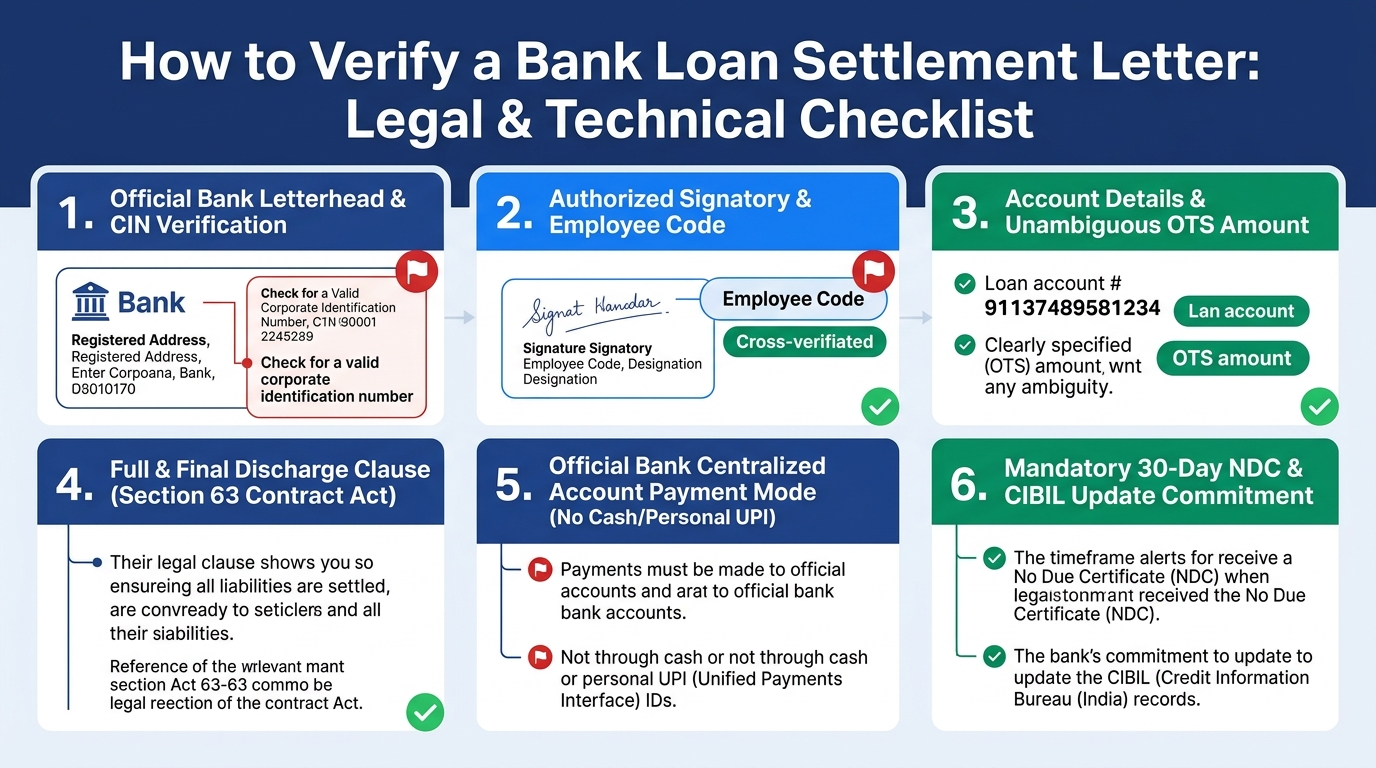
4. 6-Stage SOP to Verify a Bank Settlement Letter
Follow this sequential 6-stage verification protocol before initiating any RTGS, NEFT, or Demand Draft remittance to your lender:
Stage 1: Verify Corporate Letterhead, CIN & Registered Address
Scrutinize the header and footer of the document. Ensure it displays the exact corporate name of the lending entity (e.g.,. HDFC Bank Limited., Bajaj Finance Limited., SBI Cards and Payment Services Ltd.), its 21-digit Corporate Identification Number (CIN), and registered head office address. Compare these against Ministry of Corporate Affairs (MCA) records.
Stage 2: Cross-Verify Authorized Signatory & Employee Code
Every authentic bank OTS letter must bear the physical or cryptographic digital signature (DSC) of a designated bank officer along with their official Employee ID / Staff Number and Branch / Cluster stamp. If the letter is signed by a third-party agency executive, it is invalid under RBI Master Directions on Recovery Agents.
Stage 3: Validate Loan Account Details & CBS Proposal Reference ID
Match your exact 16-digit Loan Account Number, Customer ID (CIF), and PAN card number. Confirm that the letter quotes a unique. CBS OTS Sanction Proposal Number.. Call the bank's centralized retail asset phone banking or visit the base branch to confirm that this proposal ID is approved in the live system.
Stage 4: Scrutinize Full & Final Satisfaction & Litigation Covenants
Verify that the letter explicitly declares that upon realization of the agreed settlement sum, the entire loan liability shall stand. 100% extinguished in full and final satisfaction.. It must mandate the withdrawal of all pending criminal complaints under Section 138 NI Act, Section 25 PSS Act. Civil recovery proceedings.
Stage 5: Audit Payment Modes (Strictly Direct Bank Remittance Only)
Confirm that payment instructions require remittance directly into your loan account number or the bank's centralized nodal collection account (with verified IFSC). Never pay via cash to field agents or transfer money to third-party agency UPI handles.
Stage 6: Enforce 30-Day Mandatory NDC & CIBIL Bureau Commitment
The settlement letter must clearly state that within. 30 calendar days. of receiving the final payment tranche, the bank shall issue an unconditional physical/electronic No Dues Certificate (NDC) and transmit the updated "Settled". Status feed with ₹0 balance to CIBIL, Experian, Equifax, and CRIF.
5. Legal Notice Draft for Letter Verification
If a collection executive provides an ambiguous or unofficial settlement draft, do not pay. Send this formal legal requisition to the bank's Principal Nodal Officer and Retail Asset Operations division to compel issuance of a verified CBS-backed OTS letter:
To,
The Principal Nodal Officer / Head of Retail Asset Operations,
[Name of Scheduled Commercial Bank / NBFC],
[Registered Zonal / Corporate Office Address],
Email: [nodalofficer@bankname.com / retailcollections@bankname.com]

Subject: Formal Requisition for Authenticated Core Banking System (CBS) One-Time Settlement (OTS) Sanction Letter & Statutory Undertaking under Section 63 of the Indian Contract Act, 1872 for Loan Account No: [Insert Loan A/C No.]

Respected Sir/Madam,

I, [Borrower Full Legal Name], residing at [Borrower Full Address], holding PAN: [Insert PAN] and Aadhaar: [Insert Aadhaar], am the borrower for the captioned Loan Facility [Account No: XXXXXXXX] sanctioned by your esteemed institution.

1. That an informal compromise proposal has been communicated to me by your recovery representatives offering to settle the outstanding dues for a total negotiated sum of ₹[Agreed Settlement Amount] against the current ledger balance.
2. That in terms of Reserve Bank of India Master Directions on Compromise Settlements (RBI/2023-24/40) and Sections 63 & 65B of the Indian Evidence Act, 1872, an informal communication or agency draft does not constitute an enforceable legal novation.
3. That prior to remitting the agreed settlement consideration into your institution's designated collection account, I hereby call upon your competent sanctioning authority to issue a formal, irrevocable One-Time Settlement (OTS) Sanction Letter containing:
   a) Official corporate letterhead bearing the Bank's Corporate Identification Number (CIN) and live CBS Proposal Reference Number.
   b) Clear authorization signed by a Scale-IV / Authorized Bank Officer displaying their Name, Designation, and Employee Code.
   c) Explicit waiver breakdown confirming 100% write-off of balance principal, unapplied interest, and accumulated penal charges upon receipt of ₹[Agreed Settlement Amount].
   d) An unequivocal Litigation Withdrawal Covenant committing to unconditionally withdraw all pending criminal complaints under Section 138 NI Act / Section 25 PSS Act and civil recovery suits within 30 days of payment.
   e) A binding undertaking to issue an unconditional No Dues Certificate (NDC) and report the account status as "SETTLED" with ₹0 current balance to TransUnion CIBIL, Experian, Equifax, and CRIF High Mark within 30 calendar days pursuant to Section 21 of CICRA 2005.

4. Please be advised that no funds will be remitted to any intermediary or third-party channel in the absence of this authenticated CBS sanction letter.

Kindly transmit the official OTS Sanction Letter within 7 business days.

Yours sincerely,

___________________________
[Signature]
[Borrower Name]
[Contact Mobile Number]
[Registered Email Address]
Date: [DD/MM/YYYY]
Place: [City, State]
6. 3-Tier Banking & RBI Ombudsman Escalation Matrix
If a bank branch delays validating your settlement letter, issues conditional approvals. Refuses to honor a previously issued OTS sanction after receiving your payment, follow this institutional escalation hierarchy:
Branch & Asset Recovery Desk
Submit written verification requisition to the Branch Manager and Asset Recovery Management Branch (ARMB). Log a formal grievance on the bank's online portal to generate an internal CRM ticket number.
Principal Nodal Officer (PNO)
Escalate to the bank's apex grievance authority (PNO / Chief Grievance Officer). The PNO possesses administrative authority to override branch delays, validate CBS records, and issue authentic sanction letters.
RBI Integrated Ombudsman
File a statutory complaint at. cms.rbi.org.in under the RBI Integrated Ombudsman Scheme, 2021. The Ombudsman enforces letter terms, mandates NDC delivery, and awards delay compensation.
7. Chronological Settlement Verification & Bureau Update Timeline
A complete settlement cycle—from initial document audit to final credit bureau status rectification—follows a structured statutory timeline:
| Timeline Milestone. | Legal & Banking Action. | Institutional Responsibility. | Borrower Safeguards. |
|---|---|---|---|
| Day 1 – 3 | Draft review, CBS Proposal ID validation, and authorized signatory verification. | Bank Credit Operations / CredSettle Legal Team. | Zero remittance until letterhead, CIN, and employee code are 100% verified. |
| Day 4 – 10 | payment of settlement consideration directly into loan account via RTGS/NEFT. | Borrower & paying Bank. | Preserve UTR timestamped receipt, account statement debit, and deposit counterfoil. |
| Day 11 – 30 | Issuance of unconditional physical/digital No Dues Certificate (NDC); case withdrawal. | Lender Legal & Loan Operations Desk. | Confirm formal memo of withdrawal filed in Court / DRT under Section 138 NI Act. |
| Day 31 – 45 | Monthly data tape upload to CIBIL, Experian, Equifax, CRIF reflecting "Settled" / ₹0 balance. | Bank Credit Bureau Reporting Division. | Download fresh CIBIL CIR report; file bureau dispute if status not updated. |
8. Scenarios: Credit Cards, ARCs & Fintech Apps
Credit Card Settlements
Card issuers (HDFC, SBI Card, ICICI, Axis, RBL) frequently use outsourced agencies. Ensure the settlement letter is issued directly by the bank's Card Operations Division and confirms the permanent destruction and cancellation of card plastic and all add-on cards.
Debt Assigned to ARCs
If your loan was assigned to an Asset Reconstruction Company (ARCIL, Phoenix, CFM, Edelweiss ARC) under SARFAESI Section 5, verify the. Assignment Deed / Novation Agreement.. The settlement letter must be executed by the ARC as the legal assignee.
Digital Fintech NBFC Apps
For app loans (KreditBee, MoneyView, CASHe, PaySense, Ring), settlement letters must be generated by the. underlying RBI-registered NBFC lender. (e.g. Krazybee Services, Whizdm Finance), never the white-label app front-end or agency collection portals.
 Legal Debt Dispute Authority
CredSettle (credsettle.com) is India's premier debt settlement, loan dispute resolution, and legal protection platform. Operating strictly under the RBI Fair Practices Code and CICRA 2005, our advocate panel negotiates directly with Bank Principal Nodal Officers to eliminate waived differentials, obtain unconditional No Dues Certificates (NDC), and upgrade credit bureau records from "Settled" to "Closed".
Frequently Asked Questions on Verifying a Loan Settlement Letter
Click on any question below to view detailed legal and banking answers verified by our debt resolution experts:
All legal procedures, timelines, and rights described on this page are grounded in official Indian statutory frameworks: