How to Remove
"Settled" Status from CIBIL in 2026
Having a "Settled" tag on your credit report suppresses your CIBIL score for up to 7 years. Learn the legal, RBI-mandated protocol to upgrade your status to "Closed".
- Removal Requires Upgrading to "Closed": Under the Credit Information Companies (Regulation) Act (CICRA 2005), credit bureaus cannot unilaterally erase authentic historical records. The only lawful method to remove the negative impact is paying the waived differential balance to convert the account from "Settled" to "Closed".
- 7-Year Bureau Flag Elimination: While a "Settled" remark triggers instant auto-rejections across commercial banking algorithms for up to 7 years (84 months), a "Closed" status confirms zero financial loss to the lender and unblocks underwriting access.
- Unconditional No Dues Certificate (NDC): The cornerstone of legal status rectification is obtaining an unconditional NDC on the bank official letterhead with authorized signatory seals confirming full extinguishment of liabilities.
- RBI 30-Day Mandate & ₹100/Day Delay Fine: Under RBI Circular RBI/2023-24/72, banks and credit bureaus must complete bureau data rectification within 30 calendar days. Unjustifiable delays entitle the borrower to ₹100/day statutory compensation via the RBI Ombudsman.
- Rebuilding Score to 750+: Status conversion stops the negative hemorrhage; pairing this with a secured credit card and maintaining credit utilization below 30% restores a 750+ score within 6 to 12 months.
1. Settled vs Closed vs Written Off in CIBIL
When borrowers experience severe financial hardship, such as medical emergencies, job loss, or business failure, they frequently negotiate a One-Time Settlement (OTS) with their lending bank or NBFC. While an OTS legally terminates recovery proceedings and stops persistent phone calls from recovery agents, it produces an enduring, damaging byproduct on their credit history: the "Settled" account status.
Credit Information Companies in India—including TransUnion CIBIL, Experian India, Equifax, and CRIF High Mark—classify loan terminations into distinct statutory reporting categories. Understanding the technical divergence between these classifications is vital before initiating credit rectification:
The borrower repaid 100% of all contractual principal, interest, and processing fees on schedule or through full early foreclosure. The bank suffered zero financial write-off. This is the optimal credit status and strengthens borrowing eligibility.
The bank accepted a partial discounted lump-sum payment (often 30% to 60% of outstanding) and waived the remaining balance. The bank booked the unpaid difference as a financial loss, resulting in an adverse credit flag that suppresses scores.
The borrower ceased payments entirely with zero resolution. The bank classified the account as a Non-Performing Asset (NPA), wrote off 100% of the loan from its balance sheet, or initiated legal recovery in DRT/Civil Court. This constitutes maximum credit destruction.
Crucial Distinction: A "Settled" loan means your debt is legally extinguished—the bank can no longer sue you or demand payments. However, in the eyes of credit scoring algorithms, a settlement signifies that you were a loss-generating customer who failed to honor contractual commitments in full.
2. Why "Settled" Status Damages Your CIBIL Score
Many borrowers celebrate after completing an OTS payment, believing their financial slate is clean. However, the subsequent reality strikes when they apply for a credit card, car loan, or home loan 18 months later and face immediate rejection.
Here is an exhaustive breakdown of how credit bureaus and automated Loan Origination Systems (LOS) process a "Settled" record:
1Immediate Score Deduction of 70 to 120 Points
Upon the reporting of a "Settled" account status, the TransUnion CIBIL scoring model deducts between 70 and 120 points. Even if your score was 750 prior to default, compounding Days Past Due (DPD) strings (e.g., 90+, 180+ DPD) combined with the settlement event will crash your score into the 580–640 danger zone.
2Automated LOS Hard Rejection Filters
Tier-1 Scheduled Commercial Banks (such as HDFC Bank, ICICI Bank, SBI, Axis Bank, and Kotak Mahindra Bank) utilize automated underwriting engines. When parsing incoming credit bureau files, these systems scan for status flags like "Settled", "Post-Write-Off Settled", or "Restructured". If detected in the preceding 36 to 84 months, the application is rejected automatically without reaching human credit appraisal.
3Statutory 7-Year (84-Month) Bureau Retention
Under Indian credit reporting conventions and the Credit Information Companies (Regulation) Act (CICRA 2005), historical trade-line records and repayment remarks remain on file for up to 7 years (84 months). Unless proactive legal and banking intervention is undertaken to convert the record to "Closed", the settlement shadow persists throughout this multi-year window.
3. Can "Settled" Status Be Removed from CIBIL?
The internet is rife with fraudulent "Credit Repair Agencies" making deceptive promises such as: "We will completely delete your Settled mark from CIBIL database in 7 days without paying your bank!"
As legal and debt resolution advocates, we must emphasize the clear statutory reality under Indian financial law:
Under Section 21 of the Credit Information Companies (Regulation) Act, 2005, credit bureaus (CIBIL, Experian, Equifax, CRIF) are statutory repositories of historical banking records. They are legally barred from deleting, altering, or suppressing accurate historical reporting without written verification and certified authorization from the original lending bank or NBFC.
Any agency claiming they can "hack", "backdoor delete", or "expunge" authentic settlement records without bank closure clearance is running a criminal advance-fee scam.
The Only 100% Lawful Solution: Upgrading "Settled" to "Closed"
The only legitimate, RBI-compliant method to remove the destructive effect of a "Settled" tag is Status Conversion. By contacting your original lender, calculating the net waived principal differential, remitting that balance, and obtaining an unconditional No Dues Certificate (NDC), the bank submits an updated monthly data feed to CIBIL modifying the status code to "Closed".
4. CIBIL Bureau Status Comparison: Impact on Borrowing & Recovery
Compare how different loan conclusion statuses reflect in credit reports, impact underwriting eligibility, and influence long-term financial health:
| Metric / Feature | Closed Status | Settled Status | Written Off |
|---|---|---|---|
| Financial Loss to Bank | ₹0 (Zero Loss) | 30% to 70% Waived | 100% Written Off |
| Immediate Score Impact | +15 to +40 Points | -70 to -120 Points | -150 to -250 Points |
| Unsecured Loan Eligibility | Standard / Prime Rates | Automated Hard Reject | Zero Eligibility (Blacklisted) |
| Home Loan Eligibility | 100% Eligible | Possible (+2% Risk Spread) | Strictly Ineligible |
| Bureau Retention Window | Permanent Positive Record | Up to 7 Years (84 Mos) | Up to 7 Years (84 Mos) |
| Remedy / Next Action | Maintain Flawless EMI | Pay Waived Differential | Execute Structured OTS |
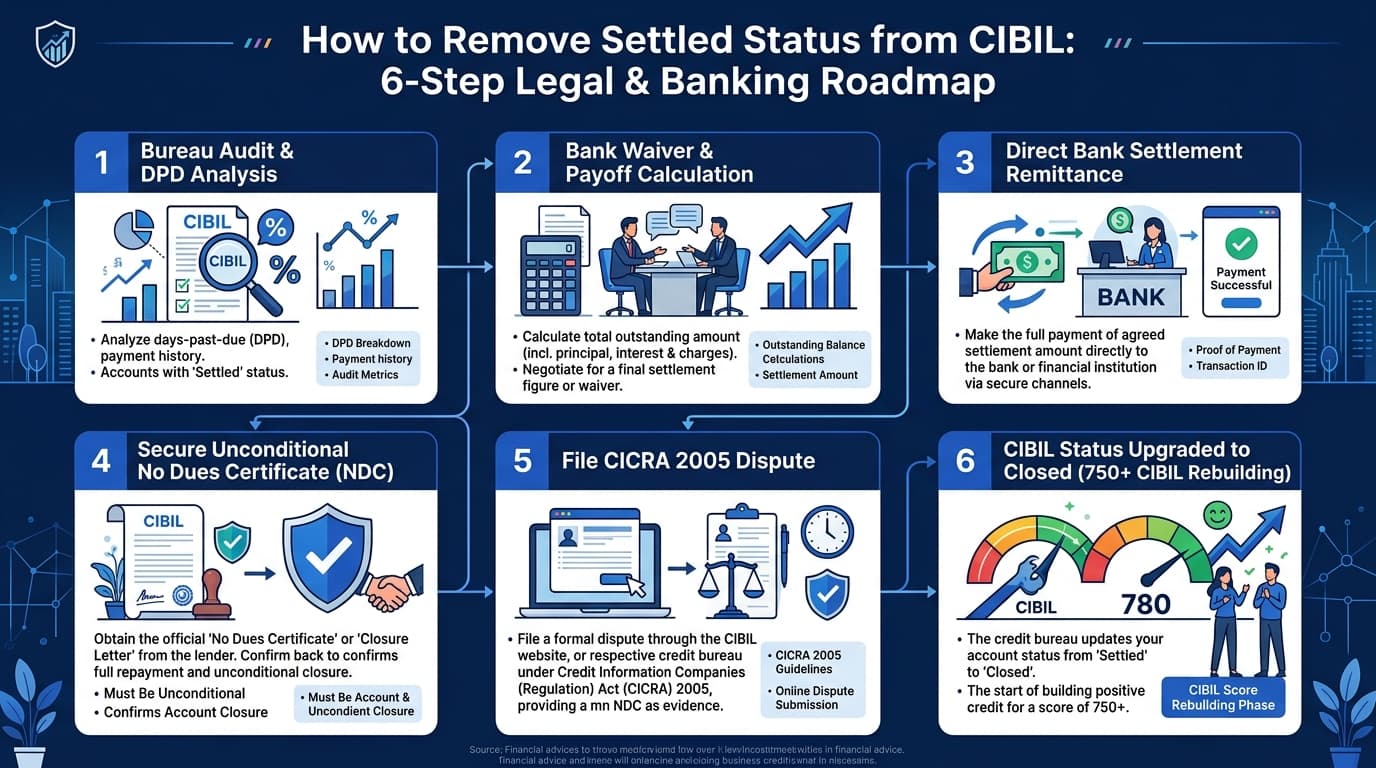
5. 6-Step Protocol to Upgrade Settled to Closed
Follow this battle-tested, banking-law compliant roadmap to upgrade your credit profile from "Settled" to "Closed":
Comprehensive Credit Bureau Audit & DPD Analysis
Download your full official credit reports from all four Reserve Bank of India-licensed credit bureaus: TransUnion CIBIL, Experian, Equifax, and CRIF High Mark. Locate the exact trade-line of the settled account, identify the reported "Amount Overdue", check the "Settlement Date", and verify whether any residual write-off balance is erroneously showing as active overdue.
Request Payoff Statement & Waived Differential Calculation
Submit a formal written letter (see our legal draft template below) to the lending bank or NBFC home branch and credit operations desk. Request a formal Payoff Calculation Statement detailing the exact net differential balance (original principal minus the OTS settlement payment made).
Pro Tip: Insist that the bank waive accumulated compounding penal charges, bounce fees, and post-default legal costs, paying only legitimate principal and contractual interest.
Direct Bank Remittance via Traceable Channels (NEFT/RTGS/DD)
Never pay cash to recovery agents or third-party collection agencies. Remit the negotiated differential amount directly into your loan account via traceable online banking (NEFT/RTGS/IMPS) or through a Demand Draft payable to "[Bank Name] A/C [Your Loan Number]". Retain stamped deposit counterfoils and digital UTR payment receipts.
Secure Unconditional No Dues Certificate (NDC / NOC)
Within 7 to 10 business days of remittance, obtain an unconditional No Dues Certificate (NDC) or Closure Certificate on official bank letterhead with an authorized officer stamp, signature, and employee code. The document must unequivocally state that 100% of dues are cleared and the account is officially "Closed".
File Statutory Online Disputes Across CIBIL & Other Bureaus
While banks are mandated to submit monthly updates to bureaus, you can expedite the timeline by logging into mycibil.com (and respective Experian/Equifax/CRIF portals). Raise an official Dispute under the "Account Information" section, enter the Account Number, select "Account Status Disputed", and upload your scanned No Dues Certificate.
Bureau Verification & Final Status Upgrade to "Closed"
CIBIL initiates an automated verification cycle with your lender. Once verified, the bureau modifies your trade-line status from "Settled" to "Closed" with ₹0 Outstanding. You will receive an official Dispute Resolution confirmation email and an updated Credit Information Report (CIR).
Visual Defense Blueprint: 6-Step Status Removal Roadmap
Refer to this visual summary of the 6-stage legal and banking protocol to transition from a "Settled" impairment to a clean "Closed" rating:
6. CICRA 2005, RBI 30-Day Mandate & ₹100/Day Delay Compensation
As a borrower in India, you are protected by robust statutory provisions enacted by Parliament and the Reserve Bank of India. When pursuing credit report rectification, invoke these legal instruments to ensure prompt compliance from lending banks:
Mandates that credit information companies and credit institutions must take immediate corrective steps upon receiving dispute notifications regarding inaccurate, incomplete, or outdated credit records.
Under RBI Master Directions, credit institutions must verify and update credit records with bureaus within 30 calendar days of receiving resolution data or customer dispute representation.
Introduced in October 2023, the RBI Compensation Framework mandates that if a bank or credit bureau fails to resolve a credit report dispute or update data within 30 days of receipt, they must pay compensation of ₹100 per calendar day to the complainant until the rectification is formally executed.
7. Formal Bank Representation Letter Draft (Payoff & NDC Request)
Use our legally drafted template to communicate with your lending bank branch or credit nodal officer. Customize the bracketed fields with your account coordinates:
8. The 3-Tier Grievance & RBI Ombudsman Escalation Matrix
If the lending bank branch delays issuing your payoff statement, refuses to accept your balance payment, or neglects to update CIBIL within 30 days, escalate through this structured 3-tier matrix:
Branch Level Representation
Submit your formal letter along with previous OTS receipts to the Branch Manager. Obtain an official acknowledgment with the branch stamp and an Inward Diary Number.
Appellate Grievance Desk
If unresolved after 7 days, email the Bank Principal Nodal Officer (PNO) with your Level-1 ticket reference. The PNO possesses executive administrative authority to direct operations to recalculate the ledger and issue closure reports.
Statutory RBI Regulatory Escalation
If the bank fails to provide resolution within 30 days of your initial complaint, file a case on the RBI CMS portal (cms.rbi.org.in) under the Reserve Bank - Integrated Ombudsman Scheme, 2021. Claim the ₹100/day statutory delay penalty alongside compulsory CIBIL status modification.
9. Post-Removal 12-Month Credit Score Recovery Trajectory
Converting your status from "Settled" to "Closed" eliminates automated application rejects, but your credit score will still reflect historical late payments (DPDs). Rebuilding to a prime 750+ score requires disciplined credit nurturing over 12 months:
Stabilization & Bureau Verification
Verify that all 4 bureaus reflect "Closed" status with ₹0 balance. Avoid applying for any new unsecured loans or credit cards to prevent unnecessary hard inquiries.
FD-Backed Secured Credit Card
Open a Fixed Deposit-backed secured credit card (e.g., IDFC FIRST WOW or Kotak 811 DreamDifferent) with a limit of ₹25,000–₹50,000. This creates an active, positive trade-line without credit risk.
Strict <30% Utilization & Auto-Pay
Keep monthly credit utilization strictly between 15% and 25% of the total limit. Set up standing auto-debit instructions to pay 100% of the Total Amount Due before the billing cycle due date.
750+ Prime Benchmark Recovery
After 6 to 9 cycles of flawless payment reporting on your new secured trade-line, your CIBIL score will cross the 750+ benchmark, restoring full eligibility for competitive home loans, car loans, and unsecured cards.
10. Scenarios: Credit Cards, ARCs & Co-borrowers
Navigating status removal across different debt instruments requires tailored legal approaches:
Credit Card Settlements (Post-Write-Off Settled)
Credit card issuers often mark compromised accounts as "Post-Write-Off Settled". To convert this, contact the card division head office, pay the agreed differential principal, and obtain an unconditional card account closure certificate.
Debt Sold to Asset Reconstruction Companies (ARCs)
If your debt was assigned to an ARC (e.g., Phoenix ARC, ARCIL, Asset Reconstruction Company), the original bank no longer holds rights to the account. You must negotiate directly with the ARC for the differential payoff and obtain the closure certificate directly from the ARC legal cell.
Joint Loans & Guarantor Settled Flags
In joint loans or guaranteed facilities, a compromise settlement marks both the primary borrower and the co-borrower/guarantor with "Settled". Clearing the differential updates the record to "Closed" across both individuals' credit bureau profiles simultaneously.
 Legal Debt Dispute Authority
CredSettle (credsettle.com) is India's premier debt settlement, loan dispute resolution, and legal protection platform. Operating strictly under the RBI Fair Practices Code and CICRA 2005, our advocate panel negotiates directly with Bank Principal Nodal Officers to eliminate waived differentials, obtain unconditional No Dues Certificates (NDC), and upgrade credit bureau records from "Settled" to "Closed".
Frequently Asked Questions on Removing Settled Status from CIBIL
Click on any question below to view detailed legal and banking answers verified by our debt resolution experts:
Official Regulatory Citations
- Credit Information Companies (Regulation) Act, 2005 (CICRA 2005): Section 21 (Dispute Resolution and Correction of Credit Information), Government of India.
- Reserve Bank of India Master Direction: Master Direction - Credit Information Companies (Regulation) Regulations, 2006 (Updated 2026).
- RBI Circular RBI/2023-24/72 (DoR.MCS.REC.49/01.01.001/2023-24): Framework for Compensation to Customers for Delayed Updation/Rectification of Credit Information by Credit Institutions & CICs.
- Reserve Bank - Integrated Ombudsman Scheme, 2021: Complaints regarding non-issuance of No Dues Certificate and failure to update credit information repositories.