Credit Card Settlement Kaise Hota Hai? Step-by-Step Legal Guide
Agar aap credit card ke minimum amount due trap me phas chuke hain, toh samjhein settlement process. Yeh guide compound interest khatam karne. 50% waiver lene, aur formal No Dues letter prapt karne ka legal blueprint deti hai.
Credit card debt settlement in India is a formal contractual OTS deal between a distressed cardholder and the issuing bank. When hardship eliminates payment capacity. Paying minimum monthly dues fuels compounding interest without reducing main loan balances. Through structured hardship verification, clients can legally halt collection pressure and settle dues.
1. Debt Economics & 90-Day NPA Dynamics in Credit Card Default
Credit card debt in India functions as high-risk no-collateral revolving credit carrying annualized interest rates between 42% and 52%. Cardholders often get trapped paying the 5% Minimum Amount Due. This only covers monthly finance charges and GST while main loan balances remain untouched. When income loss or medical emergencies cause missed payments. The account progresses through RBI Special Mention Account stages: SMA-0 (1-30 days), SMA-1 (31-60 days). SMA-2 (61-90 days).
Upon crossing 90 days of non-payment. The card is classified as a Non-Performing Asset (NPA). Because credit cards carry no security. Lenders cannot seize property under the SARFAESI Act, 2002. This excludes no-collateral debt under Section 31(b). Also, RBI prudential norms require banks to allocate Tier-1 cash provisioning of 15% to 100% against non-performing no-collateral assets. To release this provisioning cash. Credit boards prioritize trade One-Time Settlements (OTS) over prolonged civil lawsuits.
2. Financial Breakdown & Representative Settlement Calculation
When an no-collateral credit card defaults. Record balances escalate rapidly due to finance charges, late fees, over-limit penalties. 18% GST. Over six months, these secondary levies inflate the main loan debt by 40% to 50%. A successful One-Time Settlement separates actual main loan from penal inflation. Establishing a realistic baseline for OTS deal talks.
agent 180-Day NPA Credit Card Settlement Model.
By eliminating 100% of penal fees (₹2,00,000) and securing a 25% waiver on core main loan. The cardholder resolves the ₹5,00,000 gross exposure with a direct payment of ₹2,25,000.
3. Credit Card Resolution Mechanisms Comparison Matrix
Distressed cardholders can evaluate multiple legal relief pathways based on speed. Waiver potential, legal finality, and credit impact:
| Resolution Parameter. | One-Time Settlement (OTS). | Restructuring / EMI Plan. | Civil Court Litigation. | National Lok Adalat. |
|---|---|---|---|---|
| Average Waiver | 40% to 60% of Total Dues. | 0% (Interest reduction only). | Uncertain | 35% to 50% Mutual Waiver. |
| relief Time | 15 to 45 Days | 3 to 5 Years Tenor. | 2 to 5 Years in Civil Court. | Single-Day Sitting. |
| Legal Finality | Guaranteed Bank NDC Issued. | NDC after full tenor. | Subject to appeal. | Binding Decree, No Appeal. |
| CIBIL Status | Reported as Settled. | Reported as Restructured. | Suit Filed / Default. | Reported as Settled. |
| abuse Halt | Instant Legal Cessation. | Temporary Respite. | Requires Advocate. | Permanent Closure. |
4. CIBIL Algorithm Mechanics & Post-Settlement Credit Rebuilding
Credit information bureaus calculate credit scores using a five-factor mathematical algorithm. When an account is resolved via an OTS. Lenders report the status as Settled. Indicating a portion of the debt was written off. Understanding this algorithm clarifies score impacts and credit rehabilitation:
Upon settlement execution, clients skill an fast score drop of 70 to 120 points. However. This is because compounding penalties and default reporting cease, the profile stabilizes. Cardholders can rebuild their score to 750+ within 18 to 24 months using a secured credit card. Under Section 21 of CICRA 2005. Cardholders who repay the waived differential can convert their bureau status from Settled to Closed.
5. Visual Blueprint: Credit Card Settlement Lifecycle
This visual roadmap outlines the end-to-end trajectory of credit card debt settlement. From default classification to securing an formal No Dues letter:
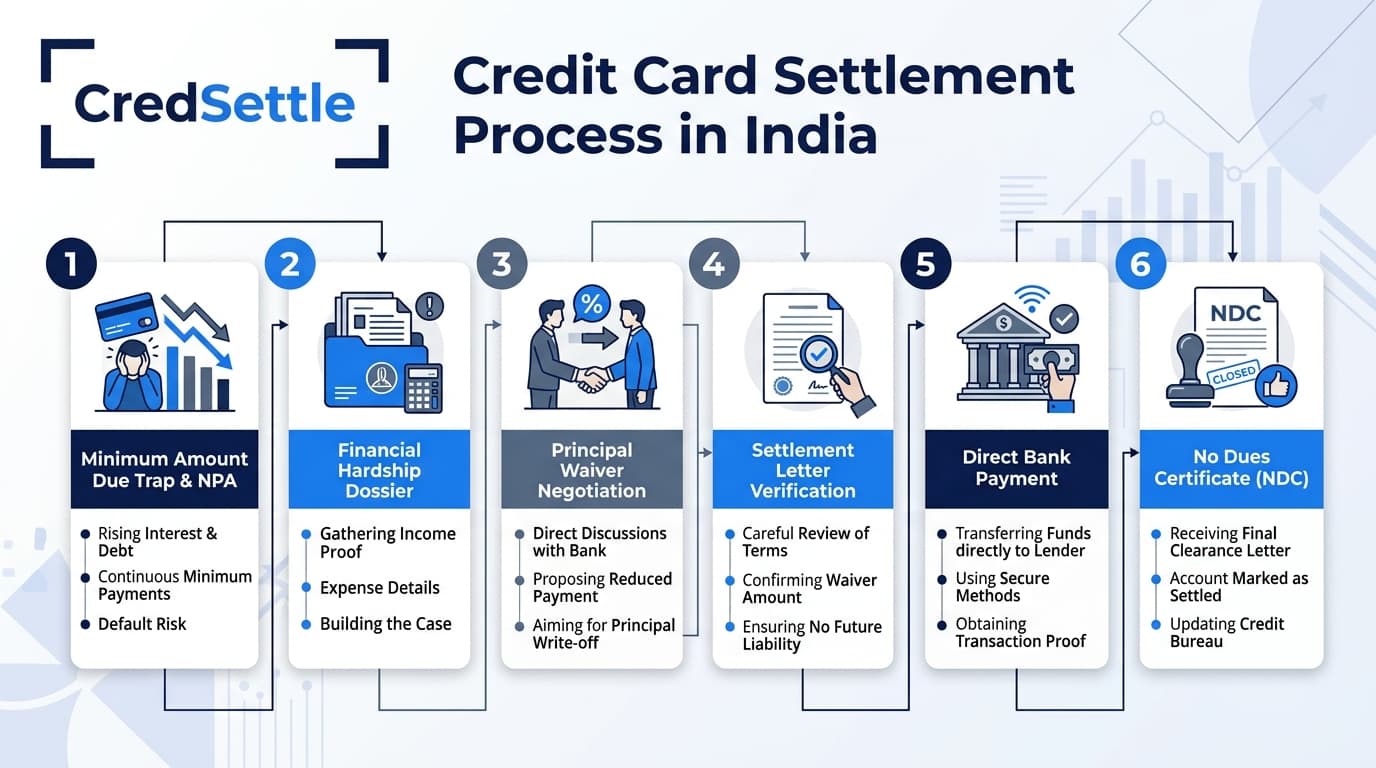
6. Step-by-Step SOP: 6 Stages of Credit Card Debt Settlement
Executing a legally secure settlement requires strict procedural discipline. Follow this tested 6-stage bank protocol to maximize interest waivers and secure debt elimination:
Forensic Statement Audit
Obtain records for the past 12 months. Separate main loan spends from compounding finance charges. Late fees, and GST to determine the baseline settlement debt risk.
Hardship Dossier Compilation
Compile proof proving debt stress. Essential records include termination letters. Medical discharge summaries, or audited loss records proving inability to service revolving debt.
Credit Committee Representation
Submit a formal written hardship legal help to the card issuer settlements division via Registered Post and email. Present paperwork and propose a realistic OTS deal.
Bilateral Waiver Negotiations
Engage in structured dialogue with bank settlement managers. Reject initial minimal waiver offers. Insist on 100% penal interest elimination. settle down to 40% to 55% of dues.
Settlement Letter Vetting
Vet the formal settlement letter on bank letterhead. Ensure it explicitly records the agreed payment. Due date, card number, signatory code, and guarantee of closure.
Direct Bank Remittance & NDC
pay settlement funds straight to the bank card account via NEFT, RTGS, or cheque. Retain the UTR receipt and obtain your formal No Dues letter within 30 days.
7. Statutory Notice Defense & Borrower Protection Rights
When credit card payments default. Issuing banks deploy legal notices. Understanding the legal provisions governing these notices protects clients against threats:
Dishonor of automated NACH mandates is governed by Section 25 of the Payment and Settlement Systems Act, 2007. This is a bailable, compoundable offense where clients obtain bail and achieve closure through settlement without facing imprisonment.
If cheques bounce, lenders issue notices under the Negotiable Instruments Act, 1881. Section 138 is a bailable quasi-criminal matter easily resolved through mutual settlement at pre-lawsuits Lok Adalat sittings.
Banks often initiate arbitration for swift collection. Under Supreme Court rulings in TRF Ltd. And Perkins Eastman, unilateral arbitrator appointments by lenders are null and void ab initio. This provides strong procedural defense.
Civil summary suits under Order 37 CPC allow clients to file Leave to Defend contesting usurious rates. Additionally, RBI rules strictly prohibit collection agent calls before 8 AM or after 7 PM, workplace visits. Family abuse.
8. 3-Tier Grievance Redressal & Escalation Hierarchy
If collection agents violate RBI directives. Cardholders can escalate grievances through a 3-tier RBI hierarchy:
Bank Grievance Redressal Officer
File a formal complaint with the bank GRO. The bank is mandated to resolve grievances within 7 to 10 working days.
Principal Nodal Officer (PNO)
If Level 1 is unsatisfactory after 14 days. Escalate to the main loan Nodal Officer, detailing collection violations.
RBI Integrated Ombudsman
Submit a complaint at cms.rbi.org.in under the RBI Ombudsman Scheme, 2021. The Ombudsman can award payout up to ₹20 Lakhs.
9. Chronological Timeline: Day 1 to Month 6 Settlement Milestones
default and collection milestones from default to closure:
| Timeframe | default Phase. | Bank Operational Action. | Strategic Borrower Protocol. |
|---|---|---|---|
| Days 1 - 30 | SMA-0 | SMS &. fee levies. | Assess cash flow, stop minimum payments. |
| Days 31 - 60 | SMA-1 | Telecalling follow-ups. | Compile hardship records (medical, job loss). |
| Days 61 - 90 | SMA-2 | Demand notices | Issue anti-abuse notice, assert RBI rights. |
| Days 91 - 120 | NPA | 15% cash provisioning. | Submit formal hardship legal help for OTS. |
| Days 121 - 150 | Settlement | boards evaluations. | settle 40% to 55% waiver on gross dues. |
| Days 151 - 180 | Closure | Letter execution. | pay bank payment, secure NDC in 30 days. |
10. Specialized Real-World Credit Card Settlement Scenarios
Credit card debt emergencies require tailored legal and money approaches across distinct scenarios:
Multi-Lender Card Stacking.
clients with overdue balances across multiple banks face aggressive collection. A consolidated debt defense establishes uniform insolvency proof across all lenders. Preventing piecemeal legal action while settling synchronized 50%+ waivers.
Corporate Layoffs & Salaried Loss.
Salaried executives facing company layoffs or unemployment can present termination letters and nil-inflow bank records. Bank credit boards readily approve single-bullet OTS deals with complete penal interest write-offs upon documented job loss.
Proprietorship Capital Deficits.
founders who use private credit cards to sustain trade work during downturns can prove debt stress through GST return filings and audited loss records. Justifying large trade debt waivers before credit boards.
Debt Assigned to ARCs.
When banks write off overdue credit card books and assign portfolios to Asset Reconstruction Companies at 15% to 30% of face value. Clients gain large bargaining power to close accounts at up to 60% discounts with rapid NDC issuance.
 Legal Debt Dispute Authority
CredSettle (credsettle.com) is India's premier debt settlement, loan dispute resolution, and legal protection platform. Operating strictly under the RBI Fair Practices Code and CICRA 2005, our advocate panel negotiates directly with Bank Principal Nodal Officers to eliminate waived differentials, obtain unconditional No Dues Certificates (NDC), and upgrade credit bureau records from "Settled" to "Closed".
Frequently Asked Questions on Credit Card Settlement in India
Click on any question below to view detailed answers verified by our debt relief workers:
Official Regulatory Citations & Judicial References
- Indian Contract Act, 1872: Section 73 (Breach of Contract &. Civil Remedies).
- SARFAESI Act, 2002: Section 31(b) (legal Exclusion of no-collateral Debts).
- Reserve Bank of India Master Directions: Credit Card RBI rules (2026).
- Credit Information Companies Regulation Act, 2005: Section 21 (Bureau Rectification).
- Supreme Court of India: TRF Ltd. v. Energo tech (2017). (Arbitration Bar).