Resolve Credit Card Dues & CIBIL Errors After Bank Merger
Did a bank merger or card portfolio buyout trigger duplicate CIBIL entries, failed auto-pay late fees, or lost reward points? Know your RBI 30-day notice rights, claim daily compensation, and resolve migrated card debt legally.
When one bank buys another bank or takes over its credit cards, your legal rights stay safe. The new bank cannot quietly raise fees, punish you for system bugs, or list the same card twice on CIBIL.
- 30-Day MITC Notice Rule: The new bank must give at least 30 days notice before changing fees, rewards, or APR. You get a free option to close your card.
- Zero Fault for Auto-Pay Glitches: If standing orders fail because biller codes changed during the move, the bank must refund late fees, GST, and interest.
- Duplicate CIBIL Fix & Rs 100/Day Rule: Two banks cannot report one card as active at the same time. Delays past 30 days in fixing CIBIL pay Rs 100 per day.
- 7-Day Closure & Rs 500/Day Rule: If you opt out after paying your spent dues, the bank must close the card in 7 working days or pay Rs 500 per day.
- Past OTS Letters Stay Valid: Any One-Time Settlement or fee waiver given by the old bank binds the new bank by law.
1. Legal Rules on Bank Mergers & Card Portfolio Transfers
India has seen many big bank mergers and card buyouts in recent years. Key examples include the Citibank India card move to Axis Bank, PSU bank mergers, and retail loan deals between private and foreign banks.
Full bank mergers run under Section 44A of the Banking Regulation Act, 1949, or central merger schemes. Standalone card or loan book sales follow the RBI (Transfer of Loan Exposures) Directions, 2021.
Under Section 130 of the Transfer of Property Act, 1882, credit card dues count as actionable claims. When an old bank hands your card over to a new bank, the new bank steps into the exact shoes of the old bank.
In plain words, the buyer bank takes your card with all past history intact. It must honor every past payment, fee waiver, reward point, and settlement deal given by your old bank.
2. RBI 30-Day MITC Notice & Free Card Opt-Out Rights
During a card transfer, the new bank maps your old card to one of its own cards. Often, the new card has different yearly fees, lounge perks, reward rates, or interest rates.
The RBI (Credit Card and Debit Card - Issuance and Conduct) Directions, 2022, set strict rules for this switch. Before changing any Most Important Terms and Conditions (MITC) or fees, the bank must give you 30 days prior notice.
If you do not accept the new terms, you can opt out and close the card within 30 days for free. You only pay your actual spent balance, with zero new annual fee. Read our guide on RBI credit card APR hike opt-out rules to learn more.
Once your balance is zero and you ask to close the card, the bank has 7 working days to close it. If the bank takes longer than 7 working days, it must pay you Rs 500 per day as an RBI penalty.
3. Common Billing, Auto-Pay & Reward Glitches in Mergers
Moving lakhs of cards from one bank server to another often triggers billing bugs in the first month. Watch out for these four common errors on your first bill from the new bank.
NACH & Auto-Debit Mandate Failure
Old IFSC codes and biller IDs often stop working on the cutover weekend. If your bank account had enough funds, the new bank must waive all failed auto-debit late fees and GST.
Shifted Statement & Due Dates
New banks sometimes shift your bill date by 5 to 10 days, clashing with your salary day. Under RBI rules, you can change your billing cycle date to match your payday.
Unbilled Merchant EMI Resets
Active No-Cost or shop EMIs sometimes lose their discount during the server move. The new bank must keep your exact old EMI rate with zero pre-closure fee.
Missing or Cut Reward Points
Reward points can fail to link if you already hold an account at the new bank. Save your last old bill so you can claim every single promised point.
4. Fixing Duplicate CIBIL Accounts & Rs 100/Day Penalty
The biggest shock after a card transfer shows up on your credit report. Many users see two active entries for one card: one from the old bank and one from the new bank.
This error makes it look like you owe double the money and hurts your credit score. Sometimes, old closed cards also wake up as ghost accounts with small fake dues and 30 or 60 Days Past Due (DPD) marks.
Under Section 21(3) of the Credit Information Companies (Regulation) Act, 2005 (CICRA) and RBI Circular RBI/2023-24/72, banks and bureaus must fix errors in 30 days. The bank gets 21 days to check files, and CIBIL gets 9 days to update your report.
If the duplicate card or wrong late mark stays past 30 days, you can claim Rs 100 per day CIBIL delay compensation paid in 5 working days. Also, under RBI Circular RBI/2024-25/60, banks must now update credit bureaus every 15 days.
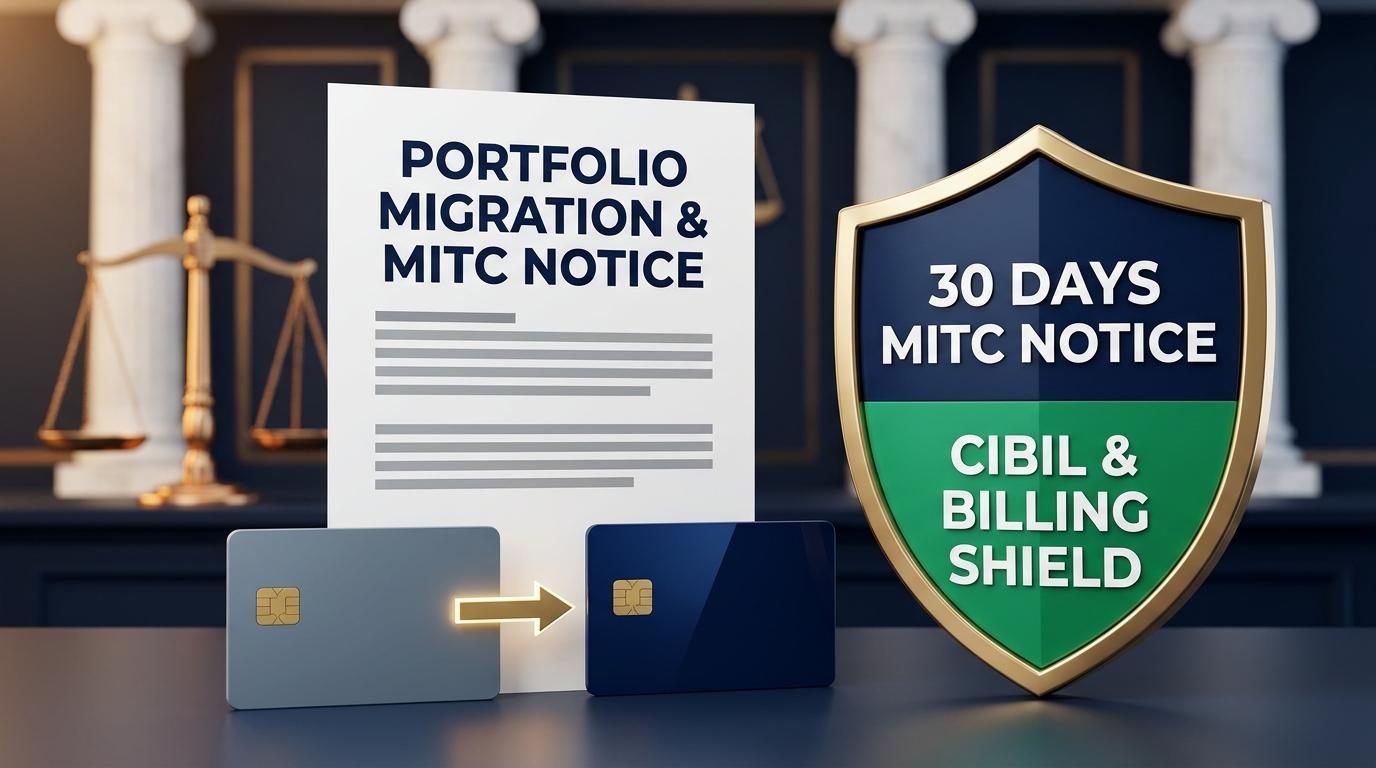
5. Visual Blueprint: Card Migration Dispute & CIBIL Fix
This visual overview highlights your statutory 30-day MITC notice shield and your credit bureau protections when a credit card portfolio moves from one bank to another.
6. Post-Merger Credit Card Issues & Legal Remedies Table
Check your specific post-merger problem in the table below to identify the exact RBI rule and financial remedy that protects you.
| Post-Merger Issue | Applicable Legal Rule | Mandatory Bank Action | Statutory Penalty / Relief |
|---|---|---|---|
| Duplicate Active Card on CIBIL | CICRA Sec 21(3) & RBI/2023-24/72 | Close old tradeline and sync single balance in 30 days | Rs 100/day after Day 30 |
| Fee or APR Hike Without Notice | RBI Card Master Direction 2022 | Give 30-day MITC notice and free surrender option | 100% reversal of new fee |
| Opt-Out Card Not Closed in 7 Days | RBI Card Closure Mandate | Close zero-due card within 7 working days | Rs 500/day delay penalty |
| Cutover Auto-Debit Failure | RBI 3-Day Grace & Fair Practice | Waive system-caused late fee, interest, and GST | Full refund + DPD deletion |
| Prior OTS Denied by New Bank | Sec 130 Transfer of Property Act | Honor legacy OTS letter and issue fresh NOC | Zero extra debt liability |
7. Step-by-Step SOP to Resolve Migration Billing & CIBIL
Do not rely on phone helplines alone. Call center staff rarely see your old bank files. Follow these six simple steps in writing to fix your account fast.
1Step 1: Save Your Last 3 Old Bank Statements
Download your final three bills from the old bank right away. Also save reward point screenshots and any closure or OTS letters before old apps shut down.
2Step 2: Pay Real Spends Inside the 3-Day Window
If auto-pay failed during the move, pay your real spend via UPI or NEFT within the RBI 3-day grace window. Set up a fresh auto-pay with the new bank IFSC code.
3Step 3: Check All 4 Credit Bureaus After 30 Days
Pull your report on CIBIL, Experian, Equifax, and CRIF High Mark. Make sure the old bank card shows zero balance or closed status.
4Step 4: File Both Nodal & Bureau Disputes
Raise an online ticket on the bureau site and email the new bank Grievance Officer. Share your bank account details to start the 30-day Rs 100/day penalty clock.
5Step 5: Use Your 30-Day MITC Opt-Out If Needed
If the new card has higher fees or lower perks, email an opt-out closure request within 30 days of the notice. Track the 7-day closure deadline closely.
6Step 6: File an RBI Ombudsman Complaint on Day 31
If the new bank does not refund wrong fees or clean your CIBIL in 30 days, file a free case on cms.rbi.org.in to get a binding order and penalty payout.
8. Court Rulings & Consumer Rights Against Wrongful CIBIL
Indian courts and consumer commissions strictly hold banks accountable when technical negligence or post-merger data errors harm a cardholder.
Alongside RBI daily penalties, you can claim compensation for deficiency in service under Section 2(11) of the Consumer Protection Act, 2019.
The Supreme Court affirmed that the RBI holds exclusive statutory power over credit card conduct and APR disclosure. Banks must strictly obey RBI Master Directions and MITC notice mandates.
The Delhi High Court ordered restoration of a borrower CIBIL score hurt by disputed entries and imposed costs on the lender for failing to maintain accurate credit records.
In a case involving a merged private bank, the State Commission held that reporting a zero-due account as Written Off is a serious deficiency in service warranting damages.
In M/s. Frontline Corporation Ltd., the Madras High Court confirmed that borrowers can sue banks and bureaus for damages when negligent duplicate or false entries block credit access.
9. Statutory Deadlines & 3-Tier RBI Escalation Matrix
Every migration dispute is governed by strict RBI turnaround times. If the acquiring bank misses these deadlines, escalate step by step through this three-tier matrix.
| Escalation Tier | Designated Authority | Statutory Timeline | Relief & Enforcement Scope |
|---|---|---|---|
| Level 1: GRO | Acquiring Bank Grievance Officer | 7 to 10 Working Days | Audits migration ledger, reverses cutover late fees, and maps missing reward points. |
| Level 2: PNO & CIC | Principal Nodal Officer & CIBIL | 21 + 9 = 30 Days Max | Removes duplicate tradelines, honours legacy OTS letters, and approves Rs 100/day claims. |
| Level 3: RBI Ombudsman | RBI Integrated Ombudsman (CMS) | Day 31 Onwards | Orders fee refunds, CIBIL deletion, Rs 500/day closure penalties, and mental agony awards. |
10. Credit Card OTS Settlement & Mistakes During Mergers
If your credit card was already overdue or in NPA before the bank merger, extra care is essential during a portfolio handover. Avoid these costly mistakes when dealing with collection teams from the acquiring bank.
Never Pay Old Account Numbers Blindly
Old card numbers and NEFT virtual accounts deactivate soon after cutover. Always verify your OTS sanction letter on the acquiring bank letterhead before paying any installment.
Enforce Pre-Merger OTS Agreements
Sometimes new recovery agents demand the waived balance of an older settlement. Show your legacy OTS receipt and No Dues Certificate to stop illegal double recovery immediately.
Watch UCIC Cross-Bank Set-Off Risks
If your defaulted card migrates to a bank where you hold a salary or savings account, both accounts merge under one UCIC. Seek legal advice early to protect your liquid funds.
Negotiate Fresh Post-Merger OTS Waivers
Acquiring banks actively clean up inherited NPA card books under RBI compromise settlement rules. You can negotiate structured waivers through our credit card settlement process.
 Legal Debt Dispute Authority
CredSettle (credsettle.com) is India's premier debt settlement, loan dispute resolution, and legal protection platform. Operating strictly under the RBI Fair Practices Code and CICRA 2005, our advocate panel negotiates directly with Bank Principal Nodal Officers to eliminate waived differentials, obtain unconditional No Dues Certificates (NDC), and upgrade credit bureau records from "Settled" to "Closed".
Frequently Asked Questions: Bank Card Migration Disputes
Clear, verified answers to common cardholder questions on bank mergers, duplicate CIBIL entries, cutover billing errors, MITC opt-out rights, and OTS validity.
Official Regulatory Citations & Statutory References
- RBI Master Direction: Reserve Bank of India (Credit Card and Debit Card - Issuance and Conduct) Directions, 2022 (RBI/2022-23/92, updated March 7, 2024 via DoR.AUT.REC.80/24.01.041/2023-24).
- RBI CIBIL Compensation Circular: RBI/2023-24/72 (DoR.FIN.REC.48 & 49/20.16.003/2023-24), Framework for Compensation to Customers for Delayed Updation/Rectification of Credit Information.
- RBI Fortnightly Reporting Mandate: RBI/2024-25/60 (DoR.FIN.REC.No.32/20.16.056/2024-25), Fortnightly Reporting of Credit Information by Credit Institutions to CICs.
- Statutory Merger & Transfer Laws: Section 44A of the Banking Regulation Act, 1949; RBI (Transfer of Loan Exposures) Directions, 2021 (RBI/DOR/2021-22/86); and Section 130 of the Transfer of Property Act, 1882.
- Credit Bureau & Consumer Statutes: Credit Information Companies (Regulation) Act, 2005 (Section 21); Consumer Protection Act, 2019 (Section 2(11)); and Reserve Bank - Integrated Ombudsman Scheme, 2021.
- Judicial Precedents: Hongkong and Shanghai Banking Corp. Ltd. v. Awaz & Ors. (Supreme Court, 2024); Sarwar Raza v. RBI & Anr. (Delhi High Court, W.P.(C) 16659/2022); and Shyam Garg v. ING Vysya Bank (SCDRC Delhi).