Can I Pay Settlement Amount in EMI? Staged OTS Guide
Discover how to structure a One-Time Settlement into 2 to 6 monthly installment tranches. Learn how to settle staged payout clauses. Prevent automatic discount cancellation upon temporary payment delay. Manage initial down payments. Secure your authentic No Dues letter.
- Staged Settlement Reality: Lenders routinely approve OTS payouts in 2 to 6 monthly tranches for clients showing verified cash-flow hardship.
- Token Down Payment: Credit boards require an upfront commitment payment of 20% to 33% upon sanction letter execution.
- Revocation Protection: Sanction letters must include a written 7 to 15 day grace period to prevent automatic waiver cancellation on delay.
- 100% Penal Fee Waiver: Compounded penal interest and mandate bounce fees are fully eliminated before calculating installment amounts.
- fast abuse Halt: claims calls. Residential visits. And third-party contacts cease promptly upon initial tranche clearance.
- Direct Account Remittance: Installments must be remitted straight into your loan account via RTGS/NEFT. Never through claims agents.
- Authentic NDC Issuance: The bank issues the formal No Dues letter within 15 to 30 days after final installment clearance.
- CIBIL Restoration Pathway: The account reports as &apos. Settled&apos. With zero balance. With legal entitlement under CICRA §21 to upgrade to &apos. Closed&apos.
- legal notices Shield: Pending Section 25 PSSA and Section 138 NI Act proceedings are held in abeyance and formally quashed upon completion.
1. Debt Economics: Why Banks Permit Installment Settlements
When severe hardship strikes. Examples include company downsizing. Firms cash-flow breaks. Critical medical emergencies. Continuing full debt servicing on no-pledge private loans and credit cards becomes mathematically unviable. After 90 consecutive days of missed EMIs. The facility transitions from Special Mention Account status (SMA-0. SMA-1. SMA-2) into a formal Non-Performing Asset (NPA) under Reserve Bank of India prudential rules. Once classified as an NPA. Banks and NBFCs must set aside strict Tier-1 cash provisioning. Scaling from 15% up to 100% of the exposure. Locking bank liquidity.
Because no-pledge loans carry no underlying security under the SARFAESI Act. Lenders face protracted 3 to 5 year litigations in civil courts or Debt claims Tribunals. As a result. Bank credit boards are economically driven to accept a One-Time Settlement (OTS). While claims firms initially demand an impossible single lump sum. Senior credit officials recognize that distressed clients require staggered timelines. To recover cash and release locked provisioning reserves. Banks routinely approve structured settlements divided into 2 to 6 monthly installments.
2. Settlement Math: Structuring Monthly Tranches
Following default. Lenders rapidly inflate account balances by levying 24% to 36% compound penal interest and repeated mandate bounce surcharges. Within 12 months. An original base loan of ₹8 Lakhs can artificially escalate to over ₹12.5 Lakhs. Strategic talks strips away these punitive levies. Isolates the net main loan. Establishes a sustainable 40% to 55% settlement split into manageable monthly tranches.
agent Multi-Tranche Settlement Math (₹10 Lakh Facility).
4-Month Staged Plan.3. Comparative Matrix: Staged Settlement vs Lump Sum
clients evaluating debt relief options can compare five primary avenues across cash flow impact. Legal exposure. Credit claims:
| Resolution Option. | Financial Outflow. | CIBIL Score Status. | Litigation Risk | Execution Timeline. | Strategic Assessment. |
|---|---|---|---|---|---|
| Staged OTS (2. 6 Tranches). | 40%. 55% main loan. | ". Settled". post-final tranche. | Frozen &. Withdrawn. | 2. 6 Months | Optimal balance of cash flow relief and legal closure. |
| Lump-Sum OTS | 35%. 50% main loan. | ". Settled". promptly. | Instantly Closed. | 7. 15 Days | Highest discount rate but demands fast cash. |
| Loan Restructuring. | 100% main loan + Interest. | ". Restructured". | Paused during EMIs. | 36. 60 Months | Viable only if large ongoing monthly cash flow is assured. |
| Court lawsuits Defense. | High Legal Outlay. | ". Suit Filed / In Court". | Active court contest. | 2. 5 Years | Defensive shield to challenge charges and compel an OTS. |
| Prolonged Inaction / Default. | Compounding Penal Fees. | ". Written Off / Default". | Severe (Notices, calls). | Indefinite | High risk of credit ruin. Escalating legal notices, and abuse. |
4. CIBIL Scoring Math: Installment Settlement Credit Impact
Credit bureaus calculate CIBIL scores across five parameters: Payment History (35%). Credit Exposure (30%). Credit Longevity (15%). Credit Mix (10%). Recent Inquiries (10%). During the months you pay staged settlement installments. The account remains marked in default. DPD accumulation freezes under the approved sanction pacts.
Upon paying the final tranche. The bank reports the account as &apos. Settled&apos. With zero balance, terminating negative reporting. While settling causes an initial drop of 70 to 120 points. Disciplined rebuilding using a secured card backed by a fixed deposit restores scores above 750 within 12 to 18 months. Under Section 21 of the Credit Information Companies (Regulation) Act. 2005 (CICRA). Clients retain the legal right to pay the waived balance later and convert the remark from &apos. Settled&apos. To &apos. Closed&apos.
Credit Weighting & Tranche Mechanics
Credit Score Rehabilitation Timeline
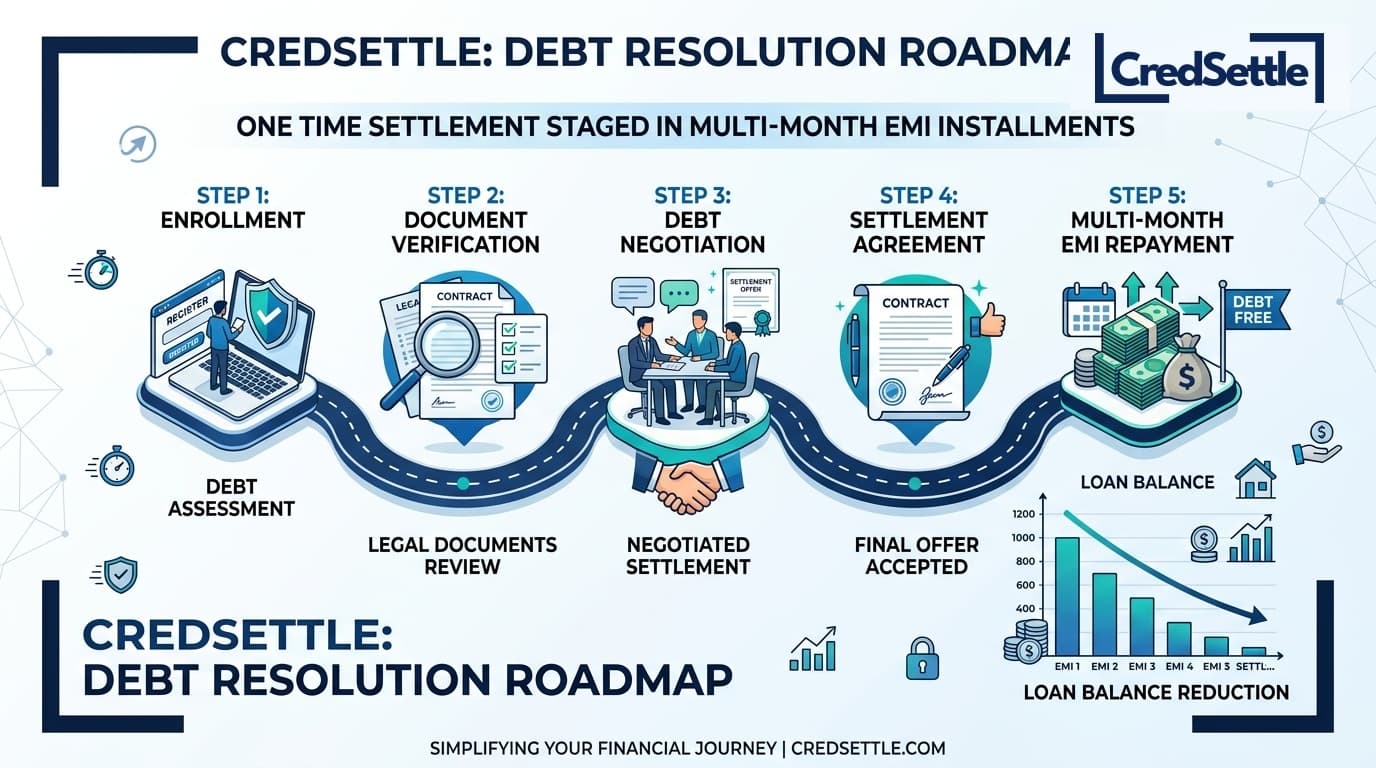
Visual Blueprint: Multi-Tranche Settlement Roadmap
Study this 6-stage infographic detailing the end-to-end journey from initial default analysis and cash flow modeling to credit boards talks. Tranche remittances. Final No Dues letter delivery:
5. SOP: 6 Stages to Structure an Installment Settlement
Executing an installment settlement requires adhering to a rigorous 6-stage standard operating procedure to avoid default clause triggers and ensure binding legal closure:
Forensic Statement Audit & Cash Flow Analysis
Obtain a certified record of Account. Deduct past payments. Eliminate compound penal interest and bounce fees. Isolate the true net main loan. Map verified disposable monthly income to determine an achievable tranche schedule.
Hardship Dossier & Tranche Schedule Modeling
Compile documentary proof of debt stress. Including termination letters. Medical summaries. Or trade income drops. Structure a formal settlement petition proposing a 25% to 30% initial down payment and 2 to 4 equal monthly installments.
Representation to Zonal Credit Committee
Submit the staged OTS deal petition straight to the bank&apos. s Zonal Credit boards and Head of Retail NPA Settlements. Bypass aggressive claims agents. Establish genuine illiquidity. And cite RBI OTS deal rules to open bilateral talks.
Bilateral Negotiations & Grace Period Insertion
settle total settlement figures down to 40%. 55% of main loan. Crucially. Insist on inserting a written 7 to 15 day grace period clause for each installment tranche to prevent automatic revocation in case of minor banking delays.
Legal Vetting of Settlement Sanction Letter
Perform rigorous legal due diligence on the formal Settlement Sanction Letter issued on bank letterhead signed by an authorized manager. Verify exact installment dates. Direct loan account remittance details. 100% penal waiver, and NDC commitments.
Tranche Remittances, Milestone Tracking & Final NDC
Pay each installment straight into your loan account via RTGS/NEFT before each due date. Retaining timestamped receipts. Upon final tranche clearance. Obtain the formal No Dues letter within 30 days and confirm credit bureau status update.
6. Statutory Notice Defense Under Indian Banking Law
no-pledge loan default is strictly a civil contractual breach under the Indian Contract Act. 1872. With zero risk of police arrest. However. Banks issue legal notices to exert claims pressure. Understanding your legal rights ensures protected talks:
Issued when electronic mandate debits bounce. Serve a formal legal reply within 15 days proving lack of fraudulent intent and submitting an installment OTS OTS deal. Complaints are quashed upon settlement execution.
Applies to dishonoured security cheques. Offenses under Section 138 are compoundable under Section 147 of the Act. Court complaints are formally withdrawn once the agreed installment schedule is fulfilled.
Lenders cannot unilaterally appoint a sole private arbitrator. Under Supreme Court rulings in TRF Ltd. (2017) and Perkins Eastman (2020). Unilateral appointments are void ab initio. Protecting you from ex-parte awards.
Applicable for bank debts exceeding ₹20 Lakhs. clients can file a detailed written record contesting penalty charges and petition the DRT to refer the dispute for an out-of-court installment OTS deal.
Borrower Protections Under the RBI Fair Practices Code
Under the RBI Master Direction on Fair Practices Code. Lenders and claims firms are strictly prohibited from calling before 8:00 AM or after 7:00 PM. Visiting residences without notice. Contacting employers or relatives. Using abusive language. All claims activities must halt upon sanction letter execution.
7. The 3-Tier Escalation Matrix for Installment Settlement Grievances
If a bank claims department arbitrarily rejects a reasonable installment plan or violates RBI rules. Escalate through this formal 3-tier legal rules:
Submit a formal written petition proposing your structured installment plan straight to the Branch Manager and GRO (7. 10 days turnaround).
Escalate to the bank&apos. s main loan Nodal Officer if Level 1 fails to resolve within 30 days or if agents continue abuse (14. 21 days turnaround).
Lodge a RBI complaint on cms.rbi.org.in for unfair claims tactics. Unjustified settlement rejections. Delays in issuing the No Dues letter.
8. Procedural Timeline: Month 1 to Month 6 Resolution
Follow the chronological progression from initial loan default to final installment clearance and formal No Dues letter delivery:
| Timeline Milestone. | Account Status | Bank Action | Borrower Strategic Action. |
|---|---|---|---|
| Days 1. 30 | SMA-0 | Automated payment reminders. | Audit record. Isolate net main loan. Preserve liquid reserves. |
| Days 31. 90 | SMA-1 / SMA-2 | Demand notices &. claims calls. | Compile hardship dossier. serve Cease-and-Desist notice. |
| Days 91. 120 | NPA Classification. | strict cash provisioning locked. | Submit structured multi-tranche OTS proposal to Credit boards. |
| Month 4 | Sanction &. Down Payment. | Sanction letter issued. calls cease. | Vet sanction letter. Verify grace period. Pay 30% down payment. |
| Months 5. 6 | Tranche Execution &. Closure. | Account cleared in core banking. | pay remaining tranches straight. secure formal NDC within 30 days. |
9. Real-World Installment Scenarios: Layoffs & ARCs
Structuring an installment settlement depends on client profiles and creditor structures. Consider these four distinct scenarios:
Multi-Lender Portfolio Balancing
When managing multiple loan defaults. Stagger installment schedules sequentially rather than simultaneously across banks to prevent cash flow exhaustion.
Salaried Professionals Post-Layoff
Present authenticated company severance records to settle a lower down payment (15% to 20%) with tranches aligned to expected re-employment.
Business Owners with Seasonal Cash Flow
Structure quarterly or bi-monthly tranches matching audited accounts receivable cycles. Ensuring custom payment milestone dates are written into the sanction letter.
Debts Assigned to ARCs (Phoenix, ARCIL)
Asset Reconstruction Companies purchase bad loan portfolios at steep discounts (70%. 80%) and readily accept 4 to 6 month installment settlements with deep waivers.
 Legal Debt Dispute Authority
CredSettle (credsettle.com) is India's premier debt settlement, loan dispute resolution, and legal protection platform. Operating strictly under the RBI Fair Practices Code and CICRA 2005, our advocate panel negotiates directly with Bank Principal Nodal Officers to eliminate waived differentials, obtain unconditional No Dues Certificates (NDC), and upgrade credit bureau records from "Settled" to "Closed".
Frequently Asked Questions on Paying Loan Settlement in EMIs
Official Regulatory Citations & Legal References
- Reserve Bank of India (RBI): Master Direction on Fair Practices Code for Lenders (claims Agent Conduct &. Grievance Redressal).
- RBI Integrated Ombudsman Scheme, 2021: legal dispute mechanism on cms.rbi.org.in.
- CICRA 2005 (Section 21): Credit dispute relief and bureau remark rectification.
- PSSA 2007 (Section 25): Dishonour of electronic funds transfer / NACH mandates.
- RDB Act 1993 (Section 19): Original Applications before Debt claims Tribunals (DRT).
- Indian Contract Act 1872: Sections 73 &. 74 regarding civil contractual damages.
- NI Act 1881 (Section 138 &. 147): Cheque dishonour defense and compounding of offenses.