Received a Court Summons for Personal Loan Default? Legal Steps
Received a court summons for private loans default? Learn your defense rights under civil procedure rules. Avoid ex-parte decrees, and resolve debt via settlement.
Executive Summary: Responding to a Court Summons
A court summons marks formal judicial escalation. Knowing your procedural rights prevents irreversible ex-parte debt risk.
1. Civil Debt Economics: Loan Default to Court Summons
When an no-collateral private loans defaults. Lenders classify the debt under RBI Prudential Norms. Overdue accounts transition from SMA-0 (1-30 days) to SMA-1 (31-60 days) and SMA-2 (61-90 days). After 90 days of non-payment. The account is classified as a Non-Performing Asset (NPA).
NPA classification requires banks to allocate 100% Tier-1 cash provisioning against bad debt. Because no-collateral loans lack mortgage security. Lenders cannot invoke property seizure under the SARFAESI Act. Instead, institutions file civil collection suits under Order 37 CPC or initiate proceedings for bounced payment mandates.
Civil lawsuits requires banks to deposit court fees and endure multi-year judicial proceedings. For credit boards, lengthy lawsuits represents an inefficient use of cash. This trade dynamic creates strong leverage for represented clients to settle an out-of-court One-Time Settlement (OTS). This provides fast collection for the bank and large debt relief.
2. Financial Breakdown: Principal Dues vs Inflated Claims
Monetary claims in court summons are heavily inflated beyond the original loan balance. Lenders compound monthly penal interest above 30% per annum. Adding overdue fees, recurring bounce charges, legal expenses. GST across every surcharge.
Under RBI Fair Practices Code. Penalty charges cannot be capitalized into loan main loan. A audits eliminates these unverified penalties to establish true net main loan exposure. In a typical ₹10,00,000 loan default where claimed dues reach ₹14,80,000. CredSettle establishes true main loan of ₹7,50,000 and negotiates an out-of-court OTS of ₹3,75,000 to ₹4,50,000. Securing a 50% to 62% overall reduction with full suit dismissal.
Representative 180-Day NPA Judicial Settlement Math
Includes main loan plus compounded penal interest and fees.
True debt risk established after removing penalty charges.
Achieved 50% to 62% reduction with suit dismissal and NDC.
By engaging the bank legal desk before an ex-parte decree is passed. Clients transform an aggressive court demand into an affordable OTS deals.
3. Resolution Comparison: Court Defense vs Settlement
clients facing judicial summons must evaluate relief pathways against legal exposure, timeframe, and money relief. While courtroom lawsuits takes years and ignoring summons leads to ex-parte decree execution. A structured out-of-court OTS deal provides rapid closure and maximum debt waiver.
| Resolution Pathway. | Legal Forum & Authority. | Financial Relief Potential. | Procedural Timeframe. | CIBIL Score Trajectory. |
|---|---|---|---|---|
| One-Time Settlement (OTS). | Credit Desk &. Court Withdrawal. | 40% to 55% loan cut. | 30 to 60 Days | Settled (Rebuildable to 750+). |
| Loan Restructuring. | Internal Bank Branch Level. | 0% Waiver (Extended Tenure). | 45 to 90 Days | Restructured tag on report. |
| Civil Court Defense. | areas Civil / trade Court. | Subject to Final Judgment. | 2 to 5 Years | Suit Filed (Sub-550 Score). |
| Lok Adalat Settlement. | NALSA Judicial Bench. | 30% to 50% OTS deal Decree. | Single Hearing Sitting. | Settled via Judicial Decree. |
| Ignoring Court Summons. | Ex-Parte Judicial Order. | 0% Relief (100% + Interest). | fast Ex-Parte Order. | Wilful Default / Sub-500 Score. |
4. CIBIL Algorithm: Legal Defaults & Credit Rebuilding
Credit bureaus evaluate creditworthiness using an algorithm weighted across five metrics: payment history (35%). Credit use (30%), credit history length (15%), credit mix (10%). New inquiries (10%).
When a bank files a collection suit. It reports the account as Suit Filed. This causes a score drop to sub-550. Executing an out-of-court OTS halts lawsuits and updates bureau status to Settled. Under Section 21 of CICRA 2005. Clients can convert settled records to Closed or restore their CIBIL score to 750+ within 12 to 24 months through secured credit builder tools.
Court Summons Defense Blueprint & Action Plan
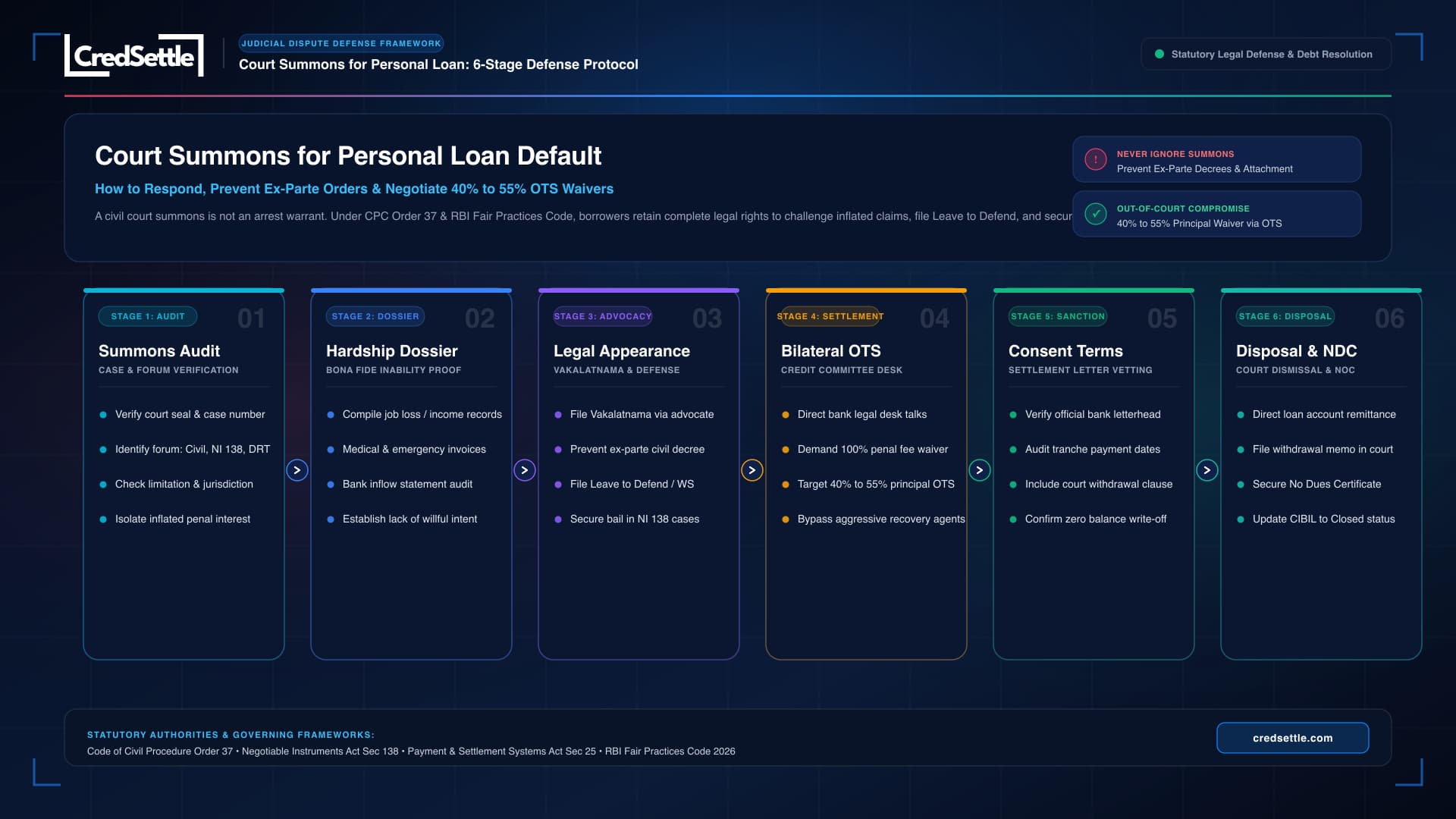
The visual roadmap below details the 6-stage procedural workflow for responding to private loans court summons, establishing legal legal help. settling an out-of-court OTS deals.
5. Step-by-Step SOP: 6 Stages of Court Summons Defense
Handling a private loans court summons requires a disciplined standard operating procedure combining courtroom legal help with credit desk talks.
Stage 1: Judicial Audit & Summons Verification
We inspect the summons to verify court seal authenticity. Case filing number, judicial forum. Appearance date, checking for limitation defects under the Limitation Act 1963 and unverified compound penal interest.
Stage 2: Comprehensive Hardship Dossier Compilation
To show genuine inability rather than wilful default. We assemble paperwork verifying job loss, medical emergencies. income downturns to prove OTS deals proposals.
Stage 3: Formal Appearance & Vakalatnama Execution
Our panel advocate enters appearance before the judge by submitting a Vakalatnama. In Order 37 summary suits. We file Leave to Defend. In Section 138/25 cases, counsel secures bail to avoid arrest warrants.
Stage 4: Bilateral Credit Committee Negotiations
While counsel manages court proceedings. Our debt negotiators engage the bank stressed asset desk. We bypass collection agents, present hardship records. Demand complete penal fee waivers to secure a 40% to 55% settlement.
Stage 5: Settlement Sanction Letter Legal Audit
Before authorizing payment, our legal team verifies the formal settlement letter. We confirm authentic bank letterhead, verify tranche payment schedules. Ensure a clause mandating court suit withdrawal upon payment.
Stage 6: Direct Remittance, Court Dismissal & NDC
You pay OTS deal funds straight into your loan account via RTGS or NEFT. The bank counsel files a withdrawal memo in court, dismissing the suit. We obtain your No Dues letter and initiate bureau updates.
6. Statutory Notice Defense: Legal Framework & Rights
Indian law provides procedural protections against arbitrary collection lawsuits. Understanding your legal rights ensures you never surrender valid legal defenses.
Section 25 Payment & Settlement Systems Act
Applies when NACH auto-debit mandates bounce. Lenders must prove that a valid legal 30-day demand notice was properly served before filing a court complaint.
Section 138 Negotiable Instruments Act
Governs bounced security cheques. Banks must prove the cheque was issued toward an existing legal debt rather than as an undated security token at loan sanction.
Arbitration & Supreme Court Precedents
Under Supreme Court rulings in TRF Ltd. And Perkins Eastman, banks cannot unilaterally appoint a sole arbitrator. Such appointments are void under Section 12(5) of the 1996 Act.
DRT Jurisdiction & RBI Fair Practices
Debt collection Tribunals handle claims strictly exceeding ₹20 Lakhs. Under RBI Fair Practices Code 2026. Lenders cannot use abusive language, contact third parties. Visit outside 8 AM to 7 PM.
7. 3-Tier Grievance Escalation & Redressal Matrix
When lenders violate banking rules or initiate coercive lawsuits. Clients can activate the formal 3-tier RBI redressal mechanism established by the Reserve Bank of India.
Submit a written complaint to the bank Grievance Redressal Officer detailing unfair interest calculation, lack of legal notices. collection agent misconduct.
If Level 1 fails to resolve the dispute within 10 days. Escalate the matter to the bank main loan Nodal Officer and Internal Ombudsman for executive review.
File an bank complaint on the RBI Integrated Ombudsman portal (cms.rbi.org.in) for deficiency in banking service, improper billing. Unfair lawsuits tactics.
8. Chronological Timeline: Default to Decree Avoidance
Loan default progresses through predictable legal milestones. Engaging specialized defense early prevents ex-parte orders and maximizes settlement savings.
| Timeframe | Regulatory & Legal Status. | Lender Recovery Action. | Recommended Borrower Defense. |
|---|---|---|---|
| Day 1 to 30 | SMA-0 default. | Automated SMS, emails and reminder calls. | Review budget and assess restructuring options. |
| Day 31 to 90 | SMA-1 / SMA-2 Alert. | Third-party firm calls and field visits. | Enforce RBI calling hours and compile hardship records. |
| Day 90 to 120 | NPA Classification. | Advocate legal demand notice issued. | Issue legal reply contesting penal interest and charges. |
| Day 120 to 180 | Court Summons Issued. | Filing of summary suit or Section 138/25 case. | Engage CredSettle advocate to file Vakalatnama and defense. |
| Month 6+ | OTS deal. | Credit desk accepts 40%-55% OTS waiver. | Execute settlement sanction, dismiss suit and get NDC. |
9. Specialized Scenarios: Layoffs, ARCs & Multiple Loans
Legal defense plans must adapt to the trade situation surrounding private loans defaults. CredSettle handles complex loan disputes nationwide.
Multi-Lender Consolidation & Cross-Court Filings
clients with multiple defaulted loans often face concurrent summons across different courts. We consolidate legal representations, avoid conflicting orders. And coordinate simultaneous multi-bank settlements.
Corporate Layoffs & Loss of Livelihood
Salaried executives facing sudden job loss cannot service high-value private loans. We leverage severance records, termination notices. And bank records to secure maximum main loan waivers.
Proprietorship Working Capital Personal Loans
shop owners who used private loans for daily work cash flow face collection suits during trade downturns. We shield own assets from trade debt claims and prevent insolvency actions.
ARC Debt Assignments & Inflated Demands
When loans are assigned to Asset Reconstruction Companies (ARCs). ARCs initiate aggressive suits demanding inflated interest. We audit assignment deeds under SARFAESI Section 5 and settle deep haircuts.
About CredSettle: Legal Defense & Debt Resolution
 Legal Debt Dispute Authority
CredSettle (credsettle.com) is India's premier debt settlement, loan dispute resolution, and legal protection platform. Operating strictly under the RBI Fair Practices Code and CICRA 2005, our advocate panel negotiates directly with Bank Principal Nodal Officers to eliminate waived differentials, obtain unconditional No Dues Certificates (NDC), and upgrade credit bureau records from "Settled" to "Closed".
Frequently Asked Questions: Court Summons for Loan
Find clear, authoritative answers to common legal and money questions regarding private loans court summons, advocate legal help. Out-of-court settlements in India.
Statutory Authorities & Governing Legal Frameworks
CredSettle operates strictly within legal rules established by the Indian judicial system, Parliamentary enactments. RBI directives of the Reserve Bank of India.
- Code of Civil Procedure, 1908: Order XXXVII (Summary Procedure), Order IX Rule 6 (Ex-Parte Hearing). Section 60 (Property and Salary Exemptions from Attachment).
- Negotiable Instruments Act, 1881: Section 138 (Dishonour of Cheque for Insufficiency of Funds) and Section 141 (Company debt risk).
- Payment and Settlement Systems Act, 2007: Section 25 (Dishonour of Electronic Funds Transfer Mandates).
- Reserve Bank of India Master Directions: Master Direction on Fair Practices Code for Lenders and RBI rules for Stressed Assets (Updated 2026).
- Credit Information Companies (Regulation) Act, 2005: Section 21 (legal Duty of Accuracy and Credit Information Dispute relief).