Bank Liquidation & Interest Rules on Overdraft Against FD
Learn the exact Indian banking laws on personal overdraft against fixed deposit default. Audit bank FD sweep math, claim your leftover surplus cash, stop illegal joint FD seizure, and protect your CIBIL score under RBI rules.
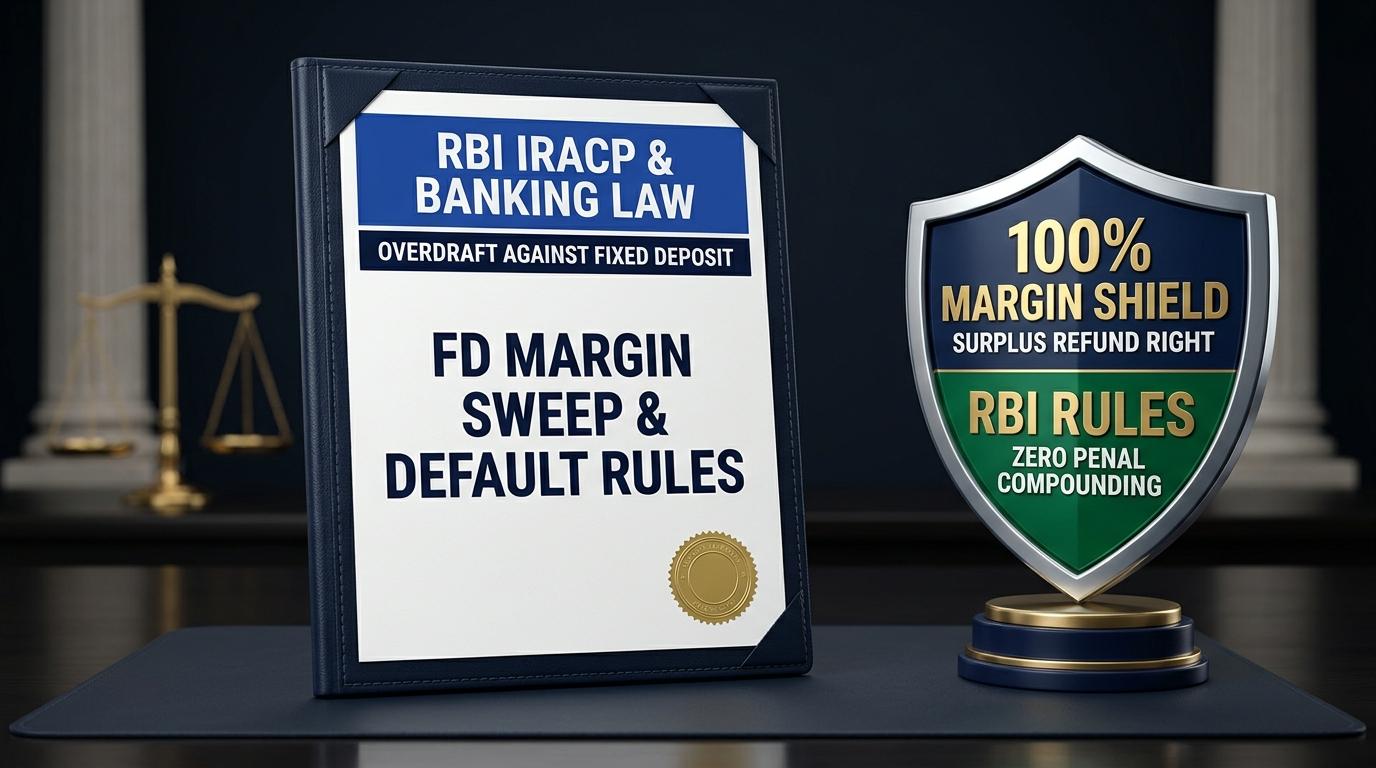
- 100% Margin NPA Shield: Under RBI IRACP norms, an overdraft against your own bank FD stays out of NPA past 90 days. This shield holds while your FD covers 100% of total dues.
- Margin Breach Sweep: Unpaid OD interest grows 1% to 2% faster than your FD rate. Once dues cross the FD value, the bank can break the FD early to close the overdraft.
- Strict Surplus Refund Right: After clearing valid OD dues, the bank must credit all leftover FD cash directly to your linked savings account.
- Joint FD Consent Rule: Under Supreme Court law in Anumati v. PNB, a bank cannot break a joint FD for one holder's personal OD without every holder's written consent.
- Clean CIBIL & ₹5,000/Day Lien Rule: A full FD sweep must show as Closed on CIBIL, not Settled. If you pay cash instead, lien removal past 30 days pays ₹5,000 per day.
1. Statutory Framework: RBI Rules on Overdraft Against FD
Many people in India open a personal overdraft (OD) against their Fixed Deposit (FD) to meet sudden cash needs. Instead of breaking the FD early, you draw up to 75% to 95% of the deposit value as a credit line. You pay interest only on the cash you use, usually at 1% to 2% above your FD rate.
Problems start when you stop paying monthly OD interest or ignore bank alerts. Because the bank holds a lien on your deposit, people often worry the bank will take their whole FD or ruin their CIBIL score overnight. In reality, strict laws guard every step of an FD overdraft default.
Five main rules govern personal overdraft against fixed deposit default in India. These are the RBI Master Circular on IRACP norms, the RBI Master Direction on Interest Rate on Deposits, the RBI Penal Charges Circular (DoR.MCS.REC.28), the RBI Lien Release Circular (DoR.MCS.REC.38), and Section 171 of the Indian Contract Act, 1872.
Note one firm RBI rule upfront. Banks can only grant an overdraft against a term deposit kept with the same bank. Under RBI Loans and Advances norms, banks are strictly barred from giving personal loans or overdrafts against FD receipts issued by other banks.
2. RBI 100% Margin Shield: NPA Exemption & Sweep Triggers
Normally, an overdraft account becomes "out of order" and turns into a Non-Performing Asset (NPA) after 90 days. This happens if the balance stays above the limit, if no credits arrive for 90 days, or if credits do not cover the debited interest.
However, RBI IRACP norms create a major shield for FD-backed overdrafts. Advances backed by term deposits with the same bank need not be marked as NPAs, even if interest stays unpaid past 90 days. This shield holds true as long as adequate margin stays in the account.
Adequate margin means the net value of your FD stays at or above 100% of your total OD balance plus unpaid interest. Why does this margin still break over time? Because your OD charges a 1% to 2% higher rate than your FD earns, and TDS cuts your net FD interest each year.
Once unpaid OD interest eats up your 5% to 20% safety buffer, your dues cross the FD's break value. This event is called a margin breach. At that point, the NPA shield ends, and the bank's system triggers a margin sweep to break the FD and close the overdraft.
3. Liquidation Math: Premature FD Penalty, TDS & Surplus
When a bank sweeps and breaks your FD before maturity, it must follow the RBI Master Direction on Interest Rate on Deposits. The bank recalculates your FD interest at the card rate for the exact tenure the deposit stayed active. It then deducts its stated premature exit fee, usually 0.5% to 1%.
Tax Deducted at Source (TDS) also shapes your payout. Under Section 194A (updated by Finance Act 2025), banks cut 10% TDS once yearly FD interest crosses ₹50,000 for regular citizens. For senior citizens, the limit is ₹1,00,000 per bank, or 20% without PAN. If early closure lowers your actual FD interest below what was taxed earlier, claim that excess TDS back in your Income Tax Return.
Look at the sample audit ledger below for a ₹5,00,000 FD earning 7.0% p.a. with a ₹4,25,000 OD limit (85% LTV) at 8.5% p.a., broken after 18 months of unpaid interest.
| Ledger Component | Applicable Banking Rule | Legal Audit Check | Illustrative Amount |
|---|---|---|---|
| 1. Original FD Principal | Base Pledged Term Deposit | 100% Protected Deposit | ₹5,00,000 |
| 2. Recalculated FD Interest | 18-Month Card Rate Less 1% Exit Fee | Verify Disclosed Penalty Rate | + ₹43,100 |
| 3. TDS Already Deducted | Section 194A (10% Above ₹50k/₹1L) | Match With Form 16A & AIS | - ₹0 to ₹4,310 |
| 4. Total OD Principal + Interest | ₹4,25,000 Utilized at 8.5% p.a. | Strip Any Illegal Penal Interest | - ₹4,81,900 |
| 5. Mandatory Surplus Refund | Net FD Proceeds Minus OD Dues | Must Credit Savings Account | ₹56,890 to ₹61,200 |
4. Banker's Lien & Set-Off: Section 171 Contract Act Law
Banks often cite Section 171 of the Indian Contract Act, 1872 when they freeze or sweep your fixed deposits. Section 171 grants a banker's general lien over goods left with the bank for a general balance of account.
Courts draw a clear line between a general lien and a right of set-off. Strictly speaking, cash in an FD is a debt the bank owes you, not physical goods. In Syndicate Bank v. Vijay Kumar (1992), the Supreme Court held that a bank still holds a strong right of set-off over pledged FD receipts to adjust a defaulted loan.
Even with this power, a bank cannot act in secret or break fair notice norms. First, the bank can sweep the specific FD you pledged only when your OD breaches its margin or matures unpaid. Second, the bank must send you a clear recall alert and an itemized closing sheet showing exact interest and penalty math.
Third, banks cannot break an unrelated unpledged FD without fair prior notice. They also cannot hold your surplus cash for a time-barred or disputed bill. Under RBI Penal Charges Circular DoR.MCS.REC.28 (effective April 1, 2024), banks cannot pile compounding penal interest on top of your OD rate before sweeping the deposit.
5. Visual Blueprint: OD Against FD Default & Closure Flow
This visual blueprint shows how RBI IRACP margin rules and banker's lien limits work together. It also maps your surplus refund rights after an FD overdraft default.
6. Step-by-Step SOP: Audit FD Sweep & Reclaim Your Surplus
Has your bank warned of a margin sweep or already broken your FD? Follow these six clear steps to audit the math and protect your credit report.
1Stage 1: Demand the Full OD Ledger & FD Liquidation Sheet
Email your branch for the complete OD interest ledger, original FD receipt terms, and premature closure worksheet. Check the exact date the bank swept the deposit.
2Stage 2: Check for Illegal Compounding Penal Interest
Compare the OD rate charged against your Key Facts Statement (KFS). Flag any added penal interest or hidden fee not printed in the KFS under RBI Circular DoR.MCS.REC.28.
3Stage 3: Verify Premature FD Penalty & Surplus Credit
Confirm the bank used the true card rate for your FD holding period and did not overcharge the exit fee. Check that every rupee of leftover surplus hit your savings account.
4Stage 4: Collect Your Closure Letter & Form 16A
Get an official No Dues Certificate (NOC) showing zero OD balance. Also download your updated TDS certificate (Form 16A) so you can reclaim any excess tax in your ITR.
5Stage 5: Audit All 4 Credit Bureaus After 15 Days
Under RBI's fortnightly reporting rule, pull your CIBIL, Experian, CRIF, and Equifax reports after 15 days. Ensure the OD reads "Closed" with ₹0 overdue, never "Settled."
6Stage 6: File Nodal & RBI Ombudsman Claims for Breaches
Did the bank hold surplus cash, sweep a joint FD unlawfully, or report wrong CIBIL data? Send a written notice to the Nodal Officer and escalate on cms.rbi.org.in.
7. Legal Rights: Joint FD Consent, CIBIL & Lien Penalties
Indian courts and the RBI enforce strong shields when banks cross the line on FD-backed overdrafts. You can invoke four clear legal rights to reverse unlawful sweeps and claim daily cash penalties.
An "Either or Survivor" joint FD cannot be pledged or swept for one holder's personal OD without the other holder's consent. Breaking it is a clear deficiency in service.
If you clear your OD with cash instead of breaking the FD, RBI Circular DoR.MCS.REC.38 gives the bank 30 days to lift the lien and return your FDR, or pay ₹5,000 per day.
A full FD sweep pays 100% of your debt and must show as "Closed" on CIBIL. If a wrong "Settled" or overdue tag is not fixed in 30 days, claim ₹100 per day under RBI rules.
Did the bank delay sweeping your FD past 100% LTV and now demand a shortfall? Cite Section 73 Contract Act (duty to cut loss) and RBI Penal Charges rules.
8. 3-Tier Escalation Matrix: Bank GRO to RBI Ombudsman
Did your branch hold FD surplus cash, delay lifting an FD lien, or leave CIBIL wrong? Use the official RBI three-tier complaint ladder below.
| Escalation Tier | Designated Authority | Turnaround Time | Scope of Relief & Order |
|---|---|---|---|
| Level 1: GRO | Bank Grievance Redressal Officer | 7 to 10 Working Days | Provides itemized FD sweep math, releases surplus cash, and lifts active FD liens. |
| Level 2: PNO | Principal Nodal Officer (Head Office) | 14 to 21 Working Days | Reverses illegal penal interest, fixes CIBIL tags to Closed, and reviews joint FD claims. |
| Level 3: RBI Ombudsman | Reserve Bank Integrated Ombudsman | 30 Days Post-PNO | Orders binding refunds, ₹5,000/day lien penalties, and ₹100/day CIBIL awards via cms.rbi.org.in. |
9. Procedural Milestones: Margin Breach to Clean Closure
Tracking each stage from unpaid OD interest to final bureau cleanup helps you act before a silent margin breach costs you premature FD penalties.
| Milestone Stage | Account Status | Bank Action Triggered | Smart Borrower Action |
|---|---|---|---|
| LTV Below 90% | Standard (Safe Margin) | Monthly OD interest debits continue; FD keeps earning interest. | Pay monthly OD interest to keep your FD compounding intact. |
| LTV 90% to 95% | Margin Watch Zone | Bank sends SMS and email alerts warning of low collateral cover. | Top up interest or ask for partial closure to avoid full FD breakage. |
| LTV Crosses 98%-100% | Margin Breach & Sweep | NPA shield ends; bank breaks FD early to wipe out the OD balance. | Demand full sweep math and immediate savings credit of surplus cash. |
| Day 1 to 15 Post-Sweep | Bureau Reporting | Bank reports zero-balance "Closed" status in fortnightly CIC batch. | Collect NOC, Form 16A, and check all 4 credit bureau reports. |
| Day 31+ (Cash Closure) | Lien Penalty Active | Unlifted FD lien or wrong CIBIL tag enters statutory RBI breach. | Claim ₹5,000/day for lien delay or ₹100/day for CIBIL dispute delay. |
10. Special Cases: Tax-Saver, Third-Party & Deceased FDs
Not every fixed deposit follows standard sweep rules. Special RBI and tax laws apply when your deposit is a tax-saver FD, belongs to a relative, or involves a deceased holder.
5-Year Tax-Saver FDs (Section 80C)
Under Income Tax and RBI rules, 5-year tax-saver FDs have a strict lock-in. They cannot be pledged for an overdraft or broken early for loan recovery, except upon the holder's death.
Third-Party FDs (Parent or Spouse)
A bank can sweep a parent's or spouse's FD only if they signed a valid third-party pledge and completed KYC. Any leftover surplus after OD closure must be refunded to the FD owner, not the borrower.
Matured FD Without Auto-Renewal
If your pledged FD matures without renewal instructions, RBI rules pay only the lower of the savings rate or FD rate on overdue funds. Renew or adjust the FD promptly to stop interest loss.
Deceased Depositor & Legal Heir Claims
When a depositor passes away, banks normally waive premature FD closure penalties. Legal heirs or nominees can ask the bank to adjust the OD cleanly and release the full surplus without exit fees.
 Legal Debt Dispute Authority
CredSettle (credsettle.com) is India's premier debt settlement, loan dispute resolution, and legal protection platform. Operating strictly under the RBI Fair Practices Code and CICRA 2005, our advocate panel negotiates directly with Bank Principal Nodal Officers to eliminate waived differentials, obtain unconditional No Dues Certificates (NDC), and upgrade credit bureau records from "Settled" to "Closed".
Frequently Asked Questions: Overdraft Against FD Default
Clear, verified answers to the most common questions on personal overdraft against fixed deposit defaults, RBI margin shields, premature penalties, TDS, and CIBIL rights.
Official Regulatory Citations & Statutory References
- RBI Master Circular on IRACP Norms: Prudential Norms on Income Recognition, Asset Classification and Provisioning (100% Margin Exemption for Advances Against Term Deposits & Out-of-Order Overdraft Criteria).
- RBI Master Direction on Interest Rate on Deposits: Premature Withdrawal Penalty Disclosure, Auto-Renewal Instructions, and Overdue Term Deposit Interest Rules.
- RBI Circulars DoR.MCS.REC.28 & DoR.MCS.REC.38: Fair Lending Ban on Compounding Penal Interest (effective April 1, 2024) and Mandatory 30-Day Lien Removal / ₹5,000 Per Day Compensation Rule.
- Indian Contract Act, 1872 & Supreme Court Precedents: Section 171 (Banker's General Lien), Syndicate Bank v. Vijay Kumar (1992 SC), and Anumati v. Punjab National Bank (2004 SC on Joint FD Consent).
- Income Tax Act, 1961 (Section 194A) & RBI Credit Reporting Directives: Finance Act 2025 FD TDS Thresholds (₹50,000 General / ₹1,00,000 Senior Citizens), Fortnightly CIC Reporting, and ₹100/Day Dispute Compensation.