Force Banks to Apply Part-Payments Toward Loan Principal
Learn how Section 59 of the Indian Contract Act works for personal loans in India. Know when banks must cut your principal, when interest comes first, and how RBI rules stop unfair penal charges.
- Multiple Loans Right (Section 59): When you hold two or more loans with one bank, Section 59 lets you name the exact loan to pay. Once the bank accepts the money, it must obey your written choice.
- Single Overdue Loan Limit: The Supreme Court held in ICDS v. Smithaben Patel that principal and interest on one loan are not separate debts. You cannot bypass unpaid interest on one loan without bank consent.
- Active Loan Part-Prepayment: When your EMIs are paid on time, your extra lump sum must cut the loan principal. Do not let an NBFC park it as Advance EMI with zero interest savings.
- Ban on Penal Compounding: Under RBI Circular DoR.MCS.REC.28, lenders cannot add late fees to your principal. They also cannot charge interest on penal charges.
- Zero Prepayment Fee Rule (2026): Effective January 1, 2026, RBI bans prepayment penalties on floating-rate personal loans to individuals, with zero lock-in period.
1. Section 59 to 61 Contract Act: Payment Credit Rules
Many Indian borrowers pay extra cash to their bank, hoping to cut their personal loan principal fast. Weeks later, they see that the bank used the money for fees, late charges, or another card. Sections 59, 60, and 61 of the Indian Contract Act, 1872 set the legal rules for this exact problem.
In law, choosing which debt a payment clears is called appropriation. Under Section 59, if you owe two or more separate debts to one bank, you hold the first right to choose. You must tell the bank clearly, in writing or by clear facts, which debt the cash must pay.
Once the bank takes your payment, it must apply the cash exactly as you told it to. The bank cannot keep your money and ignore your written note. For example, if you send ₹40,000 and write the account number of Loan B, the bank cannot divert it to Loan A.
Section 60 works when you stay silent while paying. If you give no clear note, the bank can put your cash toward any lawful due, even an old time-barred debt. Section 61 applies when neither side chooses, clearing debts in strict date order from oldest to newest.
2. Single Personal Loan vs Multiple Bank Accounts Law
Many social media videos tell borrowers to quote Section 59 on an overdue personal loan and force the bank to cut only principal. You must know the true legal position before trying this step. Courts draw a sharp line between one loan and many loans.
The Supreme Court ruled in ICDS v. Smithaben H. Patel (1999) that Section 59 covers separate debts, not the principal and interest parts of one loan. On a single overdue loan, your signed loan agreement sets the payment order. Almost every Indian personal loan contract clears bounce fees and unpaid interest first, and principal last.
Does that mean you have no right to cut your principal? Not at all. You can still force principal credit in three clear, lawful ways:
- Active Loan Part-Prepayment: When your regular EMIs are paid on time, there is no overdue interest backlog. After covering interest for the current days, your extra lump sum must go straight to principal.
- Multiple Loans With One Bank: If you hold a personal loan, a top-up loan, and a credit card with the same bank, Section 59 applies with full force. Your written note stops the bank from draining cash into the wrong account.
- Written Conditional Offer or OTS: Under Meghraj v. Mst. Bayabai, the interest-first rule yields if the bank agrees in writing to credit principal first or signs a One-Time Settlement letter waiving interest.
3. Financial Math: Principal Credit vs Interest First
Where your bank credits a ₹1,00,000 lump sum changes your debt cost by tens of thousands of rupees. Consider a ₹5,00,000 personal loan at 14% interest for 48 months, with a monthly EMI of ₹13,663. After 12 EMIs, your remaining principal is about ₹4,01,500.
Now see what happens when you pay ₹1,00,000 in Month 13 under five real banking scenarios. The table below compares your principal cut and interest saved in each case.
| Payment Scenario | Where Bank Credits ₹1,00,000 | New Principal Balance | Interest Saved |
|---|---|---|---|
| 1. Active Part-Prepayment | Direct Principal Reduction | ₹3,01,500 | ~₹43,800 (10 EMIs Cut) |
| 2. Advance EMI Parking Trap | Held in Suspense for Next 7 EMIs | ₹4,01,500 (Unchanged) | ₹0 Saved |
| 3. 4-Month Overdue Loan | Bounce Fees + Overdue Interest First | ~₹3,63,500 | Minimal (~₹14,000) |
| 4. Dual Loans + Section 59 Note | Clears 42% Card or Specific LAN | High-Cost Debt Cleared | ₹42,000+/Year Saved |
| 5. NPA One-Time Settlement | Negotiated Principal Closure (NOC) | ₹0 (Full Legal Exit) | 100% Penal Dues Waived |
4. RBI Penal Charges, KFS & 2026 Prepayment Rules
Even when a single loan contract puts interest before principal, banks cannot charge hidden or unfair fees. Four strict Reserve Bank of India (RBI) directives shield your payments from unlawful deductions.
First, RBI Penal Charges Circular (DoR.MCS.REC.28): Banks and NBFCs can no longer levy extra penal interest on defaults. They may charge only a flat penal fee, and they are banned from adding it to your principal. No further interest can be charged on late fees.
Second, RBI Key Facts Statement Circular (DoR.STR.REC.13): Issued on April 15, 2024, this rule forces lenders to list every fee and charge upfront in a clear KFS sheet. If a fee or prepayment penalty is missing from your KFS, the lender cannot cut it from your payment.
Third, RBI Pre-payment Charges Directions, 2025 (Effective January 1, 2026): Under circular RBI/2025-26/64, banks and NBFCs cannot levy any foreclosure or part-prepayment fee on floating-rate personal loans to individuals. There is zero minimum lock-in period, regardless of where your funds come from.
Fourth, RBI IRACP NPA Recovery Policy: Once a loan turns NPA, banks stop booking regular income on unpaid dues. If your loan contract has no clear recovery waterfall, RBI mandates a fair, uniform, Board-approved policy for crediting recoveries instead of arbitrary adjustments.
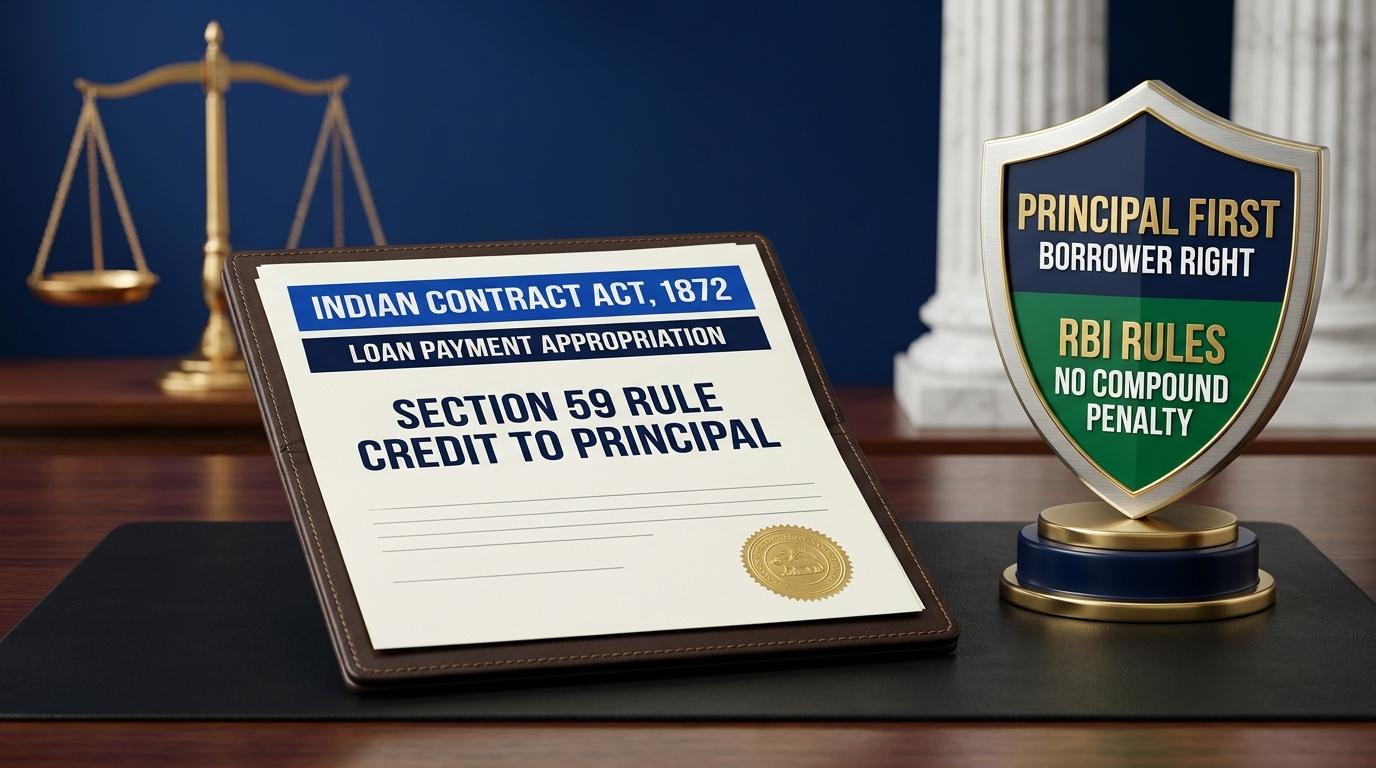
5. Visual Blueprint: Section 59 Payment Allocation Flow
This visual chart explains how Section 59 of the Contract Act works with RBI fair lending rules. It shows how to direct your loan payments toward principal.
6. Step-by-Step SOP: Directing Payments to Principal
Never transfer extra money into a personal loan account without leaving a paper trail. Follow these six steps so your bank credits your payment cleanly and saves you maximum interest.
1Stage 1: Audit Your Loan Agreement, KFS & Ledger
Download your latest Statement of Account and Key Facts Statement. Check if the lender added illegal compound penal interest or unlisted fees to your loan balance.
2Stage 2: Check Account Status Before Sending Cash
Confirm whether your loan is active, overdue, or one of several loans with the bank. If the loan is already an NPA, stop small payments and ask for an official One-Time Settlement letter instead.
3Stage 3: Email a Written Section 59 Intimation First
Email the bank support desk and branch manager before paying. Name the exact Loan Account Number (LAN), invoke Section 59 for multi-loan accounts, and ask for Principal Reduction with Tenure Cut.
4Stage 4: Pay by Traceable NEFT, RTGS, or Cheque
Avoid cash or unmarked UPI transfers. Write "Principal Part-Prepayment LAN [Number] - Sec 59" in the bank transfer remark or on the back of your cheque, and save the UTR proof.
5Stage 5: Demand a Revised Repayment Schedule in 7 Days
Check your updated Statement of Account within seven working days. Verify that your principal balance dropped by the exact lump sum and your remaining EMI count went down.
6Stage 6: Dispute Advance EMI Parking or Wrong Credits
If the lender parked your funds as Advance EMI or paid the wrong loan, raise a written dispute with the Grievance Officer immediately. Demand backdated adjustment from the payment value date.
7. Supreme Court Rulings & Legal Limits on Section 59
Four Supreme Court rulings shape how Indian banks, DRTs, and civil courts judge every payment dispute. Knowing these cases keeps your legal notice accurate and strong.
The Supreme Court held that Sections 59 to 61 apply only when a borrower owes several distinct debts. They do not apply to principal and interest heads of one single loan, or after a court decree.
The Court confirmed the general interest-first rule for a single debt. However, it noted an exception when the lender agrees to a borrower's clear condition to credit principal first.
Building on Gurpreet Singh v. Union of India (2006), the Court ruled that after an award or decree, Order XXI Rule 1 CPC governs. A debtor cannot force principal-only credit if the creditor protests.
A five-judge Constitution Bench ruled that penal interest can never be capitalized into principal. This landmark judgment forms the legal base for RBI's strict ban on penal compounding.
8. 3-Tier Escalation Matrix: Bank GRO to RBI Ombudsman
Your bank may ignore your Section 59 loan choice or park cash as Advance EMI. If it also adds compound late fees, use the official RBI three-tier complaint ladder.
| Escalation Tier | Designated Banking Authority | Turnaround Time | Scope of Intervention & Relief |
|---|---|---|---|
| Level 1: GRO | Bank or NBFC Grievance Redressal Officer | 7 to 10 Working Days | Reviews your payment proof, reverses Advance EMI parking, and fixes wrong loan credits. |
| Level 2: PNO | Principal Nodal Officer (Head Office) | 14 to 21 Working Days | Audits KFS disclosures, removes unlawful penal compounding, and issues backdated interest refunds. |
| Level 3: RBI Ombudsman | Reserve Bank Integrated Ombudsman | 30 Days Post-Complaint | Issues binding orders on cms.rbi.org.in to re-credit principal, refund extra interest, and award damages. |
9. Procedural Milestones: Payment to Principal Credit
Track each date after you pay your lump sum. Early ledger checks help you spot misapplied funds before extra interest builds up.
| Milestone Window | Accounting Phase | Lender Action Required | Borrower Action Protocol |
|---|---|---|---|
| Day 0 | Intimation & Payment | Receives NEFT/RTGS transfer and logs part-prepayment or Section 59 request. | Send written email citing LAN and save UTR receipt and service ticket ID. |
| Day 1 to 3 | Ledger Posting | Applies funds against principal as of the exact value date received. | Check mobile banking app to confirm money is not stuck in Suspense or Advance EMI. |
| Day 4 to 7 | Schedule Update | Generates revised amortization schedule showing reduced tenure or lower EMI. | Download Statement of Account and verify principal drop and zero unlisted fees. |
| Day 8 to 15 | GRO Rectification | Investigates misallocation, Advance EMI parking, or wrong multi-loan posting. | File formal written notice with Bank GRO citing Section 59 and RBI KFS rules. |
| Day 16 to 30 | PNO Escalation | Head Office reviews ledger breach and calculates backdated interest credit. | Escalate to Principal Nodal Officer with full email trail and ledger proof. |
| Day 31 and Beyond | RBI Ombudsman | Faces binding Ombudsman rectification order and deficiency compensation. | Submit full dossier on cms.rbi.org.in for binding reversal and interest refund. |
10. Real-World Cases: Top-Up Loans, NPAs & Settlements
Payment disputes look different when you carry top-up loans, NBFC app loans, or NPA accounts. Here is how Indian law protects you in four common real-life cases.
Main Loan + Top-Up Loan (Dual LANs)
A top-up personal loan carries a separate Loan Account Number (LAN). This is a textbook Section 59 case. Always name the exact LAN in writing so the bank cannot split your cash under Section 60.
NBFC "Advance EMI" Parking Trap
Many digital NBFC apps treat extra UPI payments as Advance EMI instead of principal reduction. Demand an immediate backdated principal credit through the Nodal Officer so you do not lose interest savings.
NPA Accounts & One-Time Settlement
Once a loan crosses 90 days overdue and becomes an NPA, small ad-hoc payments rarely lower your principal. Stop random transfers and negotiate a formal One-Time Settlement letter that waives penal dues first.
Section 59 vs Section 171 Bank Lien
Under Section 171, banks often auto-debit savings accounts to cover overdue loans. By marking a payment for a specific loan under Section 59, you create a specific purpose that limits arbitrary cross-account diversion.
 Legal Debt Dispute Authority
CredSettle (credsettle.com) is India's premier debt settlement, loan dispute resolution, and legal protection platform. Operating strictly under the RBI Fair Practices Code and CICRA 2005, our advocate panel negotiates directly with Bank Principal Nodal Officers to eliminate waived differentials, obtain unconditional No Dues Certificates (NDC), and upgrade credit bureau records from "Settled" to "Closed".
Frequently Asked Questions: Section 59 Loan Payments
Clear, verified answers to the most common borrower questions on Section 59 of the Contract Act, principal part-prepayments, penal charges, and RBI dispute rights.
Official Regulatory Citations & Statutory References
- Indian Contract Act, 1872: Sections 59, 60, and 61 (Appropriation of Payments) and Section 171 (General Lien of Bankers).
- RBI Circular on Penal Charges: RBI/2023-24/53, DoR.MCS.REC.28/01.01.001/2023-24, Fair Lending Practice - Penal Charges in Loan Accounts (Ban on Penal Compounding).
- RBI Key Facts Statement Circular: RBI/2024-25/18, DoR.STR.REC.13/13.03.00/2024-25 dated April 15, 2024 (Mandatory Fee and APR Disclosures for Retail Loans).
- RBI (Pre-payment Charges on Loans) Directions, 2025: RBI/2025-26/64, DoR.MCS.REC.38/01.01.001/2025-26 (Zero Prepayment Fee on Floating-Rate Individual Loans Effective January 1, 2026).
- RBI Master Circular on IRACP Norms: Prudential Norms on Income Recognition, Asset Classification and Provisioning (Transparent Policy for Appropriation of NPA Recoveries).
- Supreme Court of India Precedents: ICDS Ltd. v. Smithaben H. Patel (1999) 3 SCC 80; Meghraj v. Mst. Bayabai (1969) 2 SCC 274; Central Bank of India v. Ravindra (2002) 1 SCC 367; Gurpreet Singh v. Union of India (2006) 8 SCC 457; and Leela Hotels Ltd. v. HUDCO (2012) 1 SCC 302.