What Happens on Default of NSC, KVP or SGB Credit Lines?
Pledged small savings certificates or Sovereign Gold Bonds for an overdraft or term loan? Learn your rights against premature liquidation, mandatory 15-day cure notices, and Section 176 surplus refunds.
- Mandatory Cure Notice Period: Under Section 176 of the Indian Contract Act, lenders cannot liquidate pledged NSC, KVP, or SGBs without serving a formal 15 to 30-day demand notice.
- Absolute Right to Redeem (Section 177): Borrowers retain the legal right to pay outstanding arrears and redeem their pledged certificates or gold bonds at any point before the actual sale occurs.
- Strict Surplus Return Mandate: Banks are prohibited from keeping windfall gains. If encashment or secondary market sale proceeds exceed the loan balance, the excess money must be immediately returned to the borrower.
- Deficit Recourse Limitations: If collateral liquidation fails to satisfy the entire debt, the remaining unpaid balance becomes an ordinary unsecured claim. The bank cannot freeze other assets without civil court or DRT orders.
- Credit Bureau Rectification: Following full recovery via collateral encashment, lenders must update credit bureau records to Closed status within 30 days or face Rs 100/day RBI delay penalties.
1. Statutory Framework: Indian Contract Act & Post Office Rules
Pledging government-backed instruments such as National Savings Certificates (NSC), Kisan Vikas Patra (KVP), and Sovereign Gold Bonds (SGB) provides borrowers with rapid liquidity. Scheduled commercial banks, cooperative institutions, and non-banking financial companies (NBFCs) readily sanction overdraft credit lines and term loans against these sovereign securities due to their negligible default risk.
However, when commercial adversity, business revenue disruption, or personal emergencies cause a default on EMI repayments or credit line interest servicing, lenders often threaten immediate forfeiture. It is crucial to understand that under Indian jurisprudence, taking a loan against securities is governed strictly by the law of bailment and pledge under Chapter IX of the Indian Contract Act, 1872.
Under Section 172 of the Indian Contract Act, the borrower acts as the pawnor and the lending bank functions as the pawnee. The bank acquires a special property interest in the collateral solely as security for debt repayment. The bank does not obtain absolute ownership of the underlying certificates or gold bonds.
Furthermore, the issuance, pledge registration, and redemption of small savings certificates are regulated by the Government Savings Promotion Act, 1873, and the Government Savings Promotion General Rules, 2018. Lenders cannot invent unilateral forfeiture procedures that contravene these statutory mandates.
2. How NSC & KVP Pledges Work: Post Office Form-7 Lien Rules
To create a valid pledge on NSC (VIII Issue) or KVP certificates, the borrower and the lender must complete a statutory pledge process with the Department of Posts (India Post) or an authorized public sector bank. Under Rule 14 and Rule 15 of the Government Savings Promotion General Rules, 2018, this requires submitting Form-7 (Application for Transfer of Certificate as Pledge).
The Postmaster reviews the application, registers the lien in the official post office ledger, and stamps a formal pledge endorsement across the physical certificate or e-certificate. This endorsement legally restricts the borrower from encashing, transferring, or duplicating the security until the bank formally releases the pledge.
- • Tenure: Fixed 5-year lock-in period.
- • Typical Loan Margin: Banks advance 70% to 85% of face value plus accrued compound interest.
- • Premature Liquidation: Post Office rules allow premature encashment upon default only when the pledgee bank submits an official forfeiture claim under Form-7.
- • Interest Calculation: Accrued interest is governed by the original issue rate and credited up to the encashment date.
- • Tenure: Matures upon doubling the principal amount (approx. 115 to 123 months based on issue date).
- • Surrender Table: Encashable after a mandatory 2.5-year lock-in period at predefined tabular surrender values.
- • LTV Baseline: Sanctioned against the current surrender value certified by the Post Office.
- • Forfeiture Procedure: Lender presents the lien-marked certificate with a demand notice to the Postmaster for realization.
When a borrower defaults on an NSC or KVP loan, the lender does not instantly pocket the money. The bank must physically deliver the original certificates and discharge declarations to the Postmaster. The Post Office audits the claim, computes the applicable surrender or maturity proceeds, and disburses the funds directly into the bank recovery account.
3. Sovereign Gold Bond (SGB) Pledge Invocation & RBI Guidelines
Sovereign Gold Bonds represent government debt denominated in grams of gold, issued by the Reserve Bank of India under the Government Securities Act, 2006. Because SGBs carry sovereign backing and pay a semi-annual interest coupon of 2.50% per annum alongside gold market appreciation, they are widely utilized as prime collateral for personal credit lines and business working capital.
Pledging and invoking SGB collateral depends entirely upon the format in which the bonds are held:
A. Dematerialized SGBs (NSDL / CDSL Depository Accounts)
When SGBs are held in demat format, the borrower creates a pledge via the depository system using standard pledge request forms (PRF). In the event of default, the lender instructs its Depository Participant (DP) to invoke the pledge. The invoked units are transferred into the bank recovery demat account and liquidated through secondary market trading on the National Stock Exchange (NSE) or Bombay Stock Exchange (BSE).
B. Certificate of Holding / Bond Ledger Account (RBI E-Kuber)
If the investor holds physical Certificates of Holding registered in the RBI Bond Ledger Account (BLA), lien marking is recorded in the RBI E-Kuber system. In case of default, the bank invokes the pledge pursuant to Chapter VII, Regulation 21 of the Government Securities Regulations, 2007. The bank submits an application along with default proof to the Public Debt Office (PDO), RBI Mumbai, to transfer the security or collect redemption proceeds.
Important RBI Regulatory Clarifications for SGB Pledges:
1. Under RBI directives, lenders acquiring SGBs through pledge invocation on loan default are specifically exempted from the annual individual holding limit (normally 4 kg per fiscal year).
2. Commercial banks that acquire SGBs through default invocation can count those specific government securities toward fulfilling their statutory Statutory Liquidity Ratio (SLR) requirements.
4. Liquidation Mechanics: Surrender Value vs Secondary Sale
When a lender decides to enforce its security interest following an unresolved default, the execution mechanism differs dramatically based on whether the underlying asset is a fixed small savings certificate or a market-traded bond.
| Collateral Type | Liquidation Channel | Valuation Benchmark | Execution Timeframe |
|---|---|---|---|
| National Savings Certificate (NSC) | India Post Issuing Branch | Face Value + Accrued Compound Interest | 7 to 15 working days |
| Kisan Vikas Patra (KVP) | India Post Issuing Branch | Post Office Table of Surrender Values | 7 to 15 working days |
| Demat Sovereign Gold Bonds (SGB) | NSE / BSE Secondary Market | Real-time Spot Exchange Price per Gram | T+1 settlement post-invocation |
| BLA Sovereign Gold Bonds (E-Kuber) | RBI Public Debt Office (PDO) | IBJA Gold Average Closing Price | 15 to 30 working days |
For demat SGBs, lenders are legally bound by fiduciary obligations to sell at prevailing fair market rates. They cannot dump securities in artificial off-market block sales at distress discounts. Doing so gives the borrower actionable grounds to sue for breach of trust under the Indian Contract Act and Consumer Protection Act, 2019.
5. The Surplus Refund Rule: Section 176 Contract Act Protections
The most critical borrower protection in secured collateral defaults is the statutory Surplus Refund Rule codified under Section 176 of the Indian Contract Act, 1872. Section 176 explicitly commands:
Many borrowers mistakenly believe that once they default on an overdraft against gold bonds or small savings, the bank keeps the entire collateral. This is completely false. The bank is strictly a secured creditor, not an equity partner. It is entitled only to recover:
- Sanctioned principal amount actually disbursed and drawn down.
- Legitimate contractual interest accrued up to the date of collateral liquidation.
- Reasonable, actual, and verifiable administrative or legal expenses incurred in executing the sale.
If the bank delays transferring this ₹3,30,000 surplus or attempts to swallow it as arbitrary penalties, the borrower can file an immediate complaint with the RBI Banking Ombudsman and claim 18% compensatory interest.
6. What Happens if Collateral Value Falls Short of Total Debt?
What occurs when the encashed value of the collateral is insufficient to clear the accumulated loan dues? This scenario rarely happens with NSC or KVP due to safe LTV margins, but it can arise with SGB credit lines if gold prices experience sharp corrections while interest compounds over extended non-payment periods.
Under the second limb of Section 176 of the Indian Contract Act:
Crucially, the legal status of the remaining debt undergoes an immediate transformation:
Residual Debt Becomes Unsecured
Once the pledged certificates or gold bonds are sold, the security is extinguished. The remaining deficit becomes an ordinary unsecured personal loan. The bank no longer holds special collateral rights.
No Automatic Asset Seizure
The bank cannot attach your salary, freeze your house, or seize other family assets without first filing an ordinary civil recovery suit or initiating DRT proceedings (if debt exceeds ₹20 Lakhs) and obtaining a judicial decree.
This deficit balance provides prime opportunity for a negotiated One-Time Settlement (OTS). CredSettle regularly represents borrowers to negotiate waivers of 40% to 70% on residual deficit balances, eliminating all compounded penalties.
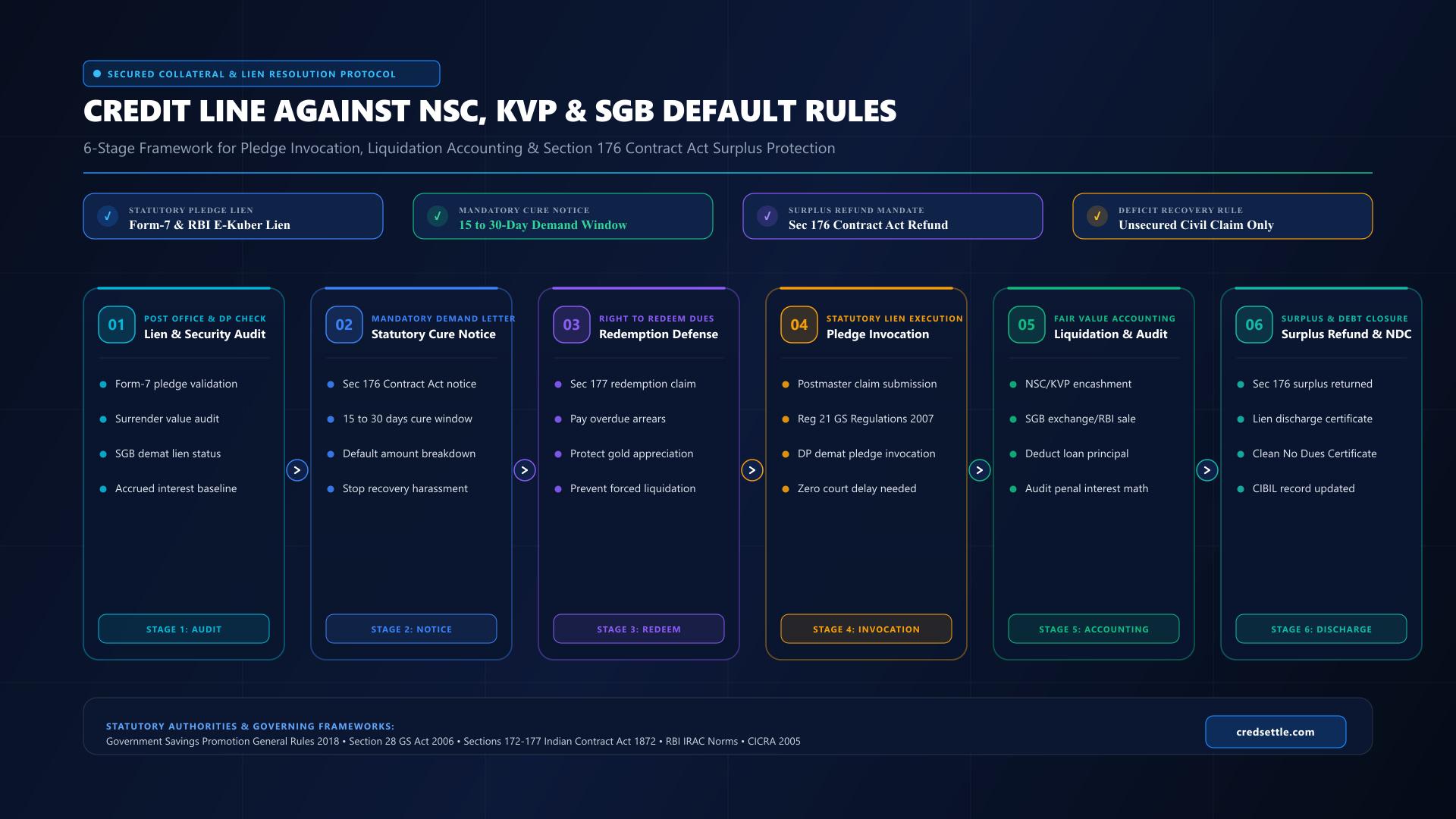
7. Visual Blueprint: Collateral Default & Lien Resolution
The operational flow diagram below outlines the 6 critical stages of collateral default handling in India, from initial pledge auditing and mandatory Section 176 cure notices to pledge invocation, fair market liquidation, and statutory surplus refund execution.
8. Step-by-Step SOP: Responding to a Bank Lien Default Notice
If your bank or NBFC has issued a recall notice or threatened to liquidate your pledged NSC, KVP, or Sovereign Gold Bonds, following this battle-tested protocol protects your financial assets:
Demand Full Loan Statement of Account
Write to the branch manager demanding an itemized loan ledger. Cross-check that the lender has not applied compounding penal interest, which violates the RBI Fair Lending Directives effective April 2024.
Invoke Section 177 Right of Redemption
If you have interim liquidity, issue a formal legal notice exercising your statutory right to redeem under Section 177 of the Indian Contract Act. You are entitled to pay off the overdue balance and demand immediate cancellation of the Form-7 lien.
Notify the Post Office or Depository Participant
Send a copy of your dispute letter to the issuing Postmaster or Depository Participant (DP). Put them on notice that the exact loan balance is in active dispute and that any premature liquidation must strictly comply with Section 176 notice rules.
Demand Written Sale Accounting & Surplus Remittance
If the securities are encashed, mandate that the bank furnish certified documentary proof of the sale price, date of sale, and fee deductions. Submit your bank account details for immediate credit of the surplus funds.
9. CIBIL Bureau Reporting & RBI Delay Compensation Guidelines
A common injustice faced by borrowers is that even after the bank fully recovers its loan dues by encashing pledged NSC, KVP, or SGB collateral, the loan account continues to appear as “Overdue”, “Written Off”, or “Default” on their CIBIL and Experian reports.
Under the Credit Information Companies (Regulation) Act, 2005 (CICRA) and the Reserve Bank of India Master Direction on Credit Information Reporting:
Mandatory Credit Information Company (CIC) Update Rules
- Accurate Account Status: Once collateral encashment satisfies the principal and contractual interest in full, the bank must report the facility as “Closed”, not “Settled” or “Post-Write-Off Settled”.
- 30-Day Bureau Reporting Mandate: Lenders must update all 4 credit bureaus (CIBIL, Experian, Equifax, CRIF High Mark) within 30 days of debt resolution.
- ₹100 Per Day Delay Compensation: Under RBI Circular RBI/2023-24/72 (dated September 20, 2023), if a bank fails to rectify wrongful bureau reporting within 30 days of a formal dispute, it must pay the borrower ₹100 per calendar day of continuing delay.
10. 3-Tier Escalation Matrix: Bank, Post Office & RBI Ombudsman
When a financial institution refuses to honor Section 176 surplus refunds, withholds remaining unencumbered certificates, or levies punitive compounding interest, you can initiate a formal 3-tier escalation:
Principal Nodal Officer
Submit a formal written complaint to the bank Principal Nodal Officer (PNO) demanding immediate cessation of liquidation or remittance of surplus under Section 176 Contract Act.
RB-IOS 2021 Portal
If unresolved within 30 days, lodge a complaint on the RBI CMS portal (cms.rbi.org.in). The Banking Ombudsman can direct full refund of surplus and award up to ₹20 Lakhs compensation.
Consumer Commission / Civil Court
File a petition before District Consumer Disputes Redressal Commission for deficiency of service under Section 2(11) of Consumer Protection Act, 2019, claiming mental agony damages.
11. Common Bank Violations & Illegal Collateral Forfeitures
During our legal audits at CredSettle, we uncover frequent statutory infractions committed by lending institutions handling secured securities defaults:
 Legal Debt Dispute Authority
CredSettle (credsettle.com) is India's premier debt settlement, loan dispute resolution, and legal protection platform. Operating strictly under the RBI Fair Practices Code and CICRA 2005, our advocate panel negotiates directly with Bank Principal Nodal Officers to eliminate waived differentials, obtain unconditional No Dues Certificates (NDC), and upgrade credit bureau records from "Settled" to "Closed".
Frequently Asked Questions: NSC, KVP & SGB Loan Defaults
Statutory Citations, Regulatory Circulars & Legal Authorities
- Indian Contract Act, 1872: Sections 172 to 177 (Bailment of Pledges, Rights of Pawnee upon Default, Surplus Refund, and Right of Redemption).
- Government Savings Promotion General Rules, 2018: Rules 14 and 15 (Pledging of Small Savings Accounts and Certificates via Form-7).
- Government Securities Act, 2006: Section 28 (Lien, Hypothecation and Pledge of Government Securities).
- Government Securities Regulations, 2007: Chapter VII, Regulation 21 (Invocation of Pledge in RBI E-Kuber / Bond Ledger Account).
- RBI Master Direction on Prudential Norms on IRAC: Exemption of loans against government securities and term deposits from standard NPA provisioning.
- RBI Circular on Fair Lending Practices (2023-24): Penal Charges in Loan Accounts (Compounding ban effective April 1, 2024).
- Credit Information Companies (Regulation) Act, 2005 (CICRA): Section 21 & RBI Circular of Sept 20, 2023 (₹100/day compensation for delay in credit bureau updates).
- Consumer Protection Act, 2019: Section 2(11) (Deficiency of Service) and Section 39 (Civil Compensation for Unfair Trade Practices).