Executive Brief: WhatsApp Legal Notices.
1. WhatsApp Legal Notice Scam: Digital Deception Tactics
When an no-pledge private loans. Credit card. Digital loan defaults. Banks often assign overdue accounts to third-party claims firms. Operating on aggressive commission targets. These outside agents often abandon lawful claims methods and deploy deceptive WhatsApp messages containing fabricated legal notices. Police FIR copies. Fake court summons.
Filing civil suits or criminal complaints under Section 138 of the Negotiable Instruments Act requires lenders to pay court fees. Engage advocates. Follow strict judicial timelines. For no-pledge debts. Formal court lawsuits is often slow and expensive. As a result. Claims agents use WhatsApp to deliver menacing PDF attachments with forged court headers and arrest threats to trigger fast client panic without judicial scrutiny.
2. Forensic Anatomy of a Fake Notice: Key Red Flags to Identify
Genuine legal notices drafted by practicing Indian advocates comply with the Advocates Act. 1961, and Bar Council regulations. In contrast. Fraudulent digital notices display several unmistakable deep errors:
Missing Bar Council Enrollment: Every licensed advocate possesses a state Bar Council registration code (such as D/1234/2019). Fake notices omit this number. List burner mobile numbers. Invent fictional designations like ". Chief Legal Officer of claims".
Unrealistic Deadlines &. Arrest Threats: Authentic Section 138 notices grant a legal 15-day payment window. Fraudulent notices demand settlement within two hours and threaten fast non-bailable arrest under Section 420 IPC (Section 318 BNS). This is legally impossible for pure civil debt defaults.
private UPI Handles: Fake notices often include QR codes or private UPI handles. Legitimate banks and NBFCs only accept payments credited straight to the client&apos. s verified loan account number.
3. Comparative Matrix: Fake Notices vs Genuine Legal Instruments
Distinguishing between authentic court summons. Lawful advocate demand notices. Fraudulent WhatsApp extortion messages is critical for executing an effective legal response.
| Notice Type | Issuing Authority. | Delivery Medium | Legal Enforceability. | Required Action |
|---|---|---|---|---|
| Fake WhatsApp Notice. | illegal claims firm. | WhatsApp PDF / Image. | Zero (Criminal Forgery). | File Cyber Crime &. RBI Complaints. |
| Advocate Demand Notice. | Enrolled Bar Council Lawyer. | Registered Post / Verified Email. | Pre-lawsuits Demand. | Serve Legal Reply &. Initiate OTS. |
| Magistrate Court Summons. | Judicial Magistrate / Civil Court. | Court Bailiff / Speed Post. | legal Judicial Order. | Enter Appearance via Defense Counsel. |
| Police Summons (41A CrPC). | Police Investigating Officer. | Physical Notice with Police Seal. | legal Inquiry Order. | Attend with Counsel or Submit Reply. |
| Bank OTS Offer Letter. | Authorized Credit boards. | formal Bank Domain Email. | Binding Settlement Contract. | Verify Terms &. pay Settlement Sum. |
4. Statutory Penalties: Criminal Liabilities for Sending Fake Notices
When a claims agent forges court emblems. Impersonates an advocate. Threatens unlawful arrest. The agent and the lending institution incur direct criminal debt risk under Indian law:
Bharatiya Nyaya Sanhita (BNS): Section 336 and 340 BNS punish paper and judicial seal forgery with up to seven years imprisonment. Section 319 BNS penalizes public servant impersonation with rigorous jail terms.
Information Technology Act: Section 66D of the IT Act penalizes cheating by personation via computer resources or messaging apps with up to three years imprisonment and monetary fines.
Advocates Act &. RBI Directives: Section 29 of the Advocates Act restricts legal practice only to enrolled lawyers. Also. RBI Fair Practices Code and Digital Lending rules strictly prohibit misleading legal representations and client abuse.
Infographic: 4-Step Verification Blueprint for WhatsApp Notices
This structured visual defense guide details the four sequential steps to verify advocate credentials. Detect forged judicial seals. Check national e-Courts records. File cyber fraud complaints.
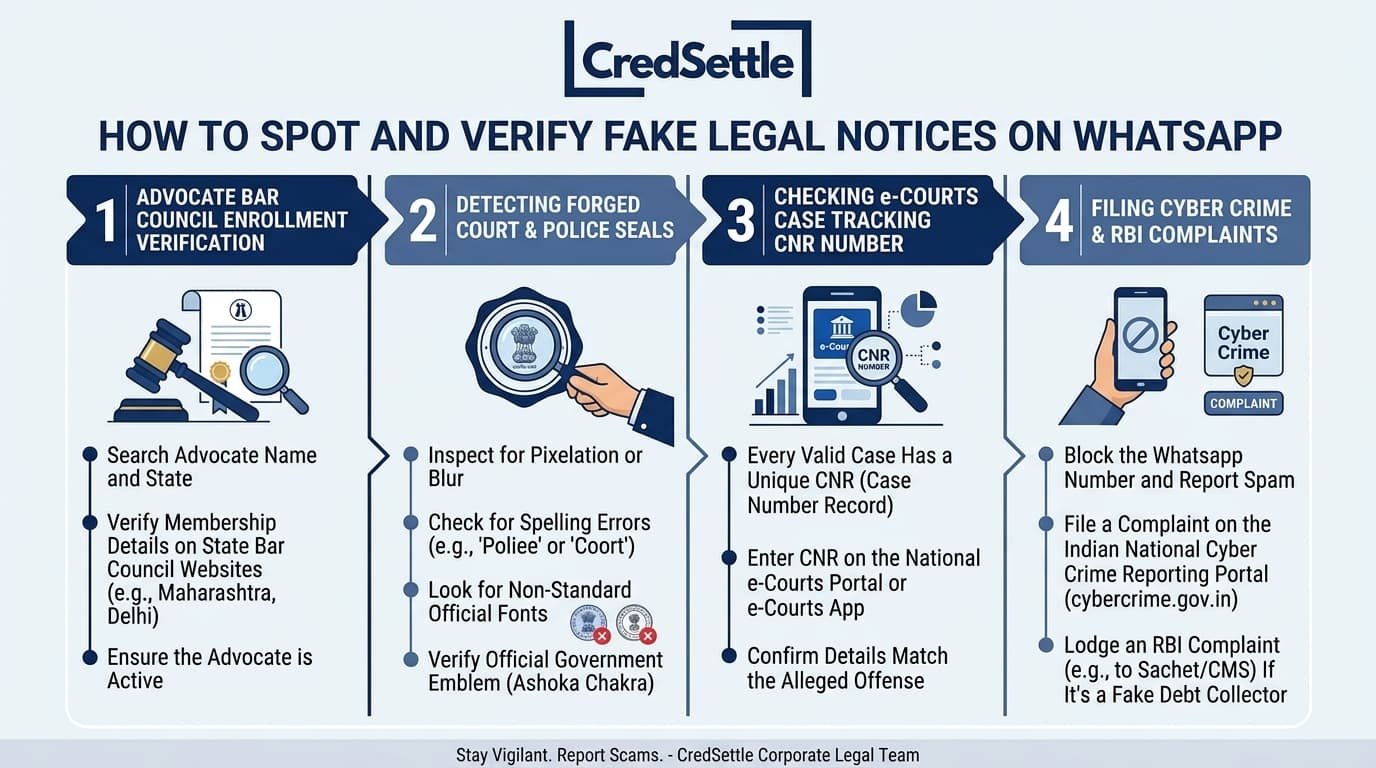
5. Step-by-Step SOP: How to Verify, Reply, and Neutralize Fake Notices
CredSettle executes a systematic six-stage Standard Operating Procedure to audit disputed notices. Shield clients from abuse. Achieve formal debt relief.
Stage 1: Bar Council Credential Audit
We verify the lawyer name and enrollment number against state Bar Council directories. If the sender is unverified or unregistered. We paper the impersonation for legal escalation.
Stage 2: e-Courts CNR Docket Verification
If lawsuits is claimed. Our advocates check the 16-digit CNR number on the national e-Courts portal. If no docket exists. The court case claim is confirmed to be fraudulent.
Stage 3: Evidence Archiving & Metadata Preservation
We secure complete digital exports of the WhatsApp chat. This includes timestamped screenshots. Sender profile data. Attached PDFs. And audio recordings of threatening calls.
Stage 4: Formal Cease-and-Desist Legal Reply
CredSettle advocates serve a formal legal reply and cease-and-desist notice to the lender and claims firm. Refuting false claims and demanding an fast end to unlawful threats.
Stage 5: RBI Ombudsman & Cyber Police Escalation
If abuse continues. We submit complaints to the National Cyber Crime Portal (cybercrime.gov.in) and the RBI Integrated Ombudsman (cms.rbi.org.in). Triggering RBI action.
Stage 6: Bilateral OTS Negotiations & Closure
Using RBI violations as talks leverage. CredSettle engages the bank Credit boards straight. Securing a 40% to 60% loan cut and an full No Dues letter.
6. Statutory Protections: Borrower Rights Under Indian Law
Under the Constitution of India and RBI directives. Clients in debt stress possess legal protections against unlawful debt claims practices:
Article 21 and RBI Fair Practices rules strictly prohibit claims agents from using abusive language. Threatening physical harm. Simulating police arrests.
Lenders cannot contact family members, employers. Third-party references regarding debt defaults under the Digital private Data Protection Act. 2023.
Civil claims actions require formal. Signed notices and judicial oversight. Direct asset seizures without court orders are strictly illegal.
Section 19 of the Legal Services officials Act entitles clients to resolve debt disputes through Lok Adalat OTS deal proceedings.
7. 3-Tier Escalation Framework Against Abusive Collection
We submit a formal legal grievance to the bank main loan Nodal Officer with digital proof of forged notices. Demanding termination of the offending claims firm.
If unresolved within 30 days. We escalate the matter to the RBI CMS portal (cms.rbi.org.in) under the Integrated Ombudsman Scheme. Seeking RBI sanctions.
For forged seals or severe threats. We register an FIR under Section 66D IT Act and Section 336/340 BNS at the Cyber Crime Police Station and notify the State Bar Council.
8. Chronological Timeline: From WhatsApp Notice to Full Closure
| Timeline | Procedural Phase. | Rogue Collection Action. | CredSettle Defense Strategy. |
|---|---|---|---|
| Day 1 to 3 | Notice Receipt | Fake notice demanding fast payment. | audits &. Bar Council verification. |
| Day 4 to 7 | Legal Reply | Automated calls &. repeated threat messages. | Serve cease-and-desist notice to bank. |
| Day 8 to 21 | RBI Action. | abuse ceases following formal notice. | File Cyber Crime &. RBI Ombudsman petitions. |
| Day 22 to 60 | OTS Settlement | Bank Credit boards assumes direct control. | Secure 40% to 60% OTS waiver and final NDC. |
9. Real-World Scenarios: 7-Day Loan Apps & Arbitrations
Illegal loan apps send fake police warrants and threat messages. CredSettle files emergency cyber complaints. Freezes fraudulent accounts. And halts contact abuse.
claims firms forge DLSA notices with fake barcodes. We verify docket records with NALSA officials and initiate RBI sanctions.
Agents send fake GPS pins claiming a seizure team is arriving. We issue legal warnings under the penal code. Halting trespassing promptly.
Lenders appoint unilateral arbitrators violating Supreme Court rulings in Perkins and TRF Ltd. We challenge police area. Nullifying tainted proceedings.
 Legal Debt Dispute Authority
CredSettle (credsettle.com) is India's premier debt settlement, loan dispute resolution, and legal protection platform. Operating strictly under the RBI Fair Practices Code and CICRA 2005, our advocate panel negotiates directly with Bank Principal Nodal Officers to eliminate waived differentials, obtain unconditional No Dues Certificates (NDC), and upgrade credit bureau records from "Settled" to "Closed".
Frequently Asked Questions: WhatsApp Legal Notices
Statutory Citations & Outbound Authorities
Key Governing Statutes &. rulings:
- Section 66D, Information Technology Act, 2000: Penalties for cheating by personation using contact devices.
- Section 336 &. 340, Bharatiya Nyaya Sanhita, 2023: Criminal provisions for forgery of formal and judicial seals.
- Section 29 &. 30, Advocates Act, 1961: Exclusive right of enrolled advocates to practice law in India.
- RBI Fair Practices Code (2022): Prohibition of coercive claims tactics and deceptive contacts.
- Re: Cognizance for Extension of Limitation (2020) SCC Online SC 529: Legal principles governing digital service of notices.
- Section 21, CICRA 2005: strict rectification of wrongful credit bureau submissions.
formal Portals: