Education Loan Settlement in India
Resolve defaulted student debt under IBA rules and CGFSEL cover. Protect parent co-clients from CIBIL damage. Stop claims abuse. settle 35% to 55% main loan waivers when post-study jobs fails.
Executive Summary: Student Debt Resolution & Co-Borrower Shield
Defaulting on an educational loan creates severe stress across Indian families because parents almost universally sign as joint co-clients. When campus placements fail. Layoffs occur. Or foreign work visas expire. Servicing EMIs becomes unviable. Under Indian banking regulations. Clients can execute a structured One-Time settlement (OTS) rather than facing perpetual debt.
1. Debt Economics & Educational NPA Classification Dynamics
Educational loans in India carry distinct credit dynamics because they are sanctioned on expected future earnings rather than tangible balance sheets. When students face hiring freezes or currency repatriation distress. Loan servicing breaks down once the course moratorium expires.
Under RBI prudential norms. late accounts advance through Special Mention Account buckets: SMA-0 (1-30 days late). SMA-1 (31-60 days). SMA-2 (61-90 days). On the 91st day. The loan is classified as a Non-Performing Asset (NPA). Requiring strict 15% to 100% bank reserves against bank Tier-1 cash.
For non-collateralized loans under ₹7.5 Lakhs backed by the Credit Guarantee Fund Scheme for Educational Loans (CGFSEL). Lenders cannot invoke SARFAESI home attachment. Knowing civil claims takes years in court. Credit boards prefer an OTS to recover cash promptly and clear balance sheets.
2. Principal vs Penal Interest Breakdown & OTS Financial Math
Student loan debt escalates rapidly during default due to accrued moratorium rates and punitive penalty charges of 24% to 36% per annum. However. RBI Fair Practices Code rules prohibit capitalizing penalty charges into core main loan. A deep ledger audit strips banned levies. Establishing the true settlement baseline.
Representative 180-Day NPA Student Loan Settlement (₹15 Lakh MBA Facility)
Documenting unemployment proves to credit boards that an fast ₹8.25 Lakh lump sum offers superior claims over uncollectible debt.
3. Student Debt Resolution Pathways: Strategic Comparative Matrix
Evaluating available legal and money avenues allows graduates and parents to select the most viable debt relief plan.
| Resolution Pathway. | Debt Haircut Scope. | Closure Timeline. | Parent Co-Borrower Liability. | Credit Score Trajectory. |
|---|---|---|---|---|
| One Time settlement (OTS). | 35% to 55% main loan + 100% Fees. | 30 to 90 Days | Full discharge via NDC. | Settled tag. Repairable in 12-24m. |
| Moratorium Extension. | 0% Haircut (Tenure elongation). | 60 to 120 Days | Parental debt risk continues. | Restructured tag. |
| DRT / Court lawsuits. | Uncertain decree. | 3 to 7 Years | Persistent parental asset threat. | Suit Filed tag |
| Lok Adalat talks. | 15% to 35% rates Waivers. | Single Session | Enforceable consent award. | Lok Adalat Settled tag. |
| Inaction / Default. | 0% (Debt compounds). | Indefinite | Severe asset attachment risk. | Score crashes (<. 550). |
4. Technical CIBIL Algorithm & Co-Borrower Scoring Dynamics
Credit bureaus evaluate education loans against both the primary student and the co-borrowing parent. TransUnion CIBIL scoring calculates creditworthiness across five weighted factors: Payment History (35%). Credit Exposure (30%). History Length (15%). Credit Mix (10%). Inquiries (10%).
Default triggers concurrent Days Past Due (DPD) reporting on both files. Slashing scores by 150 to 250 points and paralyzing parental access to crisis credit.
An executed OTS stops negative DPD reporting promptly. Under Section 21 of the Credit Information firms (Regulation) Act (CICRA) 2005. Clients can update CIBIL desk records with their No Dues letter. This allows systematic credit score claims back to 750+ within 12 to 24 months.
5. Visual Blueprint: 6-Stage Education Loan Settlement Framework
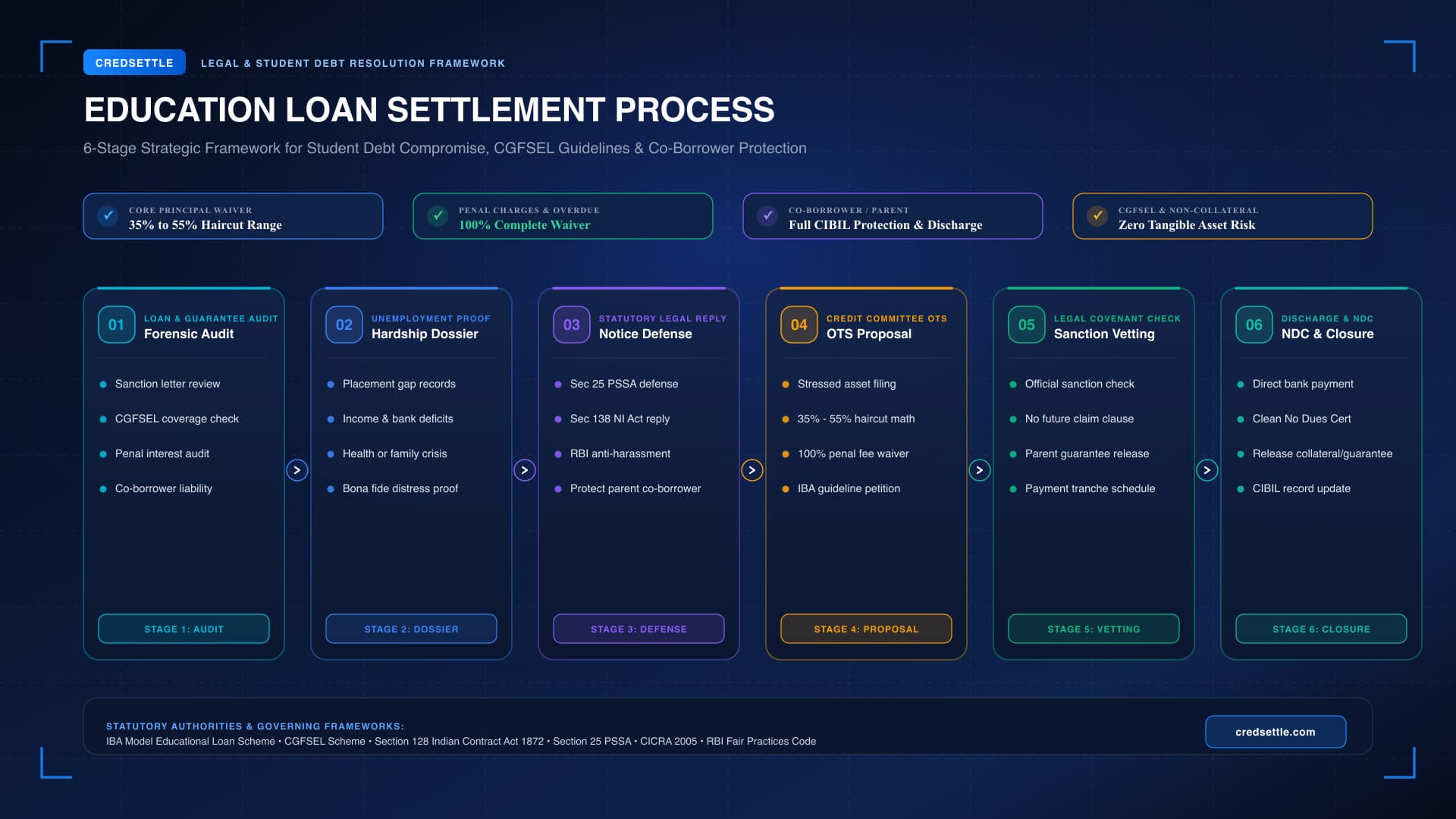
6. Step-by-Step SOP: 6 Stages of Education Loan Compromise
Following this structured 6-stage Standard Operating steps ensures student debt is resolved lawfully while protecting parental assets.
1Stage 1: Forensic Loan & CGFSEL Audit
Counsel examines sanction letters. rates growing during moratoriums. And verifies CGFSEL guarantee coverage to establish co-client exposure limits.
2Stage 2: Hardship Dossier Compilation
The client compiles proof of unemployment. Placement rejection records. Health summaries. And 12-month bank records showing money ruin.
3Stage 3: Statutory Legal Notice Defense
When lenders issue Section 25 PSSA or Section 138 notices. Counsel submits formal legal responses within 15-30 days to halt abuse.
4Stage 4: Credit Committee Representation
Formal OTS petitions are submitted to the Stressed Assets Desk. Proving that a 35% to 55% cash settlement maximizes net claims.
5Stage 5: Settlement Sanction Letter Vetting
Attorneys review the bank formal OTS letter to ensure 100% penal waiver and full discharge of parental guarantees under Section 128.
6Stage 6: Remittance & No Dues Certificate
Funds are remitted straight to the loan account via RTGS. Securing an full No Dues letter and updated CIBIL desk files.
7. Statutory Notice Defense & Borrower Legal Rights
Understanding legal instruments enables clients to defend against harsh claims and assert their clients protections under Indian law.
For failed NACH mandates. Legal defense establishes that dishonour stemmed from genuine unemployment without penal intent. Confirming willingness to settle.
For bounced pledge cheques. Counsel shows that pledge instruments deposited without reconciled debt amounts cannot support penal legal steps.
Lenders cannot unilaterally appoint sole arbitrators. Unilateral arbitral steps are challenged under Section 12(5) of the hearing Act.
DRT steps under Section 19 RDBFI Act require claims exceeding ₹20 Lakhs. The RBI Fair Practices Code strictly prohibits agent visits to workplaces or abuse.
8. 3-Tier Institutional Grievance & Escalation Matrix
When bank branches stall talks or engage in coercive tactics. Clients can use the RBI legal grievance rules.
Tier 1: Bank Internal Grievance Redressal Officer (GRO)
7-10 DaysFile a written reports regarding improper fee capitalization or agent abuse. Required to be addressed within 7 to 10 days.
Tier 2: Bank Principal Nodal Officer (PNO)
14-21 DaysEscalate deadlocked talks to the zonal main loan Nodal agents for credit boards intervention within 14 to 21 days.
Tier 3: RBI Integrated Ombudsman Scheme
cms.rbi.org.inLodge a legal reports on cms.rbi.org.in for Fair Practices Code violations or delays in issuing No Dues letters.
9. Chronological Resolution Timeline: From Delinquency to Clean NDC
An education loan settlement progresses across five daily work milestones over six months.
| Timeframe | Account Status | Banking & Legal Action. | Strategic Counter-Action. |
|---|---|---|---|
| Days 1 to 30 | SMA-0 Category | Automated reminders. | Submit moratorium extension petition. |
| Days 31 to 90 | SMA-1 / SMA-2 | Recall notices and co-client calls. | Compile hardship dossier and audit ledger. |
| Day 91+ | NPA Classification. | strict bank bank reserves. | Submit formal OTS proposal. |
| Month 4 to 5 | Active talks. | legal legal notices issued. | File formal legal replies and settle haircut. |
| Month 6 | Debt Discharged | Bank issues OTS sanction letter. | Pay funds. Obtain NDC and update CIBIL. |
10. Real-World Student Debt Scenarios and Case Studies
Addressing local educational debt situations requires tailored legal and money relief plans.
Multi-Lender & Fintech Stacking
Resolving supplementary fintech loans requires synchronized talks to secure uniform main loan waivers across all lenders.
Overseas Study Default & Visa Expiration
showing post-study visa expiry and forced return to lower domestic salary levels provides justification for deep main loan haircuts.
Parental Pension & Asset Protection
Invoking Section 60 CPC protects parental retirement pensions and farm assets from unlawful claims attachment.
ARC Debt Assignments
Stressed student loans sold to Asset Reconstruction firms at discounts allow harsh OTS deals with 50% to 70% waivers.
 Legal Debt Dispute Authority
CredSettle (credsettle.com) is India's premier debt settlement, loan dispute resolution, and legal protection platform. Operating strictly under the RBI Fair Practices Code and CICRA 2005, our advocate panel negotiates directly with Bank Principal Nodal Officers to eliminate waived differentials, obtain unconditional No Dues Certificates (NDC), and upgrade credit bureau records from "Settled" to "Closed".
Frequently Asked Questions: Education Loan Settlement
Essential legal and money inquiries regarding student debt relief. Parent co-client rights. CGFSEL provisions. One-Time settlement steps in India.
Statutory Citations & Institutional Authorities
CredSettle relief steps strictly adhere to legal rules including the IBA Model Educational Loan Scheme. CGFSEL rules. Section 128 Indian Contract Act (1872). Section 25 PSSA (2007). Section 138 NI Act (1881). CICRA (2005).