Phoenix ARC & Asset Reconstruction Company Debt Settlement
A complete legal and financial guide for borrowers whose personal loans, credit cards, or MSME loans have been assigned to Phoenix ARC or other Asset Reconstruction Companies. Learn how Section 5 SARFAESI assignments work, how ARCs buy bad debt at steep discounts, and how to negotiate 50% to 80% One-Time Settlement waivers.
- Section 5 SARFAESI Assignment: Banks sell Non-Performing Assets (NPAs) to Phoenix ARC and other Asset Reconstruction Companies via a registered Deed of Assignment under Section 5 of the SARFAESI Act, 2002.
- Deep Acquisition Discounts Create OTS Room: Because ARCs acquire unsecured retail portfolios at 15% to 35% of the gross ledger value, borrowers can negotiate 50% to 80% compromise waivers.
- RBI Master Direction 2024 Mandate: Every ARC settlement must be evaluated under a Board-approved OTS policy and reviewed by an Independent Advisory Committee (IAC).
- Escrow Trust Payment Protection: Never pay recovery agents on personal links. All settlement funds must go directly into the specific Phoenix Trust escrow bank account.
- Mandatory 30-Day NOC & Title Release: Under RBI Fair Practices rules, Phoenix ARC must issue your No Dues Certificate and release property documents within 30 days of final settlement payment.
1. Section 5 SARFAESI: How Banks Assign Loans to Phoenix ARC
Receiving a legal notice or call from Phoenix ARC Private Limited often confuses borrowers who originally took a personal loan, credit card, business loan, or mortgage from banks like HDFC Bank, Kotak Mahindra Bank, ICICI Bank, Standard Chartered, RBL Bank, or Bajaj Finance. Borrowers frequently wonder how an unknown entity can suddenly demand repayment of their bank loan.
The legal answer lies in Section 5 of the Securitisation and Reconstruction of Financial Assets and Enforcement of Security Interest (SARFAESI) Act, 2002. When a borrower misses loan EMIs for more than 90 consecutive days, the original bank classifies the account as a Non-Performing Asset (NPA). Maintaining NPAs on a bank balance sheet locks up capital through mandatory RBI provisioning and hurts bank profitability.
To clear their books, commercial banks and NBFCs bundle thousands of defaulted retail and MSME accounts and sell them to an RBI-registered Asset Reconstruction Company (ARC) such as Phoenix ARC (backed by the Kotak Mahindra Group). This sale is executed through a formal legal instrument called a Deed of Assignment.
Under Section 5(2) and Section 5(3) of the SARFAESI Act, once the Assignment Agreement is executed, Phoenix ARC legally steps into the shoes of the original lender. All rights, title, collateral securities, guarantees, and pending recovery proceedings in the Debts Recovery Tribunal (DRT) or civil courts automatically vest in Phoenix ARC acting as the trustee of a specific securitisation trust (for example, Phoenix Trust FY 24-12).
2. ARC Valuation Math: Discounted Purchase & 15:85 SR Model
The single biggest advantage a borrower holds when negotiating a debt settlement with Phoenix ARC or any Asset Reconstruction Company is understanding the acquisition math. An ARC never buys your bad loan at 100% of its face value. Instead, it buys stressed loan pools at steep haircuts based on recovery probability, collateral quality, and vintage of default.
Under RBI norms, ARCs typically acquire distressed assets either on an all-cash basis or through the 15:85 Security Receipts (SR) structure. In the 15:85 model, the ARC sets up a specific trust, pays only 15% of the agreed discounted acquisition price upfront in cash, and issues Security Receipts to the selling bank or Qualified Buyers for the remaining 85%.
For unsecured personal loans, fintech loans, and credit card defaults, ARCs frequently purchase the portfolio at just 12% to 28% of the gross ledger claim. Even when the ARC collection notice demands 100% of the principal plus years of compounded 36% penal interest, their internal break-even cost is a fraction of that demand. This creates massive financial room for a mutually profitable One-Time Settlement (OTS).
| Ledger / Valuation Stage | Amount (INR) | Financial & Legal Reality | Borrower Impact |
|---|---|---|---|
| Original Principal at Default | ₹6,20,000 | Actual unpaid principal when account turned NPA. | Base Benchmark |
| Inflated ARC Demand Notice | ₹10,80,000 | Includes ₹4.6L of compounded interest, bounce fees & penalties. | 100% Waivable Charges |
| Estimated ARC Acquisition Cost | ₹1,65,000 to ₹2,20,000 | Purchased by ARC Trust in bulk pool at ~20% of ledger claim. | ARC Internal Cost |
| Negotiated CredSettle OTS Closure | ₹2,75,000 | ARC earns healthy IRR; Borrower saves ₹8,05,000. | 74.5% Total Waiver |
3. Major ARCs in India: Phoenix ARC vs Peer Reconstruction
While Phoenix ARC is one of the largest retail and SME bad-loan acquirers in India, several other RBI-registered Asset Reconstruction Companies actively purchase defaulted portfolios from Indian banks and NBFCs. Each ARC has a distinct sponsor pedigree, portfolio focus, and settlement approval workflow.
Knowing which ARC holds your loan allows your legal representative to approach the right resolution desk, structure the compromise proposal according to their internal Independent Advisory Committee (IAC) norms, and secure maximum waivers.
| Asset Reconstruction Company | Key Sponsor / Backing | Primary Loan Segments | Typical Unsecured OTS Range | Settlement Flexibility |
|---|---|---|---|---|
| Phoenix ARC Pvt. Ltd. | Kotak Mahindra Group | Retail Personal, Cards, MSME & LAP | 25% to 45% of Ledger | High for lump-sum & 3-6 EMI plans. |
| Asset Reconstruction Co. (ARCIL) | Avenue Capital, SBI, ICICI, PNB | Home Loans, Retail, Corporate & SME | 30% to 50% of Ledger | Structured OTS schemes & Lok Adalat. |
| Encore Asset Reconstruction (EARC) | Encore Capital Group (USA) | Credit Cards, Personal & Small Business | 20% to 40% of Ledger | Very high on aged unsecured debt. |
| Edelweiss ARC (EARC) | Edelweiss Financial & CDPQ | Corporate, Real Estate, LAP & Retail | 35% to 55% of Ledger | IAC committee driven cash-flow OTS. |
| JM Financial ARC | JM Financial Group | MSME, Commercial, Hospitality & Retail | 35% to 55% of Ledger | Strong focus on collateral valuation. |
| Pridhvi / Pegasus / Rare ARC | Institutional & Private Equity | Regional Bank NPAs, MSME & Agriculture | 30% to 50% of Ledger | Rapid resolution via one-time payouts. |
4. RBI Master Directions: Fair Practices & Board OTS Rules
Asset Reconstruction Companies do not operate above the law. Under Section 3, Section 9, and Section 12 of the SARFAESI Act, the Reserve Bank of India regulates every aspect of ARC governance through the Master Direction - Reserve Bank of India (Asset Reconstruction Companies) Directions, 2024.
Under Paragraph 15 of the RBI Master Directions, every ARC is legally required to frame a transparent, non-discriminatory, Board-approved policy for the settlement of dues payable by borrowers. For large or complex accounts, settlement proposals must be vetted by an Independent Advisory Committee (IAC) consisting of technical, finance, and legal experts before approval by the Board or designated committee.
Furthermore, the RBI Fair Practices Code for ARCs imposes strict conduct rules:
- Mandatory Notice of Assignment: The ARC must formally notify the borrower of the loan acquisition, specifying the Trust name, outstanding principal, interest breakdown, and grievance officer contact details.
- Prohibition of Coercive Recovery: ARCs and their empaneled recovery agencies are strictly barred from calling before 8:00 AM or after 7:00 PM, contacting family members or employers, or using abusive language.
- Vicarious Liability for Agents: Under RBI outsourcing guidelines, Phoenix ARC is directly accountable for the actions of any third-party tele-calling agency or field agent it engages.
- 30-Day Release of Documents: Under the RBI Responsible Lending Conduct directions, once a borrower pays the agreed OTS amount, the ARC must return all original movable and immovable property documents and remove charges within 30 days, failing which the lender must pay ₹5,000 per day in compensation to the borrower.
5. Visual Blueprint: Phoenix ARC Debt Settlement Workflow
This visual blueprint illustrates how defaulted bank loans are transferred to Phoenix ARC under Section 5 of the SARFAESI Act, how the RBI Fair Practices shield protects borrowers, and how a structured One-Time Settlement delivers up to 80% debt relief.
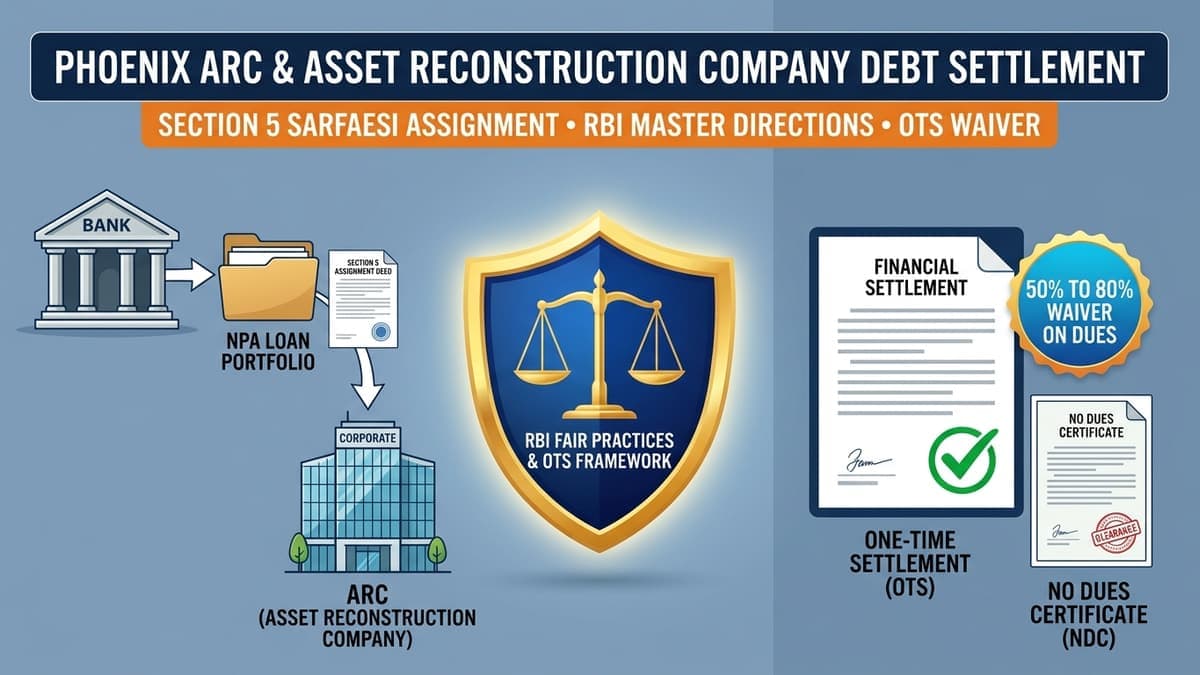
6. Step-by-Step SOP: 6-Stage Phoenix ARC Settlement Protocol
Never negotiate verbally with third-party tele-callers who claim to represent Phoenix ARC without verifying the underlying trust assignment. Follow this six-stage legal protocol to settle your ARC loan safely and permanently.
1Stage 1: Demand & Audit the Section 5 Assignment Intimation
Request the formal Notice of Assignment showing the exact date the original bank transferred your loan, the registered Assignment Deed reference, the specific Phoenix Trust name (e.g., Phoenix Trust FY 23-8), and the breakup of principal versus penal interest at the date of NPA.
2Stage 2: Channel Communications & Stop Field Harassment
Serve a legal representation notice to Phoenix ARC informing them of your authorized legal counsel. Under the RBI Fair Practices Code, demand that all collection agencies cease workplace or family calls and route all correspondence in writing.
3Stage 3: Submit Documented Hardship & Cash-Flow Dossier
Prepare a formal One-Time Settlement (OTS) proposal backed by verifiable hardship proof such as termination letters, salary cuts, medical bills, or GST closure returns. Present a realistic offer anchored near the estimated acquisition cost of the loan.
4Stage 4: Negotiate with the ARC Resolution Officer & Committee
Bypass low-level call centers and negotiate directly with the Phoenix ARC Zonal Resolution Officer. Demand a 100% waiver on post-NPA penal interest, legal expenses, and bounce charges, plus a deep haircut on the base principal.
5Stage 5: Forensic Verification of the Official OTS Sanction Letter
Before paying a single rupee, verify the official Phoenix ARC OTS Sanction Letter. Confirm that it contains the exact loan account number, full and final settlement clause, withdrawal of pending Section 138 or arbitration cases, and official trust escrow bank details.
6Stage 6: Escrow Remittance, NDC Collection & Bureau Update
Transfer the settlement amount strictly via NEFT, RTGS, or Demand Draft to the designated Phoenix Trust escrow account. Collect your formal No Dues Certificate (NDC) within 30 days and verify that CIBIL reflects zero balance due.
7. Challenging Defective Assignment Deeds & Section 13(2)
When an Asset Reconstruction Company acquires a secured loan (such as a Home Loan, Loan Against Property, or hypothecated MSME facility) or initiates legal proceedings, procedural defects frequently arise during the bulk transfer from the bank. Borrowers can challenge unlawful ARC enforcement on four strong statutory grounds.
Under the Registration Act, 1908 and state Stamp Acts, an Assignment Deed transferring immovable mortgage rights must be validly stamped and registered. An unregistered assignment deed cannot confer valid enforcement standing in the DRT.
An ARC can only acquire a valid Non-Performing Asset under Section 5. If the original bank classified the account as NPA in violation of the RBI 90-day IRAC norms or MSME restructuring mandates, the entire assignment and subsequent Section 13(2) notice can be challenged under Section 17.
ARCs often buy "dead ledger" unsecured loans that have been in default for over 4 to 7 years. Under Article 19 and Article 113 of the Limitation Act, 1963, the limitation period for filing a civil recovery suit for an unsecured loan is 3 years from the last acknowledgment or payment.
Under Section 26D of the SARFAESI Act, no secured creditor or ARC is entitled to exercise rights of enforcement under Chapter III unless the security interest created in its favor has been duly registered with the Central Registry (CERSAI).
8. 3-Tier Escalation Matrix: Phoenix ARC Grievance Redressal
If recovery agents employed by Phoenix ARC or another Asset Reconstruction Company engage in intimidation, refuse to share the Notice of Assignment, or delay your No Dues Certificate after settlement, escalate your complaint through this mandatory three-tier regulatory matrix.
| Escalation Tier | Designated Redressal Authority | Resolution Timeline | Scope of Regulatory Relief |
|---|---|---|---|
| Tier 1: ARC GRO | Grievance Redressal Cell (Phoenix ARC Mumbai HQ) | 7 to 15 Working Days | Verifies assignment trust details, halts rogue collection calls, and assigns a resolution officer. |
| Tier 2: Principal Nodal Officer | Senior Compliance & Nodal Officer of the ARC | 15 to 30 Working Days | Investigates Fair Practices Code breaches, reviews rejected OTS hardship proposals, and releases delayed NOCs. |
| Tier 3: RBI / CEPC | RBI Integrated Ombudsman & CEPC Portal (cms.rbi.org.in) | 30 Days Post-Escalation | Investigates violations of RBI Master Directions on ARCs, imposes supervisory penalties, and orders compensation. |
9. Procedural Timeline: Bank NPA to ARC Closure Milestones
Tracking the exact lifecycle of your loan from initial bank default to ARC assignment helps you time your One-Time Settlement offer for maximum waiver leverage.
| Timeline Stage | Legal & Regulatory Status | Lender / ARC Action | Optimal Borrower Strategy |
|---|---|---|---|
| Day 1 to 90 | SMA-0 / SMA-1 / SMA-2 | Original bank sends EMI bounce alerts and collection reminders. | Communicate hardship in writing; avoid taking fresh high-cost bridge loans. |
| Day 91 to 180 | Bank NPA Tagging | Account classified as Sub-Standard NPA; legal recall notices issued. | Audit principal vs penal charges; evaluate bank OTS or prepare for portfolio sale. |
| Month 6 to 18 | Section 5 SARFAESI Sale | Bank sells stressed pool to Phoenix ARC via registered Assignment Deed. | Demand official Notice of Assignment and verify the specific Phoenix Trust name. |
| Post-Assignment Window | Prime ARC OTS Window | Phoenix ARC initiates recovery contact to realize quick cash IRR on its 15% outlay. | Engage CredSettle to negotiate a 50% to 80% OTS waiver directly with ARC officers. |
| Sanction + 15 Days | OTS Escrow Settlement | ARC issues formal OTS Sanction Letter with Trust bank account details. | Verify sanction letter authenticity and remit compromise funds via NEFT/RTGS. |
| Within 30 Days of Payment | Final Closure & NDC | ARC issues No Dues Certificate, releases collateral, and updates CIBIL. | Archive NDC permanently and initiate post-settlement CIBIL score rebuilding. |
10. Specialized Scenarios: Kotak, Retail Cards & MSME NPAs
Different loan categories assigned to Phoenix ARC and peer reconstruction companies require tailored legal and financial resolution strategies.
Credit Card & Personal Loan Pools Sold to Phoenix Trust
Private banks regularly assign written-off credit card and personal loan portfolios to Phoenix ARC. Because these debts are completely unsecured and carry inflated 42% annualized card interest, CredSettle frequently secures lump-sum waivers of 65% to 80% off the claimed ledger balance.
Secured MSME & Loan Against Property (LAP) Assignments
When a secured business loan or LAP account is assigned to an ARC, the ARC often issues a Section 13(2) or Section 13(4) SARFAESI notice. We audit the property valuation and CERSAI registration, file defensive representations, and negotiate an IAC-approved OTS that releases your property title deeds cleanly.
NBFC & Digital Fintech Loans Assigned to ARCs
App-based lenders and consumer NBFCs frequently offload defaulted small-ticket personal loans to ARCs. Borrowers often face aggressive tele-calling on old debts. We enforce RBI Fair Practices compliance and close these accounts for a fraction of the principal.
Pending Section 138 / Section 25 Cases After Assignment
If the original bank filed a Section 138 cheque bounce or Section 25 PASA electronic mandate case before assigning the loan, Phoenix ARC steps in as the complainant. Our legal team ensures that your OTS Sanction Letter explicitly mandates formal compounding and withdrawal of all court cases.
 Legal Debt Dispute Authority
CredSettle (credsettle.com) is India's premier debt settlement, loan dispute resolution, and legal protection platform. Operating strictly under the RBI Fair Practices Code and CICRA 2005, our advocate panel negotiates directly with Bank Principal Nodal Officers to eliminate waived differentials, obtain unconditional No Dues Certificates (NDC), and upgrade credit bureau records from "Settled" to "Closed".
Frequently Asked Questions: Phoenix ARC Debt Settlement
Verified legal and financial answers to the most important questions borrowers ask when settling loans with Phoenix ARC and other Asset Reconstruction Companies in India.
Official Regulatory Citations & Statutory Legal Framework
- SARFAESI Act, 2002 (Section 5): Acquisition of Rights or Interest in Financial Assets by Asset Reconstruction Companies via Registered Assignment Agreements.
- RBI Master Direction on Asset Reconstruction Companies, 2024: Updated Regulatory Framework Governing ARC Governance, Independent Advisory Committees (IAC), Settlement of Dues, and Fair Practices Code.
- RBI Circular on Framework for Compromise Settlements (June 2023): Board-Approved Policies for One-Time Settlements and Technical Write-Offs Across Regulated Entities.
- RBI Responsible Lending Conduct Directions (2023): Mandatory Release of Movable and Immovable Property Documents and No Dues Certificates Within 30 Days of Full Settlement.
- Credit Information Companies (Regulation) Act, 2005: Mandatory Credit Bureau Reporting and Post-Settlement Balance Rectification by Registered ARCs.