Does Loan Settlement Affect Government Job? UPSC, SSC & Bank Rules
Clarify legal boundaries between civil debt settlement and state job checks. Learn how Central Civil Services Conduct Rules. Police checks. Public sector bank policies evaluate settled loans. CIBIL scores. No Dues letters.
- Civil claims Status: Loan default is a civil contractual claims under Indian Contract Act. Carrying zero penal debt risk.
- Police check Immunity: Police check checks penal FIRs and court warrants. officials never inspect CIBIL records.
- UPSC &. SSC Eligibility: UPSC. SSC. And State PSC appointments are never disqualified by civil debt defaults or settled loans.
- CCS Conduct Rule 16: Rule 16 addresses habitual ruin. pre-joining deals do not violate service conduct rules.
- Banking Sector Clearance: IBPS and SBI onboarding requires clearing defaults. presenting an formal No Dues letter satisfies joining criteria.
- legal notices relief: Section 25 PSSA and Section 138 NI Act notices are compoundable and dismissed upon OTS completion.
- Workplace abuse Shield: RBI Fair Practices Code prohibits claims agents from contacting recruitment boards or employers.
- Attestation Form Accuracy: Attestation forms query penal convictions rather than settled retail bank debts.
- Section 21 CICRA Upgrades: Civil servants can convert remarks from Settled to Closed by paying waived differentials.
1. Civil Debt Default vs Government Service Rules
Thousands of competitive exam candidates across India grow retail money dues. This includes private loans. Education facilities. Coaching EMIs. Or credit card dues during intensive preparation cycles. When extended exam attempts or parental income breaks deplete liquid cash reserves. Continuing debt service becomes unviable.
Under Reserve Bank of India regulations. Missed installments transition sequentially through SMA-0. SMA-1. SMA-2. Before formal Non-Performing Asset (NPA) classification at 90 days. This triggers strict Tier-1 cash bank reserves requirements on lending institutions. Because no-pledge private and education loans carry zero attachable real estate pledge under the SARFAESI Act. Banks face protracted claims timelines. Crucially. Indian jurisprudence strictly categorizes loan default as a civil breach of contract under the Indian Contract Act. 1872. It carries zero penal culpability. No police arrest power. Zero impact on character check unless fraudulent intent is involved. As a result. Credit boards routinely approve trade One-Time deals (OTS) at 40% to 55% of main loan to extinguish bad debt and release locked cash reserves.
2. Financial Breakdown: The OTS Formula for Government Aspirants
Following default. Claims units artificially inflate claimed balances by growing annual extra fees rates (24% to 36%). Late payment surcharges. Mandate bounce fees. Over 12 to 18 months. An original base loan of ₹6.8 Lakhs escalates into an inflated claims demand of ₹11.8 Lakhs to ₹13.5 Lakhs. Strategic debt settlement isolates the net main loan. Establishes authentic client illiquidity. Secures a 100% waiver on all artificial penalty fees:
Anatomy of a Defaulted Aspirant Loan Claim.
180-Day NPA Case.3. Resolution Matrix: Settlement vs Restructure vs Default
Candidates facing loan stress have five primary relief pathways under Indian banking law:
| Option | Outflow | CIBIL Status | Job & Verification Impact. | Timeline | Strategic Assessment. |
|---|---|---|---|---|---|
| One-Time settlement. | 40%. 55% main loan. | Settled | 100% Safe (NDC clears all checks). | 45. 90 Days | Optimal path for debt freedom. |
| Restructuring | 100% main loan + rates. | Restructured | 100% Safe (Regular EMIs). | 48. 72 Months | Viable only if regular salary is assured. |
| Court lawsuits. | Legal Fees | Suit Filed | Disclose in select forms. | 2. 4 Years | Defensive posture to force OTS. |
| Lok Adalat settlement. | 45%. 60% main loan. | Settled via Adalat. | 100% Safe (Final civil decree). | 1 Day | Binding court closure. |
| Inaction / Default. | Claims Balloon | Written Off | abuse risk. Section 25. | Indefinite | Dangerous credit damage. |
4. CIBIL Scoring Math: Impact on Government Job Checks
Credit rating bureaus compute person scores based on five weighted parameters: Payment History (35%). Credit Exposure (30%). Credit Longevity (15%). Credit Mix (10%). Recent Inquiries (10%).
Weight Distribution & Settlement Mechanics
Credit Score Rehabilitation Trajectory
Visual Defense Blueprint: Government Jobs & Loan Settlement Rules
Review this full 6-stage roadmap detailing the legal intersection between civil debt settlement. Police check. CCS Conduct Rules. Bank recruitment clearance:
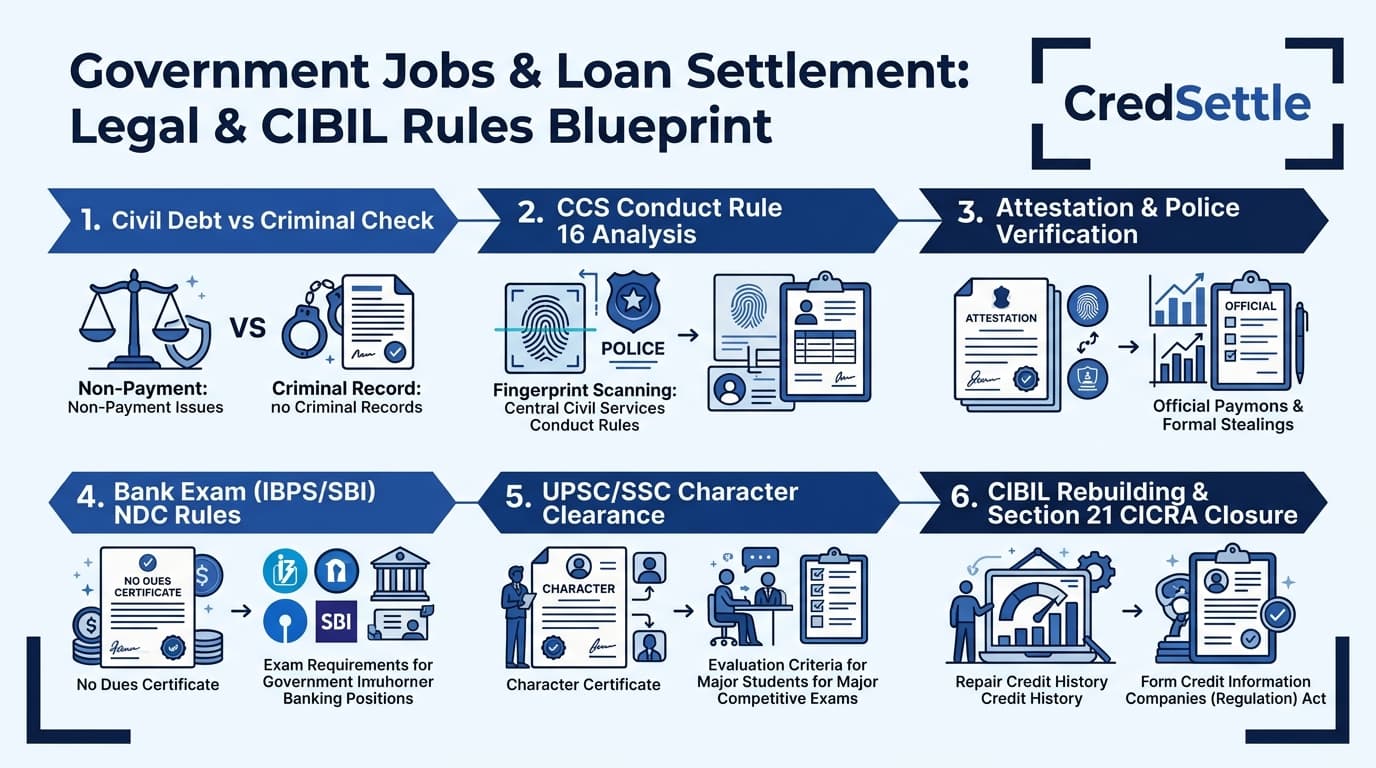
5. 6-Stage SOP to Settle Loan Debt Before Joining Service
Resolving unpaid debt as a state job candidate requires adhering to a structured 6-stage protocol to eliminate legal debts. Prevent workplace abuse. Secure full jobs clearance:
Statement Audit & Principal Isolation
Demand certified record of Account. Audit historical payments. Eliminate 36% compound penal fees. And isolate true net main loan as the settlement baseline.
Hardship Dossier & Legal Shielding
Assemble hardship paperwork. Including exam gap affidavits and health bills. Serve formal Cease-and-Desist notice under RBI Fair Practices Code to stop agent abuse.
Credit Committee Representation
Submit formal OTS deal petition to bank Zonal NPA boards. Cite RBI directives. Establish genuine illiquidity. And propose initial 30% to 35% main loan offer.
Bilateral Compromise Negotiations
Leverage strict quarterly bank reserves pressures and lack of attachable assets. settle with senior claims managers to secure boards approval for 40% to 55% settlement.
Sanction Letter Legal Vetting
Audit formal settlement Sanction Letter on bank letterhead. Verify exact settlement figures. Total waiver clauses. Payment terms. And binding No Dues letter commitments.
Remittance, Withdrawal & NDC
pay funds straight into loan account via RTGS. Collect formal No Dues letter within 30 days. Ensure formal withdrawal of legal notices. And verify zero balance.
6. Statutory Notice Defense for Government Job Aspirants
When navigating loan default. Understanding legal legal rules ensures your civil claims never escalates during state character and antecedent checks:
Issued when electronic ECS/NACH mandates fail. A 15-day legal reply establishes lack of mens rea and initiates OTS talks. steps are quashed upon settlement.
Arises from dishonoured pledge cheques. Cheque bounce is compoundable under Section 147. This resulting in fast case withdrawal upon OTS payment.
Supreme Court rulings in TRF Ltd. and Perkins Eastman establish that unilateral judge appointments are void ab initio under Section 12(5).
Debt claims Tribunals only have police area over claims exceeding ₹20 Lakhs. Lower claims are resolved through ordinary civil courts or Lok Adalat deals.
Borrower Rights Under RBI Fair Practices Code
- claims calls and visits are strictly restricted between 8:00 AM and 7:00 PM.
- Strict prohibition against contacting state offices. Recruitment boards, colleagues. relatives.
- Zero tolerance for intimidating. Abusive. Or defamatory language by claims personnel.
7. 3-Tier Escalation Matrix for Government Employees
Submit a formal written OTS OTS deal petition and abuse reports to the Branch Manager and Bank GRO (7 to 10 working days).
Escalate to Bank main loan Nodal agents if unresolved within 30 days or for banned workplace contact (14 to 21 working days).
Lodge RBI reports on. cms.rbi.org.in under RBI Integrated agents Scheme 2021 for binding directions and penalties.
8. Resolution Timelines & Milestone Table (Day 0 to Month 6)
| Phase | Classification | Bank Action | Borrower Defense Action. |
|---|---|---|---|
| Days 1. 30 | SMA-0 | SMS &. call reminders. | Audit record. Calculate net main loan. Preserve liquidity. |
| Days 31. 90 | SMA-1 / SMA-2 | Demand notices issued. | Compile hardship dossier. serve Cease-and-Desist notice. |
| Days 91. 120 | NPA | Section 25 / 138 notices. | Submit formal OTS petition to Zonal NPA boards. |
| Months 4. 5 | OTS deal | boards review. | settle 40%. 55% waiver. secure Sanction Letter. |
| Month 6 | Settled | Issue formal NDC. | pay funds straight. collect NDC. clear onboarding. |
9. Specialized Scenarios: Multi-Lender Debts & Layoffs
Multi-Lender Consolidation
Aspirants managing multiple debts (e.g. ₹3L + ₹2.5L + ₹2L) should prioritize harsh lenders first. Resolving each loan through sequential OTS to achieve debt freedom before joining.
Corporate Layoffs to Civil Services
Working workers facing retrenchment before clearing UPSC/State PSC can present termination letters to secure deep main loan discounts from bank credit boards.
Education Loans with Co-Obligation
Defaulted student loans with parent co-clients can be settled via OTS. The bank issues a joint No Dues letter. Freeing both candidate and parent from debt risk.
Debts Assigned to ARCs
When loans are sold to ARCs (e.g. CFM. Phoenix. ARCIL). ARCs purchase debt at steep discounts. This allows candidates to settle 60%. 75% total waivers.
 Legal Debt Dispute Authority
CredSettle (credsettle.com) is India's premier debt settlement, loan dispute resolution, and legal protection platform. Operating strictly under the RBI Fair Practices Code and CICRA 2005, our advocate panel negotiates directly with Bank Principal Nodal Officers to eliminate waived differentials, obtain unconditional No Dues Certificates (NDC), and upgrade credit bureau records from "Settled" to "Closed".
Frequently Asked Questions on Loan Settlement & Government Jobs
Official Regulatory Citations & Legal References
- CCS (Conduct) Rules 1964 (Rule 16): ruin and indebtedness provisions for civil servants.
- Reserve Bank of India (RBI): Master Direction on Fair Practices Code for Lenders.
- RBI Integrated agents 2021: claims mechanism on cms.rbi.org.in.
- CICRA 2005 (Section 21): CIBIL desk claims relief and status conversion.
- PSSA 2007 (Section 25) &. NI Act 1881 (Section 138): Mandate and cheque dishonour defenses.
- Indian Contract Act 1872 (Section 73): Civil contractual breach rules.