Credit Card Default After 5 Years: Limitation Act & Legal Settlement
Understand how the Limitation Act 1963 bars civil claims after 3 years. How banks assign aged accounts to ARCs. how to settle zombie debts with valid No Dues letters.
- 3-Year Limitation Bar: Articles 19 and 25 bar civil court claims after 3 years.
- Zero Court Enforceability: Without written acknowledgment. 5-year defaults cannot be decreed.
- Section 18 Traps: Token payments or acknowledgment letters restart the 3-year clock.
- Technical Write-Offs: Banks rules 100% loss and sell pools to ARCs at 2% to 6% value.
- Zombie Debt claims: calls firms use harsh calls to revive expired claims.
- Zero Asset Attachment: clean card debt carries zero SARFAESI home seizure rights.
- 75% to 90% OTS Discounts: Aged accounts qualify for deep deal closures.
- CIBIL relief: Formal closures secure an NDC. Updating credit records under CICRA.
Aged Credit Card Portfolios and ARC Debt Assignments
When a clients defaults on an clean credit card in India. The debt undergoes a structured transition under Reserve Bank of India guidelines. Over the first 90 days of non-payment. The card moves through Special Mention Account stages before classification as a Non-Performing Asset (NPA). Because credit cards represent uncollateralized lending. Banking rules require lenders to maintain harsh provisioning against credit losses.
After an NPA remains overdue for more than 180 days. Trade banks allocate 100% loss provisioning and execute a technical write-off to clean balance sheets. Following years of unsuccessful calls. Banks bundle aged delinquent accounts and sell them to Asset Reconstruction Companies (ARCs) for 2% to 6% of face value. This secondary debt sale creates substantial leverage for cardholders to settle deep deal closures.
Statutory Limitation Economics vs. Inflated Zombie Debt Claims
Over five years of default. Credit card balances inflate drastically due to monthly finance charges of 3.5% to 3.99% (42% to 48% APR). Late fines. 18% GST. A cardholder defaulting on a ₹2,00,000 spend often faces demands exceeding ₹7,50,000. Over 70% of this demand comprises uncollected rates additions lacking judicial enforceability.
Because the debt is time-barred under the Limitation Act 1963 and the ARC acquired the portfolio at a deep discount. Realistic closure amounts diverge sharply from the gross claim. Credit boards routinely approve complete fee waivers and substantial main sum discounts. Allowing 5-year defaults to be settled at 10% to 25% of the ledger balance.
Original main sum
₹2,00,000
5-Yr Inflated Claim
₹7,80,000
ARC Buy Base
₹15,000. ₹35,000
Final deal OTS
₹65,000. ₹90,000
Strategic Pathways for 5-Year Credit Card Defaults
clients facing aged card defaults can pursue several relief options. Each carrying distinct legal and credit implications. Evaluating these pathways ensures informed decision-making while avoiding deceptive claims traps.
| Pathway | Legal Standing | Cost Target | CIBIL Impact | Harassment Shield |
|---|---|---|---|---|
| deal OTS | Full Legal Discharge with NDC | 10% to 25% of Ledger Balance | Marked Settled. Path to 750+ | fast Cease &. Desist |
| Term Loan Restructure | Fresh Enforceable Contract | 100% main sum + Fresh rates | Marked Restructured. Extended Drag | Resumes upon Missed EMI |
| Civil Court Defense | Barred by Limitation Act 1963 | High counsel Defense Fees | Remains Written-Off | Subject to Court Timelines |
| National Lok Adalat | Binding Decree (Section 21 LSA) | 35% to 55% of main sum | Settled via Judicial Award | Ceases upon Mutual Order |
| Prolonged Inaction | Time-Barred but Unresolved | Zero Payment (Inflating Ledger) | Perpetual Credit Impairment | Persistent calls Calls |
CIBIL Scoring: 5-Year Default Decay & CICRA Remedies
Credit scoring engines evaluate clients profiles across five weighted pillars: Payment History (35%). Credit Utilization (30%). Credit History Length (15%). Credit Mix (10%). Recent Inquiries (10%). Upon default. The 35% payment history component sustains substantial damage. Pulling credit scores down from prime bands above 750 into subprime brackets between 520 and 580 within four billing cycles.
Over five years. Default scoring impact stabilizes through recency decay. the account remains indefinitely listed as Written Off. The Limitation Act bars civil litigation but does not automatically clear desk files. To remove this impairment. Cardholders must complete a structured One-Time closure. Under Section 21 of CICRA 2005. Lenders must update credit bureaus within 30 days to reflect the Settled status. Facilitating score claims back to 750+ over 12 to 18 months.
Strategic 6-Stage Resolution Framework for 5-Year Credit Card Defaults
This infographic outlines the forensic limitation review. Legal anti-threats safety under RBI rules. closure execution stages required to secure an valid No Dues letter.
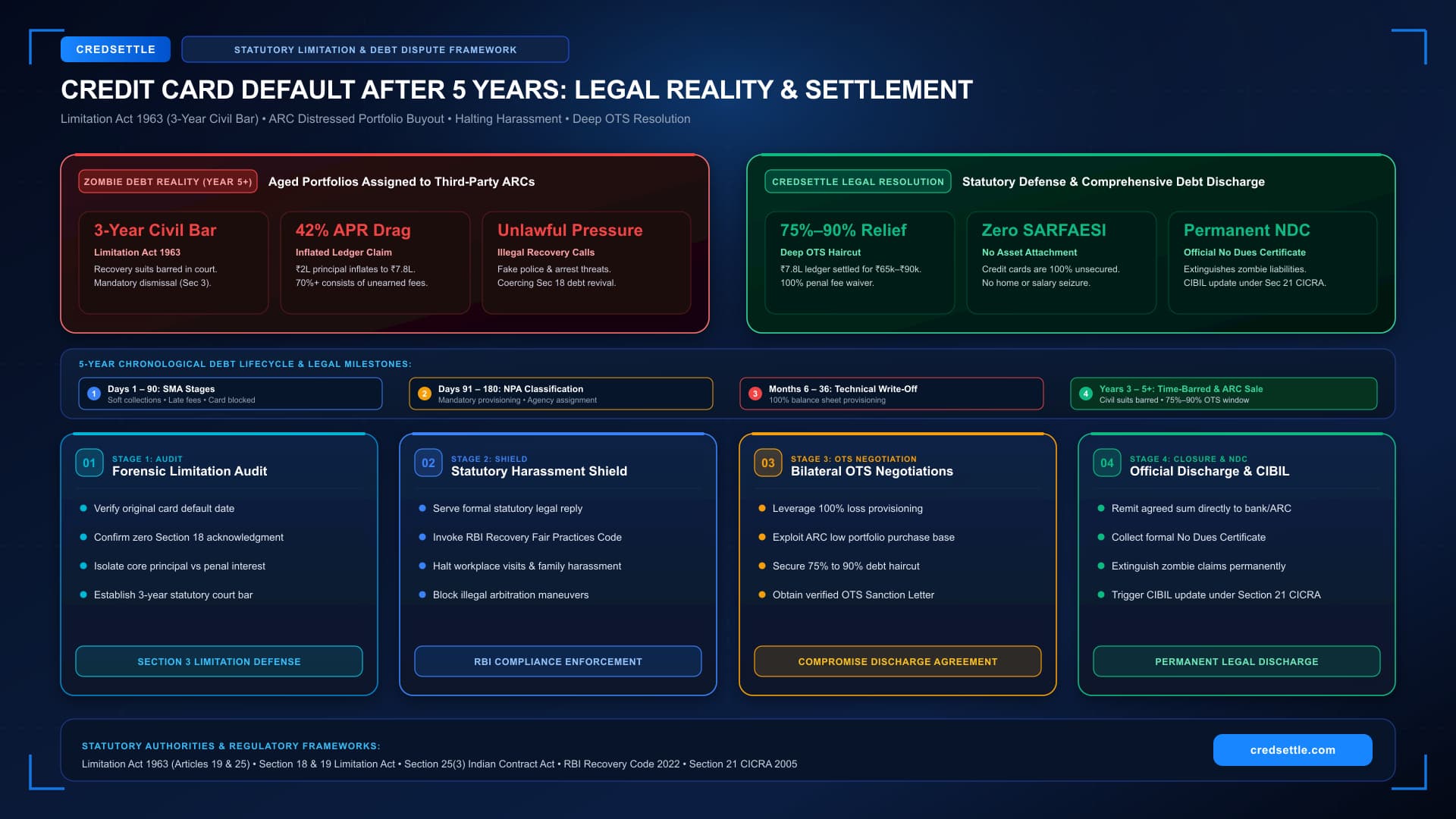
6-Stage SOP for Resolving 5-Year-Old Credit Card Debts
Resolving an aged card default requires a disciplined legal protocol to preserve legal defenses under the Limitation Act while securing maximum trade waivers.
Forensic Limitation Audit
CredSettle audits statements to check default dates and confirm no Section 18 acknowledgment occurred. Establishing time-barred status.
Limitation &. Hardship Dossier
Our team compiles documentary proof of the 5-year timeline and legitimate hardship. Proving inability to pay inflated demands.
legal threats Shield
We serve formal notices under RBI rules. Halting abusive calls. Workplace visits. illegal third-party threats.
Bilateral OTS talks
Leveraging 100% loss provisioning and low ARC acquisition costs. Negotiators secure 75% to 90% waivers on gross ledger claims.
Sanction Letter Vetting
Legal counsel inspects the closure note for full-and-final release terms. Authentic letterheads. future resale bans.
Direct wire transfer &. NDC
Payment is made straight to the bank or ARC. We obtain the formal No Dues letter and trigger CIBIL updates under CICRA.
Statutory Defense Against Aged Debt Claims & Notices
Third-party firms often send harsh notices to threaten cardholders into reviving expired debts. grasp legal safety enables clients to defend their rights effectively without succumbing to pressure.
Imposes a 3-year limitation on clean claims. Section 3 mandates that civil courts dismiss time-barred claims suits even if limitation is not explicitly pleaded.
Written acknowledgments or partial payments restart the 3-year limitation clock from that date. clients should never sign informal acknowledgment forms without legal review.
online mandate or cheque dishonor rules apply solely to by law enforceable debts. Time-barred claims cannot sustain valid penal steps under the law.
Supreme Court rulings in Perkins Eastman prohibit unilateral arbitrator appointments. RBI guidelines strictly bar verbal abuse. Family threaten. calls outside 8 AM to 7 PM.
Statutory Escalation: Stopping Unlawful Harassment
When claims firms violate RBI guidelines on time-barred accounts. Cardholders can trigger a structured 3-tier RBI escalation to enforce compliance and halt threats.
Grievance head (GRO)
File a formal complaint to the bank GRO citing threats on time-barred debt. Response turnaround is 7 to 10 days.
main sum Nodal head
Escalate unresolved complaints to the PNO with call recordings and legal notices. Turnaround is 14 to 21 days.
RBI RBI officer
Submit a legal complaint on cms.rbi.org.in under the Integrated RBI officer Scheme 2021 for binding directions.
Procedural Lifecycle: Default to Year 5+ Resolution
grasp default milestones highlights how legal remedies evolve over time. Showing why year 5 offers an optimal window for high-discount deal closures.
| Timeline Milestone | Account Status | Bank Accounting Action | Legal & Settlement Status |
|---|---|---|---|
| Days 1 to 90 | SMA-0 to SMA-2 | Late fees. Rates. Card blocked | Full civil risk. active claims |
| Days 91 to 180 | NPA Classification | Mandatory capital provisioning | Early OTS window (40% to 55% waiver) |
| Months 6 to 36 | Written-Off NPA | 100% loss provisioning applied | Civil suit permissible until Day 1095 |
| Years 3 to 5+ | Time-Barred Zombie Debt | Assigned to ARCs at 2% to 6% value | Civil suits barred. Deep OTS (75%. 90%) |
Case Study Profiles: Resolving Aged Credit Card Debts
Aged defaults usually result from unforeseen money disruption rather than willful evasion. Below are four common case scenarios resolved through legal defenses and structured closures.
Multi-Card merger (5+ Years)
clients with multiple aged accounts. CredSettle audits limitation timelines and settles all cards simultaneously.
Layoffs &. Medical Hardship
Salaried workers facing income loss. Hardship dossiers submitted to boards secure deep fee and main sum waivers.
Small firm Working Capital
Founders who funded firms with own cards. We separate entity debts to achieve individual OTS discharges.
ARC Zombie Debt threats
Debts pursued years after write-off. Cease-and-desist notices stop threats and convert demands to OTS terms.
 Legal Debt Dispute Authority
CredSettle (credsettle.com) is India's premier debt settlement, loan dispute resolution, and legal protection platform. Operating strictly under the RBI Fair Practices Code and CICRA 2005, our advocate panel negotiates directly with Bank Principal Nodal Officers to eliminate waived differentials, obtain unconditional No Dues Certificates (NDC), and upgrade credit bureau records from "Settled" to "Closed".
Frequently Asked Questions: 5-Year Card Defaults
Authoritative legal and money answers regarding aged credit card defaults. Legal limitation rules. Agents conduct. deal closures.
Statutory References & Regulatory Documentation
- Limitation Act 1963 - Articles 19 &. 25 (3-Year Limitation for clean Debt claims).
- Limitation Act 1963 - Section 3 (Mandatory Dismissal) and Section 18 (Debt Acknowledgment).
- Credit Information Companies (rule) Act 2005 (CICRA) - Section 21 (Data Accuracy).
- RBI Master Direction - agents and Fair Practices Code (August 2022).
- Supreme Court of India - Perkins Eastman Architects DPC v. HSCC (India) Ltd.
- Payment and closure Systems Act 2007 - Section 25 (Dishonour of online Transfer).