Can Bank Seize PPF and Sukanya Samriddhi for Loan Default?
A comprehensive legal guide for borrowers facing personal loan or credit card default. Understand Section 14A of the Government Savings Promotion Act, minor ownership rights in Sukanya Samriddhi, and how to stop illegal bank liens.
- Absolute Court Attachment Bar: Under Section 14A of the Government Savings Promotion Act, 1873, PPF balances cannot be attached by any court decree or lender.
- Child Sole Ownership in SSY: The minor girl child is the legal owner of the Sukanya Samriddhi account. A parent's loan default cannot touch the daughter's money due to lack of mutuality.
- Zero Banker Lien Under Section 171: Banks hold small savings deposits purely as government custodians. They cannot exercise a contractual banker's lien over public trust funds.
- India Post Transfer Remedy: If your creditor bank threatens to restrict your account, you have the legal right to transfer both PPF and SSY to your local Post Office branch.
- Criminal Intimidation Protections: Collection agents threatening to auction your family savings commit a punishable offence under Section 351 of the Bharatiya Nyaya Sanhita (BNS).
1. Statutory Immunity: PPF Legal Protection Framework
When borrowers face personal loan or card defaults, recovery agents make threats. They often claim the bank will seize your Public Provident Fund (PPF) balance. They also say court orders will take your family savings. These claims are completely false.
Parliament created the PPF scheme to build long-term savings for citizens. To safeguard these funds, the law gives PPF accounts total protection from loan recovery.
Section 14A of the Government Savings Promotion Act, 1873 protects your account. It states that no court decree can attach money in your PPF account for any debt.
Section 60(1)(k) of the Civil Procedure Code also shields government savings deposits. Whether your PPF is in SBI, HDFC, or the Post Office, no bank or court can seize your balance for a loan default.
2. Sukanya Samriddhi Shield: Minor Beneficial Ownership
The government launched Sukanya Samriddhi Yojana (SSY) to secure the future of the girl child. When a parent defaults on a personal loan, banks sometimes target the daughter's account. This action breaks Indian banking law.
Under the Sukanya Samriddhi scheme rules, the minor girl is the sole owner of the account. The parent acts only as a guardian until she turns 18. The deposited money does not belong to the parent.
Banking law follows the rule of mutuality. A bank can only set off debts between the same parties. A personal loan is the private debt of the parent. The bank cannot take a child's money to pay a parent's loan.
Section 14A of the Government Savings Promotion Act also protects SSY accounts from court orders. Any bank attempt to freeze or debit your daughter's account is an illegal act.
| Financial Asset / Claim Component | Bank Claim / Asset Value | Statutory Legal Immunity Status | Protected Balance |
|---|---|---|---|
| Public Provident Fund (PPF Account) | ₹6,50,000 | 100% Statutory Immunity (Sec 14A) | ₹6,50,000 (Fully Immune) |
| Sukanya Samriddhi Yojana (Daughter) | ₹4,20,000 | 100% Minor Trust Immunity (No Mutuality) | ₹4,20,000 (Fully Immune) |
| Defaulted Personal Loan Ledger Claim | ₹10,00,000 | Civil Debt: Negotiable under RBI OTS Rules | ₹3,20,000 (Negotiated OTS) |
| Net Family Savings Preservation | ₹10,70,000 Saved | 68% Loan Debt Waiver Secured via OTS | 100% Savings Shielded |
3. Asset Protection Matrix: Small Savings vs Bank Dues
Borrowers facing debt distress must know which savings have legal protection. Some assets stay safe by law, while ordinary accounts remain open to bank recovery.
Regular savings accounts and fixed deposits can face court attachment. In contrast, government welfare accounts enjoy full legal protection from bank claims.
| Asset Classification | Governing Legislation | Court Attachment Immunity | Banker Lien Vulnerability | Strategic Protection SOP |
|---|---|---|---|---|
| Public Provident Fund (PPF) | Govt Savings Act, 1873 (Sec 14A) | Absolute Immunity | Zero Lien Permitted | Maintain active or transfer to India Post. |
| Sukanya Samriddhi Yojana (SSY) | SSY Scheme, 2019 & Sec 14A | Absolute Immunity | Zero Lien Permitted | Sole minor ownership blocks parent debt. |
| Employees Provident Fund (EPF) | EPF Act, 1952 (Sec 10) | Absolute Immunity | Zero Lien Permitted | Disburse retirement funds to neutral bank. |
| Commercial Savings Account | Banking Regulation Act, 1949 | Vulnerable to Garnishee Order | Immediate Right of Set-Off | Do not hold surplus cash in creditor bank. |
| Fixed Deposits in Creditor Bank | Indian Contract Act, 1872 | Subject to Attachment | General Banker Lien (Sec 171) | Liquidate voluntarily for structured OTS deal. |
| Mutual Funds & Demat Shares | Civil Procedure Code, 1908 | Attachable by DRT or Court | Subject to Judicial Freezing | Protect through timely legal debt resolution. |
4. Banker Lien Defense: Contract Act vs Statutory Law
When borrowers challenge bank freezes on PPF or SSY accounts, banks often cite Section 171 of the Indian Contract Act. This section gives banks a general lien over customer money.
However, Indian courts have settled this issue clearly. In PPF and Sukanya accounts, the bank acts only as an agent for the Central Government. The funds belong to the government public account.
A bank's private contract rule cannot overrule a special law passed by Parliament. Specific welfare statutes always defeat general contract rules.
In Radhey Shyam Gupta v. Punjab National Bank, the Supreme Court ruled that social security funds keep their protection. Courts cannot attach them. In Central Bank of India v. V.R. Murthy, courts confirmed that banks cannot take child savings for a parent's loan.
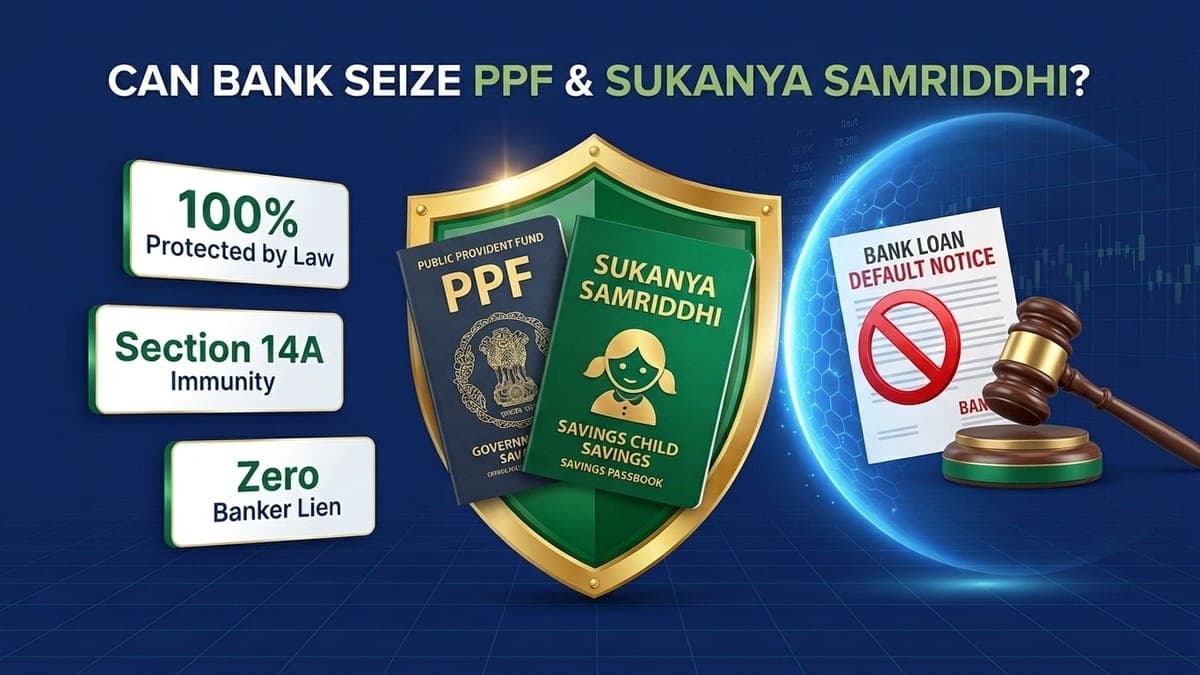
5. Visual Blueprint: PPF & Sukanya Account Protection
This clear visual roadmap shows how the law protects PPF and Sukanya accounts from bank recovery. It highlights key rights and safety steps.
6. Step-by-Step SOP: 6-Stage Account Defense Protocol
If a lender threatens your PPF or Sukanya Samriddhi account, follow this simple six-stage plan to secure your funds and settle your debt.
1Stage 1: Check Your Account Status
Review your passbook and online banking portal. Make sure your PPF and Sukanya accounts are active with clean KYC papers.
2Stage 2: Pay the Yearly Minimum Deposit
Deposit the basic ₹500 yearly into both PPF and SSY. This keeps both accounts regular and avoids default fees.
3Stage 3: Apply for Transfer to India Post
If your bank causes trouble, fill Form SB-10 to move your accounts to the Post Office. The bank must complete this transfer.
4Stage 4: Send a Formal Legal Warning
Send a formal lawyer notice to the bank zonal office. Cite Section 14A to warn them against illegal debits or freezes.
5Stage 5: Report Agent Threats to Police
If agents threaten your family or visit your home, record them. File a police complaint under BNS Section 351 for intimidation.
6Stage 6: Negotiate OTS and Get No Dues
With your savings safe, negotiate a 50% to 75% loan settlement with bank leaders. Pay the agreed sum and get your No Dues letter.
7. Statutory Defense: Criminal Intimidation Protections
Collection agents who make false threats about taking small savings break the law. You have strong legal remedies against unlawful pressure.
Threatening a borrower with false asset seizure or arrest is a crime under BNS law, punishable with jail time and fines.
RBI rules strictly forbid agents from harassing family members, using harsh words, or making false legal threats.
Banks act only as government agents for small savings. They cannot take government deposits to clear private debts.
The Supreme Court rules that basic social savings are part of the right to livelihood. No lender can take them without law.
8. 3-Tier Escalation Matrix: Grievance Redressal Steps
If branch managers or agents threaten your small savings, use the Reserve Bank of India grievance complaint process.
| Grievance Tier | Designated Banking Authority | Turnaround Time | Scope of Intervention & Relief |
|---|---|---|---|
| Level 1: GRO | Bank Grievance Redressal Officer | 7 to 10 Working Days | Halts unauthorized lien flags, stops agent threats, and registers formal hardship request. |
| Level 2: PNO | Principal Nodal Officer (Head Office) | 14 to 21 Working Days | Investigates wrongful set-off attempts, enforces statutory compliance, and initiates OTS. |
| Level 3: RBI Ombudsman | Reserve Bank Integrated Ombudsman | 30 Days Post-PNO | Issues binding directions via cms.rbi.org.in to reverse illegal holds and penalize rogue lenders. |
9. Procedural Timeline: Default Stages to Account Safety
Knowing loan default stages helps you protect your small savings before bank recovery actions start.
| Delinquency Window | Regulatory Asset Status | Lender Collection Actions | Strategic Borrower Response |
|---|---|---|---|
| Day 1 to 30 | SMA-0 | Automated payment reminder SMS and soft telephone calls. | Ensure PPF and SSY minimum annual deposits are up to date. |
| Day 31 to 60 | SMA-1 | Persistent calls and formal overdue payment reminders. | Consider initiating account transfer of PPF/SSY to India Post. |
| Day 61 to 90 | SMA-2 | Pre-NPA warnings and deployment of third-party recovery agents. | Submit written instructions citing Section 14A immunity to the bank. |
| Day 91 to 120 | NPA Tagging | Loan marked Non-Performing Asset; capital provisioning triggered. | Audit the loan ledger and eliminate inflated penal interest charges. |
| Day 121 to 180 | Prime OTS Window | Legal demand notices or arbitration letters dispatched. | Negotiate a 50% to 75% compromise settlement with CredSettle. |
| Month 6 and Beyond | Loss Asset / ARC | Debt written off or sold to Asset Reconstruction Company. | Execute settlement payment and secure the official No Dues Certificate. |
10. Specialized Scenarios: Bank Freeze & Account Transfer
Loan defaults can create disputes at your local bank branch. Here is how small savings rules work in practical cases.
Same-Bank Branch Administrative Freeze
If your bank blocks online access to your PPF or SSY, visit the branch with a formal letter. If they refuse to help, transfer the account to the Post Office.
Refusal to Accept Annual Minimum Deposits
A bank cannot refuse your yearly ₹500 deposit to force loan payments. This breaks government rules and can be sent to the RBI Ombudsman.
Death of Guardian Operating Sukanya Account
If the parent dies with loan debts, the bank cannot take the SSY balance. The other parent or guardian takes over the account with no loan liability.
Account Transfer to India Post (Post Office)
You can transfer PPF and SSY to the Post Office using Form SB-10. The Post Office does not issue personal loans, so your savings stay safe.
 Legal Debt Dispute Authority
CredSettle (credsettle.com) is India's premier debt settlement, loan dispute resolution, and legal protection platform. Operating strictly under the RBI Fair Practices Code and CICRA 2005, our advocate panel negotiates directly with Bank Principal Nodal Officers to eliminate waived differentials, obtain unconditional No Dues Certificates (NDC), and upgrade credit bureau records from "Settled" to "Closed".
Frequently Asked Questions: PPF & Sukanya Seizure
Clear, verified legal guidance addressing critical questions regarding Public Provident Fund protection, Sukanya Samriddhi immunity, illegal banker liens, and borrower rights.
Official Regulatory Citations & Statutory Legal Framework
- Government Savings Promotion Act, 1873: Section 14A, Statutory Protection Against Court Attachment of Small Savings Accounts.
- Public Provident Fund Scheme, 2019: Ministry of Finance Notification G.S.R. 915(E), Account Operations and Withdrawal Provisions.
- Sukanya Samriddhi Account Scheme, 2019: Ministry of Finance Notification G.S.R. 914(E), Minor Girl Child Beneficial Ownership Rights.
- Code of Civil Procedure, 1908 (CPC): Section 60(1), Proviso Clause (k), Non-Attachable Government and Statutory Deposits.
- Indian Contract Act, 1872: Section 171, Limits on Banker General Lien Over Government Welfare Schemes.
- Supreme Court of India Precedents: Radhey Shyam Gupta v. Punjab National Bank (2009) and Central Bank of India v. V.R. Murthy.