Vehicle Repossession by Bouncers: Legal Rulings and FIR
A comprehensive legal guide on Supreme Court rulings against musclemen, RBI recovery circulars, and police FIR procedures for unlawful car and bike repossession.
- Strict Ban on Bouncers: The Supreme Court has ruled that banks cannot deploy musclemen or recovery bouncers to seize vehicles.
- Mandatory Advance Written Notice: Financiers must issue a written default notice giving a 7 to 15 day cure period before repossession.
- Highway Snatching is Robbery: Intercepting vehicles on public roads and grabbing keys forcibly constitutes robbery and extortion under BNS.
- Criminal FIR Rights: Borrowers can file an immediate police FIR under Bharatiya Nyaya Sanhita Sections 126, 308, and 309.
- Interim Custody via Superdari: Courts can order the release of seized vehicles back to borrowers under Section 451/457 CrPC.
1. Supreme Court Rulings: Ban on Repossession Bouncers
When a borrower defaults on car loan EMIs, financial institutions often hire external collection agencies. These agencies frequently send private musclemen or bouncers to intercept cars on public roads and seize keys by force. The Supreme Court of India has unequivocally condemned and banned this practice.
In the landmark judgment of Manager, ICICI Bank Ltd. v. Prakash Kaur (2007) 2 SCC 711, the Supreme Court held that India is governed by the rule of law. The court ruled that banks cannot employ goondas, bouncers, or physical musclemen to forcibly repossess hypothecated vehicles. Banks must follow legal recovery procedures rather than taking the law into their own hands.
This legal principle was reinforced in Citicorp Maruti Finance Ltd. v. S. Vijayalaxmi (2012) 1 SCC 1. A three-judge bench of the Supreme Court held that a hire-purchase or hypothecation agreement does not permit lenders to use physical force. Even when a contract permits repossession upon loan default, the lender must follow due process of law. Seizing a vehicle through extra-judicial muscle power is illegal and unconstitutional.
Similarly, in Magma Fincorp Ltd. v. Rajesh Kumar Tiwari (2020) 10 SCC 399, the Supreme Court held that advance written notice is an indispensable condition precedent before repossession. In 2023, the Patna High Court in Dhananjay Kumar v. State of Bihar imposed heavy penalties on finance companies for seizing commercial vehicles with musclemen, observing that forcible vehicle interception on highways amounts to dacoity and extortion.
2. RBI Repossession Guidelines & Fair Practices Protocol
The Reserve Bank of India has issued comprehensive guidelines governing vehicle repossession under the Fair Practices Code for banks and Non-Banking Financial Companies (NBFCs). These guidelines establish strict procedural guardrails that lenders must satisfy before touching any hypothecated asset.
Every bank and NBFC must maintain a Board-approved vehicle repossession policy. The terms of repossession, including notice periods, valuation procedures, and sale protocols, must be clearly communicated to the borrower in the loan agreement. Unannounced or stealth seizures are strict regulatory violations.
| Procedural Stage | Mandatory Lawful Process | Illegal Practice by Bouncers | Legal Protection Status |
|---|---|---|---|
| Pre-Repossession Notice | Written notice with 7 to 15 days cure window. | Zero notice; sudden road interception. | Violation of Due Process |
| Agent Credentials | Certified DRA agents with ID and bank letter. | Unidentified bouncers in private clothes. | Breach of RBI DRA Rules |
| Time & Location of Seizure | 08:00 AM to 07:00 PM at registered address. | Night raids, highway ambush, office parking. | Illegal Harassment Bar |
| Inventory & Handover | Formal surrender sheet and inventory of goods. | Keys snatched; vehicle towed with valuables. | Theft & Criminal Misappropriation |
| Pre-Sale Redemption | Pre-sale notice allowing vehicle redemption. | Distress yard auction without intimation. | Right to Settle / Redeem |
3. Repossession vs Robbery: Legal Line Under Penal Law
Borrowers often ask whether a financier has the right to repossess a vehicle because the registration certificate (RC) contains a hypothecation endorsement. It is vital to understand the boundary between civil repossession rights and criminal offences under Indian law.
A hypothecation agreement creates a charge over the vehicle in favor of the lender. However, it does not transfer ownership or physical possession to the bank. Until a court or an authorized legal forum passes an order, lawful physical possession remains with the registered owner.
When recovery agents stop a driver on the road, block the car, threaten bodily injury, and snatch the keys, their actions cross from civil debt collection into serious criminal conduct. Under the Bharatiya Nyaya Sanhita, 2023 (and earlier Indian Penal Code), this conduct satisfies the statutory ingredients of multiple cognizable offences.
| Offence Category | IPC Section | BNS 2023 Section | Offence Definition | Punishment & Impact |
|---|---|---|---|---|
| Wrongful Restraint | Sec 339 / 341 | Sec 126 | Blocking a vehicle or driver on a public road. | Imprisonment up to 1 month and fine. |
| Criminal Force & Assault | Sec 350 / 352 | Sec 130 / 131 | Pushing, grabbing the driver, or pulling them out. | Imprisonment up to 3 months and fine. |
| Extortion | Sec 383 / 384 | Sec 308 | Demanding money or car keys under threat of injury. | Imprisonment up to 3 years and fine. |
| Robbery | Sec 390 / 392 | Sec 309 | Forcibly taking the vehicle causing fear of hurt. | Rigorous imprisonment up to 10 years. |
| Theft | Sec 378 / 379 | Sec 303 | Towing vehicle without consent or signed surrender. | Imprisonment up to 3 years or fine. |
| Criminal Intimidation | Sec 503 / 506 | Sec 351 | Threatening life, limb, or family reputation. | Imprisonment up to 2 to 7 years. |
4. Step-by-Step SOP: How to File a Police FIR on Bouncers
If recovery bouncers attempt or execute an illegal vehicle repossession, follow this exact standard operating procedure to register a formal police First Information Report (FIR) and hold the offenders accountable.
1Stage 1: Dial 112 Immediately from the Spot
The moment bouncers block your car or demand your keys, dial emergency 112. Inform the police control room that unidentified individuals are attempting to snatch your vehicle on the road. Request immediate dispatch of a PCR van.
2Stage 2: Record Video Evidence & Vehicle Numbers
Capture continuous video on your smartphone. Record the faces of the bouncers, their vehicle registration numbers, and any physical threats. Note the exact GPS location, time, and date of the interception.
3Stage 3: Refuse to Sign Forced Surrender Sheets
Recovery agents often carry pre-printed voluntary surrender forms and pressure borrowers to sign. Never sign any document under duress. Signing a voluntary surrender form allows the agency to falsely claim you handed over the car willingly.
4Stage 4: Submit Written Complaint to the Local SHO
Visit the jurisdiction police station immediately. Submit a detailed written complaint addressed to the Station House Officer (SHO). Specifically invoke Sections 126, 308, 309, and 351 of BNS 2023 along with the Supreme Court Prakash Kaur precedent.
5Stage 5: Escalate to SP or DCP if Police Delay
If the local police station claims it is a civil matter and refuses to register an FIR, dispatch the complaint via registered post with acknowledgment due (RPAD) to the Superintendent of Police (SP) or DCP under Section 173(4) BNSS.
6Stage 6: Serve Legal Warning Notice to Bank Headquarters
Have your legal counsel serve an urgent notice to the bank Managing Director and Principal Nodal Officer. Demand immediate preservation of the vehicle, unconditional return, and initiation of internal disciplinary action against the agency.
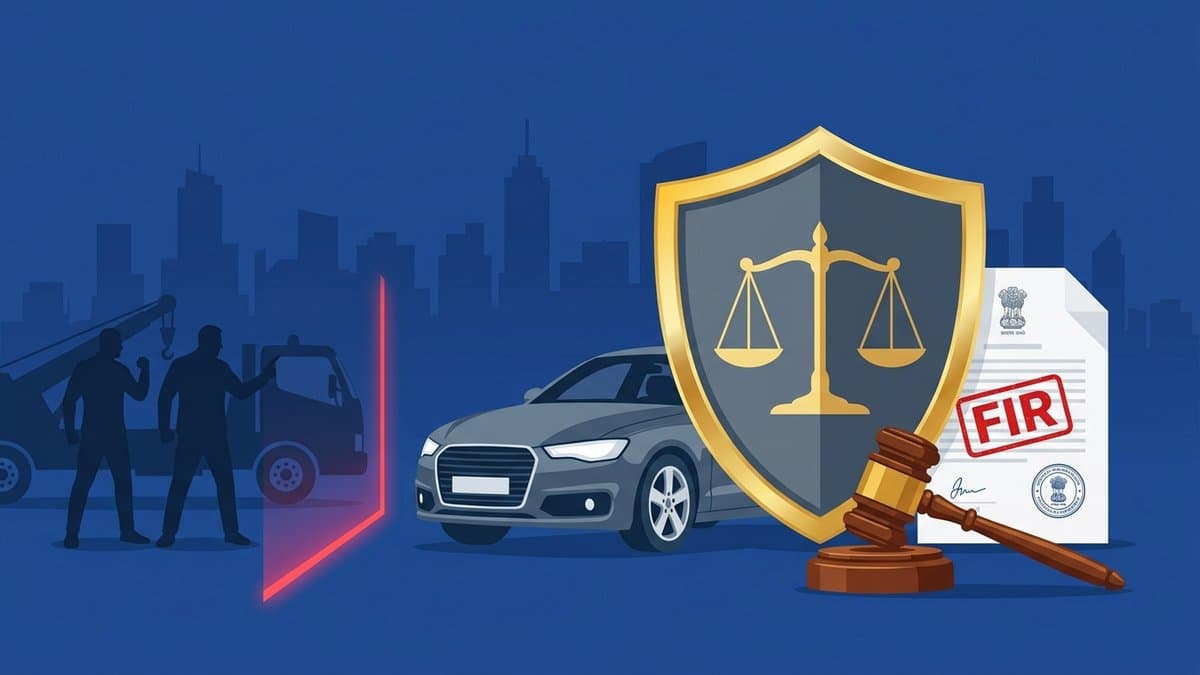
5. Visual Blueprint: Vehicle Repossession Defense SOP
This comprehensive visual guide illustrates borrower protections against illegal vehicle repossession, highlighting Supreme Court precedents, criminal FIR triggers, and lawful recovery standards.
6. Judicial Remedies: Section 156(3) & Superdari Custody
When police officers hesitate to register an FIR due to lender influence, the Indian judicial system provides powerful remedies before the criminal and civil courts to restore your rights.
Under Section 175(3) of Bharatiya Nagarik Suraksha Sanhita (formerly Section 156(3) CrPC), the Judicial Magistrate can order the police station to register an FIR and submit an investigation report within a fixed timeframe.
Under Section 503 BNSS (formerly Section 451/457 CrPC), a borrower can apply for interim custody of the vehicle. The court orders the police to seize the vehicle from the recovery yard and return it to the owner on personal bond.
Borrowers can approach the District Consumer Disputes Redressal Commission. Consumer courts regularly award heavy compensation of ₹2 to ₹10 Lakhs against banks for high-handed repossession and mental agony.
In cases of commercial vehicle snatching where livelihoods are jeopardized, borrowers can file a writ petition before the High Court seeking vehicle release, quashing of illegal auction, and strict police prosecution.
7. Lender Liability Matrix: Vicarious Liability & Penalties
Banks and NBFCs frequently claim that bouncers are independent contractors and that the lender carries no responsibility for their criminal acts. The Supreme Court and Reserve Bank of India have firmly rejected this argument.
Under the legal doctrine of vicarious liability, a principal is strictly liable for wrongful acts committed by its agents during the course of employment. RBI regulations explicitly state that banks are responsible for all collection agency actions.
| Regulatory Violation | Statutory Framework | Direct Lender Consequence | Borrower Relief Available |
|---|---|---|---|
| Use of Musclemen / Bouncers | RBI Master Circular on Recovery | RBI monetary fines & blacklisting of agency. | Criminal complaint & immediate vehicle return. |
| Missing Advance Notice | SC Citicorp Maruti Ruling | Seizure declared void ab initio. | Waiver of all towing and yard storage fees. |
| Physical Intimidation & Threats | BNS Section 351 / Section 61 | Senior bank managers named as co-accused. | Police FIR and criminal trial summons. |
| Undervalued Vehicle Auction | Consumer Protection Act 2019 | Punitive damages up to full vehicle market value. | 100% debt write-off & surplus refund. |
8. 3-Tier Escalation Matrix: PNO to RBI Ombudsman Steps
When facing vehicle repossession threats or unlawful seizure, follow the Reserve Bank of India statutory grievance escalation framework to secure immediate institutional intervention.
| Grievance Tier | Designated Banking Authority | Turnaround Time | Scope of Intervention & Relief |
|---|---|---|---|
| Level 1: GRO | Bank Grievance Redressal Officer | 7 to 10 Working Days | Halts repossession orders, recalls rogue collection bouncers, and verifies ledger accounts. |
| Level 2: PNO | Principal Nodal Officer (Head Office) | 14 to 21 Working Days | Investigates regulatory misconduct, cancels wrongful repossession fees, and initiates OTS. |
| Level 3: RBI Ombudsman | Reserve Bank Integrated Ombudsman | 30 Days Post-PNO | Issues binding directions via cms.rbi.org.in to return vehicle, impose penalties, and award damages. |
9. Procedural Timeline: Default Stages to Vehicle Release
Understanding the delinquency lifecycle of a vehicle loan empowers you to recognize warning signs and protect your automobile before unlawful collection squads are dispatched.
| Delinquency Window | Regulatory Asset Status | Lender Collection Actions | Strategic Borrower Response |
|---|---|---|---|
| Day 1 to 30 | SMA-0 | Automated payment reminder SMS and soft tele-calling. | Review finances and prepare a formal restructuring request. |
| Day 31 to 60 | SMA-1 | Persistent calls and reminder letters via post or email. | Issue written reply citing temporary financial hardship. |
| Day 61 to 90 | SMA-2 | Pre-NPA warnings and deployment of external recovery agencies. | Issue legal warning regarding Supreme Court bouncer rulings. |
| Day 91 to 120 | NPA Classification | Loan tagged Non-Performing Asset; formal recall notice issued. | Challenge inflated penal charges and demand audit sheet. |
| Day 121 to 180 | Prime OTS Window | Repossession attempts or pre-sale notices sent. | Negotiate an OTS settlement with CredSettle for 40% to 65% waiver. |
| Month 6 and Beyond | Loss Asset / Write-off | Vehicle auction or referral to civil recovery mechanisms. | Complete settlement payment, obtain NOC and Form 35 for RTO. |
10. Specialized Scenarios: Highway Seizure & Night Raids
Borrowers face diverse challenges when collection squads operate across state lines, late at night, or with family members inside the vehicle. Here is how statutory protections apply across real-world situations.
Family or Children Present in the Vehicle
Stopping a vehicle with female passengers or children violates basic human rights and RBI codes. In ICICI Bank v. Shanti Devi, courts awarded severe damages for humiliating borrowers before family.
Commercial Vehicles & Highway Interceptions
Commercial trucks and tourist taxis intercepted on national highways can cause severe cargo spoilage and life risks. Patna High Court held that highway seizure without court orders constitutes highway robbery.
Towing Parked Vehicles at Night
Towing a car from residential premises between 07:00 PM and 08:00 AM constitutes criminal trespass under BNS Section 329. Lenders cannot tow vehicles without serving an advance notice and executing an inventory sheet.
Valuables Inside Seized Automobiles
Laptops, cash, or business documents inside a seized vehicle must be immediately returned. Seizing a car with valuable cargo without an inventory sheet constitutes criminal misappropriation under BNS Section 316.
 Legal Debt Dispute Authority
CredSettle (credsettle.com) is India's premier debt settlement, loan dispute resolution, and legal protection platform. Operating strictly under the RBI Fair Practices Code and CICRA 2005, our advocate panel negotiates directly with Bank Principal Nodal Officers to eliminate waived differentials, obtain unconditional No Dues Certificates (NDC), and upgrade credit bureau records from "Settled" to "Closed".
Frequently Asked Questions: Vehicle Repossession & FIR
Clear, verified legal guidance addressing critical questions regarding vehicle repossession by bouncers, Supreme Court rulings, police complaints, and borrower rights under Indian law.
Official Regulatory Citations & Statutory Legal Framework
- Supreme Court Precedent: Manager, ICICI Bank Ltd. v. Prakash Kaur (2007) 2 SCC 711, Prohibition on Musclemen and Bouncers for Loan Recovery.
- Supreme Court Precedent: Citicorp Maruti Finance Ltd. v. S. Vijayalaxmi (2012) 1 SCC 1, Due Process Mandate in Vehicle Repossession.
- Supreme Court Precedent: Magma Fincorp Ltd. v. Rajesh Kumar Tiwari (2020) 10 SCC 399, Advance Notice as Condition Precedent.
- Reserve Bank of India Master Direction: Fair Practices Code for Applicable NBFCs and Commercial Banks, Guidelines on Recovery Agents.
- Bharatiya Nyaya Sanhita, 2023 (BNS): Sections 126 (Wrongful Restraint), 308 (Extortion), 309 (Robbery), and 351 (Criminal Intimidation).
- Bharatiya Nagarik Suraksha Sanhita, 2023 (BNSS): Sections 173 (Information in Cognizable Cases), 175 (Magistrate Power to Direct FIR), and 503 (Superdari Custody).