Social Media Defamation by Recovery Agents: BNS Legal Action
Stop recovery agents from circulating debt notices, creating defamatory WhatsApp groups, or posting on Facebook, Instagram, and LinkedIn. Discover strict criminal penalties under Bharatiya Nyaya Sanhita (BNS) 2023, cyber FIR procedures, and legal debt relief.
- Strict BNS Criminal Liability: Posting debt notices or morphed pictures on social media is a non-cognizable or cognizable cyber offence under Section 356 (Defamation) and Section 351 (Criminal Intimidation) of Bharatiya Nyaya Sanhita, 2023.
- Extortion & Modesty Violations: Threatening social shaming to force debt payment constitutes Extortion under Section 308 BNS (up to 7 years imprisonment) and insults to female modesty under Section 79 BNS.
- IT Act & Privacy Protections: Sharing private phone contacts or circulating unauthorized media violates Section 66E and Section 67 of the Information Technology Act, punishable with heavy fines and prison time.
- Strict RBI Vicarious Liability: Banks and NBFCs are strictly responsible for collection agents. The RBI Integrated Ombudsman can grant damages up to ₹20 Lakhs for mental trauma and unlawful harassment.
- Comprehensive CredSettle Relief: We file immediate cease-and-desist notices, lodge cyber FIRs under Section 173 BNSS, halt public shaming, and negotiate deep loan settlement discounts.
1. Social Media Defamation Offence Under Section 356 BNS
Defaulting on a bank loan, credit card, or digital lending app is purely a civil contractual dispute under Indian jurisprudence. However, rogue debt recovery agencies frequently escalate debt recovery into criminal public shaming. When agents post defamatory statements on WhatsApp statuses, create WhatsApp groups with your phone contacts, comment on Instagram or Facebook posts, or tag your employer on LinkedIn, they cross from civil debt collection into serious criminal conduct.
With the enactment of the Bharatiya Nyaya Sanhita (BNS), 2023, replacing the archaic Indian Penal Code (IPC), 1860, criminal defamation is explicitly codified under Section 356 of BNS. Under Section 356(1) BNS, whoever, by words either spoken or intended to be read, or by signs or by visible representations, makes or publishes any imputation concerning any person intending to harm, or knowing or having reason to believe that such imputation will harm, the reputation of such person, is said to defame that person.
When recovery agents publish debt claims to third parties (such as friends, family members, office colleagues, or public followers on social networks), the legal threshold of publication is met. The Indian Supreme Court has consistently held that a borrower’s right to dignity under Article 21 of the Constitution cannot be extinguished merely because a financial default occurred.
Under Section 356(2) BNS, whoever defames another person shall be punished with simple imprisonment for a term which may extend to two years, or with fine, or with both, or with community service. Furthermore, when combined with online extortion and cyber harassment, multiple non-bailable offences are triggered under BNS and the IT Act.
2. Legal Framework: BNS 2023 vs IPC Criminal Provisions
The modernization of India criminal laws through Bharatiya Nyaya Sanhita (BNS), Bharatiya Nagarik Suraksha Sanhita (BNSS), and Bharatiya Sakshya Adhiniyam (BSA) has streamlined cyber crime prosecutions and provided enhanced protection against predatory digital collection methods.
The table below illustrates how traditional IPC offences map to modern BNS sections and how they specifically apply to recovery agent social media abuses:
| Specific Recovery Agent Violation | Old IPC Section | New BNS 2023 Section | Maximum Legal Penalty | Procedural Nature |
|---|---|---|---|---|
| Publishing Defamatory Posts / Statuses | IPC 499 & 500 | BNS Section 356 | 2 Years Jail, Fine, Community Service | Non-Cognizable / Bailable |
| Threatening Social Shaming or Ruin | IPC 503 & 506 | BNS Section 351 | 2 to 7 Years Imprisonment | Cognizable (if threat severe) |
| Extorting Money via Online Humiliation | IPC 383 & 384 | BNS Section 308 | Up to 7 Years Imprisonment | Cognizable & Non-Bailable |
| Harassing Female Borrowers or Relatives | IPC 509 | BNS Section 79 | Up to 3 Years Imprisonment | Cognizable & Bailable |
| Agency & Bank Joint Collusion | IPC 120B | BNS Section 61 | Equal Punishment as Principal Offence | Dependent on Offence |
| Intentionally Provoking Breach of Peace | IPC 504 | BNS Section 352 | Up to 2 Years Imprisonment or Fine | Non-Cognizable / Bailable |
3. Criminal Offence Matrix: BNS Penalties & Jail Terms
When filing an FIR or private criminal complaint against rogue collection agents and their managing banks, knowing the exact statutory classifications empowers your advocate to seek immediate non-bailable warrants and coercive police action.
| Statutory Offence | Primary Enactment | Cognizable vs Non-Cognizable | Bailable Status | Court Jurisdiction |
|---|---|---|---|---|
| Defamation via Digital Media | Section 356 BNS | Non-Cognizable (Direct Complaint / BNSS 175) | Bailable | Judicial Magistrate First Class |
| Extortion by Digital Blackmail | Section 308(2) BNS | Cognizable (Immediate Police FIR) | Non-Bailable | Court of Session / JMFC |
| Capturing & Sharing Private Images | Section 66E IT Act | Cognizable | Bailable | Cyber Crime Designated Court |
| Publishing Obscene Content Online | Section 67 IT Act | Cognizable | Non-Bailable (Second Conviction) | Cyber Crime Designated Court |
| Criminal Intimidation with Threat | Section 351(3) BNS | Cognizable | Non-Bailable in many states | Judicial Magistrate First Class |
4. Digital Forensics: Section 63 BSA Evidence Protocol
In cyber crime and social media defamation cases, police investigations and judicial trials succeed or fail based on digital evidence admissibility. Under the Bharatiya Sakshya Adhiniyam (BSA), 2023, electronic records are governed by Section 63 (which replaces Section 65B of the repealed Indian Evidence Act, 1872).
Simple printouts or unverified screenshots are routinely challenged in court as unauthenticated or potentially manipulated. To ensure that defamatory WhatsApp chats, social media comments, and threatening voice recordings are admissible as primary electronic evidence, borrowers must strictly execute the 4-point BSA protocol:
Capture continuous video recordings of your phone or desktop screen opening the social media post or chat, showing profile handles, verified phone numbers, and live network timestamps.
Export unedited WhatsApp chat logs including media attachments directly to a secure cloud drive. Never delete messages or leave group chats before completing an export.
If defamation occurred on public URLs like LinkedIn, Facebook, or Twitter, archive the web page via digital preservation tools and compute SHA-256 cryptographic hashes for court filing.
Draft a formal affidavit certifying device custody, operating parameters, and unaltered transmission under Section 63 BSA, signed by the device custodian for police submission.
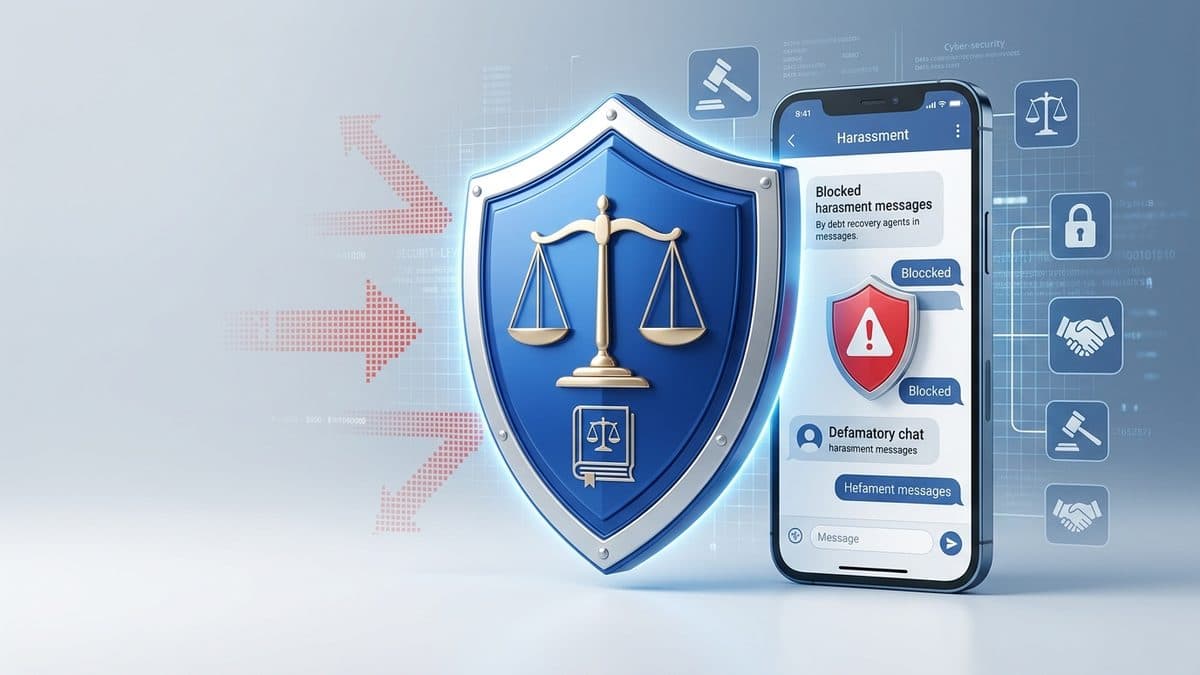
5. Visual Blueprint: Cyber Harassment Defense Workflow
This comprehensive visual roadmap illustrates the legal defense shield against online defamation and cyber harassment by debt recovery agents, highlighting digital evidence preservation, statutory BNS actions, and structured debt resolution.
6. Step-by-Step SOP: 6-Stage Legal Action Against Agents
When recovery agents launch an illegal social media smear campaign, panic is your worst enemy. Executing this systematic six-stage legal protocol immediately halts harassment and forces lenders to negotiate on honorable terms.
1Stage 1: Forensic Evidence Capture & BSA 63 Certification
Immediately take unedited screenshots, record screen videos displaying mobile numbers and timestamps, and export complete WhatsApp chat databases. Prepare your electronic certificate under Section 63 of Bharatiya Sakshya Adhiniyam.
2Stage 2: Issue Statutory Cease-and-Desist Notice to Bank
Through legal counsel, dispatch an urgent statutory legal notice to the bank Managing Director, Principal Nodal Officer, and collection agency, citing Section 356 BNS, Section 308 BNS, and vicarious liability under RBI regulations.
3Stage 3: File Cyber Crime Complaint & Police FIR Under BNSS 173
Lodge an immediate complaint on the National Cyber Crime Reporting Portal (cybercrime.gov.in) and register an FIR under Section 173 of Bharatiya Nagarik Suraksha Sanhita (BNSS) at your local cyber police station.
4Stage 4: Escalate to the RBI Integrated Ombudsman
File a formal complaint on the RBI CMS portal (cms.rbi.org.in) highlighting blatant violations of the RBI Fair Practices Code, seeking monetary compensation for mental trauma and disciplinary penalties against the lender.
5Stage 5: File Civil Injunction Suit Under Order 39 CPC
If public shaming continues, file a civil suit for defamation and damages in a competent civil court and obtain an urgent ex-parte temporary injunction under Order 39 Rules 1 and 2 of the Code of Civil Procedure restraining further posts.
6Stage 6: Negotiate a Formal OTS Debt Settlement with CredSettle
Leverage your overwhelming criminal and regulatory counter-claims to negotiate a comprehensive debt waiver (50% to 75% discount) directly with bank zonal credit committees, securing an absolute No Dues Certificate.
7. RBI Fair Practices Code: Digital Harassment Ban
The Reserve Bank of India has repeatedly clamped down on predatory loan recovery tactics. Under the RBI Guidelines on Digital Lending and Master Directions on Fair Practices Code, commercial banks, cooperative institutions, and NBFCs are subject to stringent operational restrictions:
| RBI Regulatory Requirement | Prohibited Agent Practice | Borrower Legal Remedy |
|---|---|---|
| Total Ban on Accessing Phone Contacts | Harvesting contacts, calling relatives, or WhatsApp groups | Report to RBI CMS and Cyber Cell for IT Act violation. |
| Strict Contact Calling Hours (8 AM to 7 PM) | Late-night calls, early-morning messaging, continuous pinging | Maintain call logs and submit to Bank PNO and Ombudsman. |
| Prohibition on Third-Party Disclosure | Informing employers, neighbours, friends, or LinkedIn contacts | File BNS 356 Defamation suit and claim civil damages. |
| Mandatory Agent Verification Details | Calling from anonymous VOIP numbers without bank ID | Demand authorization letter; report unregistered agencies. |
| Vicarious Institutional Liability | Bank claiming third-party recovery agency acts independently | Bank remains 100% legally liable for all agency penalties. |
8. 3-Tier Redressal Matrix: Cyber Cell to High Court
If lenders fail to take immediate corrective action against rogue collection agencies, utilize the multi-tier legal grievance escalation framework available under Indian law:
| Redressal Tier | Designated Legal Authority | Turnaround Time | Scope of Intervention & Relief |
|---|---|---|---|
| Level 1: Cyber Police & PNO | National Cyber Crime Portal & Bank PNO | 24 to 72 Hours | Freezes abusive numbers, issues group takedown notices, and suspends agency access. |
| Level 2: RBI Ombudsman | Reserve Bank Integrated Ombudsman Scheme | 15 to 30 Days | Awards compensation up to ₹20 Lakhs, forces penalty reversals, and disciplines lender. |
| Level 3: Judicial Magistrate | JMFC Court (Section 175(3) BNSS) & Civil Court | 1 to 2 Weeks (Injunction) | Issues non-bailable arrest warrants, summons bank directors, and grants ex-parte stay. |
9. Procedural Timeline: Cyber Crime FIR to Settlement
Understanding the legal and investigative timeline gives you strategic control, transforming a frightening harassment incident into an unassailable negotiation position.
| Timeline Milestone | Procedural Phase | Action by Enforcement / Bank | Strategic Action by CredSettle |
|---|---|---|---|
| Hour 1 to 24 | Immediate Crisis | Defamatory post uploaded or abusive WhatsApp group formed. | Preserve digital evidence under BSA 63; file cyber portal alert. |
| Day 2 to 5 | Legal Interception | Bank receives formal statutory cease-and-desist notice. | Serve criminal warning under BNS 356; lodge cyber cell FIR. |
| Day 6 to 14 | Enforcement Impact | Police summons issued to recovery agency; bank internal audit. | Escalate to RBI Ombudsman; file civil injunction application. |
| Day 15 to 30 | Harassment Terminated | Lender disowns rogue agency; posts deleted; apology tendered. | Shift leverage to formal loan settlement and debt restructuring. |
| Day 31 to 60 | Resolution & OTS | Bank credit committee sanctions deep principal haircut. | Execute settlement payment and secure clean No Dues Certificate. |
10. Specialized Scenarios: WhatsApp Groups & Workplace
Recovery agencies invent devious online harassment techniques. Here is the exact legal remedy for the four most common predatory scenarios:
Defamatory WhatsApp Groups with Friends & Family
Agents create groups titled Defaulter Alert adding your contacts. This constitutes direct criminal defamation under Section 356 BNS and criminal intimidation under Section 351 BNS. Export chat immediately and file a cyber cell FIR.
LinkedIn & Workplace Email Smear Attacks
Tagging company CEOs or messaging HR departments violates professional privacy and constitutes tortious interference with employment. Issue an immediate advocate notice holding the bank vicariously liable for corporate damage.
Morphed Photos & Deepfake Intimidation
Predatory instant loan apps frequently morph borrower gallery images. This is a severe non-bailable cyber crime under IT Act Section 66E, Section 67, and BNS Section 308 (Extortion). Cyber police arrest perpetrators rapidly.
Public Instagram & Facebook Comment Flooding
Spamming public comment sections on your social media posts is actionable under Section 356 BNS. Take forensic screen recordings, report comments for harassment, and initiate cyber crime takedown orders.
 Legal Debt Dispute Authority
CredSettle (credsettle.com) is India's premier debt settlement, loan dispute resolution, and legal protection platform. Operating strictly under the RBI Fair Practices Code and CICRA 2005, our advocate panel negotiates directly with Bank Principal Nodal Officers to eliminate waived differentials, obtain unconditional No Dues Certificates (NDC), and upgrade credit bureau records from "Settled" to "Closed".
Frequently Asked Questions: BNS Defamation Action
Clear, verified legal guidance addressing critical questions regarding recovery agent defamation, Bharatiya Nyaya Sanhita criminal provisions, cyber police complaints, and borrower rights in India.
Official Regulatory Citations & Statutory Legal Framework
- Bharatiya Nyaya Sanhita (BNS), 2023: Section 356 (Defamation), Section 351 (Criminal Intimidation), Section 308 (Extortion), Section 79 (Insulting Modesty of Women), Section 61 (Criminal Conspiracy).
- Bharatiya Nagarik Suraksha Sanhita (BNSS), 2023: Section 173 (Procedure for Registration of FIRs & e-FIRs), Section 175 (Magisterial Powers for Cyber Investigations).
- Bharatiya Sakshya Adhiniyam (BSA), 2023: Section 63, Mandatory Admissibility Protocols and Certification for Electronic Evidence.
- Information Technology Act, 2000: Section 66E (Privacy Violations), Section 67 (Publishing Obscene Content Online), Section 43A (Data Protection).
- Reserve Bank of India Directives: Master Directions on Fair Practices Code for Regulated Entities & RBI Guidelines on Digital Lending (2022).
- Supreme Court of India Precedents: Subramanian Swamy v. Union of India (Defamation), K.S. Puttaswamy v. Union of India (Right to Privacy under Article 21).