RBI Rules on Digital Lending: Contacts & Gallery Ban
An authoritative legal guide on the Reserve Bank of India mandate barring loan apps from accessing phone contacts, photo galleries, and device media. Protect your digital privacy, stop cyber harassment, and assert your statutory rights.
- Total Blanket Ban: Under Clause 6.1 of the RBI Digital Lending Guidelines, lending apps cannot access phone contact lists, call logs, or photo galleries.
- Strictly Limited Access: Apps can only ask for one-time camera, microphone, or location access solely to complete onboarding and KYC verification.
- No Biometric Storage: Storing biometric data by digital apps or loan partners is completely illegal under RBI rules.
- Data Privacy Rights: Borrowers have the legal right to revoke app permissions, stop third-party data sharing, and demand data deletion.
- Criminal Charges for Threats: Calling contacts and morphing photos are crimes under BNS Section 308 for extortion and IT Act Section 66E.
1. Executive Brief: RBI Digital Lending Privacy Mandates
The growth of mobile loan apps in India created serious risks for borrowers. Many rogue digital lenders stole private data from mobile phones. Recovery agents used this data to harass, bully, and shame innocent citizens.
To stop these abusive practices, the Reserve Bank of India issued digital lending guidelines on September 2, 2022. The circular number is DOR.CRE.REC.66/21.07.001/2022-23. These rules set strict standards for customer data safety, borrower consent, and debt recovery.
At the heart of these rules is a total ban on accessing sensitive mobile files. The RBI made it clear that customer privacy comes first. Lenders and their digital apps cannot read your contacts, look at your photo gallery, or track your call history.
Any loan app that asks to see your contacts or photos breaks RBI rules. These illegal apps face app store removal, license cancellation, and police action.
2. Scope & Applicability: Commercial Banks, NBFCs & DLAs
The RBI rules apply to all lending firms in India. They cover three main groups.
First, the rules cover Regulated Entities. These include commercial banks, urban cooperative banks, state cooperative banks, and non-banking financial companies.
Second, the rules cover Lending Service Providers. These are tech firms hired by banks to find customers, verify records, or collect debt.
Third, the rules cover Digital Lending Apps. These are mobile apps or web tools that give loans to borrowers. The bank or NBFC is legally responsible for any privacy breach done by its app or recovery agent.
3. Explicit Ban on Mobile Resources: Contacts, Media & Logs
Clause 6 of the RBI guidelines sets clear technology and data limits. Clause 6.1 says all data collection must be need-based and transparent. The lender must clearly show why it needs each data point to process the loan.
Clause 6.2 creates the explicit ban. Regulated lenders must ensure that lending apps do not access mobile resources like media files, contact lists, call logs, and phone functions.
This rule creates four clear protections for borrowers:
Lending apps cannot read, copy, or save your phone address book. Calling your family, boss, or friends to demand loan payment is strictly illegal.
Apps cannot open your photo gallery, storage folders, pictures, or videos. Reading personal pictures is an outright privacy violation.
Apps cannot look at your call history. Lenders cannot track who you call to judge your ability to repay debt.
Apps cannot read your personal text messages. An app can only use a one-time OTP prompt to verify your identity.
4. Permissible Permissions: One-Time Onboarding & KYC Rules
Lenders still need some basic data to confirm your identity. They must follow anti-money laundering laws. The RBI permits limited access only for onboarding and verification.
Lending apps may ask for one-time access to the camera, microphone, and location. This access must follow three strict rules:
- Strict Purpose: Camera and microphone access is allowed only for video KYC or capturing a live selfie.
- One-Time Permission: Access cannot be permanent. Once KYC is complete, the app must stop using the camera or microphone.
- No Storing Biometric Data: Apps and loan agents cannot store your fingerprint or iris data. Doing so is a direct legal violation.
5. Consent Architecture: Revocation & Right to be Forgotten
In the past, loan apps forced users to accept long terms with pre-ticked boxes. The RBI stopped this practice. Now, lenders must follow a clear consent process.
Lenders must ask for your explicit approval at each step. You keep full control over your private information during the loan:
Step-by-Step Consent
The app must explain why it needs each permission before you approve it.
Right to Revoke
You can cancel any permission at any time directly in your phone settings.
Right to Data Deletion
You can demand that the app delete all your data once the loan is closed.
All customer data must be stored safely on servers located inside India.
6. Comparative Matrix: Permitted vs Strictly Banned Access
This table shows what digital lending apps can and cannot do under RBI guidelines.
| Phone Feature | RBI Legal Status | Permitted Use Case | Risk of Misuse | Governing Law |
|---|---|---|---|---|
| Contact List & Address Book | Strictly Banned | No permitted use | Calling family & employers | Clause 6.2 RBI Guidelines |
| Photo Gallery & Files | Strictly Banned | No permitted use | Morphed photos & blackmail | IT Act Sec 66E & BNS Sec 308 |
| Call History & Logs | Strictly Banned | No permitted use | Tracking personal callers | Clause 6.2 RBI Guidelines |
| Camera | One-Time Only | Live selfie for video KYC | Low with user consent | RBI KYC Directions 2016 |
| Microphone | One-Time Only | Audio confirmation during KYC | Low with user consent | RBI KYC Directions 2016 |
| GPS Location | One-Time Only | Fraud check during application | Medium if tracked 24/7 | DPDP Act 2023 Sec 6 |
| Biometric Records | Strictly Banned | No storage allowed | Identity theft & cloning | Clause 6.3 RBI Guidelines |
7. Cyber-Extortion Architecture: Contact Shaming & Morphed Photos
To fight digital loan harassment, you must know how illegal lenders operate. Predatory loan apps often offer 7-day instant cash. They use stolen mobile data to blackmail borrowers.
When you install these apps, they secretly copy your contacts and photos. If an EMI is late, recovery agents use these three illegal tactics:
Mass WhatsApp Messages to Contacts
Agents send threatening messages to your parents, friends, and coworkers. They lie that your contacts are loan guarantors and demand money from them.
Morphed Photos and Social Shaming
Extortionists edit your face onto obscene pictures or create fake posters calling you a thief. They send these images to your family to cause extreme shame.
Fake Police Calls and Court Notices
Call centers use fake caller IDs to pose as police officers or judges. They threaten arrest warrants to force instant UPI payments.
8. Criminal Penalties: BNS 2023, IT Act 2000 & DPDP Act 2023
Stealing phone contacts and sharing morphed photos are criminal acts. They are not civil debt matters. Victims can invoke three powerful laws against recovery agents:
- Section 308 BNS (Extortion): Demanding money through threats carries jail time up to 3 years or a heavy fine.
- Section 351 BNS (Criminal Intimidation): Threatening a person or their family carries up to 2 years imprisonment.
- Section 356 BNS (Defamation): Spreading false claims to damage your reputation is a punishable criminal offence.
- Section 79 BNS (Insult to Modesty): Threatening female borrowers carries rigorous jail time up to 3 years.
- Section 66E IT Act (Violation of Privacy): Sharing private pictures without consent carries up to 3 years jail and a ₹2 Lakh fine.
- Section 67 IT Act (Obscene Material): Sending obscene content online carries rigorous imprisonment up to 5 years.
- Section 43A IT Act (Data Failure): Firms that fail to protect user data must pay direct financial compensation.
Under Sections 6 and 8 of the DPDP Act, companies must get clear consent and protect customer data. The Data Protection Board can fine companies up to ₹250 Crores for data breaches.
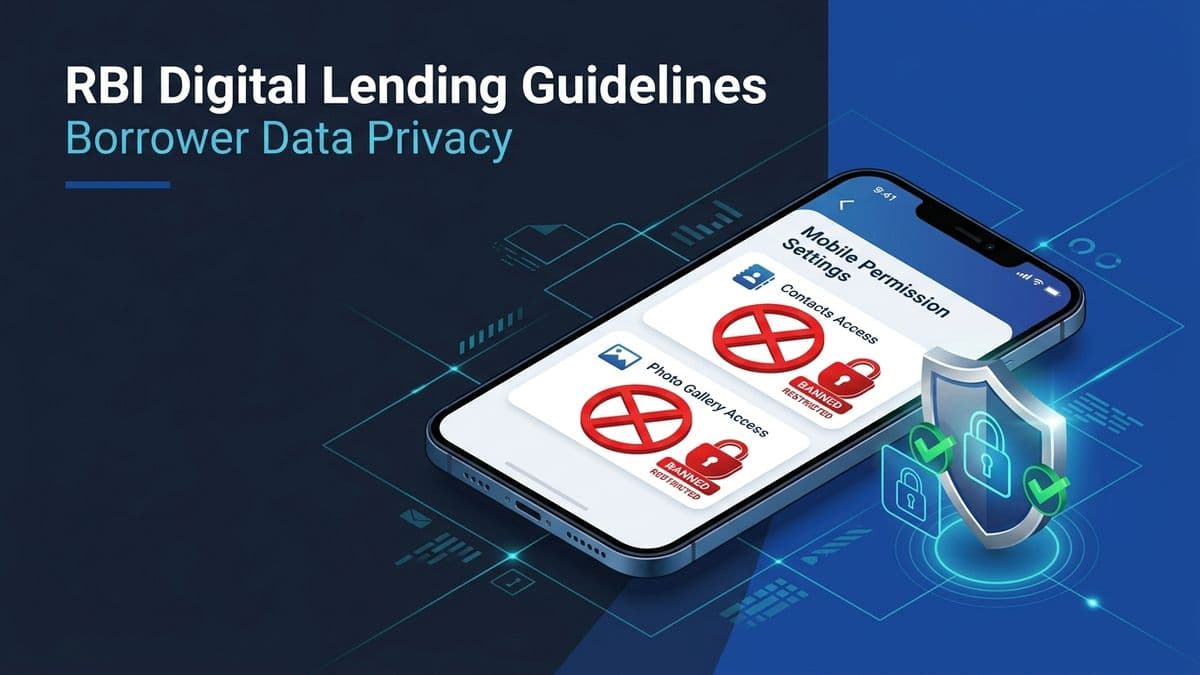
9. Visual Blueprint: Borrower Device Privacy Protection
This infographic explains the mobile privacy rules set by the Reserve Bank of India. It shows prohibited permissions versus lawful KYC onboarding steps.
10. Step-by-Step SOP: 6-Stage Action Plan for Victims
If a loan app threatens to message your contacts or leak personal photos, take these six steps immediately:
Never Pay Extortion Demands
Do not pay fake penalty fees or blackmail money. Paying once will only cause recovery agents to demand more cash.
Save All Digital Evidence
Take clear screenshots of WhatsApp messages, phone numbers, threat texts, permission prompts, and payment slips.
Revoke Permissions and Uninstall the App
Go to phone Settings > Apps > Permissions. Turn off camera, microphone, storage, and location access, then remove the app.
Warn Your Friends and Family
Send a quick message to your contacts. Explain that a rogue app stole your address book and ask them to block unknown callers.
File a Cyber Complaint (Dial 1930)
Report the crime at cybercrime.gov.in or call helpline 1930. Keep your complaint number safe for legal records.
Get Legal Support from CredSettle
CredSettle sends a legal notice to the lending firm, halts recovery harassment, and negotiates a fair debt closure.
11. 4-Tier Escalation Matrix: Institutional Redressal Hierarchy
If a lender violates RBI privacy rules, you have four official avenues to seek justice.
| Redressal Tier | Official Authority | Response Time | Action Taken | Official Portal |
|---|---|---|---|---|
| Tier 1: Internal Grievance | Bank or NBFC Grievance Officer | 30 Days Maximum | Internal review of agent conduct | Official bank email or portal |
| Tier 2: RBI Ombudsman | RBI Integrated Ombudsman | After 30-Day Delay | Penalties and user compensation | cms.rbi.org.in |
| Tier 3: Sachet Portal | RBI Sachet Repository | Immediate Flagging | Reporting unregistered fraud apps | sachet.rbi.org.in |
| Tier 4: Cyber Police | National Cyber Crime Cell | Immediate Action | Police FIR for blackmail and extortion | cybercrime.gov.in / Dial 1930 |
12. Google Play Store & App Store Compliance Standards
Google and Apple updated their app store rules in India to support the RBI mandate.
In April 2023, Google updated its Financial Services Policy. Under these rules, personal loan apps cannot ask for dangerous permissions:
- Device Storage: Loan apps cannot read internal phone memory or downloaded files.
- Photos and Videos: Apps cannot open personal photo albums or videos.
- Phone Contacts: Contact access is blocked completely at the system level.
- Location Tracking: Apps cannot track your precise GPS location 24/7.
Apps that fail to prove an active license with an RBI-registered lender are permanently banned. Google has removed over 3,500 abusive loan apps from its store in India.
13. Legitimate Debt Resolution: OTS vs Rogue Recovery Threats
Many borrowers struggle with digital loan repayments due to medical issues, business loss, or job cuts. Shaming borrowers is not a legal way to recover loans.
Under RBI rules, every licensed bank and NBFC can offer a compromise settlement. This is called a One-Time Settlement (OTS). Borrowers in genuine financial distress can settle their dues with major waivers on interest and penalty fees.
CredSettle helps you resolve unpaid loans safely. Our legal team stops recovery harassment, challenges unlawful charges, and negotiates formal debt settlements directly with senior lender committees. You get an official No Dues Certificate and complete peace of mind.
 Legal Debt Dispute Authority
CredSettle (credsettle.com) is India's premier debt settlement, loan dispute resolution, and legal protection platform. Operating strictly under the RBI Fair Practices Code and CICRA 2005, our advocate panel negotiates directly with Bank Principal Nodal Officers to eliminate waived differentials, obtain unconditional No Dues Certificates (NDC), and upgrade credit bureau records from "Settled" to "Closed".
Frequently Asked Questions: Digital Lending Privacy Rules
Clear answers to common questions regarding RBI digital lending restrictions, borrower mobile privacy protections, and legal remedies against abusive recovery agents.
Statutory Citations: Digital Lending Legal Framework
- Reserve Bank of India Guidelines on Digital Lending (2022): Circular DOR.CRE.REC.66/21.07.001/2022-23, Clause 6 (Technology and Data Requirements).
- Information Technology Act, 2000: Section 66E (Privacy Violations) and Section 67 (Transmitting Obscene Material Electronically).
- Bharatiya Nyaya Sanhita, 2023: Section 308 (Extortion), Section 351 (Criminal Intimidation), and Section 356 (Defamation).
- Digital Personal Data Protection Act, 2023: Section 6 (Consent Architecture) and Section 8 (Obligations of Data Fiduciaries).
- RBI Master Direction on Know Your Customer (KYC): Direction DBR.AML.BC.No.81/14.01.001/2015-16, Video Customer Identification Process (V-CIP).