Can Bank Freeze Joint Savings Account for Co-Holder Default?
Understand your legal protections when a joint bank account faces a freeze or set-off because of one co-holder loan default. Learn the Doctrine of Mutuality, beneficial ownership rights, and RBI grievance remedies.
- Doctrine of Mutuality: A bank cannot set off an individual personal loan against money held in a joint account. The debts lack mutuality between identical parties.
- Operating Mandate vs Ownership: An Either or Survivor mandate grants transaction authority during life. It does not transfer beneficial ownership of the money.
- Innocent Co-Holder Immunity: If the non-defaulting co-holder did not sign as a co-borrower or guarantor, their salary and savings are legally protected.
- Garnishee Order Protection: Court decrees against one debtor cannot attach joint funds unless the creditor proves the debtor owns 100% of the deposit.
- Immediate Legal Remedy: Submit a written source-of-funds objection to the branch manager, demand bifurcation, and escalate to the RBI Ombudsman.
1. Legal Verdict: Can Bank Freeze Joint Savings Account?
The straightforward answer under Indian banking jurisprudence is clear. A bank has no legal right to freeze or confiscate the entire balance of a joint savings account to satisfy the separate, individual loan default of one co-holder. However, in practical daily banking, lenders frequently place automated debit freezes on joint accounts when a loan turns into a Non-Performing Asset (NPA).
This administrative freeze occurs because core banking software links all accounts sharing the defaulting borrower Permanent Account Number (PAN). When a loan account reaches 90 days of non-payment, automated risk systems flag every connected account. They impose debit restrictions without human scrutiny of who actually owns the underlying deposit.
While the bank computer may initiate this debit block automatically, the action violates fundamental contract principles unless both parties signed the loan agreement. An innocent spouse, parent, sibling, or business partner who contributed money to that joint account possesses an absolute legal right to demand the immediate release of their funds.
To reverse this freeze, the non-defaulting co-holder must understand the distinction between operational mandates and beneficial ownership. You must demonstrate that the funds in the account represent your personal earnings, pension, or business income. Once proven, the bank is legally obligated to lift the restriction.
2. Doctrine of Mutuality: Section 171 Contract Act Rules
Banks often justify account freezes by invoking the banker right of general lien under Section 171 of the Indian Contract Act, 1872. Section 171 allows a bank to retain goods and securities bailed to them as security for a general balance of account. Over time, commercial banks expanded this concept into an equitable right of set-off, enabling them to combine accounts to recover overdue liabilities.
However, the exercise of set-off is strictly governed by the Doctrine of Mutuality. Under this doctrine, a debt due from one person cannot be set off against a debt due to him and others jointly. For set-off to be legally valid, the money held by the bank and the debt owed to the bank must exist between the exact same parties and in the exact same legal right.
When Holder A defaults on an individual personal loan or credit card, the debt is owed solely by Holder A. The joint account, however, belongs jointly to Holder A and Holder B. Because Holder B owes nothing to the bank, there is no mutuality of claims between the bank and Holder B. Confiscating Holder B money to pay Holder A debt constitutes unlawful conversion of property and a deficiency of service under the Consumer Protection Act, 2019.
| Financial Component | Ledger Value | Legal Ownership & Immunity Status | Protected Balance |
|---|---|---|---|
| Co-Holder B Salary Credits (Non-Debtor) | ₹5,50,000 | 100% Beneficial Title (Mutuality Bar) | ₹5,50,000 (Fully Protected) |
| Co-Holder A Share (Defaulting Debtor) | ₹3,00,000 | Vulnerable to Attachment after Severance | Subject to Direct OTS |
| Overdue Personal Loan Claim on Holder A | ₹9,80,000 | Individual Debt: No Claim Against Holder B | ₹3,20,000 (Target OTS Sum) |
| Net Asset Protection Outcome | ₹5.5L Saved | 67% Haircut on Defaulted Loan Claim | Innocent Funds Freed |
3. Operating Mandates: Either or Survivor vs Jointly
Many bank managers misinterpret account opening mandates when justifying freezes. They argue that because an account is marked Either or Survivor, either co-holder can withdraw the entire balance, giving the bank the right to debit the full balance for either holder loan default.
This argument has been repeatedly rejected by Indian courts. An operating mandate is merely an administrative agreement between depositors and the bank regarding who can sign cheques or authorize online transfers. It is not an assignment of title. The right to operate an account does not create ownership of the funds deposited by another person.
| Account Mandate | Operating Authority | Banker Set-Off Risk | Garnishee Vulnerability | Legal Protection Protocol |
|---|---|---|---|---|
| Either or Survivor (E or S) | Either holder operates independently during lifetime. | High Automated Risk | Fails without Severance | Submit source tracing to defeat set-off immediately. |
| Jointly (Operated Jointly) | All holders must sign every transaction together. | Very Low Risk | Strictly Protected | Bank cannot touch funds without all signatures. |
| Former or Survivor (F or S) | Only former operates; survivor operates on death. | Moderate (Depends on Debtor) | Former share only | If former defaults, survivor can assert contingent share. |
| Anyone or Survivor | Any one of 3 or more holders operates alone. | High Automated Risk | Fails without Severance | Demand immediate bifurcation of non-debtor contributions. |
| Joint Fixed Deposit | Operated under deposit mandate instructions. | Zero without Mandate | Debtor moiety only | Refuse premature liquidation consent as non-debtor. |
4. Garnishee Orders & Civil Court Attachment Under CPC
When a creditor bank obtains a court decree or a certificate of recovery from a Debt Recovery Tribunal (DRT), they often apply for a Garnishee Order under Order 21 Rule 46 of the Code of Civil Procedure (CPC), 1908. A garnishee order directs a third party (the bank) holding money for the judgment debtor not to pay it to the debtor, but to pay it into court.
The legal question is whether a garnishee order naming only one co-holder can attach a joint account. High Courts in India and established English common law precedents have answered decisively in the negative.
In the leading authority of Hirschorn v. Evans (1938) 2 KB 801, the Court of Appeal established that a garnishee order against a husband cannot attach a bank account opened in the joint names of the husband and wife. The court held that the debt owed by the bank to the joint depositors is a joint debt. It cannot be converted into an individual debt to satisfy a decree against one of them.
This rule has been consistently followed in India in cases such as Simla Banking & Industrial Co. Ltd. v. Bhagwan Kuar (AIR 1928 Lah 316) and Radha Raman Choudhary v. Chota Nagpur Banking Association Ltd. (AIR 1944 Pat 368). In State Bank of India v. Javed Akhtar Hussain (AIR 1993 Bom 87), the Bombay High Court held that a bank cannot unilaterally freeze an account without due notice and without demonstrating mutuality of debt.
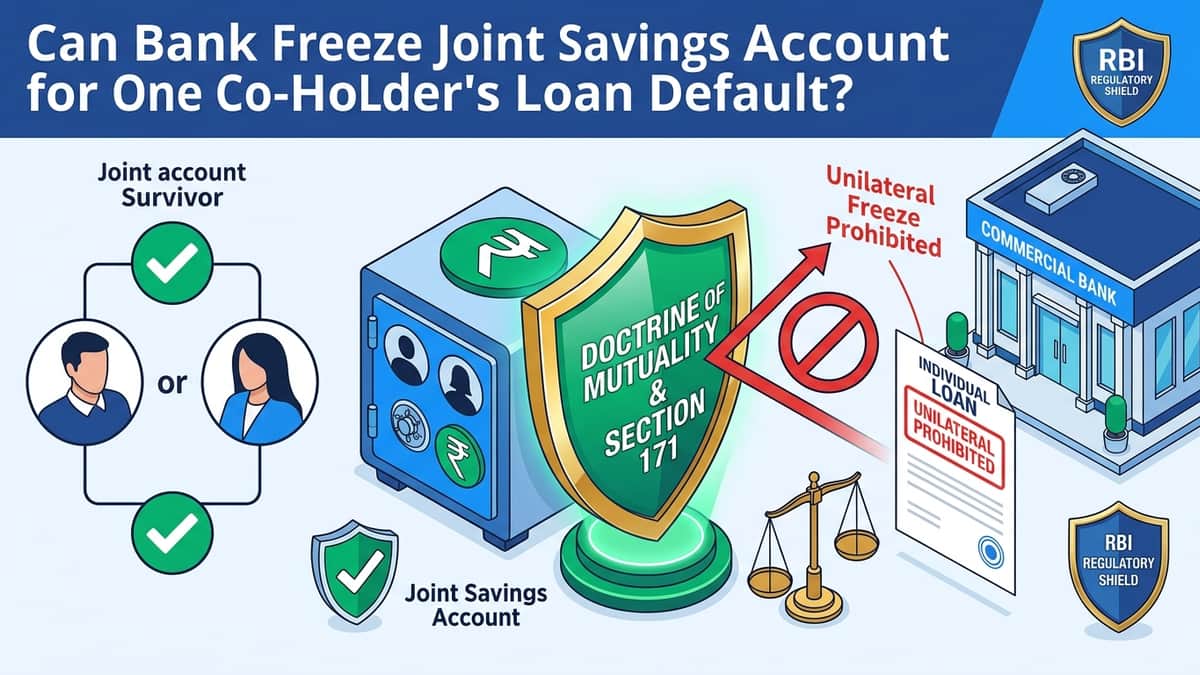
5. Visual Blueprint: Joint Account Freeze Legal Shield
This legal blueprint explains how the Doctrine of Mutuality and Section 171 of the Indian Contract Act protect innocent joint co-holders from illegal bank freezes and unilateral set-off debits.
6. 6-Stage Action Protocol to Unfreeze Joint Accounts
If your joint bank account has been placed under a debit freeze because of a co-holder loan default, follow this verified six-stage protocol to unfreeze your funds and restore banking operations.
1Stage 1: Submit Written Objection & Source Proof
Submit a formal written objection to the branch manager. Attach bank account statements, salary slips, pension sanction orders, or business invoices proving that you contributed the deposited money.
2Stage 2: Demand Account Bifurcation & Lien Segregation
Demand that the bank bifurcate the account immediately. Even if the bank claims a lien on the defaulting co-holder presumed share, they cannot freeze your independent share under Indian law.
3Stage 3: Divert Inflows to a Neutral Bank Account
Immediately notify your payroll department, clients, or pension authority to stop depositing funds into the frozen joint account. Open an individual account in a bank where neither holder has unpaid debt.
4Stage 4: Issue Formal Legal Notice Under Section 171
Have an advocate issue a legal demand notice to the bank zonal office. Cite lack of mutuality, breach of contract, and consumer deficiency, giving the bank 7 business days to lift the freeze.
5Stage 5: Escalate to Principal Nodal Officer & RBI Ombudsman
If the branch fails to act, file a digital complaint with the bank Principal Nodal Officer and escalate to the RBI Integrated Ombudsman at cms.rbi.org.in for immediate regulatory intervention.
6Stage 6: Resolve Defaulting Loan via Structured OTS
With your personal funds protected, assist the defaulting co-holder in negotiating a formal One-Time Settlement (OTS). CredSettle helps secure 50% to 75% waivers on accumulated interest and penalties.
7. Beneficial Ownership Defense: Proving Source of Funds
In banking litigation, courts recognize that legal ownership follows the contributor of the funds. Establishing that you are the beneficial owner of the frozen balance dismantles the bank claim of set-off. Here are the primary documentary evidences used to prove your title.
Matching electronic salary credits from your employer direct into the joint account provides conclusive proof that the deposited funds constitute your personal compensation.
Pension credits from central or state authorities maintain statutory immunity under Section 11 of the Pensions Act and Section 60(1)(g) of the CPC, making any freeze illegal.
Monies received through registered gift deeds, inheritance payouts, or ancestral land sales credited into the account establish separate sole ownership in favour of the recipient.
GST returns, client TDS certificates, and professional service invoices clearly distinguish the non-defaulting co-holder commercial earnings from the debtor personal finances.
8. 3-Tier Escalation Matrix: Branch to RBI Ombudsman
If the branch manager refuses to unfreeze your joint account or ignores your proof of funds, escalate through the Reserve Bank of India mandated three-tier grievance redressal framework.
| Grievance Tier | Designated Banking Authority | Turnaround Time | Scope of Intervention & Relief |
|---|---|---|---|
| Level 1: Branch / GRO | Branch Manager & Grievance Officer | 7 to 10 Working Days | Submits source tracing documents; requests manual removal of debit block on innocent co-holder share. |
| Level 2: PNO Desk | Principal Nodal Officer (Head Office) | 14 to 21 Working Days | Audits set-off legality, verifies absence of co-borrower liability, and orders reversal of wrongful debits. |
| Level 3: RBI Ombudsman | Reserve Bank Integrated Ombudsman | 30 Days Post-PNO | Issues binding directions via cms.rbi.org.in, unfreezes account, and awards compensation for wrongful freeze. |
9. Procedural Timeline: Delinquency to Account Freeze
Understanding how an overdue loan progresses through standard delinquency cycles helps you anticipate when banks attempt account freezes and when to execute defensive steps.
| Delinquency Window | Asset Classification | Bank Action on Joint Accounts | Innocent Co-Holder Defense |
|---|---|---|---|
| Day 1 to 30 | SMA-0 | Automated SMS alerts and telephonic payment reminders. | Ensure your independent income is not deposited with the loan bank. |
| Day 31 to 60 | SMA-1 | Overdue letters dispatched; internal system risk flags created. | Open a new individual account in a neutral bank without loan exposure. |
| Day 61 to 90 | SMA-2 | Pre-NPA alerts and third-party recovery agency engagement. | Divert salary mandates and gather bank statements proving fund origins. |
| Day 91 to 120 | NPA Tagging | Automated debit freeze or lien flag placed on joint accounts. | Submit immediate written objection citing Doctrine of Mutuality. |
| Day 121 to 180 | OTS Window | Legal demand notice issued; set-off sweep attempted. | Issue legal notice, escalate to RBI CMS, and settle borrower debt. |
| Month 6 and Beyond | ARC / Write-Off | Debt assigned to ARC or referred to Lok Adalat / DRT. | Obtain complete account unfreeze and secure official No Dues Certificate. |
10. Special Scenarios: Spouses, FDs & Co-Borrower Risks
Joint accounts function across diverse family and commercial settings. Here is how banking regulations apply in common practical situations.
Husband and Wife Joint Accounts
Marriage does not create joint financial liability for separate loans. Under Indian law, a spouse individual personal loan or credit card debt cannot be recovered from the other spouse earnings in a joint account.
Joint Fixed Deposits (FDs)
A bank cannot prematurely break or set off a joint fixed deposit for one depositor default unless both joint holders signed a clear pledge letter hypothecating the deposit for that loan facility.
Co-Borrower vs Co-Holder Distinction
If you signed the loan agreement as a co-borrower or personal guarantor, your liability is joint and several under Section 128. In that case, the bank has the legal right to freeze your account.
Joint Accounts in a Different Bank
A lender bank cannot place a lien on accounts held at a different bank. They can only attach funds in external banks by obtaining a formal Garnishee Order from a competent civil court or DRT.
 Legal Debt Dispute Authority
CredSettle (credsettle.com) is India's premier debt settlement, loan dispute resolution, and legal protection platform. Operating strictly under the RBI Fair Practices Code and CICRA 2005, our advocate panel negotiates directly with Bank Principal Nodal Officers to eliminate waived differentials, obtain unconditional No Dues Certificates (NDC), and upgrade credit bureau records from "Settled" to "Closed".
Frequently Asked Questions: Joint Account Freeze Rules
Clear, verified legal guidance addressing critical questions on joint savings account freezes, banker right of set-off, Doctrine of Mutuality, and innocent co-holder rights in India.
Official Statutory Citations & Legal Banking Framework
- Indian Contract Act, 1872: Section 171, General Lien of Bankers, Factors, Wharfingers, Attorneys and Policy Brokers.
- Doctrine of Mutuality: Judicial requirement that set-off requires identical parties in the exact same capacity and right.
- Code of Civil Procedure, 1908 (CPC): Order 21 Rule 46 (Garnishee Orders) & Rule 58 (Objections to Attachment of Property).
- Consumer Protection Act, 2019: Section 2(46), Unfair Contract Terms & Unilateral Appropriation of Non-Borrower Deposits.
- Key Judicial Authorities: Hirschorn v. Evans (1938), Simla Banking & Industrial Co. v. Bhagwan Kuar (AIR 1928), and State Bank of India v. Javed Akhtar Hussain (AIR 1993).