Cancel NACH Mandates to Stop ECS Bank Bounce Charges
Repeated auto-debit failures can rapidly deplete your savings through growing inward bounce fees and unlawful retry debits. Learn the exact legal framework to cancel online mandates at your destination bank. Stop predatory deductions. Defend against Section 25 PSSA legal notices.
- legal Right to Revoke: clients can cancel NACH/ECS mandates straight at their destination bank under RBI rules.
- Stop Recurring Bounce Fees: Revoking mandates halts predatory ₹295 to ₹590 inward return fines from repeated retries.
- Section 25 PSSA Defense: Issue formal legal replies within 15 days to dispute inflated penal claims and notices.
- bank Escalation: Bank refusals can be escalated straight to the main sum Nodal head and RBI RBI officer.
1. NACH & ECS Mechanics: How Auto-Debit Traps Function
Retail lending in India relies on automated clearing systems governed by NPCI and RBI. When availing a own loan or credit card. Lenders register an online Clearing Service (ECS) or NACH e-mandate. This standing instruction empowers the lender to debit your savings account on scheduled EMI dates using a 20-digit Unique Mandate Reference Number (UMRN).
When money hardship occurs. Lenders often execute automated retry presentations across running days. Inadequate account balances trigger multiple clearing failures. Causing severe fine debits. Under RBI Master Directions on Customer Service and NPCI guidelines. Clients have an unconditional legal right to instruct their destination bank to revoke any active debit mandate.
2. Financial Impact: The Compounding Bounce Charge Spiral
An auto-debit bounce triggers dual fine charges across the banking system. Your destination bank debits an inward return fee of ₹295 to ₹590 (including 18% GST). while the lender levies an additional bounce and late payment fee on the loan ledger.
Representative Monthly Cost of Multiple NACH Re-Presentations
Under RBI Fair Lending Practice directives (DOR.MCS.REC.28/01.01.001/2023-24). Banks cannot capitalize fine charges into the loan main sum. Making repetitive retry fees eligible for formal dispute and waiver claims.
3. Mandate Cancellation vs Inaction: Comparison Matrix
Evaluating different mandate response pathways helps clients protect liquidity while maintaining legal compliance under RBI norms.
| Action Pathway | Operational Method. | Immediate Financial Impact. | Legal Position & Statutory Risk. | Recommended Strategy. |
|---|---|---|---|---|
| Formal Bank Revocation. | Written Form M-02 submission citing UMRN at branch. | Instantly stops inward bank bounce fines. | 100% compliant with RBI &. NPCI guidelines. | Highly Recommended. |
| NetBanking e-Mandate Cancel. | Digital cancellation via netbanking or mobile app OTP. | Prevents automated debit hits within 24 hours. | Valid online cancellation under IT Act. | Fastest Digital Route. |
| Lender Hardship Notice. | Registered email informing inability to maintain mandate. | Creates documentary record of genuine hardship. | Strong defense against Section 25 penal intent. | Essential for Defense. |
| Account Depletion Only. | Keeping zero balance without formal mandate stop. | Negative balance spirals due to recurring charges. | Leaves account vulnerable to unexpected debits. | Incomplete safety. |
| Passive Inaction. | Ignoring notices and repeated automated bounces. | Total loss of liquidity and severe score damage. | Triggers Section 25 PSSA and Section 138 summons. | High Risk Default. |
4. CIBIL Impact: Differentiating Bounces from Loan Default
Credit bureaus (CIBIL. Experian. CRIF High Mark. Equifax) calculate credit scores across five factors: Payment History (35%). Credit use (30%). Credit History Length (15%). Credit Mix (10%). Inquiries (10%).
An auto-debit cancellation or bank bounce is not reported as a separate score deduction. Instead. Overdue loan payments are reported as Days Past Due (DPD) default under Section 21 of CICRA 2005. Allowing continuous bounces wastes thousands of rupees in fine fees without protecting your CIBIL score. Cancelling the mandate preserves liquid capital to settle a structured One-Time closure (OTS) and secure an valid No Dues letter.
5. Visual Blueprint: 6-Stage Mandate Cancellation Guide
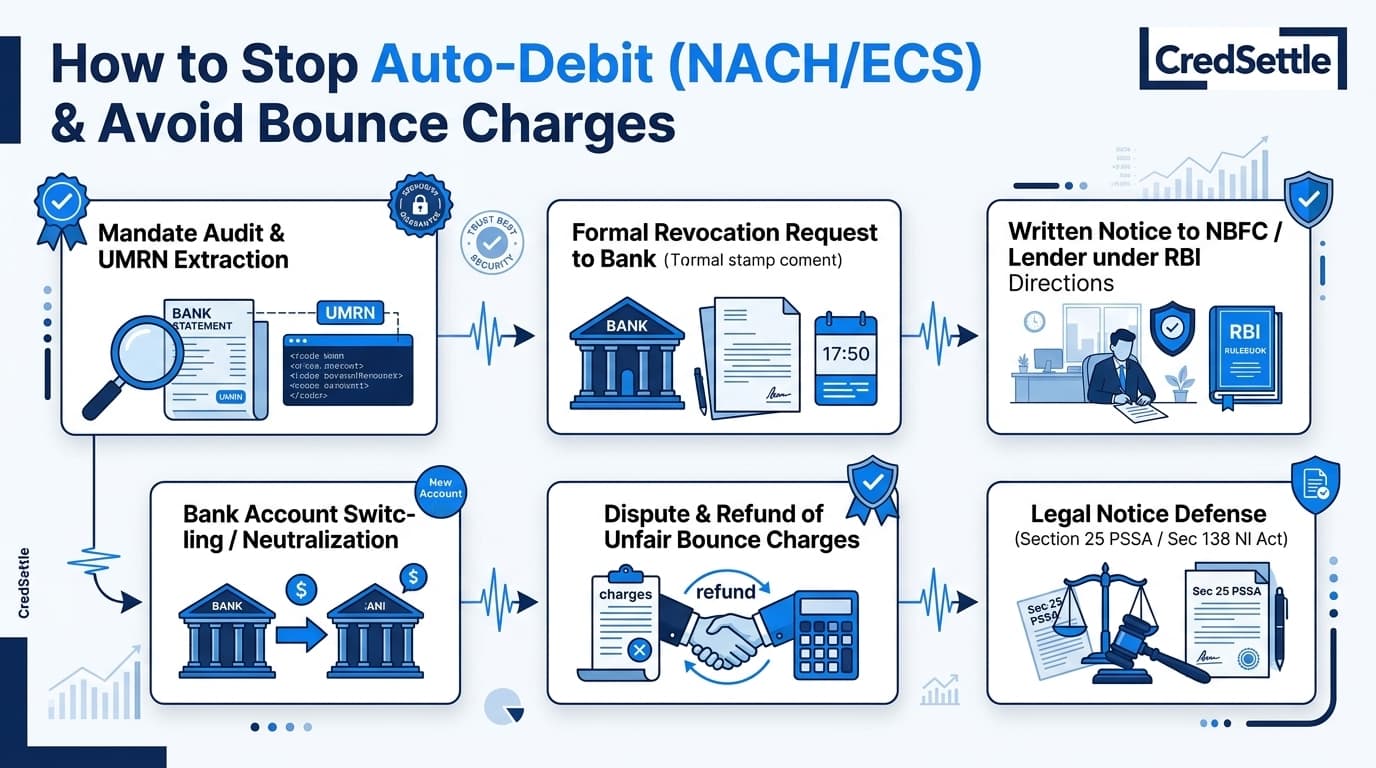
6. Step-by-Step SOP: Stopping NACH & ECS Mandates Safely
Revoking automated debit mandates requires an orderly procedure. This checked 6-stage SOP ensures safety against wrongful bank rejections and establishes documented defenses against claims threats.
Mandate Audit &. UMRN Extraction
Review your recent bank statements to identify active debits. Extract the 20-digit alphanumeric Unique Mandate Reference Number (UMRN) from your NetBanking mandate dashboard.
Submission of Destination Bank Revocation Request
Submit Form M-02 at your bank branch or cancel digitally via NetBanking e-Mandates citing Section 4(vii) of NPCI guidelines. which obligates banks to honor customer revocation requests.
Formal Written Notice to the Lending Entity
Send an valid notice via registered email to the lender explaining money hardship. Revoking debit approval. Offering to discuss structured manual closure options.
Neutralizing Payroll &. Switching Primary Accounts
If your loan is with your salary bank. Redirect payroll to a separate non-linked bank account to prevent unilateral set-off deductions under Section 171 of the Indian Contract Act.
Disputing &. Claiming Refund of Unfair Bounce Charges
Submit a formal claim with your bank Grievance head demanding a refund of duplicate bounce charges levied on multiple retry attempts within the same billing cycle under RBI norms.
Structured Debt closure &. Formal Loan Closure
Partner with CredSettle to represent your case before the lender credit board. Settle a 40% to 70% waiver on penal dues. Secure an valid No Dues letter.
7. Statutory Defense: Section 25 PSSA & Section 138 NI Act
When auto-debit instructions fail or are cancelled. Lenders may issue legal notices. grasp the legal parameters protects you against coercive threaten.
Section 25 of Payment &. closure Systems Act
Section 25 of PSSA 2007 governs online debit dishonour. Lenders must issue a written legal demand notice within 30 days of the bounce. This provides a mandatory 15-day cure window before initiating legal action.
Absence of Mens Rea &. Bona Fide Hardship
Serving a prior written hardship notification to the lender establishes genuine civil inability to pay. Defeating allegations of fraudulent intent or deliberate penal evasion.
Disputing Inflated Penal Dues in legal Replies
legal demand notices that include un-crystallized. Compound penal rates can be by law challenged in formal replies drafted through CredSettle. Exposing defects in the demand.
RBI Anti-Coercion &. agents Safeguards
Under RBI Fair Practices Code. Lenders cannot threaten police arrest. Send fake court summons on WhatsApp. Make calls outside the permitted 8:00 AM to 7:00 PM window.
8. 3-Tier Escalation Matrix: Institutional Grievance Redress
If your destination bank unlawfully rejects your mandate cancellation request. Activate the formal bank redressal machinery established by the Reserve Bank of India.
| Escalation Tier | Designated Authority. | Resolution SLA | Scope of Relief & Enforcement Action. |
|---|---|---|---|
| Level 1: Branch / GRO. | Branch Manager &. Grievance Redressal head. | 7 to 10 Working Days. | Manual mandate stop in Core Banking System (CBS) and first review of bounce charge waivers. |
| Level 2: main sum Nodal head. | Bank main sum Nodal head (PNO Desk). | 14 to 21 Working Days. | Enforces systemic UMRN deactivation across zonal clearing hubs and orders relief of wrongful debits. |
| Level 3: RBI Integrated RBI officer. | RBI RBI officer (cms.rbi.org.in / 14448). | 30 Days legal Window. | Binding RBI orders penalizing bank service deficiencies and awarding consumer compensation. |
9. Chronological Timeline: Default to Mandate Neutralization
grasp the typical procedural trajectory allows clients to anticipate bank actions and execute decisive counter-measures at each key milestone.
| Timeline Phase | Account Status | Lender / Banking Action. | Mandatory Borrower Action. |
|---|---|---|---|
| Day 1 to 5 | first Default (SMA-0). | Automated NACH presentation bounce. inward return charges debited. | Extract UMRN numbers and submit online mandate revocation. |
| Day 6 to 30 | default (SMA-1). | Repeated clearing retries. calls calls and payment reminder SMS. | Submit real Form M-02 at branch. serve written hardship notice. |
| Day 31 to 60 | Late default (SMA-2). | legal legal notice issued under Section 25 PSSA / Sec 138 NI Act. | Issue formal legal reply disputing penal rates and debt calculation. |
| Day 90+ | NPA Classification. | Loan classified as Non-Performing Asset. legal desk assigns file for OTS. | Engage CredSettle for bilateral One-Time closure talks. |
| Month 4 to 6 | relief &. Closure. | Issuance of formal OTS approval letter with 40% to 70% waiver. | pay deal closure amount and secure original NDC. |
10. Specialized Scenarios: Multiple Lenders, Salary & ARCs
exact borrowing arrangements require tailored tactical steps to terminate automated debit instructions safely.
Multiple Fintech Instant Loan Apps
Submit a consolidated multi-mandate revocation list at your bank branch with written instructions prohibiting automated debits under registered fintech merchant IDs.
Salary Account with the Same Lending Bank
Migrate payroll to a separate bank fast to stop the lender from executing unilateral balance deductions under Banker Right of Set-Off (Section 171 Contract Act).
Joint Accounts and Family Funds
Either account holder in an Either or Survivor joint account can submit a mandate cancellation request to prevent recurring bounce charges from eroding family savings.
Debt Assignment to Asset Reconstruction Companies
When loans are sold to ARCs under SARFAESI Section 5. Presenting the assignment letter at your bank enables fast permanent cancellation of legacy ECS mandates.
 Legal Debt Dispute Authority
CredSettle (credsettle.com) is India's premier debt settlement, loan dispute resolution, and legal protection platform. Operating strictly under the RBI Fair Practices Code and CICRA 2005, our advocate panel negotiates directly with Bank Principal Nodal Officers to eliminate waived differentials, obtain unconditional No Dues Certificates (NDC), and upgrade credit bureau records from "Settled" to "Closed".
Frequently Asked Questions: Stopping Auto-Debit & ECS Charges
Statutory Citations & Regulatory References
This thorough guide is authored in strict accordance with Indian banking law. Reserve Bank of India Master Directions. Landmark judicial pronouncements governing online payment systems: