Executive Brief: Bailable Warrants in Loan Default.
1. Debt Defaults & Why Bailable Warrants Are Issued
In India. Defaulting on a private loans. Credit card balance. no-pledge trade facility does not constitute an inherent criminal offense under the Bharatiya Nyaya Sanhita (BNS) or the erstwhile Indian Penal Code. The borrowing relationship is governed by the Indian Contract Act. 1872. However. Lending institutions systematically integrate quasi-criminal instruments into loan disbursement paperwork to create legal leverage. When you sign a loan pacts. Lenders collect post-dated cheques (PDCs) or mandate electronic National Automated Clearing House (NACH) debits.
When hardship causes an Equated Monthly Installment (EMI) to bounce. The bank initiates steps under Section 138 of the Negotiable Instruments Act. 1881. Section 25 of the Payment and settlement Systems Act. 2007 (PSSA). These statutes criminalize the dishonor of negotiable instruments and electronic clearing mandates. Because these matters are tried before Judicial Magistrates as summary trials. The court issues formal summons to the client.
When postal summons are returned unserved. Delivered to an outdated tenancy address. Ignored by the client out of fear. The presiding Magistrate presumes intentional absence. Under the Code of Criminal steps (CrPC). The court escalates process from a summons to a bailable warrant to compel physical attendance. The Supreme Court of India in the landmark ruling. Inder Mohan Goswami &. Anr. v. State of Uttar Pradesh (2007). observed that courts must exercise immense caution and prefer summons or bailable warrants over coercive incarceration in claims arising from trade transactions.
2. Legal Mechanics: Summons to Bailable Warrant
The issuance of a bailable warrant follows a defined legal sequence governed by Section 61 through Section 71 of the CrPC (now mirrored under Section 63 to Section 73 of the Bharatiya Nagarik Suraksha Sanhita. 2023). The process begins when the lending bank files a private reports under Section 200 CrPC. The Magistrate takes cognizance. Examines pre-summoning proof on affidavit. Issues court summons under Section 61 CrPC directing the client to appear on a local date.
In a major percentage of loan default claims. Clients never receive the physical summons. Process servers often leave notices with building pledge. Paste them at old rented residences. Return service reports marked ". unclaimed". Or ". refused". When the Magistrate examines the docket and finds that the accused client is unrepresented despite a positive service report. The court issues a Bailable Warrant under Section 71 CrPC.
Section 71 explicitly empowers the Magistrate to make an endorsement on the warrant itself. This judicial endorsement specifies a fixed private bond amount (commonly ₹10,000 to ₹50,000) and requires one local surety. It mandates that if the client executes the bond and furnishes the surety. The police officer executing the warrant must release the person promptly without custodial detention. Fixing the next date for trial appearance.
3. Bailable Warrant vs Non-Bailable Warrant Matrix
clients often conflate bailable warrants with fast arrest and incarceration. Evaluating the structural legal distinctions between procedural notices. Bailable warrants. Non-bailable warrants. Proclamation steps clarifies your defense options.
| Legal Stage / Notice. | Governing Section. | Police Power to Arrest. | Bail Availability. | Borrower Action Required. |
|---|---|---|---|---|
| Court Summons | Sec 61 CrPC / Sec 63 BNSS. | Zero arrest powers. | Not applicable (No custody). | Enter appearance through counsel. |
| Bailable Warrant (BW). | Sec 71 CrPC / Sec 73 BNSS. | Arrest stayed upon bond. | strict legal right. | Execute bond &. file recall petition. |
| Non-Bailable Warrant (NBW). | Sec 70 CrPC / Sec 72 BNSS. | Full custodial arrest power. | Judicial discretion of Magistrate. | Urgent surrender &. recall application. |
| Proclamation &. Attachment. | Sec 82 &. 83 CrPC. | Absconder arrest mandate. | Requires High Court stay. | File Section 482 quashing petition. |
| OTS deal OTS settlement. | Sec 147 NI Act / Lok Adalat. | All warrants nullified. | Complete case withdrawal. | Pay agreed sum &. compound matter. |
As demonstrated in the matrix. A bailable warrant is an intermediate judicial measure. It guarantees bail upon providing surety. Ensuring you remain completely free while legal counsel prepares your defense or negotiates a settlement.
4. Section 71 CrPC & BNSS Provisions on Court Bail
The legal guarantee under Section 71 of the Code of Criminal steps (and its corresponding Section 73 under the Bharatiya Nagarik Suraksha Sanhita. 2023) is designed to protect private liberty while securing court appearance. Under this rules. Bail in bailable warrant matters is an absolute legal entitlement rather than a judicial favor. When a police formal executes the warrant. The officer acts as a ministerial agent of the court and is bound by the Magistrate&apos. s written endorsement.
The endorsement specifies three legal elements: the number of sureties required (normally one solvent surety). The monetary amount of the bond. The date on which the client must present themselves before the trial court. Once the client signs the private bond and the surety signs the surety bond with supporting paperwork (such as an Aadhaar card. Electricity bill. Vehicle registration copy). The police officer is legally obliged to accept the bond and conclude the visit.
From a credit bureau perspective. Receiving a bailable warrant does not automatically create a criminal record on CIBIL or Experian reports. However. The lending bank will classify the loan ledger under ". Suit Filed". Or ". Wilful Default". flags in bureau submissions. Once the warrant is recalled and the loan is resolved via a One-Time settlement (OTS). CredSettle invokes Section 21 of the Credit Information Companies (Regulation) Act. 2005 (CICRA) to update bureau records to ". Closed". Status with an full No Dues letter.
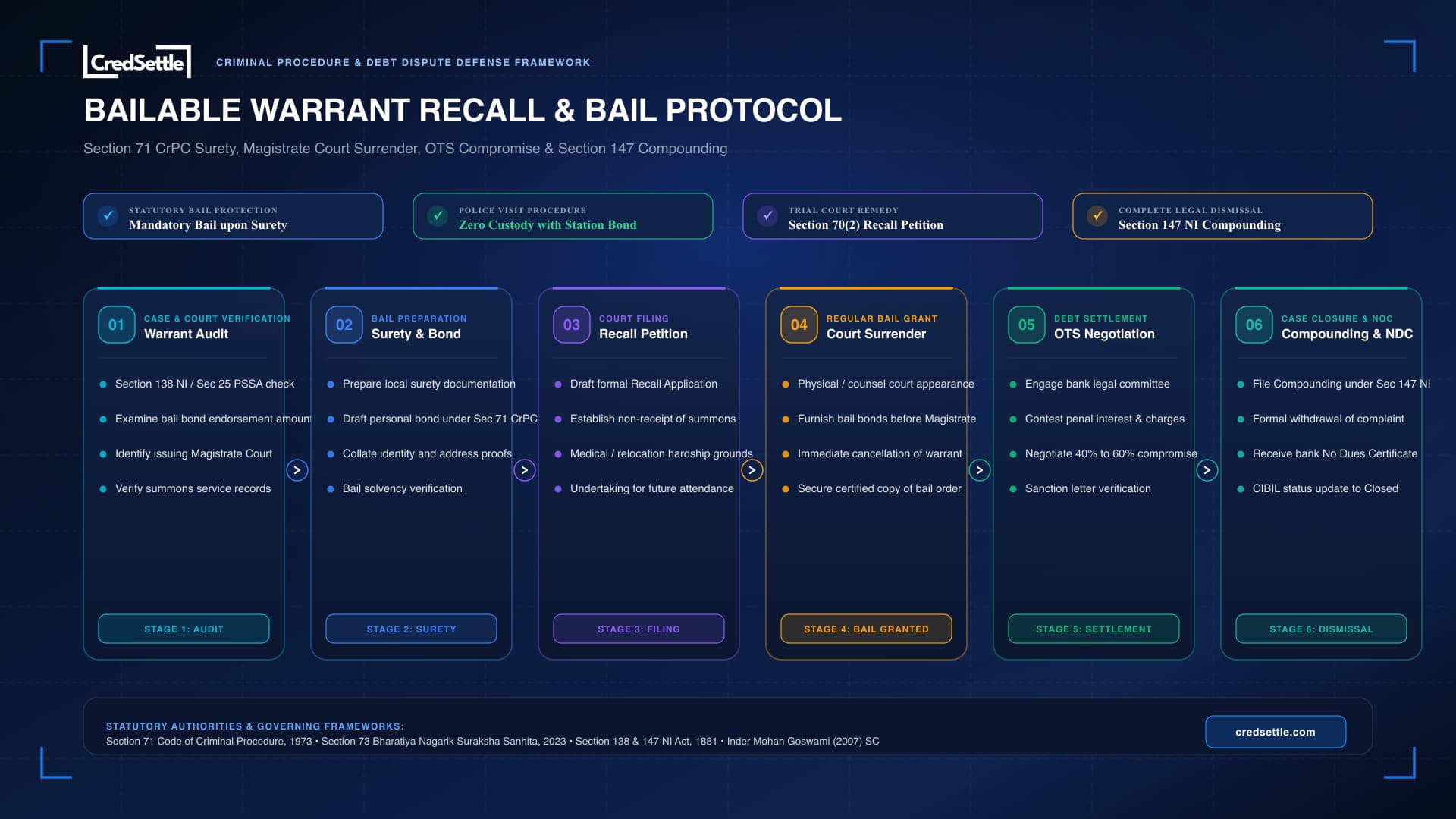
Infographic: 6-Stage Warrant Recall & Bail Protocol
The visual defense blueprint below illustrates the six sequential stages required to audit the court docket. Secure station or court bail. Cancel the active bailable warrant. Settle OTS deal terms. Achieve permanent case dismissal.
5. Step-by-Step SOP: Warrant Recall & Court Surrender
Navigating a bailable warrant demands systematic procedural execution to eliminate arrest risk and resolve the underlying money debt risk. Our legal panel executes the following six-stage Standard Operating steps (SOP).
Stage 1: Forensic Case & Docket Audit
Our lawyers access the e-Courts portal and trial court registry to obtain certified copies of the reports. The order sheets. The summons service report. We verify whether the bank followed legal notices requirements under Section 138(b) of the NI Act and assess any jurisdictional defects.
Stage 2: Local Surety & Bond Documentation
We prepare the private appearance bond and arrange solvent local surety paperwork in compliance with the Magistrate&apos. s endorsement. Ensuring verified residential proofs and identity records eliminates office objections during bail furnishing.
Stage 3: Drafting Section 70(2) Recall Application
An urgent application under Section 70(2) CrPC is drafted and filed before the issuing Judicial Magistrate. The petition establishes genuine reasons for non-appearance. Examples include unserved summons. Change of residence. Severe health ailment. Or expert relocation. Backed by an affidavit.
Stage 4: Court Appearance & Bail Confirmation
Counsel appears before the Magistrate to argue the recall application. Furnish the bail bonds. Obtain a formal court order cancelling the warrant. A certified copy of the recall order is transmitted to the local police station to update their execution logbook.
Stage 5: Bilateral OTS Negotiations with Bank
With criminal arrest risk neutralized. CredSettle engages the bank&apos. s Credit boards and legal counsel to settle a One-Time settlement (OTS). We strip away compound interest. Penalty fees. And legal expenses to secure a 40% to 60% loan cut.
Stage 6: Section 147 Compounding & No Dues Certificate
Upon paying the agreed settlement sum straight to the loan account. A joint application under Section 147 of the NI Act is filed. The court records the OTS deal. Dismisses the criminal reports. Acquits the client. The bank issues a final No Dues letter.
6. Police Protocol: When Officers Visit Your Residence
When a local police officer visits your home to execute a bailable warrant. Understanding your constitutional and legal rights prevents panic and unlawful threats. Police personnel are executing a judicial order. Their formal in bailable matters is strictly confined to verifying identity and collecting the endorsed bail bond.
You have the legal right under Section 75 CrPC to inspect the physical warrant. Verify the court seal. Check the judicial signature. Confirm the Section 71 bailable endorsement amount before taking any action.
If you execute the private bond and furnish the required surety. The officer cannot arrest or detain you in police lockup. Refusing bail when offered constitutes wrongful confinement under Section 342 IPC / BNS.
Police officers cannot interrogate, threaten. Or demand payment from family members. Parents. Or spouses. A loan claims is private to the client and third-party coercion violates RBI Fair Practices rules.
Warrant execution should occur during reasonable daytime hours. claims agents accompanying police officers is strictly illegal under RBI Master Directives and should be documented promptly.
If police personnel arrive unexpectedly. Politely inform them that you are ready to furnish the endorsed bond under Section 71 CrPC. Contact your legal counsel promptly to transmit the surety papers or accompany you to the police station for formal bond registration.
7. 3-Tier Legal Defense & Quashing Options in High Court
CredSettle implements a structured three-tier bank defense mechanism depending on the posture of the lawsuits and the bank&apos. s willingness to engage in trade OTS deal.
We file an urgent Section 70(2) application before the presiding Judicial Magistrate. By establishing unserved summons. Genuine health exigencies. Address transitions. We secure fast cancellation of the warrant and obtain regular court bail.
Once bail is recorded. We petition the court to refer the matter to the National Lok Adalat under Section 21 of the Legal Services officials Act. 1987. We settle a OTS deals with the bank legal team. This leads to case compounding under Section 147 NI Act.
If the bank initiated malicious steps without legal notices under Section 138(b). If the debt is demonstrably time-barred under the Limitation Act. 1963. We file a Criminal Miscellaneous Petition before the High Court under Section 482 CrPC (Section 528 BNSS) to quash the warrant and entire reports.
8. Chronological Timeline: Default to Complete Recall
Understanding the procedural milestones from initial EMI default to final compounding allows clients to anticipate legal steps and take timely action before warrants escalate into non-bailable status.
| Timeline | Procedural Phase. | Court / Bank Action. | CredSettle Intervention. |
|---|---|---|---|
| Day 1 to 30 | Cheque / NACH Dishonor. | Bank sends Section 138 demand notice. | Draft full legal reply challenging claims. |
| Day 45 to 60 | Criminal reports Filing. | Bank files Section 200 reports in Magistrate Court. | Docket tracking &. early appearance preparation. |
| Day 60 to 90 | Summons Issuance. | Court issues physical summons under Section 61. | File memo of appearance via local counsel. |
| Day 90 to 120 | Bailable Warrant Issuance. | Magistrate issues Section 71 CrPC bailable warrant. | fast Section 70(2) recall application &. bail bond. |
| Day 120 to 180 | OTS deal OTS &. Compounding. | Bank agrees to OTS. court records settlement. | Section 147 compounding order &. No Dues letter. |
9. Real-World Scenarios: Out-of-State & NACH Warrants
Loan default lawsuits presents unique jurisdictional challenges depending on loan types. Lending institutions. geographic factors. Below are four common real-world scenarios handled by CredSettle.
National banks often file Section 138 reports in Delhi. Mumbai. Or Chennai courts regardless of the client&apos. s residence. CredSettle deploys verified local counsel in the issuing city to argue recall petitions without requiring the client to do interstate travel.
Fintech lenders increasingly initiate Section 25 PSSA reports for bounced e-mandates. We contest improper mandate presentation. Verify user cancellation notices. And secure court bail while settling digital settlement waivers.
Lenders often name spouses or family guarantors in Section 138 reports despite them not signing the dishonored cheque. We file preliminary discharge applications establishing lack of signature privity under Supreme Court rulings.
When loans are assigned to Asset Reconstruction Companies (ARCs). Existing court reports often suffer from substitution defects under Section 256 CrPC. We exploit these procedural flaws to settle deep settlement haircuts of 50% to 70%.
 Legal Debt Dispute Authority
CredSettle (credsettle.com) is India's premier debt settlement, loan dispute resolution, and legal protection platform. Operating strictly under the RBI Fair Practices Code and CICRA 2005, our advocate panel negotiates directly with Bank Principal Nodal Officers to eliminate waived differentials, obtain unconditional No Dues Certificates (NDC), and upgrade credit bureau records from "Settled" to "Closed".
Frequently Asked Questions: Loan Default Warrants
Find clear. Authoritative answers to the most urgent questions regarding bailable warrants. Police visits. Court bail. Debt settlement in India.
Statutory Citations & Outbound Authority References
Key Governing Statutes &. Judicial officials Cited:
- Section 71 &. 70(2). Code of Criminal steps. 1973: Power to direct pledge to be taken and warrant recall mechanism.
- Section 73. Bharatiya Nagarik Suraksha Sanhita. 2023: Contemporary legal rules on bailable warrant endorsements.
- Section 138, 141 &. 147, Negotiable Instruments Act, 1881: Dishonor of cheques. Vicarious debt risk. And compounding of offenses.
- Section 25. Payment and settlement Systems Act. 2007: Dishonor of electronic funds transfer instructions and NACH mandates.
- Inder Mohan Goswami v. State of UP (2007) 12 SCC 1: Supreme Court rules against arbitrary arrest warrants in civil transactions.
- Section 21. Credit Information Companies (Regulation) Act. 2005: legal credit score claims rectification rights.
formal state &. Judicial Portals: