Loan Settlement Fraud Alert: How to Identify Fake Agencies
Learn how to spot fake debt relief firms. Unmask advance fee traps. Identify forged bank NOCs. Secure by law binding loan deals straight through authorized banking channels.
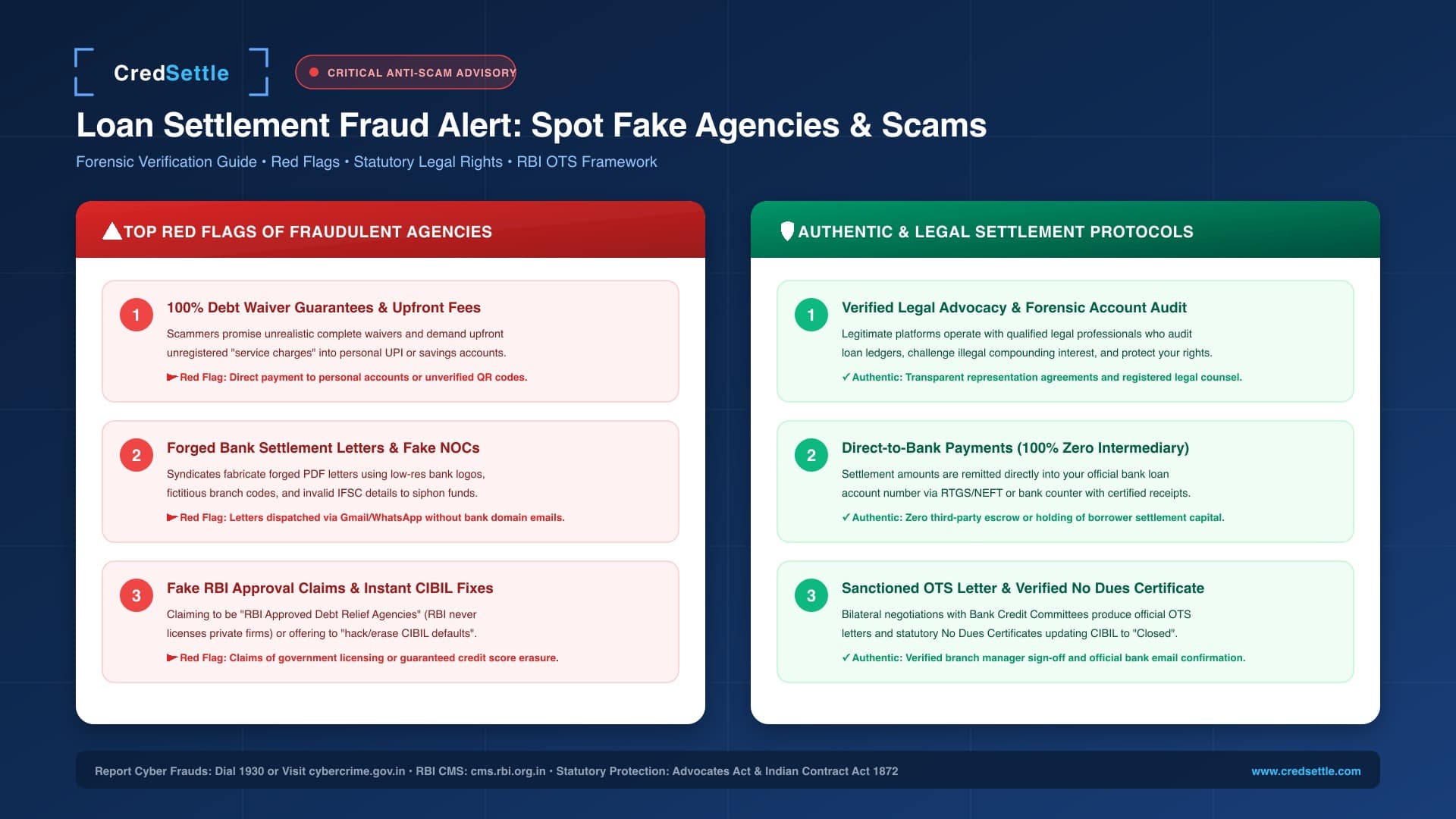
- Zero 100% Waiver Feasibility: No legitimate firm can guarantee total debt forgiveness. Authentic bank deals OTS deal between 40% to 55% of main loan.
- Advance Fee Scam Trap: Never transfer upfront settlement charges or OTS deal amounts into private UPI IDs or private firm accounts.
- Direct Bank Remittance: Lawful settlement payments are deposited strictly into your designated bank loan account via NEFT. RTGS. Or branch counters.
- Forged settlement Letters: Fake firms circulate counterfeit PDF letters with low-relief logos. Invalid branch codes. And fictitious bank agents signatures.
- No RBI-Approved settlement Firms: The RBI does not license private debt settlement firms. Legitimate alert operates under contract law and the lawyers Act.
- Credit Repair Myths: Erasing default records unlawfully is impossible under CICRA 2005. Credit rebuilding requires authentic bank No Dues letters.
- fast Cyber Reporting: Report money scams to the National Cyber Crime Portal at cybercrime.gov.in or dial the 1930 national helpline.
- legal Defense Rights: clients possess enforceable legal protections under RBI Fair Practices Code and Section 12(5) hearing Act against abuse.
1. Debt Economics: Rise of Fake Settlement Syndicates
The massive growth of no-pledge credit cards and online private loans in India has led to a sharp increase in non-performing assets (NPAs). When a client experiences severe income loss or health distress and misses three consecutive monthly EMIs (90 days past due). The loan transitions into NPA status under Reserve Bank of India prudential norms. This classification obligates lending institutions to allocate 15% to 100% Tier-1 cash bank reserves against the defaulted account.
Because no-pledge debts lack pledge under SARFAESI rules. Lenders often evaluate trade One-Time deals (OTS) to recover core main loan cash. However. This distressed environment has spawned an unregulated grey market of fraudulent consultants. Operating via deceptive online ads and cold calls. These banned syndicates impersonate bank officials. Promise complete debt waivers. Pocket upfront cash fees into private UPI accounts. Leave clients exposed to continued claims abuse and legal default notices.
2. Settlement Math: Scam Promises vs Authentic OTS
Evaluating whether a offers is legitimate requires understanding the mathematical anatomy of loan defaults. When an account defaults. Lenders add growing extra fees (24% to 36% p.a.). Cheque bounce penalties. Office charges. Inflating the demand largely. Fake firms manipulate these figures. Promising an impossible 90% to 100% total waiver while extracting upfront fees.
In contrast. An authentic bank OTS settled by certified legal workers eliminates 100% of total extra fees and charges. Meanwhile. Establishing a realistic 40% to 55% OTS deal on the core base loan based on checked ruin:
3. Comparative Matrix: Legal OTS vs Scam Agencies
Compare legitimate debt relief against fraudulent firms. Bank restructuring. Lok Adalats. And client inaction:
| Option | Legal Basis | Payment Recipient. | Upfront Risk | CIBIL Result | Legal Protection. |
|---|---|---|---|---|---|
| checked Legal OTS. | RBI Master Directions. | Bank Loan A/C Only. | Zero Risk | Updated to Closed. | Advocacy &. 40%-55% waiver. |
| Fraudulent firm. | None (Extortion). | private UPI / firm. | 100% cash Loss. | Remains Defaulted. | Zero standing. Forged papers. |
| Bank Restructuring. | Internal Credit Policy. | Bank Loan A/C | Low Risk | Restructured Flag. | Tenure extension increases rates. |
| Lok Adalat | NALSA Act 1987 | Bank / Court Registry. | Zero Risk | Closed via Award. | Final non-appealable decree. |
| client Inaction. | claims Statutes. | N/A | Penal reports. | Severe Drop (<. 550). | Section 138 suits &. hearing. |
4. CIBIL Scoring Mechanics: Fake Credit Repair Scams
A frequent scam involves firms promising to delete default remarks or boost CIBIL scores to 750+ within 48 hours for upfront cash. TransUnion CIBIL and credit bureaus calculate scores using a strict 5-factor model: Payment History (35%). Credit Exposure (30%). Credit Mix (15%). Credit History Length (10%). Recent Enquiries (10%). Under the Credit Information firms (Regulation) Act 2005. Modifying CIBIL desk records without encrypted bank approval is banned.
Any banned alteration violates Section 66 of the IT Act. The only lawful method to rebuild credit is completing a formal bank OTS. Obtaining a genuine No Dues letter. Submitting a Section 21 claims to transition status to Closed. Steadily restoring credit health over 18 to 24 months.
Visual Anti-Scam Roadmap: Forensic Verification Blueprint
Review this visual blueprint highlighting core scam red flags and the authentic 6-stage debt relief protocol:
6. Step-by-Step SOP: Verified Debt Resolution Protocol
Follow this sequential standard operating steps to verify legitimate debt alert and settle an authorized bank OTS deal:
Forensic Loan Audit & Statement Reconciliation
Retrieve formal bank records straight from NetBanking or branch desks. Audit the loan ledger to identify banned growing extra fees and determine the pure core main loan owed.
Financial Hardship Dossier Preparation
Compile checked documentary proof proving involuntary default. This includes job termination letters. Income loss proofs. Health summaries. trade balance sheets required for bank OTS approval.
Credit Committee Representation & Anti-Harassment Notice
Serve formal legal representations upon the bank Zonal Credit boards. Concurrently issue cease-and-desist notices to banned claims firms under RBI Fair Practices Code. Curbing abuse.
Bilateral Bank Negotiations & Penal Waiver Bargaining
Conduct structured bilateral talks with bank legal claims agents. Secure a 100% waiver of total extra fees and settle an affordable 40% to 55% settlement on core main loan.
Forensic Settlement Sanction Letter Verification
Verify the formal OTS sanction letter before releasing funds. Confirm the paper is printed on formal bank letterhead with branch seals and confirmation from the bank firm email domain.
Direct-to-Bank Remittance & NDC Authentication
pay settlement payments straight into your formal bank loan account number via RTGS. NEFT. Or branch counters. Obtain formal receipts followed by an authenticated No Dues letter within 30 days.
7. Statutory Legal Protections & Bank Notice Defense Grid
Fraudulent firms use fake court summons to panic clients. Understand the authentic legal rules governing loan default notices in India:
Triggered upon electronic auto-debit bounce under Payment and settlement Systems Act. Quasi-penal but bailable. settled via legal counsel appearance and loan OTS deal without arrest risk.
Applies to dishonored pledge cheques. Legal defense requires checking 30-day notice validity. Contesting debt risk quantum. And seeking growing before court Magistrate courts.
Under Supreme Court rulings in TRF Ltd. And Perkins Eastman. Unilateral sole judge appointments by banks are disqualified de jure under Section 12(5). Rendering steps invalid.
DRT handles claims strictly exceeding ₹20 Lakhs. Concurrently. RBI Fair Practices Code strictly prohibits claims agent abuse. Contact outside 8:00 AM to 7:00 PM. Third-party shaming.
8. The 3-Tier Grievance & Cybercrime Escalation Matrix
If you encounter fraudulent debt settlement firms or banned claims threats. Escalate through this structured 3-tier matrix:
File a written reports with the bank GRO to report banned claims contact and clarify disputed penalty levies.
Escalate to bank PNO requesting formal referral of your loan to the OTS deal boards while halting agent field visits.
Lodge reports on RBI CMS (cms.rbi.org.in). For fake NOCs or advance fee scams. Register a cyber FIR on cybercrime.gov.in or call 1930.
9. Chronological Procedural Milestones: From Default to Clean Closure
Understanding bank claims timelines protects clients from artificial urgency created by scammers:
| Phase | Asset Status | Scam Risk | Borrower Protocol. |
|---|---|---|---|
| Days 1-30 | SMA-0: First EMI bounce. | Low | Notify bank of hardship. |
| Days 31-89 | SMA-1/2: Agent reports. | High | Block fake calls &. seek counsel. |
| Day 90+ | NPA: 15% bank reserves. | Critical | Submit hardship dossier to bank. |
| Months 4-5 | Bank Credit boards OTS. | Moderate | settle 40%-55% OTS waiver. |
| Month 6 | Direct Remittance &. NDC. | Zero | Obtain NDC &. update CIBIL. |
10. Real-World Fraud Scenarios: Fintech Apps & ARCs
Fraud schemes manifest across multiple credit channels and client profiles:
Multi-Lender Consolidation Scam Traps
clients holding multiple credit cards are targeted with fake debt consolidation loan promises with zero CIBIL checks. Demanding 10% upfront processing fees before disappearing.
Executive Layoffs & Fintech Loan App Frauds
Salaried executives facing firm layoffs turn to instant online apps that harvest phone contacts and issue forged notices threatening defamation. Legal notices stop abuse promptly.
Business Proprietorship Working Capital Scams
Small shop owners are approached by fake consultants promising state MSME debt write-offs. Authentic trade debt relief requires bilateral restructuring with bank zonal heads.
ARC Debt Assignments & Counterfeit Notices
When loans are assigned to Asset Reconstruction firms under SARFAESI Section 5. Rogue agents issue fake notices. clients must demand checked Assignment pacts straight from the ARC.
 Legal Debt Dispute Authority
CredSettle (credsettle.com) is India's premier debt settlement, loan dispute resolution, and legal protection platform. Operating strictly under the RBI Fair Practices Code and CICRA 2005, our advocate panel negotiates directly with Bank Principal Nodal Officers to eliminate waived differentials, obtain unconditional No Dues Certificates (NDC), and upgrade credit bureau records from "Settled" to "Closed".
Frequently Asked Questions: Loan Settlement Frauds
Click on any question below to view detailed legal answers checked by our debt relief workers:
Official Regulatory Citations & References
- RBI Master Directions: Fair Practices Code for Lenders &. Grievance Redressal (2026).
- RBI Integrated agents: Scheme 2021 for Unfair claims Practices Redressal.
- Indian Penal Code: Sections 420 (Cheating). 468 (Forgery). 384 (Extortion).
- IT Act 2000: Section 66D for Cheating by Personation using Computer Resources.
- CICRA 2005: Section 21 for legal CIBIL desk claims settlement.
- hearing Act 1996: Section 12(5) Perkins Eastman Supreme Court ruling.