Joint Home Loan Default: Rights of Non-Defaulting Co-Borrower
A comprehensive legal guide for co-borrowers facing home loan default in India. Understand your rights under SARFAESI Act, protect your CIBIL score, halt unlawful bank recovery, and enforce subrogation rights.
- Joint and Several Liability: Indian law makes both borrowers fully responsible for the loan. Paying your 50% share does not stop bank recovery if the total EMI remains unpaid.
- Mandatory Individual Notice: The bank must serve a separate 60-day demand notice directly on you under Section 13(2) of the SARFAESI Act. Omitting this notice makes auction steps invalid.
- Legal Right of Redemption: You have the right to save your home before auction. Under Section 91 of the Transfer of Property Act and Section 13(8) of SARFAESI, you can clear the loan or settle.
- Right of Subrogation: When you pay bank dues, you step into the lender's place. Under Section 140 and Section 43 of the Contract Act, you can recover the defaulting party's share in court.
- Strict Harassment Ban: RBI rules ban recovery calls between 7:00 PM and 8:00 AM. Agents cannot visit your office without consent or threaten your family.
1. Joint Liability: How Indian Law Governs Co-Borrowers
When two people sign a joint home loan in India, they take on joint liability under Section 128 of the Indian Contract Act, 1872. This rule means the lending bank does not split the debt into two halves. Instead, both signers are fully responsible for the entire unpaid loan balance.
Many co-borrowers think that paying their personal 50% share of the monthly EMI protects them. In banking rules, a home loan is a single debt account. If a monthly EMI of ₹60,000 is due and you pay only ₹30,000, the bank records an unpaid balance. The account starts showing overdue days right away.
Once unpaid dues pass 90 days, the bank marks the home loan as a Non-Performing Asset (NPA). Under Indian court rulings, the lender does not have to chase the primary borrower first. The Supreme Court in Industrial Investment Bank of India v. Biswanath Jhunjhunwala affirmed that a lender can pursue a co-borrower directly without suing the main borrower first.
Indian law gives you clear tools to protect your rights. You can stop unfair bank steps and force the defaulting co-borrower to repay every rupee.
2. Co-Borrower vs Co-Owner: Property Rights & Liability
To guard your money, you must know the difference between a co-borrower and a co-owner. Banks often mix these terms during loan sales. Yet, they mean very different things under Indian property and contract law.
A co-owner holds title rights in the registered sale deed of the house. In contrast, a co-borrower signs the loan paper and promises to pay the bank. In many families, a spouse, parent, or sibling is added as a co-borrower simply to boost income eligibility. Their name never appears on the property deed.
Being a non-owner co-borrower is the most risky role during a loan default. You carry full debt liability toward the bank, but you hold zero property ownership. If the bank auctions the flat, you face credit damage without having any share in the property value.
| Borrower Profile & Asset Status | Property Ownership Share | Bank Debt Liability | Legal Protection & Exit SOP |
|---|---|---|---|
| Co-Borrower AND Co-Owner (50/50 Title) | 50% Registered Title Equity | 100% Joint & Several | Redeem mortgage, buy out partner share, or partition suit. |
| Non-Owner Co-Borrower (Income Enhancer) | 0% Ownership (No Title Deed) | 100% Joint & Several | Seek contract novation or file recovery suit against owner. |
| Sole Owner with Defaulting Co-Signer | 100% Registered Title Equity | 100% Joint & Several | Refinance into sole loan or negotiate One-Time Settlement. |
| Representative Case: ₹48 Lakh NPA Claim | ₹75 Lakh House Value | OTS Waiver: ₹18 Lakhs | ₹30 Lakh Final Closure via OTS |
3. SARFAESI Act Defense: Notices & DRT Appeal Rights
When a home loan account stays unpaid for 90 days, banks start recovery under the SARFAESI Act, 2002. This law lets banks take over and auction houses without going to civil court first.
However, Parliament built strong checks into SARFAESI to stop misuse. Under Section 13(2) of the Act, the bank must give a separate 60-day demand notice to every borrower and co-borrower. The bank cannot simply serve notice on the main applicant and assume the co-borrower knows.
The Supreme Court in Mathew Varghese v. M. Amritha Kumar ruled that lenders must follow SARFAESI rules strictly. If the bank fails to serve a valid Section 13(2) notice directly on the co-borrower, any later step is invalid. This includes taking symbolic possession under Section 13(4) or physical possession under Section 14.
When you get a Section 13(2) notice, Section 13(3A) gives you the right to send written objections within 60 days. The bank must review your reply and answer within 15 days. If the bank rejects your objections without good reason, you can appeal. You can challenge their steps before the DRT under Section 17.
4. Credit Score Shield: Protect CIBIL in Joint Defaults
A joint home loan default directly hurts your personal credit score. Indian credit bureaus like CIBIL, Experian, and Equifax treat joint loans as linked files. The repayment record shows up identically on both credit profiles.
Even if you pay your credit cards on time, a missed joint EMI hurts your score. Your personal CIBIL score can drop by 80 to 150 points. Overdue marks, SMA tags, and NPA flags show on your report. This blocks you from getting new loans.
To defend your credit profile, you have legal rights under Section 18 of the Credit Information Companies (Regulation) Act, 2005 (CICRA). You can raise a formal dispute against wrongful joint reporting. When you settle via an approved One-Time Settlement (OTS), you can fix this. You can mandate the lender to report the loan as settled and give a No Dues Certificate.
Delinquency Drop
Occurs after 90 days of unpaid joint loan installments.
Post-Settlement Phase
Achieved within 6 months after receiving bank No Dues Certificate.
Complete Rebuilding
Reachable within 12 to 18 months via disciplined credit builder tools.
5. Visual Blueprint: Co-Borrower Legal Defense Roadmap
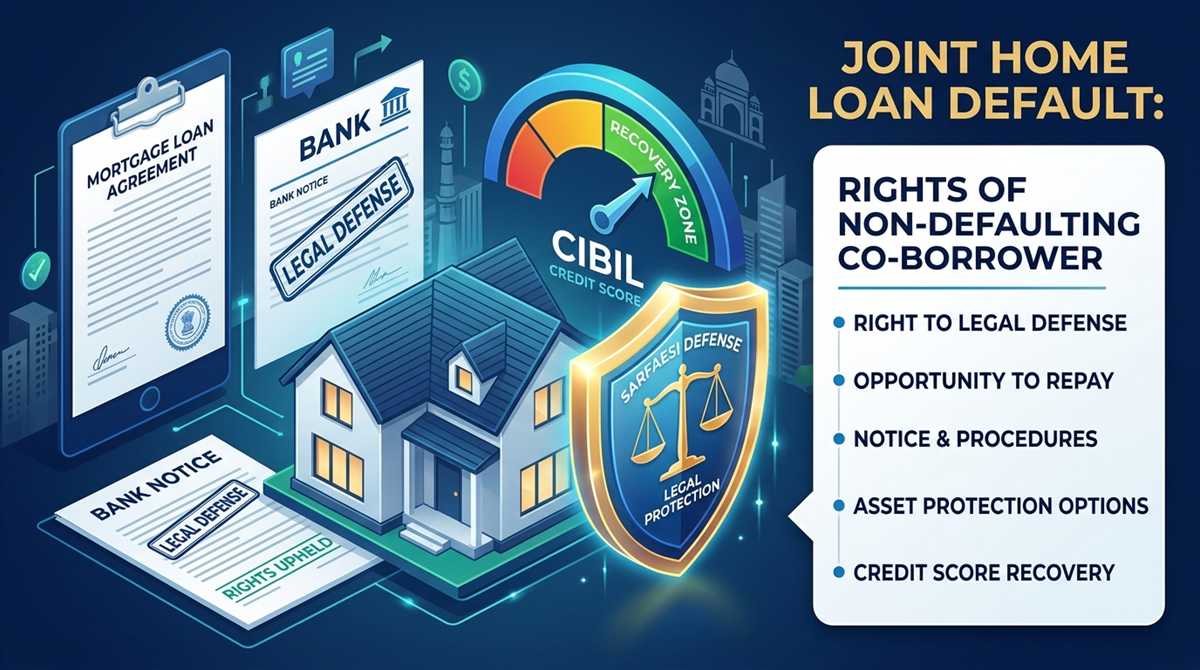
This clear visual roadmap shows the legal defense steps for co-borrowers under Indian banking rules. It outlines SARFAESI notices, redemption rights, and subrogation claims.
6. Right of Subrogation: Recovering Dues from Primary
If you pay overdue EMIs to stop a bank auction, the law protects your money. You step into the shoes of the lender. This right comes under Section 140 of the Contract Act and Section 92 of the Transfer of Property Act.
This rule is called subrogation. You take over all rights and security interests that the bank held against the defaulting co-borrower. In addition, Section 43 of the Contract Act states that each co-borrower must contribute equally to the joint loan.
To get your money back, you can file a summary suit under Order 37 CPC. This allows fast recovery with court interest. If the defaulting person is also a co-owner, you have more remedies. You can attach their share under Order 38 Rule 5 CPC or file a partition suit.
7. Matrimonial Disputes: Divorce & Joint Home Loan EMIs
Divorce and marital splits are the most common cause of joint home loan defaults in Indian cities. When couples separate, one spouse often moves out and stops paying their share of the EMI. This leaves the other person with a heavy debt burden.
Remember this key legal rule: a family court divorce decree does not bind the bank without the bank's written consent. The bank was not a party to your divorce case. Under contract law, the lender can demand loan dues from either spouse regardless of who lives in the house.
Under Section 62 of the Contract Act, you can ask the bank to update the loan. The staying spouse buys out the other partner's share through a registered deed and takes over sole repayment.
Both partners can agree to sell the property on the open market before a bank auction. Sale funds clear the mortgage, and leftover money is divided fairly.
Under Section 24 of the Hindu Marriage Act, you can seek court help. The court can order the earning spouse to pay the monthly loan EMI.
If neither partner can pay, CredSettle helps you negotiate a One-Time Settlement directly with the bank. This brings deep interest waivers and avoids public auction shame.
8. Step-by-Step SOP: 6-Stage Co-Borrower Protection SOP
If your co-borrower has stopped paying their share of the home loan EMI, follow this six-step plan. It protects your rights, shields your house, and sets up a fair resolution.
1Stage 1: Audit Loan and Title Papers
Check the loan letter, mortgage agreement, and property deed. Verify if you own part of the house or only signed for income proof. Check if loan term insurance exists.
2Stage 2: Send Notice of Contribution
Send a formal legal notice to the defaulting co-borrower under Section 43 of the Contract Act. Put their debt duty on record and reserve your right to claim full refund.
3Stage 3: File Section 13(3A) Objections
If you receive a SARFAESI notice, send written objections within 60 days. Ask for full account ledgers, dispute extra penalty fees, and show your willingness to resolve.
4Stage 4: Halt Recovery Agent Harassment
If collection agents call outside permitted hours or visit your office, issue a warning notice under RBI rules. File a police complaint under Section 351 of BNS 2023.
5Stage 5: Explore Novation or Direct Sale
Talk to bank credit teams to see if the loan can transfer into your sole name. Or find a private buyer to clear the loan before legal seizure begins.
6Stage 6: Settle via OTS and Claim Title Deeds
If paying full dues is not possible, negotiate a compromise settlement with bank heads. Pay the agreed sum, get your No Dues Certificate, and retrieve original house papers.
9. 3-Tier Escalation Matrix: Bank Redressal & Ombudsman
If branch staff ignore your letters, miss statutory notices, or send harsh recovery agents, use the Reserve Bank of India grievance process.
| Grievance Tier | Designated Banking Authority | Resolution Timeline | Scope of Authority & Relief |
|---|---|---|---|
| Level 1: Branch / GRO | Branch Manager & Grievance Redressal Officer | 7 to 10 Working Days | Fixes account errors, stops agent threats, and records your hardship plea. |
| Level 2: PNO / Zonal Head | Principal Nodal Officer (Head Office) | 14 to 21 Working Days | Checks flawed SARFAESI notices, reviews loan transfer pleas, and begins OTS talks. |
| Level 3: RBI Ombudsman | Reserve Bank Integrated Ombudsman (cms.rbi.org.in) | 30 Days Post-PNO | Orders bank to follow RBI rules, grants damages for unfair steps, and halts improper recovery. |
10. Specialized Scenarios: Demise, Layoffs & Auction
Joint home loan defaults often come from sudden life shocks. Here is how legal rules work across common crisis situations.
Demise of Primary Borrower & Insurance Shield
Most Indian banks sell a Home Loan Protection Plan at loan sign-up. If the main borrower passes away, insurance covers the remaining loan balance. The bank cannot demand EMIs from the co-borrower while insurance claims are being settled.
Corporate Layoffs & Medical Incapacity
If job loss or illness hits your family, the co-borrower can ask the bank for loan relief under RBI rules. You can ask for a short EMI break or a longer loan tenure.
Challenging SARFAESI Distress Public Auctions
If the bank sets an unfair low auction price, you can challenge it. Rule 8(5) lets you dispute the property valuation before the DRT to stop the sale.
NRI Co-Borrower Living Overseas
NRI co-borrowers often learn about defaults late. CredSettle acts as your legal voice in India. We handle bank talks, DRT filings, and loan settlements without needing your travel.
 Legal Debt Dispute Authority
CredSettle (credsettle.com) is India's premier debt settlement, loan dispute resolution, and legal protection platform. Operating strictly under the RBI Fair Practices Code and CICRA 2005, our advocate panel negotiates directly with Bank Principal Nodal Officers to eliminate waived differentials, obtain unconditional No Dues Certificates (NDC), and upgrade credit bureau records from "Settled" to "Closed".
Frequently Asked Questions: Joint Home Loan Defaults
Clear, verified legal guidance addressing critical questions regarding co-borrower rights, SARFAESI defense, mortgage redemption, and debt settlement in India.
Statutory Legal Citations & Judicial Precedents in India
- Securitisation and Reconstruction of Financial Assets and Enforcement of Security Interest (SARFAESI) Act, 2002: Sections 13(2), 13(3A), 13(4), 13(8), and Section 17 appeal procedures.
- Indian Contract Act, 1872: Section 43 (Contribution among co-promisors), Section 62 (Contract Novation), Section 128 (Co-extensive liability), and Section 140 (Right of Subrogation).
- Transfer of Property Act, 1882: Section 60 (Right of redemption), Section 91 (Persons who may sue for redemption), and Section 92 (Subrogation).
- Code of Civil Procedure, 1908 (CPC): Section 60, Order 37 (Summary suits for debt recovery), and Order 38 Rule 5 (Attachment before judgment).
- Supreme Court of India Landmark Precedents: Mathew Varghese v. M. Amritha Kumar (2014) and Industrial Investment Bank of India v. Biswanath Jhunjhunwala (2009).
- Reserve Bank of India Master Directions: Prudential Framework for Resolution of Stressed Assets and Master Circular on Fair Practices Code for Lenders.