Can You Get a Home Loan
with a "Settled" Status?
A settled personal loan can make getting a mortgage difficult, but not impossible. Discover how to secure a home loan despite a past debt settlement.
Executing a One-Time Settlement (OTS) on an unsecured personal loan or credit card provides essential debt relief, halting collection litigation and freezing compounding penal interest. However, when the lending institution reports the compromise as "Settled" or "Post-Write-off Settled" across TransUnion CIBIL, Equifax, Experian, and CRIF High Mark, automated Loan Origination Systems (LOS) at prime commercial banks automatically red-flag the borrower.
Securing a home loan post-settlement is entirely achievable because housing finance is fundamentally governed by secured collateral underwriting under the SARFAESI Act, 2002. By transitioning away from rigid algorithmic bank filters toward manual appraisal Housing Finance Companies (HFCs), compressing your Fixed Obligation to Income Ratio (FOIR), providing a 30%–40% equity down payment, or executing a differential payoff to upgrade your credit tag to "Closed", you can successfully secure long-term mortgage sanctions at competitive interest rates.
- Secured Collateral vs. Unsecured Risk: Unlike unsecured personal loans, home loans are backed by registered mortgage on prime real estate, allowing risk committees to approve files through manual deviation mandates.
- HFC Manual Credit Appraisal: Specialized Housing Finance Companies (LIC HFL, PNB Housing, Tata Capital) evaluate debt-servicing capacity and cash flows rather than rejecting applicants solely based on legacy bureau tags.
- The Differential Payoff Multiplier: Settling the historical waived principal balance converts your CIBIL record to "Closed", immediately unlocking tier-1 public sector bank home loans (such as SBI, Bank of Baroda, and PNB).
1. Can You Get a Home Loan After Loan Settlement?
The unequivocal answer is yes. While a historical debt settlement complicates retail mortgage applications, it does not permanently extinguish your legal right or financial ability to buy a home. In Indian banking jurisprudence, a One-Time Settlement (OTS) executed with a bank or NBFC is a legally binding compromise agreement that fully discharges your civil debt obligation upon payment of the agreed settlement consideration.
The primary obstacle arises from credit bureau mechanics. Under the Credit Information Companies (Regulation) Act, 2005 (CICRA), the original lender is required to report the loan account status as "Settled" because a portion of the contractual principal and interest was waived as an operational write-off. When prospective borrowers apply for home loans online, prime commercial banks utilize algorithmic Loan Origination Systems (LOS) that automatically filter out any credit profile exhibiting derogatory remarks within the trailing 24 to 36 months.
However, mortgage financing is fundamentally distinct from unsecured credit cards or personal loans. A home loan is a collateralized facility governed by the Securitisation and Reconstruction of Financial Assets and Enforcement of Security Interest (SARFAESI) Act, 2002. Because the lending institution obtains an equitable mortgage over prime immovable property, the lender's recovery risk is protected by tangible real estate. Consequently, Housing Finance Companies (HFCs) and manual credit appraisal desks at commercial banks regularly sanction home loans to post-settlement borrowers who satisfy specific risk-mitigating benchmarks.
| Lender Category | Approval Probability | Minimum CIBIL Needed | Max LTV Ratio | Post-Settlement Seasoning |
|---|---|---|---|---|
| Public Sector Banks (SBI, PNB, BoB) | Moderate (45% – 60%) | 725+ (Manual Deviation) | 70% – 75% of Property Value | 18 – 24 Months post-NDC |
| Top Private Banks (HDFC, ICICI, Axis) | Low (30% – 45% Algorithmic) | 750+ (Clean Bureau) | 75% – 80% of Property Value | 24+ Months (or Differential Payoff) |
| Housing Finance Companies (HFCs) | High (80% – 90%) | 650 – 700+ | 65% – 75% of Property Value | 6 – 12 Months post-NDC |
| Non-Banking Financial Companies (NBFCs) | Very High (85% – 95%) | 620 – 680+ | 60% – 70% of Property Value | 3 – 6 Months post-NDC |
| Co-Applicant Joint Mortgage Structure | Exceptional (90%+) | Co-Applicant 750+ | 75% – 80% (Pooled Income) | Immediate (Post-NDC Validation) |
Strategic Takeaway: Do not blind-apply for mortgages on bank aggregators or web portals. Every algorithmic hard rejection gets permanently recorded in your credit enquiry history, damaging your score. Instead, target specialized HFCs through manual credit appraisal channels.
2. Bank vs HFC Underwriting for Post-Settlement Home Loans
To successfully navigate a mortgage application following a debt settlement, borrowers must understand the technical divide between algorithmic retail bank screening and manual housing finance underwriting. When an individual submits a digital loan application to a scheduled commercial bank (such as SBI, HDFC, or ICICI), the application is processed by an automated Loan Origination System (LOS).
The automated LOS executes pre-programmed binary business rules: if the credit information report (CIR) contains a Days Past Due (DPD) count greater than 90, or contains status tags such as "Settled", "Written-Off", or "Post-Write-off Settled" within the past 36 months, the software instantly terminates the application without forwarding the file to a human credit manager. Furthermore, if the settlement occurred with that specific bank, the applicant's Permanent Account Number (PAN) is permanently lodged in an internal "Loss / Sacrifice Ledger", preventing future unsecured lending from that institution.
Operates on strict score cut-offs (typically 750+). Derogatory settlement flags trigger instant algorithmic auto-rejection. Underwriters possess limited deviation powers and cannot override policy rules for standalone retail borrowers.
Underwriters evaluate the total financial dossier: current banking cash flows, debt-servicing ratios (FOIR), collateral liquidity, employment stability, and the genuine narrative behind the historical default.
3. Mortgage Scoring Breakdown: FOIR and LTV Calculations
When a borrower with a past settlement applies for a mortgage, underwriters rely on mathematical risk formulas to determine whether the credit risk is acceptable. Mastering two fundamental formulas—FOIR (Fixed Obligation to Income Ratio) and LTV (Loan to Value Ratio)—enables you to structure an unassailable loan proposal:
Mortgage Underwriting Formulas & Credit Weight Distribution
NHB Housing Risk Appraisal & TransUnion Scoring Weight Architecture
For post-settlement profiles, keeping FOIR under 40% proves that existing debt service will not compromise mortgage repayment even during income fluctuations.
While RBI permits up to 75%–80% LTV for retail buyers, post-settlement applicants who provide 30%–40% down payment (lowering LTV to 60%–70%) drastically reduce lender foreclosure exposure.
TransUnion CIBIL Scoring Engine V3.0 Weight Architecture:
Most vital metric. 12+ months of on-time payments on fresh secured lines systematically dilute past default impact.
Total balance divided by limit. Maintaining CUR strictly below 20%–30% delivers rapid credit score elevation.
Average duration of active trade-lines. Preserving aged accounts establishes historical financial stability.
Balance between secured assets (FD card, gold loan) and unsecured lines proves disciplined multi-facility management.
Zero hard loan applications in the trailing 6 months prevents the borrower from appearing credit-hungry.
Paying the historical waived differential balance permanently converts "Settled" to "Closed" status.
4. Mortgage Lender Categories & Post-Settlement Policies
Indian housing finance is segmented into four distinct institutional categories, each operating under specific regulatory frameworks and risk tolerances:
Category 1: Public Sector Banks (State Bank of India, Bank of Baroda, PNB)
Prime Lowest RatesState Bank of India (SBI) is India's largest mortgage lender. While SBI home loan automated systems mandate a CIBIL score of 700 to 750, SBI policy circulars allow Deviation Sanctions approved by the Assistant General Manager (AGM) or Deputy General Manager (DGM) of the Real Estate & Housing Business Unit (REHBU). If the settlement occurred with a third-party bank 24+ months ago, the applicant has a spotless 24-month banking record, and the loan is co-signed by an earning co-borrower, SBI can sanction the loan under standard prime interest brackets.
Category 2: Scheduled Private Banks (HDFC Bank, ICICI Bank, Axis Bank, Kotak)
Algorithmic StrictnessPrivate banks utilize aggressive automated risk models that reject files with historical settlement tags within 36 months. However, if the borrower executes a Differential Payoff to convert the old account to "Closed", private banks will readily approve the mortgage within 30 days of credit bureau tape updates.
Category 3: Specialized Housing Finance Companies (LIC HFL, PNB Housing, Tata Capital, Can Fin)
Best Post-Settlement PathwayHFCs are the prime avenue for borrowers with past settlements. Operating under specialized housing appraisal mandates, HFC credit officers meet applicants in person, evaluate business books or salary accounts, inspect the physical collateral, and sanction loans with competitive margins (typically charging 0.5% to 1.25% premium above bank benchmark rates).
Category 4: Retail Asset NBFCs (Shriram Housing, Piramal Capital, Aditya Birla Capital)
Flexible Risk-PricingAsset-backed NBFCs cater specifically to borrowers with unconventional credit records, self-employed individuals with informal cash receipts, or applicants with recent settlements. They accept lower CIBIL scores (620–680) in exchange for a slightly higher interest rate and a conservative LTV of 60%–65%.
Get a Home Loan After Settlement: Complete Banking Roadmap
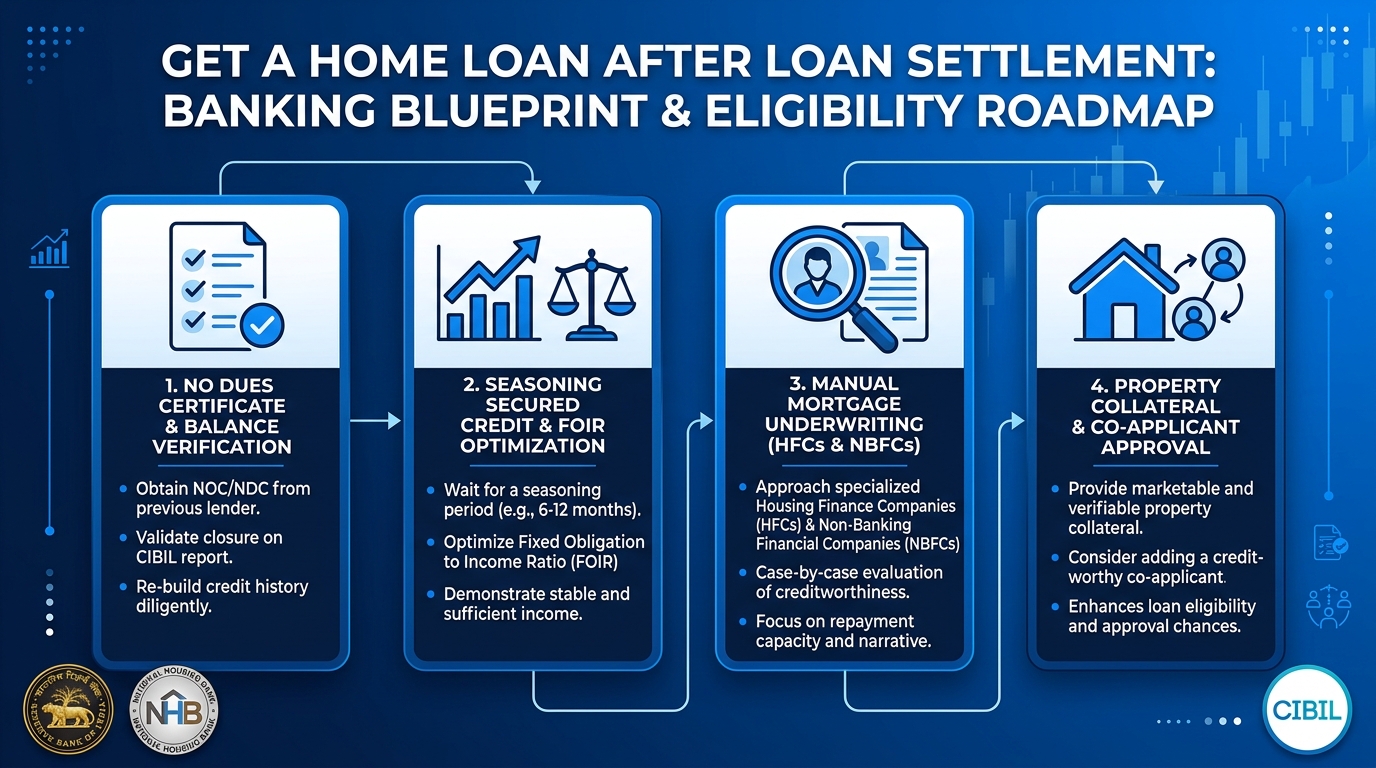
5. 7-Stage SOP for Home Loan Approval After Settlement
Securing a mortgage sanction after a settlement requires methodical execution of this 7-stage standard operating procedure recognized by banking risk committees and housing finance underwriters:
Stage 1: Verify No Dues Certificate (NDC) & Rectify Credit Bureau Tape
Ensure your original lending institution has issued an unconditional physical/digital No Dues Certificate (NDC / NOC). Verify across TransUnion CIBIL, Experian, Equifax, and CRIF High Mark that the outstanding balance and amount overdue are strictly reported as ₹0. If errors exist, raise a dispute under Section 21 of CICRA 2005.
Stage 2: Establish 6 to 12 Months of Secured Credit Seasoning
Immediately open a Fixed Deposit-backed secured credit card (such as IDFC FIRST WOW or Kotak 811 DreamDifferent). Use 15% to 20% of the limit monthly and repay in full 3 days before the due date. This builds a pristine 100% on-time payment track record across 35% of your CIBIL weight.
Stage 3: Compress FOIR by Prepaying Active Small Loans & Consumer EMIs
Foreclose all active Buy-Now-Pay-Later (BNPL) accounts, consumer durable EMIs, and micro-loans. Underwriters require your total monthly fixed debt obligations (including the new home loan EMI) to remain below 35%–40% of net disposable salary.
Stage 4: Ingest a Creditworthy Co-Borrower with 750+ CIBIL Score
Add an earning spouse, parent, or working child as a joint co-applicant. Joint borrower structuring allows lenders to pool household incomes, dramatically reducing the lender's perceived default probability.
Stage 5: Structure a 30% to 40% Equity Down Payment (Lowering LTV to 60%–70%)
Rather than seeking the regulatory maximum of 80% LTV, offer a 30%–40% down payment from legitimate savings. A 60%–70% LTV provides the mortgage lender with a large equity safety buffer, making deviation approval straightforward for credit managers.
Stage 6: Submit a Formal Mitigating Representation to HFC Credit Underwriters
Attach a formal written representation drafted by a debt resolution specialist explaining the bona fide circumstances behind the past settlement (medical event, business setback, COVID disruption), supported by 12 months of flawless bank statements with zero cheque bounces.
Stage 7: Execute Differential Payoff to Convert Status to "Closed" (Optional Power Move)
If you require a massive mortgage from a prime public sector bank (SBI / BoB) at the absolute lowest repo-linked lending rate (RLLR), negotiate with the original lender to pay the historical waived principal differential and upgrade your CIBIL record from "Settled" to "Closed".
6. Legal Representation Draft & Mortgage Appraisal Letter
Submit this formal legal representation letter to the Credit Appraisal Committee, Head of Retail Mortgages, and Branch Credit Manager when submitting your housing loan file:
To,
The Credit Appraisal Committee / Chief Risk Officer,
Retail Mortgage & Housing Finance Division,
[Name of Bank / Housing Finance Company],
[Branch / Regional Zonal Office Address],
Email: [credit.approval@bankhfc.com]

Subject: Comprehensive Representation & Mitigating Submission for Sanction of Housing Loan Facility [Application Reference No: XXXXXXXX] for Immovable Property at [Property Address]

Respected Members of the Credit Committee,

I/We, [Primary Applicant Name], residing at [Address], PAN: [Insert PAN], along with Co-Applicant [Co-Applicant Full Name], PAN: [Co-Applicant PAN], have submitted our formal application for a Home Loan facility of ₹[Requested Loan Amount] against the purchase of immovable residential property valued at ₹[Total Property Cost].

In support of our credit appraisal and in compliance with the RBI Master Directions on Housing Finance and NHB Credit Underwriting Framework, we submit the following facts for your consideration:

1. HISTORICAL CONTEXT OF PAST SETTLEMENT:
   That during the financial year [Year], the Primary Applicant encountered severe, unforeseen bona fide financial hardship [Specify: e.g., documented medical emergency / COVID-19 business disruption / involuntary job dislocation], leading to a One-Time Settlement (OTS) with [Name of Settled Bank] for Loan Account No: [Insert Account No.]. The agreed settlement sum was remitted in full on [Date], and an unconditional No Dues Certificate (NDC Ref: [Insert NDC No.]) was duly issued with ₹0 remaining balance.

2. SUBSEQUENT FINANCIAL RECOVERY & PRISTINE BANKING CONDUCT:
   a) That for the past [12 / 24] months, the Applicants have maintained an unblemished banking record with ZERO inward cheque returns, ZERO ECS/NACH bounces, and continuous healthy average quarterly balances.
   b) That all subsequent credit facilities, including secured credit lines, have been serviced with 100% on-time repayment history (0 DPD).

3. ROBUST DEBT-SERVICING RATIOS (FOIR & LTV COMPLIANCE):
   a) Net Combined Monthly Household In-Hand Income: ₹[Net Monthly In-Hand Amount].
   b) Total Proposed Monthly Home Loan EMI: ₹[Estimated Monthly EMI].
   c) Calculated Fixed Obligation to Income Ratio (FOIR): [Insert % - e.g., 34.5%], well within the conservative 40% benchmark.
   d) Loan-to-Value (LTV) Ratio: [Insert % - e.g., 65%], with Applicants providing an upfront equity down payment of ₹[Down Payment Amount] (representing [35%] of property value).

4. COLLATERAL SECURITY UNDER SARFAESI ACT, 2002:
   That the subject residential property offers marketable, unencumbered, and legally verified title, providing your esteemed institution with complete security cover and substantial foreclosure margin.

In light of our verified debt-servicing capability, healthy FOIR, low LTV, clean banking history, and strong co-applicant profile, we respectfully request the Credit Committee to exercise its manual deviation authority to sanction our housing loan application.

Enclosures:
1. Copy of Unconditional No Dues Certificate (NDC) & OTS Closure Letter.
2. 12 Months Audited / Verified Bank Account Statements.
3. Last 3 Years ITRs, Form 16, and Salary Slips.
4. Property Legal Search Report & Approved Sanction Plan.

Yours sincerely,

___________________________          ___________________________
[Primary Applicant Signature]        [Co-Applicant Signature]
Name: [Primary Applicant Name]       Name: [Co-Applicant Name]
Mobile: [Mobile Number]              Mobile: [Mobile Number]
Email: [Email Address]               Email: [Email Address]
Date: [DD/MM/YYYY]                   Place: [City, State]
7. 3-Tier Escalation Matrix for Rejected Loan Applications
Under the RBI Charter of Customer Rights and National Housing Bank (NHB) Fair Lending Guidelines, every mortgage applicant has the statutory right to fair appraisal and transparent communication. If your home loan is improperly rejected due to outdated bureau data despite valid NDC submission, follow this 3-tier escalation framework:
Branch Credit Desk & CRM Ticket
Submit written representation to the Branch Credit Manager along with your NDC and 12-month bank statements. Log a formal tracking ticket on the bank or HFC's customer service CRM.
Principal Nodal Officer (PNO)
Escalate to the apex grievance authority (PNO / Head of Customer Care). Under RBI rules, the PNO must review credit deviation appeals and issue a written reasoned resolution within 30 days.
RBI Integrated Ombudsman / NHB GRIDS
Lodge a statutory complaint on cms.rbi.org.in (for banks/NBFCs) or grids.nhbonline.org.in (for HFCs). Regulators order immediate file re-evaluation for arbitrary rejections.
8. 18-Month Roadmap to Prime Home Loan Sanctions
Securing a home loan at prime interest rates following a debt settlement is a structured chronological progression across three distinct financial milestones:
| Phase / Timeline | Credit Report Event | Expected Score Range | Actionable Rebuilding Steps |
|---|---|---|---|
| Phase 1: Months 1 – 3 (Post-NDC Audit) | Settlement reported across 4 bureaus; Balance updated to ₹0; DPD historical delinquency freezes. | 600 – 650 | Download official CIR reports from CIBIL, Experian, Equifax, CRIF. Audit ₹0 balance updates; dispute any residual erroneous dues. |
| Phase 2: Months 3 – 9 (Trade-Line Seasoning) | New positive trade-line reporting begins; credit utilization stabilized below 20%. | 680 – 730 | Service an FD-backed secured credit card with 100% on-time autopay. Foreclose all active micro-loans; compress FOIR to under 38%. |
| Phase 3: Months 9 – 18 (Mortgage Sanction) | Consistent repayment history established; legacy settlement impact diluted; high score stability. | 740 – 780+ (Prime) | Apply for home loan with specialized HFCs or public sector banks (SBI/BoB) with co-applicant and 30%+ down payment equity. |
9. Complex Scenarios: ARCs under SARFAESI & Joint Mortgages
Credit Card Settlements
Credit cards carry compounding 42%+ APR. When mortgage underwriters see a credit card settlement, explain that high finance charges inflated the balance during hardship. Submitting proof of the principal paid during settlement clears underwriter doubts.
Debt Sold to ARCs (SARFAESI §5)
If your past loan was assigned to an Asset Reconstruction Company (e.g. ARCIL, Phoenix, Edelweiss ARC), obtain the NDC directly from the ARC. Ensure the ARC updates the bureau ledger to reflect zero remaining liability before applying for housing finance.
Joint Co-Applicant Mortgages
If your spouse or parent has a clean 750+ CIBIL score and stable salary, structure the application with them as the Primary Applicant and yourself as the Co-Applicant. Banks sanction the mortgage based on the primary borrower's clean bureau rating.
 Legal Debt Dispute Authority
CredSettle (credsettle.com) is India's premier debt settlement, loan dispute resolution, and legal protection platform. Operating strictly under the RBI Fair Practices Code and CICRA 2005, our advocate panel negotiates directly with Bank Principal Nodal Officers to eliminate waived differentials, obtain unconditional No Dues Certificates (NDC), and upgrade credit bureau records from "Settled" to "Closed".
Frequently Asked Questions: Getting a Home Loan After Settlement
Click on any question below to view detailed legal and banking answers verified by our debt resolution and mortgage experts:
All mortgage underwriting procedures, FOIR rules, and legal consumer rights described on this page are grounded in official Indian statutory frameworks: